A bank security officer is the person a bank's board of directors designates, under the Bank Protection Act of 1968 and its implementing rules, to develop and administer a written security program for each banking office and to report on that program to the board at least once a year. The Federal Reserve, the FDIC and the OCC each write the role into their rules for the banks they supervise; the NCUA's rule for credit unions requires the written program and an annual certification but names no officer. The job is hard because the evidence lives in every branch, in alarm logs, vault registers, camera recorders and training files, while the accountability sits with one person and a board. Botminds' Branch Self-Assessment exists to close that distance: agents check each branch's security items from the security system before the branch manager's walk, and the security officer sees the result, with its evidence, the same day.
The examples below come from a fictional sample institution as it runs through the solution: Norrell Federal Credit Union, 38 branches, a security officer named Teresa Vance. Every person, branch and number from it is sample data. The rules are quoted from the current eCFR text.
The bank security officer, and the people the role answers to and relies on
Today
Designates the officer, approves the written program and receives the annual report. Under the OCC rule the substance of that report goes into the board minutes.
With agents
Receives a report drafted from every signed branch review, each number linked to the evidence behind it.
Still theirs: approving the program and holding the responsibility for it
Today
Writes and administers the program, picks the devices beyond the minimum, assembles the annual report from each branch’s paper once a year.
With agents
Owns and signs each branch’s security items, is told the same day when one fails, and reviews a report already drafted.
Still theirs: judgement on devices, every sign-off, and every possible internal incident
Today
Runs opening and closing procedures, keeps the vault register and the alarm codes current, ticks the security lines of the branch checklist.
With agents
Walks only the checks that need eyes and photographs the logs; system checks are done before the walk.
Still theirs: the walk, the photographs and each exception they own
Today
Drives to branches to re-check what a checklist says was reviewed.
With agents
Re-performs any security step from the stored photo and system extract, without a visit.
Still theirs: an independent conclusion, recorded next to the original
What does a bank security officer do?
A bank security officer develops and administers the institution's written security program, decides which security devices each office needs beyond the legal minimum, makes sure staff are trained, and reports to the board at least annually on whether the program works. Those four duties come straight from the rule text, and the Federal Reserve's version is typical. The program the officer runs must establish opening and closing procedures and the "safekeeping of all currency, negotiable securities, and similar valuables at all times", set procedures that help identify offenders and preserve evidence, provide for training, and provide for the devices themselves.
The program is a branch program. The board's duty under the Federal Reserve rule is to "ensure that a written security program for the bank's main office and branches is developed and implemented", and the officer's authority is to develop and administer "a written security program for each banking office" (12 CFR 208.61). With more than 76,000 domestic offices operated by FDIC-insured institutions, according to the FDIC's 2025 Summary of Deposits, that is a great deal of ground for one role in each institution to cover, and it is why most of the officer's evidence is gathered by someone else.
The bank security officer's calendar, as the rules set it
180days
at most, for a Fed member or FDIC-supervised bank’s officer to develop the written program
30days
after a new national bank opens, for its board to designate the officer
1a year
at least: the officer’s report to the board, under all three bank rules
90days
for a newly insured credit union to have a written security program
Is a bank required to have a security officer? Three rules say yes
Yes, if it is a bank: the security rules of all three federal bank regulators require the board to designate one. A state member bank's board must do it "upon becoming a member of the Federal Reserve System", an FDIC-supervised institution's board "upon the issuance of Federal deposit insurance", and a national bank's board "within 30 days after the opening of a new bank" (12 CFR 21.2). The Federal Reserve and FDIC rules give the officer "a reasonable time, but no later than 180 days" to develop the program; the OCC rule asks for "immediately developing and administering" it.
A federally insured credit union is different. Part 748 requires each credit union to have a written security program within 90 days of becoming insured, and requires its president or managing official to certify compliance every year in the Credit Union Profile, but it does not require a designated security officer and it does not list minimum devices (12 CFR 748.0 and 748.1). A credit union can still give one person the job, and has good reason to: someone has to own the program the president certifies. The difference matters when a credit union copies a bank's procedure manual: the annual board report in the bank rules has no twin in the credit union rule, whose dated duty is the certification.
What each rule asks of the security officer, clause by clause
| Duty | Federal Reserve (state member banks) | FDIC (state nonmember banks and savings associations) | OCC (national banks) |
|---|---|---|---|
| Who designates the officer | The board, on becoming a member | The board, on the issuance of deposit insurance | The board, within 30 days of opening |
| Deadline for the written program | A reasonable time, no later than 180 days | A reasonable time, no later than 180 days | Immediately |
| Who approves the program | The officer develops it "subject to the approval of the board of directors" | The same wording | The same wording |
| Other devices beyond the minimum | As the security officer determines, weighing six factors | As the security officer determines, weighing six factors | As the security officer determines, including how long police take to arrive |
| Annual report to the board | Implementation, administration and effectiveness | Implementation, administration and effectiveness | Effectiveness; its substance reflected in the board minutes |
Who appoints the bank security officer, and what the board keeps
The board of directors appoints the officer and keeps the responsibility; the officer gets authority, not ownership. Every bank rule gives the officer power to develop the program "subject to the approval of the board of directors", and the Federal Reserve rule opens by saying it "is the responsibility of the member bank's board of directors to comply with the provisions of this section". A board that designates an officer and never reads the report has not delegated its duty, it has simply stopped watching it.
In practice the appointment is a board resolution naming a person and, sensibly, a deputy for absences. The rules do not set qualifications. What they set is the substance: the person must be able to judge the risks at each office, choose and test devices, and explain to directors whether the program is working. An appointment that names a title rather than a person, or that has not been renewed after the person left, is one of the first things worth checking in the minutes.
The judgement the rules leave to the security officer
The most important line in the rules is the one that asks for judgement rather than a device. Beyond a vault or safe, lighting around a vault visible from outside, tamper-resistant locks on exterior doors and windows, and an alarm that promptly notifies the nearest law enforcement, each bank must have "such other devices as the security officer determines to be appropriate". The Federal Reserve rule lists what the officer must weigh: "the incidence of crimes against financial institutions in the area; the amount of currency and other valuables exposed to robbery, burglary, or larceny; the distance of the banking office from the nearest responsible law enforcement officers; the cost of the security devices; other security measures in effect at the banking office; and the physical characteristics of the structure of the banking office and its surroundings."
Those six factors are branch facts, and they change. A branch that moves into a shopping center, adds a drive-up lane or takes on a cash recycler has changed its exposure; a police station that closes has changed its distance. The OCC rule adds "the time required for such law enforcement officers ordinarily to arrive at the banking office". An officer who reassesses each branch only when the annual report is due is answering last year's question, which is why the branch's own periodic review is the natural place to collect the inputs.
Crime data is one of those inputs. In 2023 the FBI counted 1,362 robberies, burglaries and larcenies at federally insured institutions, 1,259 of them at branch offices (FBI Bank Crime Statistics 2023). How the alarms and cameras at those branches performed during the crimes is set out in our guide to FBI bank robbery statistics, and it is the strongest argument for testing devices on a schedule rather than trusting them.
What must a bank security officer report to the board?
At least once a year, the officer must report to the board on the security program: under the Federal Reserve and FDIC rules on its "implementation, administration, and effectiveness", under the OCC rule on its effectiveness. The OCC adds a requirement worth copying everywhere: "The substance of such report shall be reflected in the minutes of the Board meeting in which it is given" (12 CFR 21.4). A report that leaves no trace in the minutes is hard to prove was ever given.
None of the rules prescribes the report's contents beyond those words, so the officer decides what effectiveness means. A report that says the program is in place answers implementation. Effectiveness asks a harder question: did the devices work when tested, were the procedures followed at every office, were staff trained, and what happened when something went wrong. Each of those is a branch-level question, and each can be counted if the branches' evidence is kept in one place.
What an annual security program report can show the board, branch by branch
- Robberies, burglaries and larcenies since the last report
Each with the office, the date, whether staff were hurt, and what the review of the incident changed. The rules ask the program to provide for retaining a record of each one.
- Alarm and hold-up alarm tests recorded, against tests due
A missed test is a gap in evidence that a device worked; a failed test is a repair with a date.
- Cameras recording, footage kept for the set period, recorder clocks right
A camera that is mounted but not recording, or a clock that is off by an hour, fails exactly when it is needed.
- Training: who was trained, and who was not
The rules ask for initial and periodic training in the program and in conduct during and after a robbery. A new hire who has not been trained is a named gap.
- Opening, closing and vault exceptions found in branch reviews
Including repeats: the same branch failing the same procedure twice says more than ten single misses.
- Changes to devices at any office, and why
The six factors the officer must weigh, applied to each office that changed.
- What the officer asks the board to approve or note
So the minutes record a decision, not just a presentation.
Can the security officer have other duties?
Yes. None of the three bank rules says the role must be full-time or held by someone with no other job, and in a small bank or credit union it can be one hat among several, worn by an operations officer, a compliance officer or the chief financial officer. What the rules do require is that the person can do the work: develop and administer a program for each office, judge which devices each office needs, and report candidly on effectiveness.
The conflict to watch is not workload but independence. An officer who also runs branch operations is reporting to the board on the effectiveness of procedures they designed and supervise. That is allowed, but it raises the value of evidence someone else can check: a photographed vault register, a security system's alarm and badge events, a test result from the monitoring center. When the officer's report rests on evidence like that, the board can trust it without trusting only the person who wrote it.
Where the branch review meets the security program
The branch review is where the security program is tested in practice. Opening and closing procedures, vault dual control, combination changes after staff leave, alarm user codes that match current staff, recorders that keep footage: these are the program's working parts, and most of them can only be seen at, or from, the branch. A quarterly branch self-assessment that covers them gives the officer something the annual report alone never could, a current picture.
It also gives the officer a reason to hear about problems early. In the fictional sample review at Cedar Hollow, branch 17 of the sample credit union, a photographed vault access log showed that on 9 October the vault was opened with one set of initials, and the security system showed nobody else badged into the branch until 8:31 a.m. Because the same branch had done the same on 28 May, the exception was opened as high and a repeat, and the security officer was told the same day rather than when the paper reached her. How that review ran from preparation to signature is told in one branch's quarterly self assessment, start to finish.
One branch's security program items in Branch Self-Assessment, owned and signed by the security officer
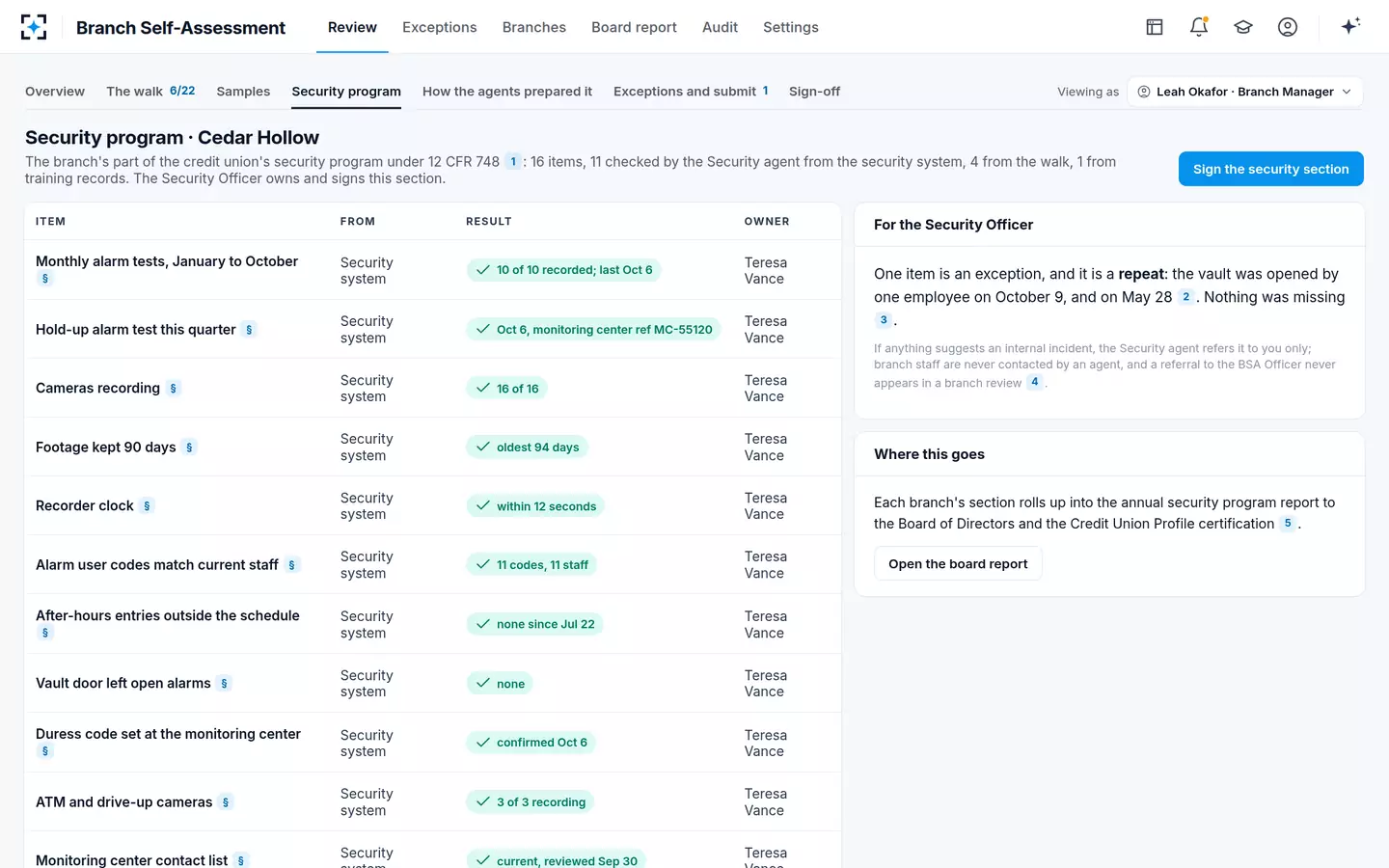
What changes when agents check the security items: Branch Self-Assessment
Agents change where the officer's evidence comes from, not who is accountable for it. In Branch Self-Assessment the Security agent reads the branch security system before the branch opens: alarm and door events, badge entries, alarm test results, camera recording and retention, user codes against the staff roster, and training records. The branch manager then walks only the checks that need eyes. The security items arrive in the officer's queue with the evidence attached, so a test that was missed in March is visible in March.
Three limits are written into the solution because of the officer's role. The Security agent never contacts branch staff about a possible internal incident; it refers the matter to the security officer only, who decides what happens next. Nothing the agents find about a referral to the BSA officer appears in a branch review. And the Roll-up agent, which drafts the annual security program report from every signed branch review, never sends anything to the board and never certifies: the security officer reviews the draft and an executive approves it before it goes.
The annual report to the board, drafted from the branch reviews and reviewed by the security officer
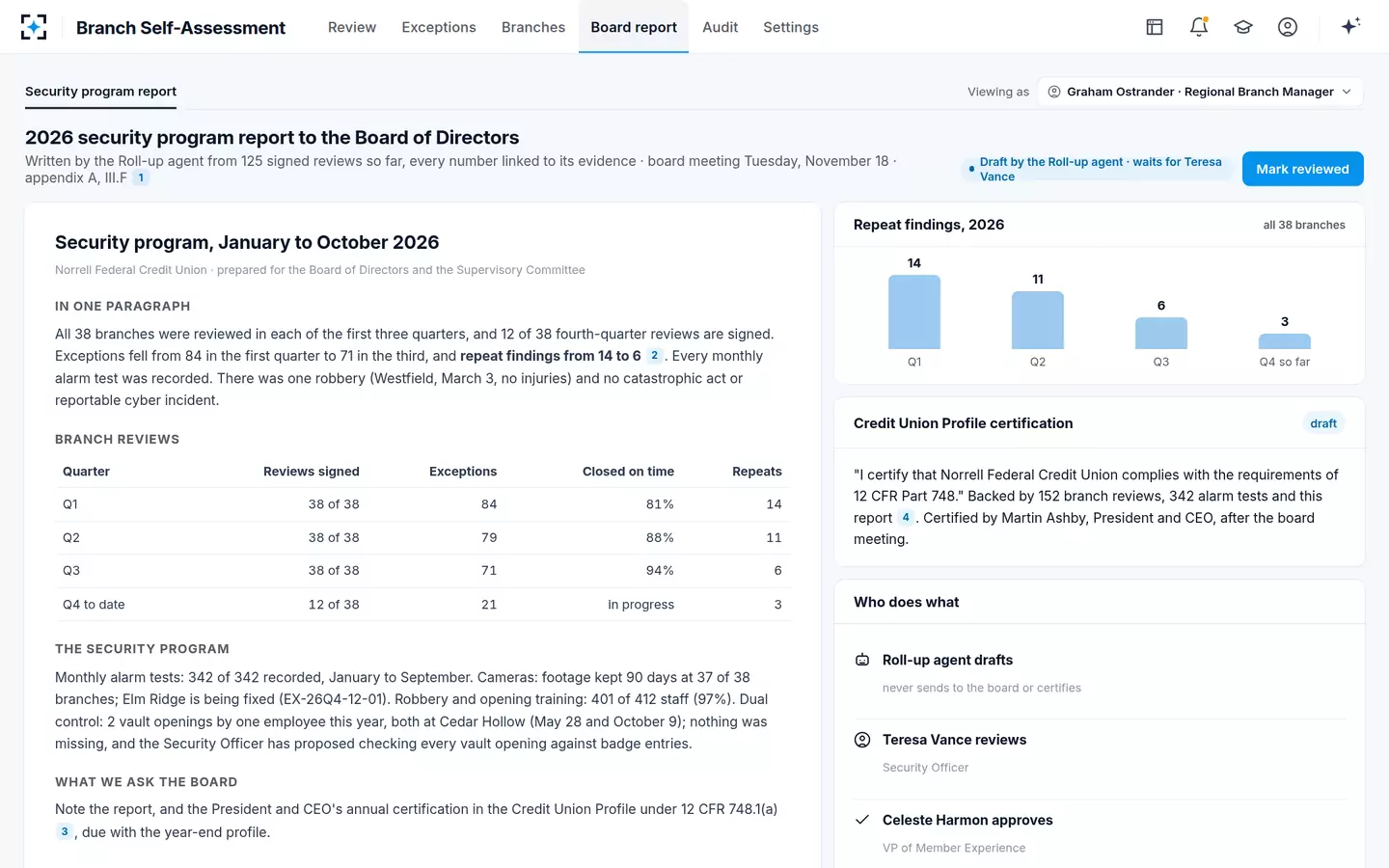
For a credit union the same draft supports the president's annual certification under 12 CFR 748.1(a), and the report itself follows the board-reporting guideline in Appendix A to Part 748, which covers the information security side of the program. For a bank it is the annual report the officer owes under 12 CFR 208.61(d), 326.4 or 21.4. Either way the officer reviews a draft built from the year's branch evidence instead of building it from paper in the weeks before the meeting. The design target for the program is that every exception reaches the officer with a named owner and a due date, and is closed only after a second person has checked the evidence. The full set of requirements, regulator by regulator, is in Bank Protection Act requirements in plain words, and the solution itself is at Branch Self-Assessment.
Questions people ask
Does a credit union need a security officer?
The NCUA rule does not require one. 12 CFR 748.0 requires a written security program within 90 days of insurance, designed to protect each office from robberies, burglaries, larcenies and embezzlement, and 748.1(a) requires the president or managing official to certify compliance every year in the Credit Union Profile. A credit union can still name one, so that a single person owns the program being certified.
What training does a bank security officer need?
The rules set no qualification or course for the officer. What they require is that the program the officer runs provides for initial and periodic training of staff in their duties under the program and in how to behave during and after a robbery, burglary or larceny (12 CFR 208.61(c)(1)(iii)). The officer's own training is a matter for the board that designates them.
What is the bank security program?
It is the written program the board must ensure exists for the main office and every branch. Under the bank rules it sets opening and closing procedures and the safekeeping of currency and valuables, procedures to identify offenders and preserve evidence, staff training, and the selection, testing, operation and maintenance of security devices, with a minimum of a vault or safe, vault lighting, tamper-resistant locks and an alarm.
Does the security officer's report go to the regulator?
No, it goes to the board. The Bank Protection Act once required periodic reports to the agencies; a 1989 amendment struck that requirement from 12 U.S.C. 1882(b). Examiners test the program during an examination, and under the OCC rule the substance of the report must appear in the board minutes.
Is the bank security officer the same as the information security officer?
Not necessarily. The Bank Protection Act rules are about physical crime: robbery, burglary and larceny. Information security programs are governed by separate interagency guidelines, and Part 748 for credit unions combines both purposes in one written program. Where different people hold the two roles, the board should know who answers for which.