The FBI's bank robbery statistics for 2023, its most recent Bank Crime Statistics report, count 1,362 violations of the federal bank robbery statute at federally insured institutions: 1,263 robberies, 95 burglaries and 4 larcenies. Of the 1,362, 1,259 happened at branch offices. The report also records what the institutions' security devices did: an alarm system was activated in 933 incidents and functioned in 880, and surveillance cameras were activated in 1,208 and functioned in 1,136. Robberies have fallen by more than two fifths since 2019, but the gap between devices activated and devices that functioned has not closed in five years. That gap is the practical case for the device testing the bank security rules already require, and for checking devices at every branch review. Botminds' Branch Self-Assessment does that from the branch security system before each review's walk.
Bank crime at federally insured institutions in 2023, as the FBI counted it
1,362
robberies, burglaries and larcenies under 18 U.S.C. 2113
1,259
of them at branch offices; 57 at main offices
880of 933
incidents where an activated alarm also functioned
54
incidents with acts of violence: 12 people injured, 21 taken hostage, no deaths
How many bank robberies happen a year?
In 2023 the FBI recorded 1,263 bank robberies at federally insured institutions, and 1,362 robberies, burglaries and larcenies together. Commercial banks accounted for 1,112 of the robberies and credit unions for 126; the rest were at savings institutions, armored carrier companies or institutions the FBI could not classify. The same report counts 1,652 people known to have been involved, of whom 801 had been identified when the statistics were recorded.
Two cautions apply to every figure on this page. The FBI's figures are a compilation of what its field offices responded to or were told about, and the report says plainly: "Not all Bank Robberies are reported to the FBI, and therefore BCS is not a complete statistical compilation of all bank robberies that occur in the United States." And the statistics are a snapshot, recorded as of a date after the year ends, and "subject to change upon the investigation of bank robbery violations" (FBI Bank Crime Statistics 2023).
Are bank robberies increasing or decreasing?
Decreasing. The FBI's own annual reports show 2,440 violations in 2019, 1,788 in 2020, 1,964 in 2021, 1,740 in 2022 and 1,362 in 2023, a fall of 44% over the five years by our arithmetic and of 22% in the last year alone. Robberies proper fell from 2,405 to 1,263 over the same period. The 2023 edition is the most recent the FBI has published in this series.
Bank robberies, burglaries and larcenies reported to the FBI fell 44% from 2019 to 2023
A falling count is not a reason to relax device testing. Fewer incidents mean each branch faces one less often, so a fault in an alarm or a recorder can sit unnoticed for longer before an incident exposes it. The rarer the event, the more a branch relies on scheduled tests rather than real use to find out whether its devices work.
How many bank robberies are at branches?
Nearly all of them. In 2023, 1,259 of the 1,362 incidents happened at branch offices, 92%, against 57 at main offices, 12 in stores and 17 at remote facilities or elsewhere. The share has been similar every year since 2019, between 92% and 95% in the FBI's tables. Most incidents happen at the counter: the institutional area involved was the counter in 1,182 incidents, an ATM in 124, the office area in 98, the vault or safe in 54 and a drive-in or walk-up in 31. Areas can overlap in one incident.
Where and when the 2023 incidents happened
| Measure | Most common | Next | Also notable |
|---|---|---|---|
| Type of office (of 1,362) | Branch office: 1,259 | Main office: 57 | Remote facility or other: 17; store: 12 |
| Location (of 1,362) | Commercial district: 836 | Shopping center: 343 | Residential: 134; rural: 30 |
| Day of the week | Friday: 280 | Tuesday: 252; Monday: 249 | Saturday: 111; Sunday: 26 |
| Time of day | 1 pm – 3 pm: 312 | 11 am – 1 pm and 3 pm – 6 pm: 307 each | 9 am – 11 am: 298; 6 am – 9 am: 16 |
| Area of the institution involved | Counter: 1,182 | ATM: 124 | Office area: 98; vault or safe: 54 |
| How it was done | Oral demand: 540; demand note: 753 | Weapon threatened: 539 | Firearm used: 230; takeover: 76 |
When do most bank robberies happen?
During business hours, at the end of the week. In 2023, Friday had the most incidents, 280, and Sunday the fewest, 26. The two-hour band from 1 pm to 3 pm had 312, the most of any band; the three-hour band from 3 pm to 6 pm had 307. The busiest band moves from year to year: 3 pm to 6 pm led in 2020, 2021 and 2022, and 9 am to 11 am in 2019. Only 112 incidents fell between 6 pm and 6 am, which is why the security rules' first program element is procedure for "opening and closing for business": the moments when staff arrive and leave are when the building is least protected and the vault is most exposed.
Do bank alarms and cameras work during robberies?
Mostly, but not always, and the FBI's tables show by how much. In 2023 the institutions that were victims maintained an alarm system in 1,196 incidents; an alarm was activated in 933 and functioned in 880, so in 53 incidents an alarm was activated but was not recorded as functioning. Cameras were maintained in 1,327 incidents, activated in 1,208 and functioned in 1,136, a gap of 72. The report does not define "functioned", and it does not say why a device failed; it records only that it did not count as having worked.
Security devices in the 2023 incidents: activated or taken, against functioned
Every device that depends on a person or a mechanism in the moment shows a gap. Bait money was taken in 180 incidents and met the bait criteria in 158. Dye or gas packs were taken in 29 and functioned in 18, the widest proportional gap in the table. The devices with the smallest gaps are the ones that run continuously and can be checked without an incident: cameras that record all the time, and alarms that are tested on a schedule with a monitoring center.
Five years of the same gap between activated and functioning
The gap is not a 2023 accident. In every year from 2019 to 2023, between about 4% and 6% of activated alarms and of activated cameras were not recorded as functioning, by our arithmetic from the FBI's five reports. The number of incidents fell by 44% over those years; the share of devices that failed when they were needed did not fall with it.
Alarms and cameras that were activated but not recorded as functioning, 2019 to 2023
| Year | Alarms: activated / functioned | Alarms that functioned | Cameras: activated / functioned | Cameras that functioned |
|---|---|---|---|---|
| 2019 | 1,909 / 1,825 | 95.6% | 2,239 / 2,140 | 95.6% |
| 2020 | 1,319 / 1,267 | 96.1% | 1,603 / 1,521 | 94.9% |
| 2021 | 1,456 / 1,380 | 94.8% | 1,718 / 1,628 | 94.8% |
| 2022 | 1,257 / 1,189 | 94.6% | 1,572 / 1,495 | 95.1% |
| 2023 | 933 / 880 | 94.3% | 1,208 / 1,136 | 94.0% |
What security devices do banks use?
In the 2023 incidents, the victim institutions maintained surveillance cameras in 1,327 cases and alarm systems in 1,196, followed by bait money in 337, guards in 183, electronic tracking devices in 159, teller cash dispensers in 127, bullet-resistant enclosures in 102, currency dye or gas packs in 64, cash recycler machines in 42, access-controlled entryways in 40 and man traps in 24. Guards were on duty in 153 incidents and armed in 39.
The bank security rules require only four devices at every banking office: a vault or safe, lighting around a vault visible from outside, tamper-resistant locks and an alarm that promptly notifies the police. The rest is the security officer's judgement. The Federal Reserve's rule lists the identification aids a program may use, including "maintaining a camera that records activity in the banking office; using identification devices, such as prerecorded serial-numbered bills, or chemical and electronic devices; and retaining a record of any robbery, burglary, or larceny committed against the bank" (12 CFR 208.61(c)(1)(ii)). Examiners check that "bait money is maintained appropriately and counted each day" and, for ATMs, "whether all ATMs contain alarm devices" and whether "a communication interruption between an ATM and the central processing unit triggers the alarm system" (FDIC RMS Manual, section 22.1). The full set of requirements, regulator by regulator, is in Bank Protection Act requirements in plain words.
How often should bank alarms be tested?
The rules require testing but set no frequency. The Federal Reserve's rule says the program must "Provide for selecting, testing, operating, and maintaining appropriate security devices", and the FDIC's and OCC's say the same; how often is left to the institution, its alarm company and its insurer. A schedule that can be shown to work has three parts: a regular test of each alarm with the monitoring center, recorded with the center's reference; a test of hold-up and duress alarms at a set interval; and a check that the people who can arm and disarm the system are the people who work there now.
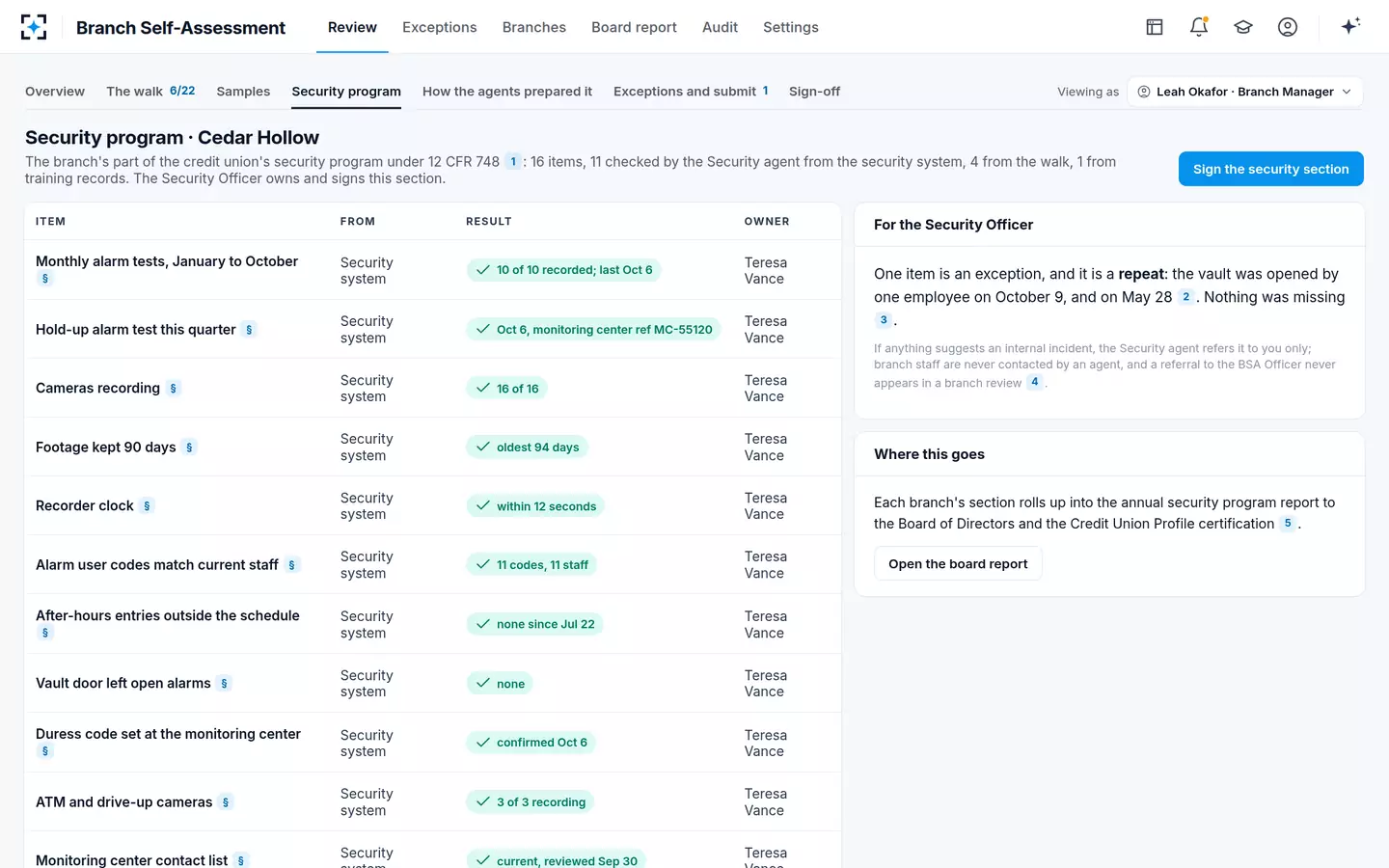
The FBI's figures argue for testing more than one thing at once. An alarm that functions but notifies an out-of-date contact list, or a camera that records with its clock an hour off, will count as having worked and still fail the purpose the rules give it, to assist in identifying and apprehending the people responsible. The fictional sample credit union in Branch Self-Assessment tests every alarm monthly and checks, at every quarterly branch review, the hold-up alarm test, camera recording, footage retention, recorder clock, alarm user codes against current staff, duress code and the monitoring center's contact list.
What the FBI figures mean for a branch review in Branch Self-Assessment
They turn device checks from a tick into a measurement. A branch review that asks "alarm tested: yes" learns nothing the FBI's table does not already warn about. One that reads the security system's records, test by test and camera by camera, finds the device that would have failed before an incident does. In Branch Self-Assessment the Security agent checks each branch's security items from the security system before the branch opens, and the branch manager's walk adds what only eyes can see: a fogged lens, a dark vault light, a hold-up button behind a box.
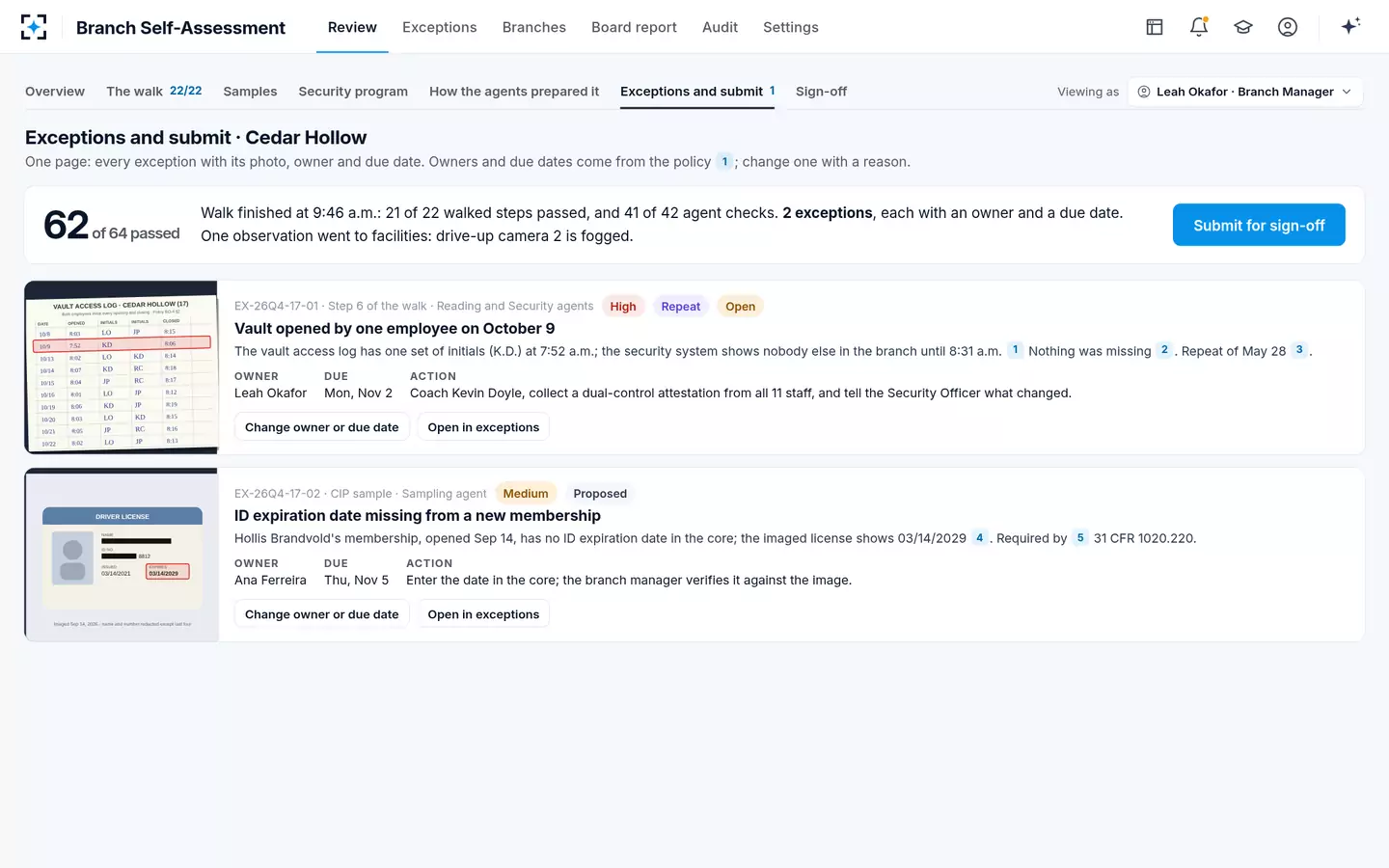
In the sample credit union's year, every monthly alarm test was recorded at every branch, 342 of 342 to the end of September, and at one branch's fourth-quarter review the walk found drive-up camera 2 fogged and sent it to facilities as an observation. Those are small things. The FBI's five-year table says small things are what fails. Device test results also belong on the program's branch scorecard, and the solution is at Branch Self-Assessment.
A branch's security items in Branch Self-Assessment, read from the security system before the walk
The walk adds what the systems cannot see: a fogged drive-up camera
Questions people ask
What are the FBI bank robbery statistics for 2023?
1,362 violations of the federal bank robbery statute at federally insured institutions: 1,263 robberies, 95 burglaries and 4 larcenies, 1,259 of them at branch offices. Acts of violence occurred in 54 incidents, injuring 12 people; 21 people were taken hostage and nobody was killed.
Where can I find FBI bank crime statistics for 2024 or 2025?
The FBI publishes Bank Crime Statistics as an annual PDF in its file repository, and the 2023 edition is the latest in the series. Until a later edition appears, 2023 is the most recent national count, with 2019 to 2022 available for comparison.
Are credit unions robbed as often as banks?
Far less often in total: in 2023 the FBI counted 126 robberies and 22 burglaries at credit unions, against 1,112 robberies and 71 burglaries at commercial banks. Credit unions are not covered by the Bank Protection Act itself, but the NCUA's rule requires a written program to protect every office from robbery, burglary, larceny and embezzlement.
How much is stolen in a typical bank robbery?
The FBI's Bank Crime Statistics report does not give amounts taken, so it cannot answer the question. It does record the methods used: in 2023 a demand note in 753 incidents, an oral demand in 540 and a firearm in 230.
What percentage of bank robberies involve a weapon?
In 2023 a firearm was used in 230 of the 1,362 incidents, about 17% by our arithmetic, another weapon in 25, and a weapon was threatened but not seen in 539. Explosives were used or threatened in 41.