The internal audit AI use cases that hold up at a branch are the evidence-heavy tests in a branch review or audit: reading photographed logs and count sheets, comparing file samples with the core, reconciling cash and reading the security system, so that internal auditors spend their time judging rather than retrieving. The design choice that decides whether internal audit can rely on it is what an agent does when it cannot verify something. A model that fills the gap with a confident guess produces a pass nobody can trust; an agent that stops and asks a named person a precise question produces an answer with an owner. Botminds' Branch Self-Assessment is built on the second behaviour. Each agent has a confidence threshold below which a person decides, every verdict shows the agent's version and confidence, and internal audit can re-perform any step from the stored evidence and record its own conclusion beside the original.
The question examples on this page are illustrative, written to show the behaviour; figures and settings come from a fictional sample credit union in the solution, Norrell Federal Credit Union, and are sample data.
A question log: what the agents could not verify, and what they asked
Vault access log photo: the second set of initials on one line is smudged
Agent and why it stoppedReading agent, under the 85% threshold
The question it askedLine for 14 Oct, 8:07: is the second set of initials RC, or is the box empty? Retake the photo, or tell me what it says.
Who answersBranch manager, on the walk
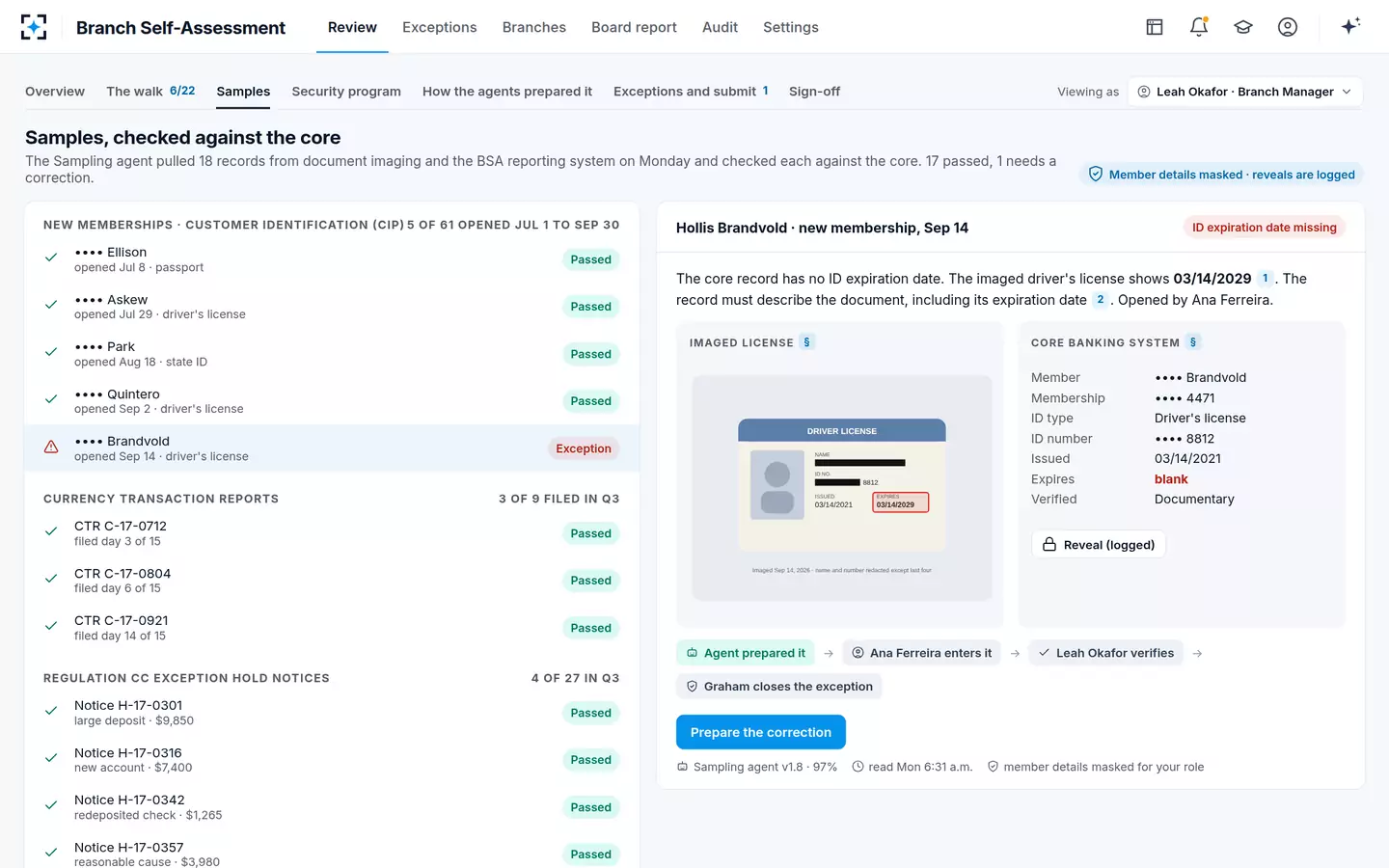
Imaged driver’s license cropped at the expiration date
Agent and why it stoppedSampling agent, under its 90% threshold
The question it askedThe image for this membership cuts off below the expiration field. Can you attach the full image, or confirm the date from the original?
Who answersBranch manager or the member service representative who opened it
Count sheet total does not equal the sum of its denominations
Agent and why it stoppedCash agent, exact match only
The question it askedThe $20 line’s note count and amount do not agree, and the total uses the amount. Which is right, and was the drawer recounted?
Who answersBranch manager and the second counter
Log shows two sets of initials, but the security system shows one person in the building
Agent and why it stoppedSecurity agent, records disagree
The question it askedThe log has two sets of initials at 7:58, but only one badge entry before 8:20. Was the second person present, and how did they enter?
Who answersSecurity officer, not branch staff
Teller platform did not answer during preparation
Agent and why it stoppedReview planner
The question it askedPreparation for this branch is incomplete: the teller platform did not respond. Retry now, or schedule the cash checks for the walk?
Who answersBranch operations program manager
How is AI used in internal audit?
AI is used in internal audit mainly to read, compare and summarize evidence at a scale people cannot: testing whole populations instead of samples, reading documents and images, matching records across systems, and drafting work for an auditor to review. None of this is new to the industry: the Treasury Department's 2024 report lists compliance and process automation among the long-established uses of AI in financial services, beside credit underwriting, trading and customer service (U.S. Treasury, 2024).
Branch work suits it unusually well. A branch review is mostly retrieval and comparison across seven systems (document imaging, the core, the teller platform, the security system, the BSA reporting system, the general ledger and the HR roster) plus a stack of paper logs. In the sample credit union's checklist, agents complete 42 of 64 checks from the systems before the branch opens and read the photographs for the other 22. What changes for internal audit is not that a machine audits the branch; it is that every test leaves evidence an auditor can re-perform from a desk.
Why an agent that asks is worth more than one that guesses
Because a guess looks exactly like a finding. Generative models can produce fluent, specific and wrong answers, and the Treasury report names the risk directly: the complexity of generative models makes them prone to hallucination, stating something false with full confidence (U.S. Treasury, 2024; why the checking has to be separate from the writing is set out in sanctions ChatGPT vs a checked answer). In a branch review, a confidently stated wrong output is a vault log read as compliant when one line is blank, or a license read as complete when the image is cropped at the date.
The defence is behavioural, and it can be tested. An agent should know which inputs it could not read and which sources disagreed, and it should hand those to a person as a question, with the evidence attached, rather than resolve them itself. The question is narrow ("is this box empty?"), names who should answer, and is recorded with the answer. A pass reached that way has an owner; a pass reached by guessing has none.
Two agents meet the same smudged vault log
An agent that guesses: Reads the smudge as a second set of initials because nine of ten lines have two.
An agent that asks: Flags the line below its confidence threshold and asks the branch manager what the box says, or to retake the photo.
An agent that guesses: Vault dual control: pass.
An agent that asks: Vault dual control: decided by the branch manager, with the agent’s reading, its confidence and the answer.
An agent that guesses: The agent’s output, and nothing about the doubt.
An agent that asks: The photo without marks, the question, the answer and who gave it.
An agent that guesses: A missed single-person vault opening, found later or never.
An agent that asks: An exception, opened the same morning with an owner.
What can AI not verify in a branch audit?
AI cannot verify presence, intent or anything that left no record. It can read that two sets of initials are on a vault log; it cannot know that two people stood at the vault, only whether the security system's badge and door events agree. It can match a count sheet to the teller platform; it cannot know the count was performed rather than copied. It can see a camera feed; it cannot judge whether a fogged lens is a facilities ticket or a security exception, or whether a pattern of after-hours entries has an innocent explanation.
Corroboration narrows the gap but does not close it. In the sample review the Reading agent transcribed the vault log, and the Security agent laid the alarm, vault door and badge events beside each opening: on 9 October the alarm was disarmed at 7:49 a.m. with one employee's code, the vault door opened at 7:52, and nobody else entered the branch until 8:31. That made the exception specific. It did not make it a conclusion about the employee; that judgement stayed with the branch manager, the regional manager and the security officer.
Where Branch Self-Assessment makes the agents stop and hand over, in the sample configuration
85%
Reading agent: below this confidence on a photographed log, count sheet or notice, the person decides
90%
Sampling agent: below this confidence on a file sample, it asks rather than passes
Exact
Cash agent: a reconciliation passes only on an exact match to the teller platform and general ledger
0
exceptions an agent may close, reviews it may sign, or member records it may change
When the agent must ask, not guess
The rule of thumb is that an agent asks whenever its answer would rest on something it did not read or could not reconcile. Five situations cover most cases, and a buyer can test each one in a demonstration on its own reviews.
When an agent in a branch review should ask a person rather than decide
- It could not read the evidence
Smudged handwriting, a cropped image, glare on a screen photo. Ask for a retake or for the person to read it.
- Two sources disagree
Initials against badge events, a count sheet against the teller platform. Ask which is right, and why.
- A source did not answer
A system was down during preparation. Mark the check not done; never carry last quarter’s result forward.
- The answer would describe a person’s conduct
A possible internal incident goes to the security officer only, never to branch colleagues.
- The fix would change a record
A member record, a balance, a closed exception. Prepare it for people; do not make it.
The questions an agent asks are an audit signal
A log of the agents' questions tells internal audit things a pass rate cannot. A branch whose photographs are often too poor to read may be rushing the walk. A branch where the vault log and the badge records often disagree has a dual-control habit worth a visit. A branch manager whose answers always clear the question in the branch's favour, or who overrides the agent's verdicts more than peers, is worth a closer look, and so is a branch where the agents never need to ask anything at all.
That is why the question and the answer belong in the review, not in a chat window. In Branch Self-Assessment every verdict shows the agent's version and confidence; when the branch manager disagrees, the reason code is recorded and carried to the regional manager at sign-off. Counted across branches and quarters, overrides and questions become a measure on the program's branch scorecard, and a guide for where internal audit spends its visits.
How do auditors review AI findings?
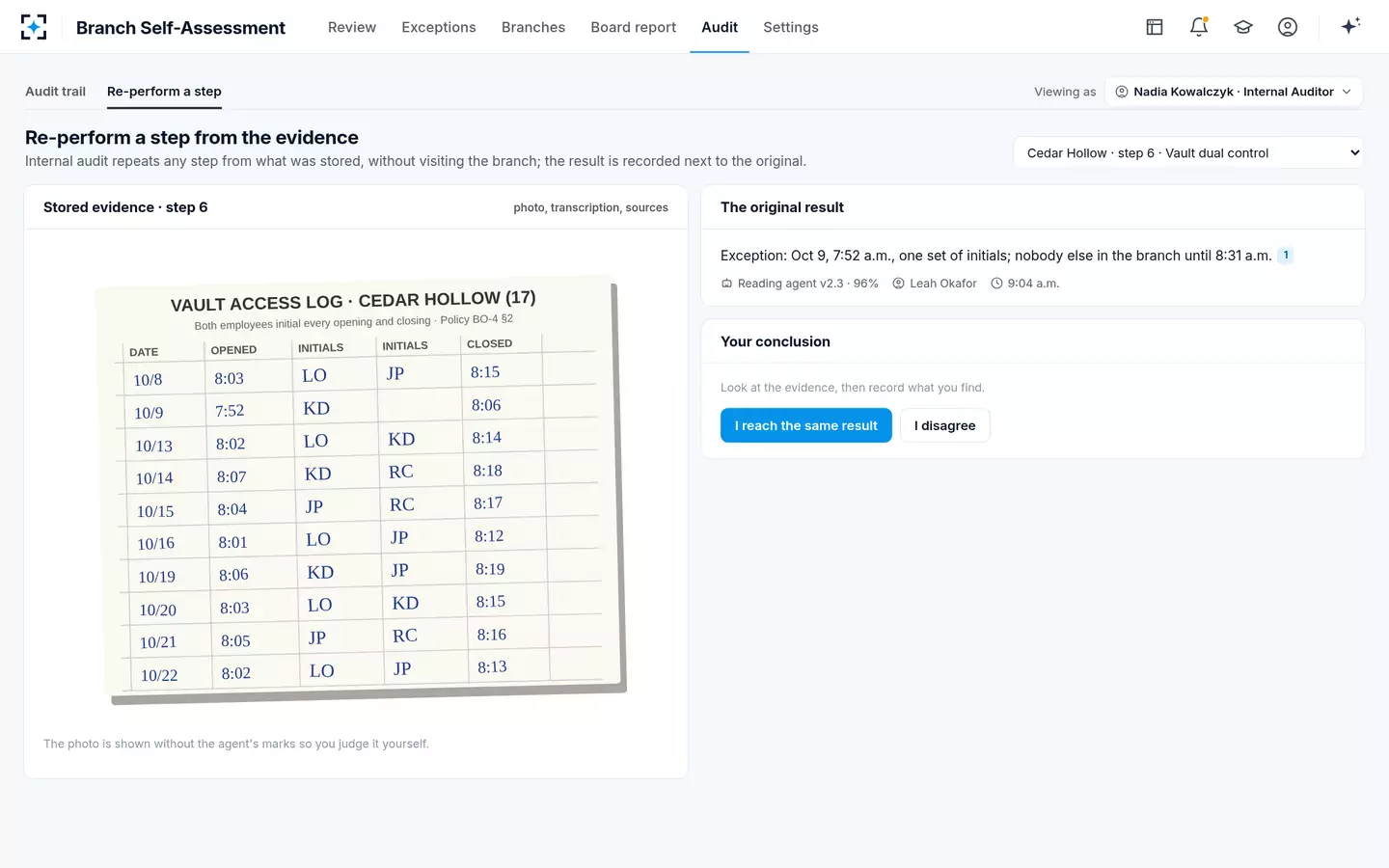
By re-performing a sample of them from the evidence, independently, and recording whether they agree. The 2026 interagency model risk guidance describes the posture as "effective challenge", which it defines as "the critical analysis conducted by objective experts who evaluate model risk and effect appropriate changes throughout the model lifecycle, from model development to ongoing monitoring" (SR 26-2 attachment). Applied to a branch review, that means an auditor who looks at the same photograph or extract the agent used, reaches a view without seeing the agent's answer first, and then compares.
In the solution an internal auditor picks a branch and a step, sees the stored photograph without the agent's marks, judges it, then sees the original result (the agent's version and confidence, and who agreed with it), and records either the same result or a disagreement with a reason. Over a year those conclusions give internal audit a measured agreement rate per agent, per step and per branch: the evidence that lets it rely on the self-assessment, or not.
Re-performing a step in Branch Self-Assessment from the evidence, without the agent's marks
What controls apply to AI in audit?
The institution's own governance, because the federal model risk guidance now explicitly leaves this kind of AI out of its scope. The interagency guidance issued in April 2026, which replaced the Federal Reserve's SR 11-7, puts generative and agentic AI outside its scope because the technology is new and moving fast, and tells each institution to govern those tools under its own risk management practices (SR 26-2; what that leaves a bank to decide is examined in whether a customer risk rating model is a model). We found no statement from the OCC, FDIC, Federal Reserve or NCUA that addresses AI in branch reviews specifically.
The controls that follow are therefore the institution's to set, and they are not exotic. Each agent should be versioned, with the version on every verdict. A new version should run in shadow beside the current one before it is released, so differences are seen before they count. Thresholds should be settings with a second approver. Hard limits should stop agents from closing findings, signing, changing records or contacting staff about a possible internal incident. And every action, by people and agents, should sit on a read-only trail with who, what, when, why and the evidence. Branch Self-Assessment is configured that way; the authority boundary between what agents may do and what only people may do is set out in AI audit software for branch reviews: agents check, managers sign.
Does AI make internal audit faster?
It makes the branch's part faster and changes where internal audit spends its time. Our estimate for the sample credit union is that a branch manager's time on one quarterly review falls from about six hours on paper to about two. The regional and internal audit follow-up a paper review needs, about two more hours by the same estimate, is outside that figure; it is the part most changed by having the evidence stored with each step. The estimate is ours, built from the solution's design figures, not a customer's measurement.
For internal audit the bigger change is reach. An auditor who once drove to a branch to re-check what a checklist said can re-perform a sample of steps at many branches from a desk, and save branch visits for the places where the questions, the overrides or the re-performance disagreements point. The checks come with their evidence: in the sample review, 22 photographs, 18 file samples and 42 system checks stored with one branch's signed review.
A file sample the agent could check, and the correction it could only prepare
Will AI replace internal auditors?
No, and in branch work it should make them more independent, not less. Internal audit exists to give the board an assessment by people without business-line responsibilities, and an agent working for branch operations is part of the business line's own self-assessment. What AI replaces is the retrieval: pulling samples, transcribing logs, matching counts to systems. What remains is the auditor's judgement on whether controls work, informed by more evidence than a branch visit used to yield.
The useful division of labour is plain. Agents test everything they can read and ask about what they cannot. Branch managers answer the questions and own the exceptions. Regional managers sign. Internal audit re-performs, challenges and concludes, and its agreement rate decides how much the board can rely on the self-assessment. How that runs in one branch over one quarter is told in one branch's quarterly self assessment, and the solution is at Branch Self-Assessment.
Questions people ask
Can AI do internal audit work?
It can do the testing that rests on records and documents: reading, matching, reconciling and summarizing evidence. It cannot provide the independence, judgement and conclusions that make audit work audit; those stay with internal auditors, who should re-perform a sample of the AI's work and record whether they agree.
What are the risks of AI in internal audit?
Confident wrong answers, which the Treasury calls hallucinations; changes to an agent's behaviour that nobody notices; agents that act beyond their role, such as closing findings; and evidence that sits only in a vendor's system. Each has a control: thresholds and questions, versioning and shadow runs, hard limits, and exportable evidence.
Does model risk management guidance apply to AI audit tools?
Not directly to generative or agentic AI: the April 2026 interagency guidance (SR 26-2) places those models outside its scope and tells institutions to govern them under their own risk management and governance practices. Its principles still apply to traditional statistical and quantitative models and to AI that is neither generative nor agentic.
How should an AI agent handle an unreadable document in an audit?
It should stop, say what it could not read, and ask a named person to read it or provide a better copy, then record the answer with the evidence. It should never fill the gap from what the document usually says.
What is agentic AI in internal audit?
Agentic AI means agents that carry out multi-step tasks, such as pulling a sample, comparing it with the core and drafting a finding, rather than answering a single prompt. In audit it is useful exactly to the extent that each step is versioned, evidenced and stopped at the boundary where a person must decide.