A general-purpose chat assistant such as ChatGPT can draft an answer to an OFAC sanctions question in seconds, but on its own it is not a safe basis for a payment decision. Unless it retrieves and cites the current text, it answers from what it learned in training, and OFAC's rules moved repeatedly after mid-2026: the Iran remittance license was stayed on August 24, Iran licensing turned to a presumption of denial on September 10, Cuba's rules changed on September 30, and a Russia general license reached its twelfth version on October 21. It can also state a wrong answer as confidently as a right one. A defensible answer needs three separate roles: a writer that cites the passage in force today with its date, a checker that re-opens every citation before anyone sees the answer, and a named person who confirms. Botminds' OFAC Sanctions Search is built on that split, so the agent that drafts an answer is never the one that checks it, and neither is the one that decides.
The search "sanctions ChatGPT" also turns up the other kind of sanctions: courts penalising lawyers for filing briefs with cases a chatbot invented. The two problems have the same root, and the research below on legal hallucination applies to both. Sources are government, courts, standards bodies and peer-reviewed research, linked where they appear.
One question in October 2026: a chat answer from the old rule, and a checked answer
An answer written from the rule as it stood in July 2026: "Can a customer send $500 to his mother in Tehran?"
A checked answer, October 15, 2026: The same question, with the draft wire attached.
An answer written from the rule as it stood in July 2026: Yes: noncommercial personal remittances to Iran are authorized under 31 CFR 560.550 if processed by a U.S. depository institution.
A checked answer, October 15, 2026: Not covered: the general license at 31 CFR 560.550 has been stayed indefinitely since August 24, 2026.
An answer written from the rule as it stood in July 2026: 31 CFR 560.550, no date given.
A checked answer, October 15, 2026: 91 FR 54957, effective August 24, 2026; eCFR editorial note on 560.550.
An answer written from the rule as it stood in July 2026: Process the wire.
A checked answer, October 15, 2026: A specific license would be needed, and Iran-related requests face a presumption of denial since September 10, 2026. The bank’s policy sends it to the BSA/OFAC Officer.
An answer written from the rule as it stood in July 2026: Nobody named.
A checked answer, October 15, 2026: The asker sent it; the Officer confirmed or returned it with a reason code.
Can ChatGPT answer OFAC sanctions questions?
It can produce an answer; it cannot, by itself, vouch for one. The U.S. standards body for AI risk names the failure directly. NIST's Generative AI Profile defines confabulation as "The production of confidently stated but erroneous or false content (known colloquially as 'hallucinations' or 'fabrications') by which users may be misled or deceived", and explains that it is "a natural result of the way generative models are designed" (NIST AI 600-1). Treasury's 2024 report on AI in financial services uses nearly the same words: generative models "can be susceptible to 'AI hallucinations,' producing confidently stated but incorrect output" (U.S. Treasury).
Legal questions are where the rate has been measured. A peer-reviewed study in the Journal of Legal Analysis tested public models, including ChatGPT 4, on questions about U.S. federal court cases and found that they "hallucinate at least 58% of the time, struggle to predict their own hallucinations, and often uncritically accept users' incorrect legal assumptions" (Dahl, Magesh, Suzgun and Ho, 2024). Those were case-law questions on 2023 model versions, not sanctions questions, and newer systems may do better. The last finding is the one a branch should worry about: a branch question that starts from an old note saying Syria is prohibited carries its own wrong assumption (the Syria change is set out in OFAC sanctioned countries list 2026).
OFAC adds a structural reason. Its FAQ 15 says OFAC may change an interpretation or opinion it gave privately, without announcing the change first (OFAC FAQ 15). No model trained on last year's pages can know this year's answer unless it reads this year's pages, and cites them so someone can check.
Five OFAC changes after mid-2026 that an answer from memory would miss
Any answer written from rules as they stood in July 2026 is wrong today on at least five common questions. Each change below took effect on a stated date, and each turns a confident "yes" or "no" into its opposite for some customer.
What changed between August and October 2026, and the answer it overturned
| Date | What OFAC did | The question it changes | Old answer → new answer |
|---|---|---|---|
| August 24, 2026 | Stayed the Iran general licenses for personal remittances, some educational activities and conferences (31 CFR 560.550, 560.544, 560.554) | Can a customer send money to family in Iran? | Authorized → not covered |
| September 9, 2026 | Rewrote FAQ 5 on judging a possible list match as six steps, ending with OFAC declining to confirm or rule out matches | Can we ask OFAC to confirm a hit? | Contact the hotline for verification → make and document your own risk-based decision |
| September 10, 2026 | Issued a presumption of denial for Iran-related specific license requests | Should the customer apply for an Iran license? | Favorable policy for some activities → denial unless required by law or exceptional |
| September 30, 2026 | Amended the Cuban regulations: indirect dealings with Restricted List entities prohibited, U-turn authorization removed | Can we process a third-country transfer with a Cuban interest? | Process → reject |
| October 21, 2026 | Issued Russia GL 131K, the twelfth version, authorized through November 21, 2026 | Is this Lukoil International payment covered? | Depends on the version in force on the payment date |
The second row deserves a note, because it is about OFAC's own guidance contradicting itself. An older OFAC FAQ, number 23, still tells a reader with a close match to "contact OFAC's hotline for verification". FAQ 5, rewritten on September 9, 2026, says OFAC does not confirm matches. A model that learned both, or a search that finds the older page first, can give either answer; only the dates decide which one stands. How to measure whether an OFAC answer is right turns that into a test.
Why a confident wrong answer is worse than no answer
Because the person reading it acts on the confidence, not on the content. NIST puts it plainly: "Risks from confabulations may arise when users believe false content – often due to the confident nature of the response – leading users to act upon or promote the false information." It also warns that generative output "may also include confabulated logic or citations that purport to justify or explain the system's answer, which may further mislead humans into inappropriately trusting the system's output" (NIST AI 600-1).
A sanctions answer with a citation looks checked. If the citation is to 31 CFR 560.550 and the reader does not open it, the reader will not see the editorial note that it "was stayed indefinitely" (31 CFR 560.550). NIST calls the reader's side of this automation bias, "excessive deference to automated systems", and notes that it "can exacerbate other risks of GAI, such as risks of confabulation". In a branch, at the end of a long line, with a customer waiting, deference is the default.
"GAI outputs may also include confabulated logic or citations that purport to justify or explain the system's answer."
NIST AI 600-1, Generative AI Profile, July 2024
Maker and checker: the writer never checks its own work
The control banks already use for money movement fits AI answers: the one who prepares is not the one who approves. Applied to a sanctions answer it means three roles. A writer drafts the answer from sources it retrieves that day and cites each passage with its date. A checker, separate from the writer, re-opens every cited passage, confirms it says what the answer claims and that it was in force on the date asked, and refuses to pass a condition with no fact behind it. A person, named and accountable, confirms the answer before money moves.
The separation matters because a model asked to judge its own answer is a weak judge: the legal study found that models "struggle to predict their own hallucinations". A federal court saw the same thing in 2024. A lawyer filed a brief citing two cases that do not exist, produced by a generative AI tool; he told the court he had tried to check it with a second AI feature, which "failed to flag the issues". The court fined him $2,000 and restated the duty: attorneys must "read, and thereby confirm the existence and validity of, the legal authorities on which they rely" (Gauthier v. Goodyear, E.D. Tex.). A check is opening the source, not asking again. FATF's guidance on new technologies makes the human part non-negotiable: the tools can point compliance effort at the right risks, but they do not replace a person's review (FATF, 2021).
How OFAC Sanctions Search separates writing, checking and deciding
Agent
Intake agentPulls parties, countries, goods, amounts, purpose and dates from the question and the payment, each with the field it came from.
Never: guesses a fact that is not there.
Agent
Sources agent (writes)Finds the program, the prohibition, the general licenses and the FAQs in force today, with passage and dates.
Never: cites a source without its passage and effective date, or a superseded passage as current.
Agent
Conditions agent (checks)Turns the license into conditions and matches each to a fact and its source; asks back when one is missing.
Never: treats a missing fact as met; below 0.90 confidence the Officer answers.
Agent
Policy agentApplies the bank’s policy, which can add a step but never remove one, and sets who confirms and on what clock.
A person decides
BSA/OFAC OfficerReads the verdict, each condition with its fact and passage, and confirms, edits, returns with a reason code, or answers it herself.
Agent
Watch agentRe-checks past answers when a passage, list or license date changes, and reopens the ones whose verdict would change.
Never: closes a reopened answer; the Officer does.
What a defensible sanctions answer contains
Enough that an examiner, a year later, can see what was decided, on what text, by whom. A chat transcript rarely has it. The list below is what to require of any answer a bank relies on, whoever or whatever drafted it.
Seven things a sanctions answer must carry to be defensible
- A one-line verdict
Prohibited, authorized under a named license, or not covered. "It depends" is a question back, not a verdict.
- The program and the prohibition
By part and section of 31 CFR chapter V or by executive order, not by country name.
- The passage, quoted, with its dates
Effective date, last amendment, expiry, and the date it was read. A citation with no date cannot be checked.
- Each license condition matched to a fact
And where the fact came from: the payment’s fields, the invoice, the customer, the screening result.
- What was missing, and who supplied it
An answer that assumed a fact is an answer to a different question.
- Who confirmed it, when, and why
A named person and a reason code, never the person who asked.
- Where it is kept
With the payment it cleared, for 10 years under 31 CFR 501.601, so a later rule change can find it.
Who checks an AI answer, and how?
The bank does, and the supervisors have said it is the bank's own governance that must cover it. The revised model risk guidance of April 17, 2026, SR 26-2, puts generative and agentic AI outside its scope and tells each bank that its own risk management and governance must still decide the controls (Federal Reserve SR 26-2; what that means for an alert queue is in AI for sanctions screening). The same letter is "most relevant to banking organizations with over $30 billion in total assets"; a community bank sets its own controls.
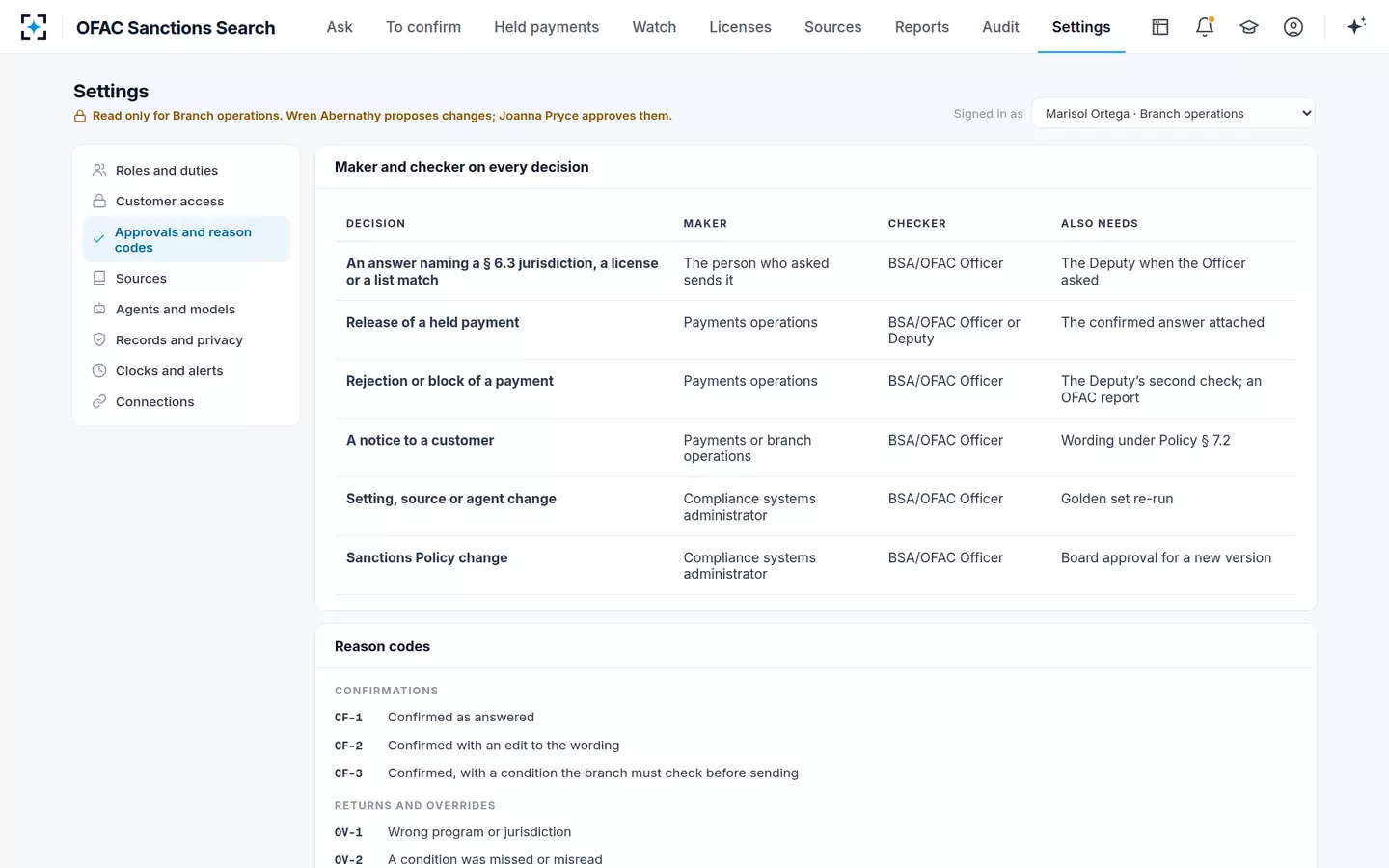
Maker-checker is that governance made concrete. In OFAC Sanctions Search the checks are settings the bank owns: the confidence threshold below which the Officer answers (0.90 by default, adjustable from 0.80 to 0.98), a golden set of 310 confirmed questions re-run before any new agent, prompt or model version goes live, and a reason code, OV-1 to OV-5, on every return or override, all figures from the solution's fictional sample bank. Every setting change is proposed by one person and approved by another.
Who may do what: a maker and a different checker on every decision
What to ask before buying an AI sanctions assistant
Ask how it knows today's rule, how it proves it, and who is accountable when it is wrong. The questions below separate a tool that drafts text from one a bank can rely on, and they apply equally to OFAC Sanctions Search.
Eight buying questions for any AI that answers sanctions questions
| Ask | A good answer | A warning sign |
|---|---|---|
| Where does each answer come from? | Retrieved passages from OFAC, the eCFR and the Federal Register, read that day | "The model knows the regulations" |
| How current are the sources, right now? | A visible freshness line, and answers routed to a person when a feed is late | No date anywhere on the screen |
| Can I open every citation? | One click to the passage, word for word, with its effective and amendment dates | A section number with no text |
| Who checks the draft? | A separate checking step, then a named person | The same model "double-checks itself" |
| What happens when a fact is missing? | It asks one plain question and waits | It assumes the common case |
| What happens when a rule changes? | Past answers resting on the passage are found and reopened | Nothing, until someone asks again |
| How is it tested before a change goes live? | A fixed set of confirmed questions re-run, results kept | Release notes |
| What does it never do? | Never releases, rejects or blocks a payment; never clears a possible match | It "automates decisions" |
Where OFAC Sanctions Search fits, and where it does not
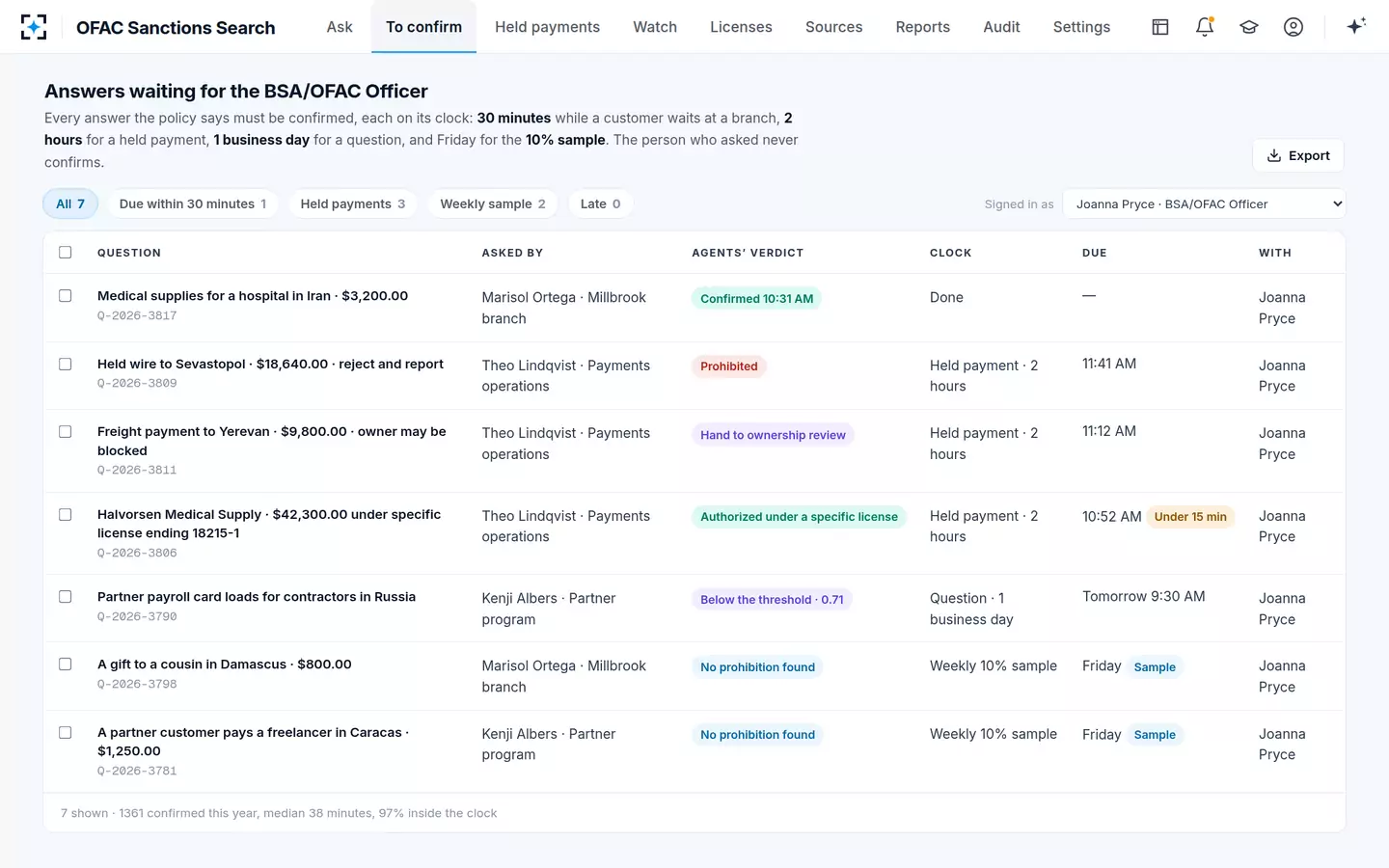
It fits the questions that today go by email to the BSA/OFAC Officer: whether a program, a country or a license covers a payment, asked by branch, payments or partner-program staff who need an answer before a cut-off. It writes the answer from the sources in force that day, checks each condition against the payment, asks when a fact is missing, and puts the decision in a named person's queue on a clock. In the fictional sample bank, 3,782 questions were answered between January 1 and October 21, 2026, each with its passage, and the Officer confirmed 1,361 of them at a median of 38 minutes.
Each answer waits for a named person, on its own clock
It does not replace list screening, which it calls rather than performs, and it does not clear possible matches or decide ownership under the 50 percent rule; those go to alert review and ownership review. It does not give legal advice. And it is not a general chat assistant: it answers sanctions questions from cited sources and declines to answer without them. For how it connects to the bank's screening service and payments hub, see the integration path.
Questions people ask
Is it safe to use ChatGPT for OFAC checks?
Not as the check itself. A general assistant can help draft or explain, but a list check needs OFAC's current data and a match decision under FAQ 5, and a license question needs the version in force on the date, cited. Use any draft as a starting point that a qualified person verifies against the sources.
How do I know an AI sanctions answer is current?
Look for the date on every source it cites and open the passage. If an answer cites 31 CFR 560.550 without the August 24, 2026 stay, or a Russia general license without its letter, it is not current, however fluent it reads.
Can AI cite the OFAC FAQ correctly?
It can if it retrieves the FAQ that day and shows the "Date Updated" line. OFAC rewrote FAQ 5 on September 9, 2026; an answer quoting an earlier version of it, or the older FAQ 23 advice to call the hotline for verification, is citing guidance OFAC has moved on from.
Why were lawyers sanctioned over ChatGPT?
Courts have penalised lawyers who filed briefs citing cases a generative AI tool invented and the lawyers did not read. In November 2024 a federal court in Texas fined one lawyer $2,000 and ordered AI training, citing the 2023 Mata v. Avianca decision in New York. The duty the courts apply is the one a bank needs: confirm the authority exists and says what you claim.
Do regulators allow AI for sanctions compliance?
Yes, with governance. Treasury's 2024 report notes AI is "widely used" for "AML/CFT and sanctions compliance", and SR 26-2 leaves generative and agentic AI to each bank's own risk management and governance. The bank remains responsible for every decision.