OFAC's official questions and answers are its FAQs, published at ofac.treasury.gov and numbered up to 1276, alongside the program pages, the regulations in 31 CFR chapter V and the general licenses. An answer drawn from them is right only if it passes four checks: it names the right program; it relies on the version of the rule in force on the date the question is about; it cites the passage, not just the topic; and it states every condition and matches each to a fact. Most wrong answers fail the second check, because OFAC's guidance changes by date and older pages stay online. OFAC's FAQs carry "Date Released" and "Date Updated" lines, which is what makes the check possible. Botminds' OFAC Sanctions Search applies all four to every answer it drafts, shows the dates on screen, and has a named officer confirm the result.
The counts below are ours, taken from OFAC's FAQ page on October 26, 2026; the sample answers come from the solution's fictional sample bank.
OFAC's question-and-answer library, by the dates it carries
989
FAQs on OFAC’s full FAQ page, numbered up to 1276
198
of them show a “Date Updated” line
57
updated in 2026, ten of them on September 9
2002
release year of FAQs still live and never updated, such as FAQ 23
OFAC
Where can I find OFAC questions and answers?
On OFAC's FAQ pages first, organised by topic and also gathered on a single page, then on each program's page, in the regulations and in the recent-actions notices. The FAQs are the closest thing OFAC has to a Q&A: on October 26, 2026 the full page carried 989 answers, from FAQ 1 ("What is OFAC and what does it do?") to answers released the month before (OFAC FAQs).
Each FAQ ends with dates. FAQ 5, the one most banks rely on for judging a match, shows "Date Released January 30, 2015" and "Date Updated: September 9, 2026". FAQ 23, which covers the same ground, shows only "Date Released September 10, 2002". That difference is the whole method of this guide: an answer is only as good as the date of the text behind it, and OFAC prints the date.
The other sources have dates too, if a reader looks. The eCFR shows how current it is; on October 26, 2026 title 31 was "up to date as of" October 22, with its latest amendment on October 15 (eCFR). Program pages show a "last updated" date. Web general licenses carry the date they were signed and say which earlier version they supersede.
How do I know an OFAC answer is still current?
Find the date of every text the answer relies on, then look for anything later that touches it. OFAC said so in 2002, in FAQ 14, and the advice has aged well: "Great care should be taken when placing reliance on such materials to ensure that the transactions in question fully conform to the letter and spirit of the published materials and that the materials have not been superseded" (OFAC FAQ 14).
"Superseded" has four forms in OFAC's world, and a currency check has to catch all four. A FAQ is updated in place, with a new "Date Updated" line. A web general license is replaced by a new letter. A regulation is amended, removed or stayed by a Federal Register rule, and the eCFR adds a source note or an editorial note. And a program can end, as Syria's did on July 1, 2025, leaving older FAQs that still mention it. The last two are the easiest to miss, because the old text often stays visible: the eCFR still prints 31 CFR 560.550, the Iran personal-remittance license, with a note that it "was stayed indefinitely" on August 24, 2026 (31 CFR 560.550).
The four checks a correct sanctions answer passes
An answer is correct when it passes all four, and each can be tested without legal judgment. The fifth line is the one that makes the other four auditable.
Four checks for any OFAC answer, plus the one that makes them testable
- 1. Right program
The answer names the program and part of 31 CFR chapter V, or the executive order, that governs these parties, this place and these goods. "Iran" is not a program; the Iranian Transactions and Sanctions Regulations, 31 CFR part 560, are.
- 2. Right version, for the date asked
The text relied on was in force on the transaction or question date: the FAQ’s update date, the general license’s letter and effective date, the regulation’s latest amendment, and no stay or removal since.
- 3. Cited to the passage
Section and paragraph, quoted, so a reader can open it and see the words. A citation to a whole part, or to a FAQ number with no date, cannot be checked.
- 4. Every condition stated and matched
Each condition of a license or exemption is listed and matched to a fact, with where the fact came from. A condition with no fact is a question back, not a pass.
- 5. Dated and signed
The answer records the date it was given and who confirmed it, so a later change to any cited text can find it.
Should answers cite OFAC FAQs or regulations?
Both, for different jobs, and never a FAQ instead of the rule. The regulation, or the executive order a program rests on, is what prohibits and what authorizes; a general license authorizes only within its terms. OFAC's FAQs explain how OFAC reads its own rules and are worth citing for that, with their dates. OFAC's FAQ 15 adds a reason not to lean on anything less formal: OFAC can change "its previously stated, non-published interpretation or opinion without first giving public notice".
What each kind of OFAC source can and cannot carry in an answer
| Source | What it does | Cite it for | Date to record |
|---|---|---|---|
| Statute or executive order | Creates the program and its powers | Why a prohibition exists; secondary-sanctions authority | Signature date; any amending order |
| Regulation, 31 CFR chapter V | Prohibits, defines, and sets general licenses in subpart E | The prohibition and any regulatory license | Latest amendment in the source note; any stay |
| Web general license | Authorizes a category of transactions | An authorization not yet in the CFR | Date signed, letter, "authorized through" |
| FAQ or guidance | Explains OFAC’s reading | Interpretation, examples, process | Date released and date updated |
| Hotline reply | Helps navigate OFAC’s materials | Context only; OFAC does not confirm list matches | Date of the exchange |
Two OFAC answers that disagree, and which one wins
The later dated text wins, and a reader who does not look at dates will not know there is a conflict. The clearest case is the question every analyst asks: what to do with a close match. FAQ 23, released in 2002 and never updated, says: "If there are many similarities, contact OFAC's hotline for verification" (OFAC FAQ 23). FAQ 5, rewritten as six steps on September 9, 2026, says the opposite in its last line: OFAC does not confirm potential matches and expects a risk-based determination (OFAC FAQ 5).
Same question, two OFAC answers, twenty-four years apart
FAQ 23, released September 10, 2002: "What do I do if I have a match to the Specially Designated Nationals (SDN) or one of OFAC’s other sanctions lists?"
FAQ 5, updated September 9, 2026: "When screening for sanctions, how do I determine if I have a valid match to a name on one of OFAC’s lists?"
FAQ 23, released September 10, 2002: Check name closeness and location; "do a little more research".
FAQ 5, updated September 9, 2026: Six steps: which list, which kind of nexus, quality of match, licenses, block or reject, report and keep records.
FAQ 23, released September 10, 2002: "contact OFAC’s hotline for verification"
FAQ 5, updated September 9, 2026: OFAC does not confirm potential matches or false positives.
FAQ 23, released September 10, 2002: Not mentioned.
FAQ 5, updated September 9, 2026: Keep "complete, accurate records detailing the steps taken".
A search that ranks the older page first, or a model that learned both, can return either. A process that records dates returns the right one and can explain why. This is not a quirk of one FAQ: of the 989 on OFAC's full page, 791 show no "Date Updated" line, and many of those are sound; the date alone does not make a FAQ wrong, but it tells the reader to check what came after.
Even an amendment that changes nothing must be read
Not every amendment changes an answer, but a version check cannot know which until it reads them. On July 27, 2026, OFAC amended 31 CFR 560.530, the Iran general license for medicine and medical devices, to replace "www.treasury.gov/ofac" with "https://ofac.treasury.gov" in paragraph (a)(3)(ii), one of many website updates across chapter V that day (91 FR 46836). The source note in the eCFR now ends "91 FR 46840, July 27, 2026" (31 CFR 560.530).
The license's substance did not move. But an answer that still reports an older amendment as the latest is now wrong on a fact it chose to state, and an examiner reading it has reason to ask what else was not checked. The right behaviour is to detect the amendment, read it, and record that it does not change the verdict. That is what a currency check is for: not to reopen everything, but to know.
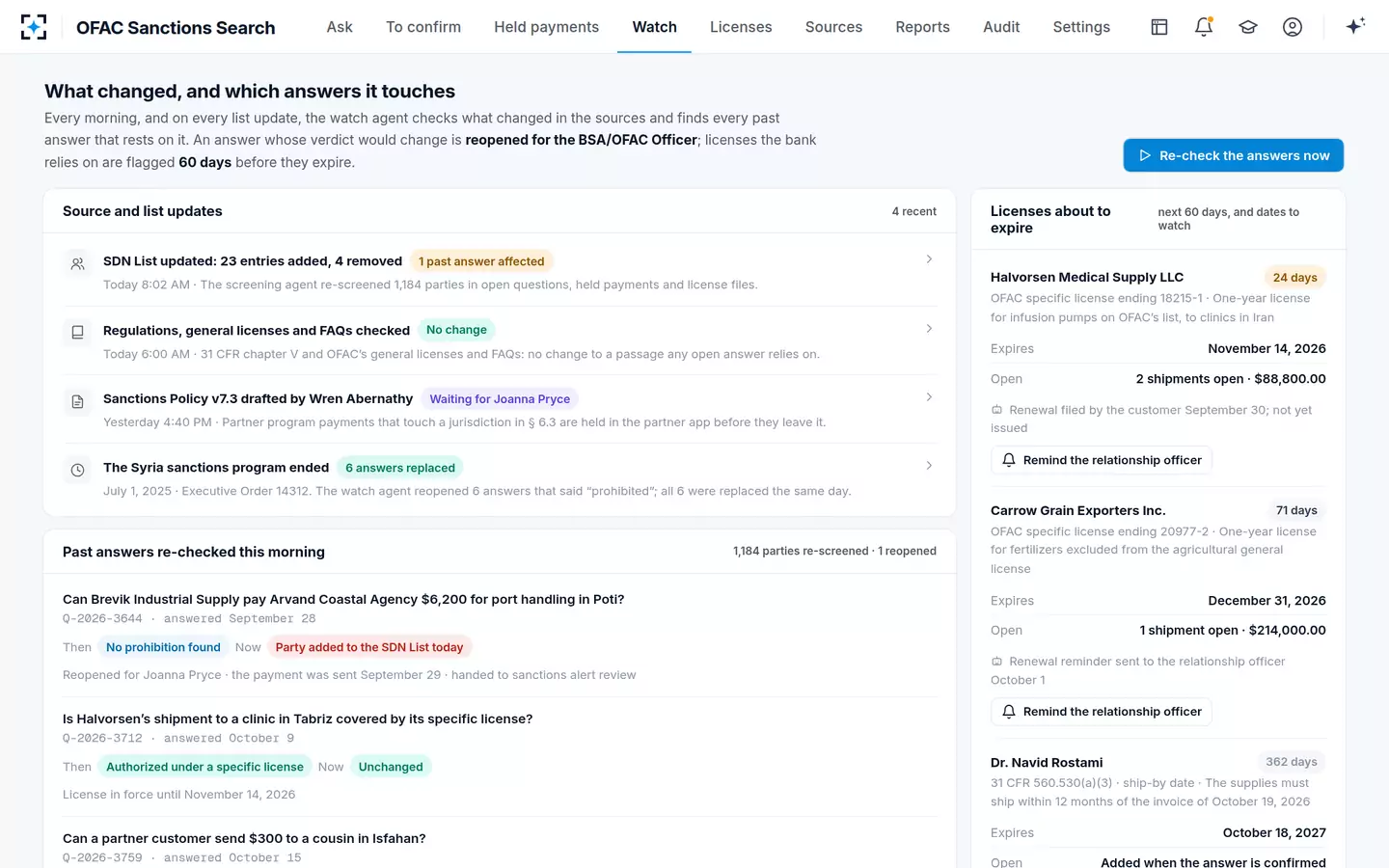
A morning check that reports 'no change' is still a check
How do I test a sanctions Q&A tool?
With a fixed set of questions whose right answers, and the dates they became right, you already know. Run the set before you buy, and again before any new version of the tool goes live. Score each answer on the four checks, not just on whether the verdict looks right, and include questions designed to trip each check. Wolfsberg's principles for AI in financial crime compliance ask the same of any such tool: institutions "should understand the potential impact" before implementation, and keep checking afterwards that the tool performs as steadily as it did on the day it was approved (Wolfsberg Group, 2022).
A 40-question test set that exercises every check, by the trap each question sets
Score four numbers, one per check, and keep the misses. A tool can get the verdict right for the wrong reason, citing a superseded license that happened to say the same thing; that answer will fail the next time the license changes. The useful measures are the share of answers whose every citation opens to the quoted words, the share whose cited versions were in force on the question date, and the share of missing-fact questions where the tool asked instead of assuming.
What OFAC's hotline answers, and what it will not
OFAC's Compliance Hotline helps with how to comply and how to find OFAC's guidance; it does not decide a bank's matches. Its page sends people to the Sanctions List Service to check lists and to FAQ 5 for assessing potential matches before they write in, and describes itself as "a resource for the public to contact OFAC for guidance on how to comply with OFAC-administered sanctions programs and tips for navigating OFAC's website" (OFAC Compliance Hotline). License questions go to a separate Licensing Hotline, and list-file problems to Technical Support (Contact OFAC).
OFAC also will not certify that someone is clean. FAQ 469: "OFAC does not issue non-inclusion certificates to show an entity or individual is not listed on one of OFAC's sanctions lists, nor does OFAC publish a 'safe list'" (OFAC FAQ 469). The answer a bank relies on is its own, which is why it has to be one the bank can defend.
Scoring a sample: what the four checks catch
Applied to real answers, the checks separate the ones a bank can file from the ones it cannot. The table scores three answers from the solution's fictional sample bank and one answer written from an outdated rule, our illustration, against the four checks.
Four answers, four checks, and the one that fails
| Question | Program | Version for the date | Cited passage | Conditions matched |
|---|---|---|---|---|
| $18,640 wire to a furniture maker in Sevastopol (sample) | Pass: E.O. 13685, Crimea | Pass | Pass: E.O. 13685 section 1(a) | Pass: no general license; no blocked interest, so reject |
| $800 to a cousin in Damascus; "our 2024 note says Syria is prohibited" (sample) | Pass: Syria program ended; PAARSS lists only | Pass: rejects the 2024 note | Pass | Pass: parties screened, no match |
| Buy ginseng from a seller in Pyongyang online (sample) | Pass: North Korea | Pass | Pass | Pass: prohibited, no license |
| $500 to a mother in Tehran, answered from the July 2026 rule (illustration) | Pass: Iran | Fail: 560.550 stayed August 24, 2026 | Partial: section cited, stay not shown | Fail: conditions of a license no longer in force |
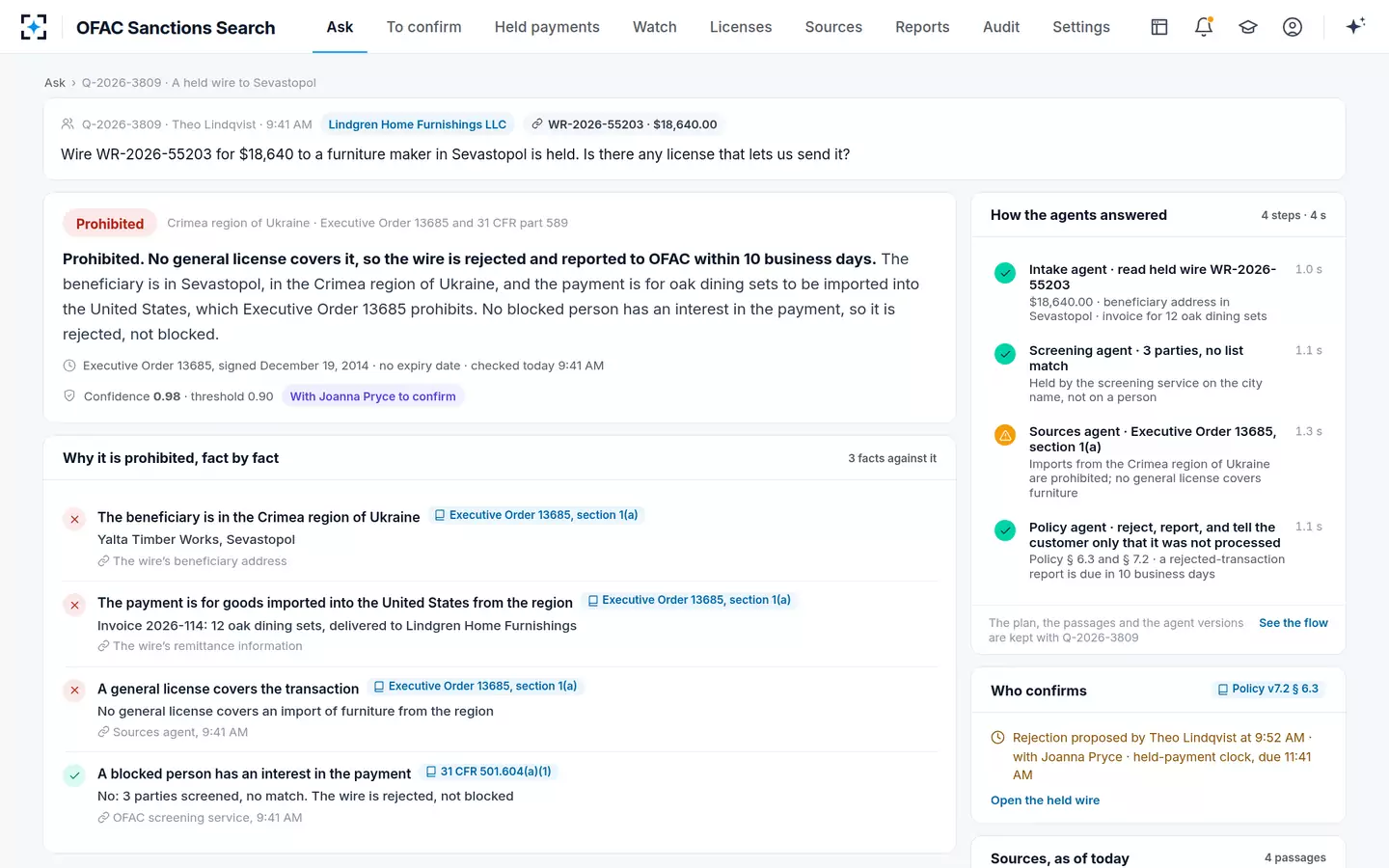
The last row is the pattern to fear: right program, right section number, confident verdict, wrong date. It is also the row an examiner finds hardest to forgive, because the stay was published in the Federal Register two months before. How OFAC Sanctions Search keeps the writer and the checker apart, and why a general chat assistant does not, is set out in sanctions ChatGPT versus a checked answer; the Crimea answer in the first row is shown below.
An answer that passes all four checks shows them on the screen
Questions people ask
Does OFAC confirm sanctions matches?
No. FAQ 5, updated September 9, 2026, says OFAC does not confirm potential matches or false positives and expects organizations to make risk-based determinations. Older guidance, such as FAQ 23 from 2002, still suggests contacting the hotline for verification; the later text governs.
How many OFAC FAQs are there?
OFAC's full FAQ page listed 989 FAQs on October 26, 2026, numbered up to 1276, since not every number is in use. Fifty-seven had been updated during 2026.
What makes a sanctions answer correct?
The right program, the version of the rule in force on the date in question, a citation to the exact passage, and every condition of any license matched to a fact. An answer that gets the verdict right without those cannot be shown to be right, and fails the next time the rule changes.
Are OFAC FAQs legally binding?
They are OFAC's published guidance on how it reads its regulations, not regulations themselves. Cite the regulation or general license for what is prohibited or authorized, and the FAQ, with its date, for how OFAC interprets it.
Can I ask OFAC a question directly?
Yes, through the Compliance Hotline for compliance questions and the Licensing Hotline for license questions. OFAC asks people to check the Sanctions List Service and FAQ 5 first, and it will not confirm a match or issue a certificate that someone is not listed.