Yes, a person in the US can still send money to Cuba in most ordinary cases. A U.S. person aged 18 or older may send family remittances to close relatives in Cuba with no dollar cap, and donative remittances to other Cuban nationals, under 31 CFR 515.570, provided the recipient is not a prohibited Cuban government official or Communist Party member (or a close relative of one) and no entity on the State Department's Cuba Restricted List collects, forwards or pays out the money. What changed on September 30, 2026 sits mostly on the bank's side of the counter: OFAC now prohibits even indirect financial transactions with Cuba Restricted List entities, removed the authorization for U-turn transfers, ended accounts for Cuban private entrepreneurs, and added a new list-based program. An answer a branch gave in August can be wrong in October. Botminds' OFAC Sanctions Search answers this kind of question from the regulations as they read on the day asked, cites the passage and its dates, and reopens past answers when the passage changes.
Every rule below is linked to OFAC or the Federal Register. The comparison of an August and an October answer is our illustration, not a customer case.
From a presidential memorandum to new rules in fifteen months
- NSPM-5 reissued; no rule change yet213 d
- E.O. 14380: national emergency92 d
- E.O. 14404 signed; GL 1 from May 7152 d
- New rules in force; meetings wind down30 d
Can I send money to Cuba from the US in 2026?
Yes, if the transfer fits one of the remittance general licenses in 31 CFR 515.570 and avoids the Cuba Restricted List. The family-remittance license reads: persons subject to U.S. jurisdiction "who are 18 years of age or older are authorized to make remittances to nationals of Cuba who are close relatives" of the remitter, provided the money is not from a blocked source, the recipient is not a prohibited official of the Government of Cuba, a prohibited member of the Cuban Communist Party or a close relative of either, and the remittance is not "made for emigration-related purposes" (31 CFR 515.570(a)). There is no amount limit: OFAC removed the $1,000-a-quarter cap on family remittances effective June 9, 2022, and added donative remittances to non-prohibited Cuban nationals the same day (OFAC Cuba FAQs).
The other categories survive too: remittances to religious organizations, to relatives studying in Cuba under an educational license, two one-time emigration remittances of up to $1,000 each per payee, and remittances to individuals and independent non-governmental organizations, including to support private businesses. Paragraph (j) then excludes "a transaction relating to the collection, forwarding, or receipt of remittances involving any entity or subentity identified on the Cuba Restricted List" (31 CFR 515.570(j)).
Banks, credit unions and U.S.-registered money transmitters may process authorized remittances without a specific license under 31 CFR 515.572(a)(3), subject to the same Restricted List exclusion since November 26, 2020 (OFAC FAQ 733), and the same holds for digital payments if the provider is a U.S.-registered money transmitter or other qualifying banking institution (OFAC FAQ 1090). Whether a particular app or remitter offers Cuba transfers is that company's choice; the rule is about what it may do.
Cuba in numbers, October 2026
No cap
on family remittances to close relatives, since June 9, 2022
2 × $1,000
one-time emigration remittances per payee
98
SDN List entries carrying the new CUBA-EO14404 tag
our count
30days
wind-down for professional-meeting travel, to October 30, 2026
What changed in Cuba sanctions on September 30, 2026?
Four things a bank feels, and a fifth that changes who can be designated. OFAC's alert of September 29, 2026 summarises them: an "Expanded Prohibition on Financial Transactions with Cuba Restricted List Entities", "New Restrictions on U-Turn Transactions", "Restrictions on Bank Accounts for Independent Private Sector Entrepreneurs", narrower travel authorizations, and new Cuba Sanctions Regulations implementing E.O. 14404 (OFAC alert, September 2026).
The amendment to the Cuban Assets Control Regulations implements the 2025 reissue of National Security Presidential Memorandum 5, signed June 30, 2025. In OFAC's words, the rule "adds a prohibition on indirect financial transactions with entities or subentities on the Cuba Restricted List; amends other authorizations related to financial transactions, including removing an authorization for 'U-Turn' transactions; and amends authorizations related to travel" (91 FR 61741). Group people-to-people travel and the general license for professional meetings in Cuba are gone, with a wind-down to October 30, 2026 for travelers already there.
Accounts are the change most likely to surprise a branch. Until September 30, a U.S. bank could open and maintain accounts in the name of a Cuban independent private sector entrepreneur under 515.584(h)(2). That authorization has been removed, and OFAC's alert is blunt about the existing accounts: banks "are required to block all such funds and accounts and report them to OFAC, unless separately authorized by OFAC" (OFAC alert). Accounts for other Cuban nationals in Cuba, used only to receive payment for authorized transactions, remain authorized under the revised 515.584(h) (31 CFR 515.584).
What is the Cuba Restricted List, and why does "indirect" matter to banks?
The Cuba Restricted List is the State Department's list of entities and subentities under the control of, or acting for, the Cuban military, intelligence or security services. Section 515.209 has prohibited direct financial transactions with them since 2017; from September 30, 2026 it also prohibits indirect ones. A person engages in an indirect financial transaction "by participating in a transfer of funds, but not acting as an originator or ultimate beneficiary, where either the originator or the ultimate beneficiary is an entity or subentity on the Cuba Restricted List" (31 CFR 515.209(a)(2)).
That definition is written for banks. Before September 30, a U.S. bank in the middle of a payment chain did not breach 515.209 by processing a transfer whose ultimate beneficiary was a listed hotel, because it was neither originator nor beneficiary; OFAC deleted the note that said so. Now it does. OFAC adds that this definition "is unique to the Cuban Assets Control Regulations and should not be interpreted to apply to other OFAC programs" (OFAC FAQ 735).
Two limits keep the rule workable. Entities owned or controlled by a listed entity "are not treated as restricted unless also specified by name", and the prohibition does not reach travel-related transactions or commercial engagements that were in place before the entity was listed (31 CFR 515.209). The remittance exclusion has no such grandfathering: OFAC's Cuba FAQs say it applies "regardless of the existence of any pre-existing commercial engagements".
"Entities or subentities that are owned or controlled by another entity or subentity on this list are not treated as restricted unless also specified by name on the Cuba Restricted List."
31 CFR 515.209, note 1 to paragraph (a)
Are U-turn payments to Cuba still allowed?
No. Until September 29, 2026, 515.584(d) let a U.S. banking institution process a funds transfer in which Cuba or a Cuban national had an interest if it originated and terminated outside the United States and neither originator nor beneficiary was subject to U.S. jurisdiction. That authorization is removed and replaced with an authorization "to reject funds transfers originating and terminating outside the United States, provided that neither the originator nor the beneficiary is a person subject to U.S. jurisdiction" (31 CFR 515.584(d)).
OFAC's FAQ 757, updated September 29, 2026, puts it in one line: banking institutions "are prohibited from processing 'U-turn' transactions" and are "authorized pursuant to 31 CFR § 515.584(d) to reject (vice block) such 'U-turn' transactions" (OFAC FAQ 757). For a correspondent bank the difference between reject and block matters: a rejected transfer goes back and is reported within 10 business days; a blocked one sits in an interest-bearing blocked account until OFAC licenses its release.
What E.O. 14404 and the Cuba Sanctions Regulations add
A second, list-based Cuba program now runs beside the embargo. Executive Order 14404 of May 1, 2026 blocks foreign persons determined to operate in "the energy, defense and related materiel, metals and mining, financial services, or security sector of the Cuban economy", among other criteria, and lets Treasury cut off a foreign financial institution that "has conducted or facilitated any significant transaction" for a person blocked under it (91 FR 61748). On October 26, 2026, 98 entries on the SDN List carried the CUBA-EO14404 tag.
The two programs run in parallel. OFAC's FAQ 1252: "All existing prohibitions and authorizations pursuant to the CACR remain in effect" (OFAC FAQ 1252). Cuba General License 1, dated May 7, 2026, authorizes transactions prohibited by E.O. 14404 to the extent they are authorized or exempt under the CACR, so that CACR-authorized activity is not interrupted when a person already blocked or identified under the CACR, OFAC's example is GAESA, is also blocked under the new order; it "does not expand the scope of any authorization or exemption under the CACR" (OFAC FAQ 1253). For a non-U.S. bank the new order is the bigger change: OFAC's alert warns that foreign financial institutions facilitating significant transactions for persons blocked under it "may be sanctioned".
One remittance question asked twice: August and October
The same customer question can get a different answer five weeks apart, and the change is rarely where the customer expects. The comparison below is our illustration of four questions a branch could receive about the same family, answered under the rules of August 15 and of October 15, 2026.
Four Cuba questions, answered on August 15 and on October 15, 2026
Answer on August 15, 2026: Authorized: family remittance, 515.570(a). No cap.
Answer on October 15, 2026: Unchanged: still authorized under 515.570(a), with the Restricted List exclusion in (j).
Answer on August 15, 2026: Authorized: the account was licensed for transactions authorized or exempt under the CACR.
Answer on October 15, 2026: The account must be blocked and reported; the gift can still go as a family remittance under 515.570(a), but not into that account.
Answer on August 15, 2026: Could be processed under the U-turn authorization, 515.584(d).
Answer on October 15, 2026: Reject, not block; report within 10 business days.
Answer on August 15, 2026: The customer’s direct payment was prohibited; the bank in the middle was not originator or beneficiary.
Answer on October 15, 2026: Now an indirect financial transaction for the bank as well, unless the travel was booked before the hotel was listed.
Three of the four answers moved, and none of them because the customer did anything differently. That is the case for dating answers. An answer recorded as "authorized, 515.584(h)(2)" in August is now resting on a paragraph that no longer exists, and a bank that keeps answers without their sources cannot find it. In OFAC Sanctions Search every answer stores the passages it cited and their effective dates; when a passage changes, the solution's watch agent re-checks the past answers that rest on it and reopens the ones whose verdict would change for the BSA/OFAC Officer.
Asking a sanctions question in plain words, with the sources' freshness in view
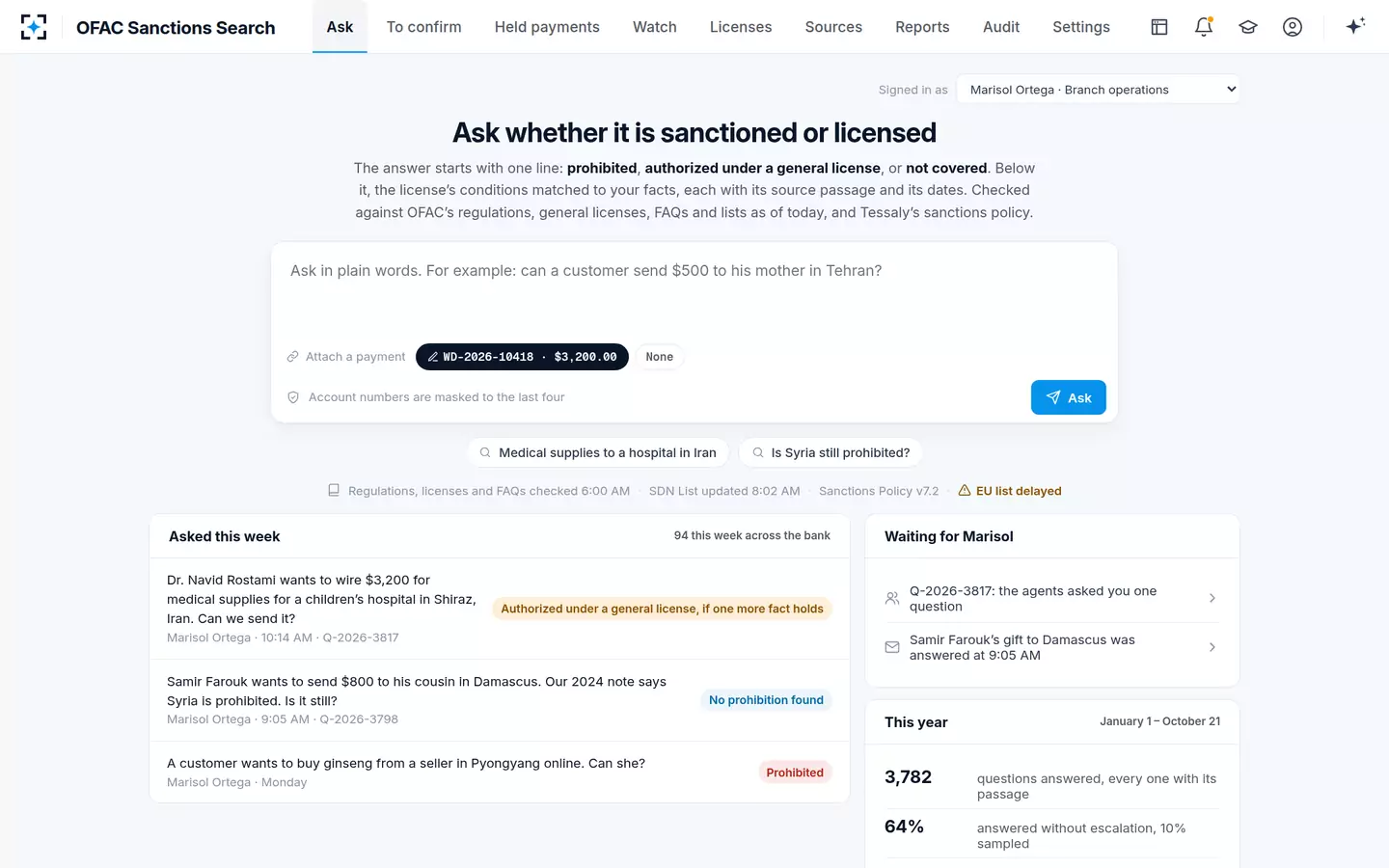
Is it legal to send money to Iran? Not under a general license since August 24, 2026
Iran moved the opposite way from Cuba's family remittances. Until August 23, 2026, 31 CFR 560.550 authorized noncommercial, personal remittances to or from Iran through a U.S. depository institution, other than to blocked persons or the Government of Iran. Effective August 24, 2026, OFAC stayed that general license indefinitely, with four others, and said "any such transactions are no longer authorized by OFAC as of August 24, 2026" (91 FR 54957). The eCFR still prints the section, with an editorial note that it "was stayed indefinitely" (31 CFR 560.550).
A specific license is now hard to get. OFAC's Statement of Licensing Policy of September 10, 2026 presumes that requests under the Iranian regulations will be refused, leaving room only for what the law requires and for emergencies such as a threat to life or safety (OFAC; what that means for an application is in the OFAC license application process). Exports of medicine and medical devices remain authorized under 31 CFR 560.530 with its conditions, which is why a hospital-supplies payment and a gift to a parent now get opposite answers.
What should a bank ask before sending money to Cuba?
Enough to place the payment in one license, and no more than the license needs. OFAC lets remittance processors "rely on the statements of their customers that remittance transactions are authorized unless they know or have reason to know a transaction is not authorized", while expecting due diligence "commensurate with its overall risk profile" (OFAC FAQ 1057). The questions below are the facts each condition turns on.
Eight facts to establish before a remittance to Cuba leaves the branch
- Who receives it, and how are they related?
A close relative as defined in 515.339 for a family remittance; any non-prohibited Cuban national for a donative one.
- Is the recipient a prohibited official or party member, or a relative of one?
Both remittance licenses exclude them; ask, and record the answer.
- Who pays it out in Cuba?
Any collection, forwarding or receipt by a Cuba Restricted List entity takes it outside 515.570, whatever was agreed before.
- Is it for emigration?
Then only the two one-time payments of up to $1,000 per payee apply, the second only after a visa is issued.
- Is the sender 18 or older, and is the money from a blocked source?
Family and donative remittances require an adult remitter; no remittance may come from a blocked account except as 515.570(f) allows.
- Does the payment use an entrepreneur account the bank opened under 515.584(h)(2)?
Those accounts must now be blocked and reported unless OFAC authorizes otherwise.
- Does the chain run through the bank only as an intermediary?
A U-turn is now rejected; an indirect transfer to a Restricted List entity is prohibited.
- What did we rely on, and on what date?
Keep the license paragraph, its date and the customer’s statements with the payment for 10 years.
The same facts are what OFAC Sanctions Search asks for when they are missing: the agents never treat a missing fact as met, and they ask the person who spoke to the customer one plain question instead of guessing. Answers that touch Cuba go to the BSA/OFAC Officer before the payment moves when the bank's policy says so. For the broader picture of which jurisdictions are embargoed, see why there is no OFAC sanctioned countries list, and for who exactly is bound, the U.S. person rule.
Questions people ask
Is there a limit on how much money I can send to Cuba?
Not for family remittances to close relatives: OFAC removed the $1,000-per-quarter cap effective June 9, 2022, and the September 30, 2026 rules did not restore it. Emigration-related remittances are limited to two one-time payments of up to $1,000 per payee.
Can I send money to a friend in Cuba, not a relative?
Yes, as a donative remittance under 515.570(b), if you are 18 or older, the friend is not a prohibited government official or Communist Party member or a close relative of one, and the money is not for emigration. The Restricted List exclusion applies to who pays it out.
Can I send money to Cuba through an app?
OFAC allows authorized remittances through digital payments if the provider is a U.S.-registered money transmitter or another banking institution as 515.314 defines it (FAQ 1090). Whether a given app offers Cuba transfers is the company's own decision.
What is the Cuba Restricted List?
A State Department list of entities and subentities controlled by, or acting for, Cuba's military, intelligence or security services. Since September 30, 2026 persons subject to U.S. jurisdiction may not engage in direct or indirect financial transactions with them, and remittances involving them are excluded from the remittance licenses.
What does Executive Order 14404 do?
Signed May 1, 2026, it creates a list-based Cuba program: it blocks foreign persons in named sectors of the Cuban economy and others meeting its criteria, and lets Treasury restrict or block foreign financial institutions that facilitate significant transactions for them. General License 1 keeps activity authorized under the CACR, such as family remittances, from being caught by it.