The OFAC license application process starts with a check that no general license already covers the transaction, because OFAC will not grant a specific license where one does. The applicant then files online through OFAC's licensing portal, describing the transaction and naming every party; receives a Reference ID at submission and, once OFAC begins processing, a Case ID in the form YYYY-9999999; and waits for a case-by-case decision, which OFAC sends by email and for which it publishes no timeline. A specific license is issued to the applicant alone, usually for a fixed period, and OFAC recommends applying to renew or amend it at least 60 days before it expires. Banks own the last step: before processing a payment under a customer's license, they must check that the payment fits its terms and dates. Botminds' OFAC Sanctions Search keeps every specific license a bank's customers rely on, with its dates, matches payments to its terms, and warns 60 days before each one expires.
Every step below is sourced to OFAC's regulations and FAQs, most of them updated on September 9, 2026. The license dates in the worked example belong to the solution's fictional sample bank and its customers.
One specific license year: OFAC's 60-day renewal window, and a renewal filed 45 days out
- In force, before the 60-day mark304 d
- OFAC’s window to apply for renewal60 d
- Not yet filed319 d
- Filed late in the window; pending45 d
How do I apply for an OFAC license?
Online, through OFAC's licensing portal, with a full description of the transaction and every party to it. OFAC's FAQ 75: "OFAC encourages applicants to file an electronic license application", and "When applying for a license, provide a detailed description of the proposed transaction, including the names and addresses of any individuals or entities involved" (OFAC FAQ 75). The rule behind it, 31 CFR 501.801, requires the application to be signed and filed through OFAC's Reporting and License Application Forms page, or by mail if that is unavailable, and says "Any person having an interest in a transaction or proposed transaction may file" (31 CFR 501.801(b)).
The phone line is not a filing route. FAQ 75 says the Licensing Hotline "should not be used to submit license applications" and points general compliance questions to the Compliance Hotline instead. Applications to release blocked funds go through the same portal, or on Form TD-F 90-22.54 if the portal is unavailable.
The application, step by step, and who owns each step
A person decides
Applicant (or its agent)Checks for a general license first; files one application online, signed, naming every party and attaching the documents; an agent names its principal.
Agent
OFAC portalConfirms submission with a Reference ID; the applicant can download a PDF copy.
A person decides
OFAC Licensing DivisionAssigns a Case ID once processing begins; may ask for more information; reviews in the order received.
A person decides
State, Commerce and other agenciesConsulted where foreign policy, national security or export controls are involved.
A person decides
OFACDecides and notifies the applicant by email: a license, with its terms and expiry, or a denial.
A person decides
The bank processing the paymentVerifies the payment fits the license’s terms and effective dates, keeps a copy, and reports if the license requires it.
Do I need a specific license, or does a general license already cover it?
Check the general licenses first, because if one applies OFAC will not issue a specific license. The rule is explicit: "It is the policy of OFAC not to grant applications for specific licenses authorizing transactions to which the provisions of a general license are applicable" (31 CFR 501.801(a)). OFAC's license page repeats it for Cuba travel, where twelve categories of general license cover most trips and travelers "do not need to notify OFAC of their travel plans" (OFAC license application page).
The difference matters for who may rely on the authorization. A general license is public and "self-executing" for anyone who meets its terms. A specific license "is a non-public document issued by OFAC to a particular individual or entity, authorizing a particular transaction in response to a license application" (OFAC FAQ 74). A bank cannot look a specific license up; it has to see the customer's copy. Finding the right general license, and the version in force, is covered in OFAC general license search.
What goes into the application
Everything OFAC needs to decide without asking twice. Under 501.801(b)(2) the applicant "must supply all information specified by relevant instructions" and "must fully disclose the names of all parties who are concerned with or interested in the proposed transaction"; relevant documents are attached; applicants for released blocked funds are "encouraged to include" the OFAC Reporting System numbers of the original block report. OFAC asks for one copy only: "submitting multiple copies may result in processing delays" (31 CFR 501.801(b)).
For humanitarian work, OFAC says it "prioritizes requests for specific licenses to provide humanitarian assistance and endeavors to review such applications expeditiously", and asks for "a brief description of the proposed activities, the sanctioned jurisdictions or persons involved", and "any risk mitigation measures that will be used to prevent potential violations" (OFAC FAQ 59). Oral presentations can be requested through the license page, and the regulation adds that "Such requests are rarely granted."
What is a Case ID, and how is it different from a Reference ID?
The Reference ID is created when you submit; the Case ID is assigned when OFAC starts work, and it is the number to use from then on. OFAC's FAQ 1269, released September 9, 2026: once processing begins, "OFAC's Licensing Division will assign a case identification ('Case ID') number. This number will be in the Year-Case ID format (i.e., YYYY-9999999)", and it "is different from the Reference ID that was created when you submitted your application" (OFAC FAQ 1269).
Three numbers an applicant may see, and what each is for
| Number | When it appears | Who creates it | Use it for |
|---|---|---|---|
| Reference ID | At submission; on the confirmation email and the PDF copy | The portal, or the applicant if filing as a guest | Tracking until a Case ID exists |
| Case ID (YYYY-9999999) | When OFAC begins processing | OFAC’s Licensing Division | Status checks, hotline questions, renewals and reconsideration |
| Application Alias | Optional, in an account dashboard | The applicant | Your own filing only: OFAC does not track it |
The status check uses the Case ID. FAQ 77: applicants "can check the status of their application through the OFAC Specific Licenses and Interpretive Guidance page ... by selecting 'View Application Status' and entering the case identification ('Case ID') number", and "OFAC will notify applicants via email as soon as a determination has been made" (OFAC FAQ 77).
How long does an OFAC license take?
OFAC does not say, and an honest answer is that it depends on the case, the program and the queue. FAQ 58 answers the question "How long will it take?" with the factors, not a number: applications are reviewed "on a case-by-case basis, generally in the order in which they are received"; OFAC "may require additional information" or "may need to consult with other U.S. government agencies"; and "an increase in the volume of licensing applications may lead to longer wait times" (OFAC FAQ 58).
Consultation is often why. FAQ 78 explains that "many of OFAC's licensing determinations are guided by U.S. foreign policy and national security concerns", so OFAC "often coordinates with the U.S. Department of State and other government agencies, such as the U.S. Department of Commerce", and that a license from OFAC does not remove the need to comply with export rules such as the Export Administration Regulations (OFAC FAQ 78). What an applicant controls is completeness: FAQ 58 says following the guidelines and "providing all required information, can help accelerate the review process".
"OFAC reviews each specific license application on a case-by-case basis, generally in the order in which they are received."
OFAC FAQ 58, updated September 9, 2026
How do I renew or amend a specific license?
By filing a new application of the same type, citing the current license, at least 60 days before it expires. FAQ 1270: to amend terms "due to a change in circumstance, or wish to renew or extend the license's expiration date", applicants "submit the same type of application as your current license (e.g., Transactional)" and "reference your current license in the 'Previous License Number' field"; and "Where applicable, OFAC recommends you apply at least 60 days prior to the current specific license's expiration date to avoid a lapse in authorization" (OFAC FAQ 1270).
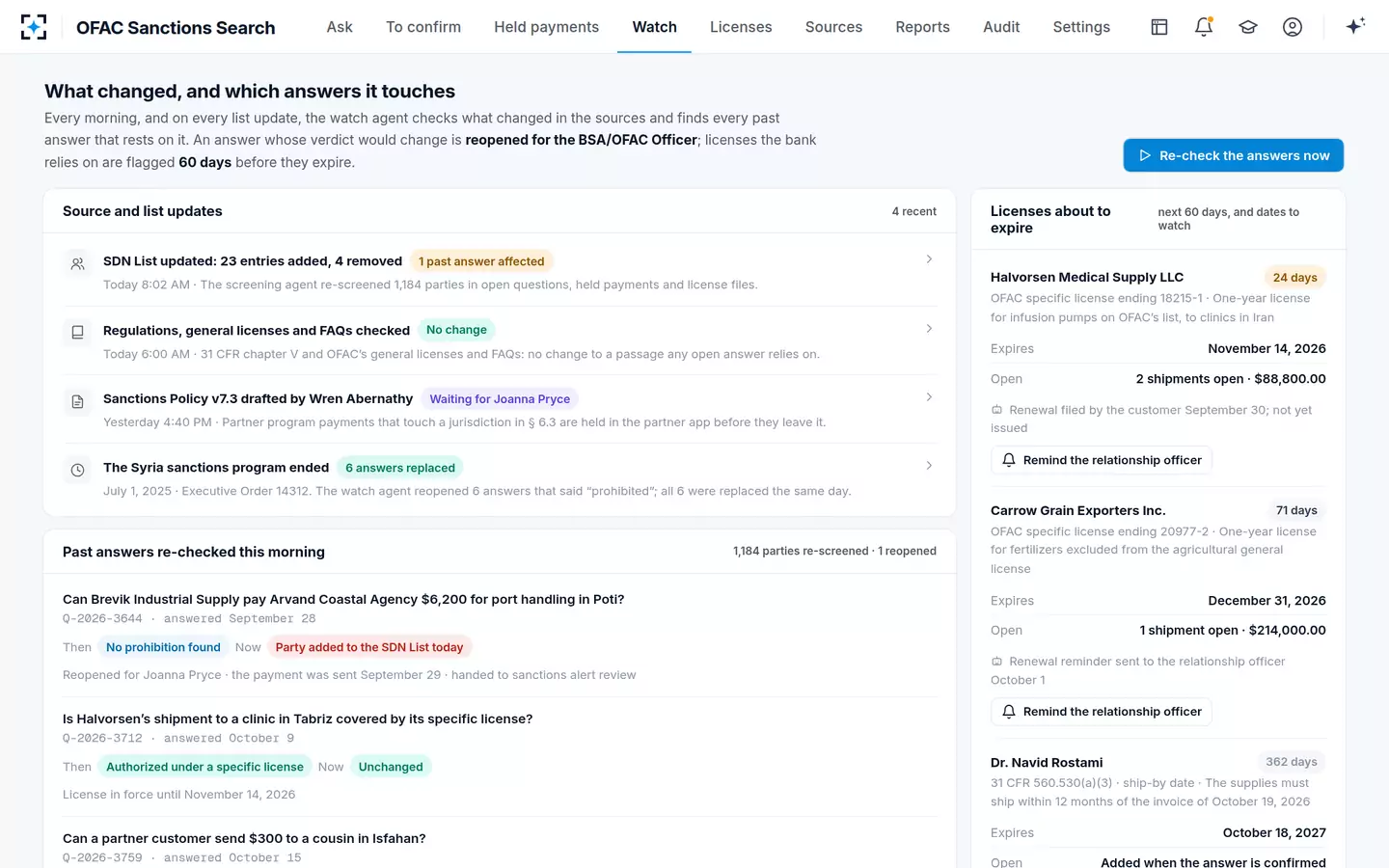
Some licenses expire by design. The Iran rule for agricultural commodities, medicine and medical devices outside the general licenses requires "a one-year specific license ... for contracts entered into during the one year period of the license and shipped within the 12-month period beginning on the date of the signing of the contract" (31 CFR 560.530(a)(1)). In the sample bank, a medical supplier holds such a license for infusion pumps on OFAC's list, in force from November 15, 2025 to November 14, 2026, with two shipments worth $88,800 still open. It filed for renewal on September 30, 2026, 45 days before expiry and later than OFAC's 60-day recommendation, and on October 21 the renewal had not been issued.
Licenses about to expire, with open shipments and renewal status
What if the application is denied?
Ask for reconsideration with something new, or apply again; there is no appeal in the ordinary sense. FAQ 76: "Applicants or other interested parties may request, at any time, reconsideration of a denied license application on the basis of changed circumstances or new facts", and OFAC "will reconsider such determinations for good cause". The request is made by submitting a new application "referencing the previous license denial", and it should "clearly identify how circumstances have changed" (OFAC FAQ 76). The regulation says the same: a denial "does not preclude the reconsideration of an application or the filing of a further application" (31 CFR 501.801(b)(5)).
While the decision is pending or after a denial, the transaction is prohibited. A customer whose license lapses during a renewal has no authorization for shipments or payments in the gap, which is why the 60-day lead time matters more than any other date on the license.
What should a bank verify when a customer has a license?
That this payment, on this date, fits the license's terms. The FFIEC manual: "If a bank's customer claims to have a specific license, the bank should verify that the transaction conforms to the terms and conditions of the license (including the effective dates of the license), and may wish to obtain and retain a copy of the authorizing license for recordkeeping purposes." It adds: "If it is unclear whether a particular transaction would be authorized under the terms of the license, the bank should contact OFAC", and that keeping copies helps "if another bank in the payment chain requests verification of a license's validity" (FFIEC manual, OFAC section).
Seven checks before processing a payment under a customer's specific license
- Is the license genuine and is the customer the licensee?
A specific license authorizes only the person it names. For a document not posted publicly, OFAC asks to be contacted with its case ID (FAQ 468).
- Is the payment inside the effective dates?
Payment date, and for one-year export licenses the contract date and the 12-month shipping window.
- Does the payment fit the authorized transaction?
Goods, quantities, parties, end user and value must match what the license describes.
- Do the payment terms fit?
For Iran exports, payment terms are limited to those in 31 CFR 560.532 unless the license says otherwise.
- Are any other parties blocked?
A license for one transaction does not authorize dealings with other listed persons in the chain.
- Does the license require reports?
A specific license may require the licensee to report the transactions it authorizes, in the form and at the times it sets (31 CFR 501.801(b)(4)).
- Is a copy kept with the payment?
For 10 years after the transaction under 31 CFR 501.601, longer than the five years the FFIEC manual still prints.
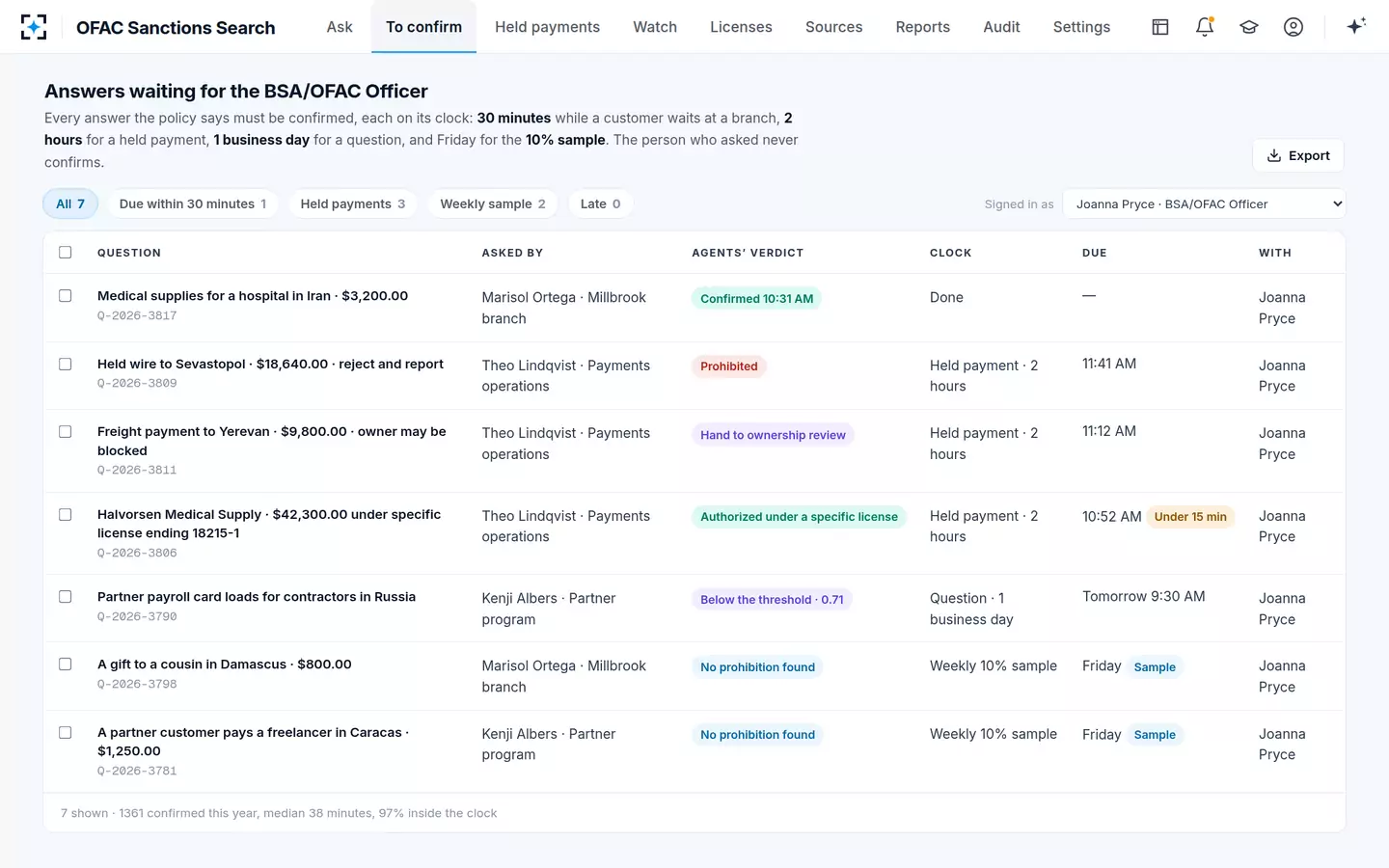
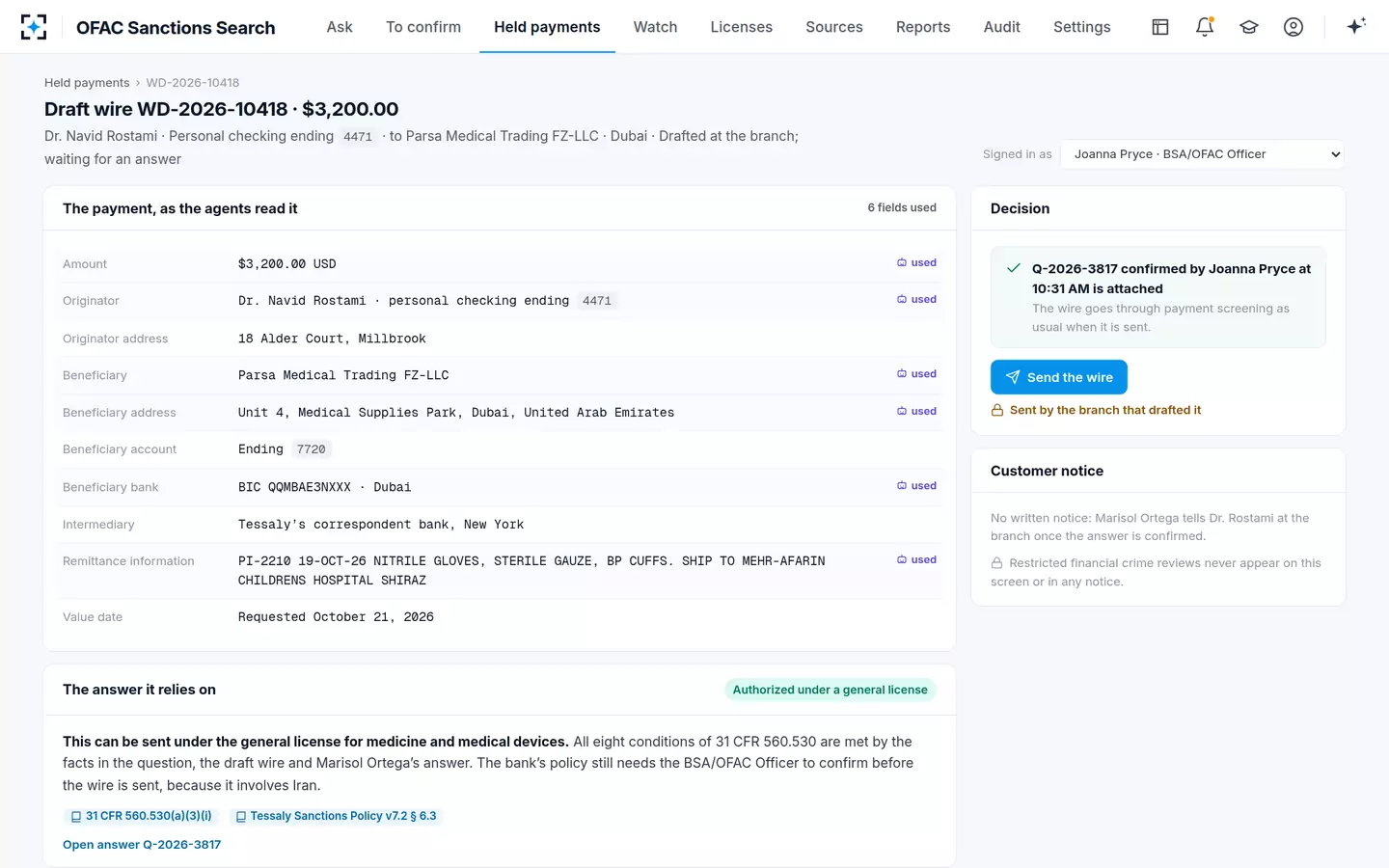
In OFAC Sanctions Search a payment under a specific license is answered like any other: the agents match the payment's fields to the license's terms and dates, and the answer goes to the BSA/OFAC Officer on the clock the bank's policy sets. In the sample bank, a $42,300 payment for the same medical supplier under its specific license sat in the Officer's queue on a two-hour held-payment clock, due in under 15 minutes; the confirmed answer is then attached to the payment it cleared, with the license it rested on.
A payment under a specific license, on the Officer's held-payment clock
The confirmed answer travels with the payment it cleared
Iran in 2026: a presumption of denial
Iran-related specific licenses are now presumed refused. OFAC's Statement of Licensing Policy of September 10, 2026 "establishes a presumed denial for licensing requests to engage in activities which are prohibited by the Iranian Transactions and Sanctions Regulations", suspends earlier statements that had given some activities a favorable licensing posture, and allows licenses "only ... as required by law or in exceptional and urgent circumstances, such as risk to life, limb, or environmental safety". Applicants "should provide written attestation demonstrating these circumstances" (OFAC).
For a bank's customers that changes the planning, not the process. An Iran-related renewal filed in late September, like the sample supplier's, is decided under the new policy, and whether it falls within "as required by law" is a question for the applicant's counsel and OFAC, not for the bank. What the bank controls is the gap: it should know which payments rest on the expiring license and stop them at expiry unless a renewal has issued. Why Iran and Cuba moved in opposite directions in 2026 is set out in sending money to Cuba from the US.
Questions people ask
How do I check my OFAC license application status?
On OFAC's Specific Licenses and Interpretive Guidance page, select "View Application Status" and enter the Case ID; account holders can also log in to see it. OFAC emails the applicant when a decision is made (FAQ 77).
Is there a fee to apply for an OFAC license?
OFAC's licensing rule, 31 CFR 501.801, and its licensing FAQs describe how to file and what to include and set no application fee. The costs are the applicant's own: preparing a complete application and, often, legal advice.
Can a bank apply for an OFAC license on a customer's behalf?
"Any person having an interest in a transaction or proposed transaction may file an application", and an agent filing for someone else "must disclose the name of his or her principal(s)" (31 CFR 501.801(b)). When a bank holds blocked funds, their owner can apply for release and is encouraged to cite the bank's blocking report numbers.
What is an example of an OFAC specific license?
A one-year license to export medical devices on OFAC's list to Iran under the Trade Sanctions Reform Act rules is one common type; another is a license to release funds a bank blocked. Each names its holder, the authorized transactions, any conditions and reporting, and the dates it runs.
Does an OFAC license cover export controls too?
No. FAQ 78 says OFAC's coordination with other agencies "does not eliminate the need for the applicant to comply" with their rules, such as the Export Administration Regulations or the International Traffic in Arms Regulations.