There is no official OFAC sanctioned countries list for 2026, because OFAC "does not maintain a specific list of countries with which U.S. persons may not do business". It runs 36 active sanctions programs instead. A handful are comprehensive and embargo a whole jurisdiction: in October 2026 that means Cuba, Iran, North Korea and the Crimea, so-called Donetsk and Luhansk regions of Ukraine. Syria came off that group when its national emergency ended on July 1, 2025. Most programs are targeted: they block listed people and companies wherever they are, which is why "Russia" or "Venezuela" is never a yes-or-no answer. For a bank, a country question is really a program question asked on a date. Botminds' OFAC Sanctions Search answers it that way, naming the program and the passage it rests on with their dates, so a branch employee is not left with a list copied from a blog in 2023.
Sources below are OFAC's own pages, the Federal Register and OFAC's list files, linked where they appear. The worked examples come from the solution's fictional sample bank.
What stands in for a country list
0
country lists published by OFAC
OFAC
36
active sanctions programs on OFAC’s program page
Oct 26, 2026
18
of those program pages updated since September 1, 2026
32.6%
of SDN List entries carry the Russia E.O. 14024 tag
our count
Is there an official OFAC sanctioned countries list?
No. OFAC's FAQ 10, rewritten on October 26, 2026 to replace its old "Where is OFAC's Country List?" page, opens: "While OFAC does not maintain a specific list of countries with which U.S. persons may not do business, the Sanctions Programs and Country Information page on OFAC's website provides a list of sanctions programs administered by OFAC." It explains why: sanctions "target either a particular jurisdiction (i.e., a country or geographic region) or specified activities (e.g., terrorism or narcotics trafficking) anywhere in the world", and "Each sanctions program is unique, and sanctions programs may change frequently" (OFAC FAQ 10).
What OFAC publishes instead is a program page for each of its 36 active programs, the regulations in 31 CFR chapter V, and its lists. The rewritten FAQ 10 now also names, "As of this FAQ's publication", the jurisdictions under broad sanctions (Cuba, Iran, North Korea, the Crimea region and the so-called Donetsk and Luhansk People's Republic regions of Ukraine) and, separately, the governments whose property is blocked wherever it is found: Cuba, Iran, North Korea and Venezuela (OFAC FAQ 10). That is the nearest thing to a list OFAC offers, and it is dated on purpose. Any document titled "OFAC sanctioned countries list" is someone's summary of those pages on the day it was written, and the rest of this guide is about how quickly such a summary goes wrong.
Which jurisdictions are comprehensively sanctioned in 2026?
Cuba, Iran, North Korea, and three regions of Ukraine: Crimea and the so-called Donetsk and Luhansk People's Republics. OFAC has never published that list as a list, but it names the group in passing. FAQ 951, on Afghanistan, contrasts it with the programs "with regard to North Korea, Cuba, Iran, Syria, and the Crimea and so-called Donetsk People's Republic and Luhansk People's Republic regions of Ukraine" (OFAC FAQ 951). That FAQ was last updated on February 25, 2022, and one of the jurisdictions it names has since left the group.
The 2026 picture, jurisdiction by jurisdiction, with what moved since 2025
| Jurisdiction | Type of program, October 2026 | What changed in 2025–2026 | Where the rule sits |
|---|---|---|---|
| Cuba | Comprehensive embargo, plus a new list-based program | September 30, 2026: indirect dealings with Cuba Restricted List entities prohibited, U-turn authorization removed; new Cuba Sanctions Regulations implement E.O. 14404 of May 1, 2026 | 31 CFR parts 515 and 516 |
| Iran | Comprehensive embargo | Eight general licenses stayed in August and September 2026, including personal remittances; presumption of denial for Iran-related license requests from September 10, 2026 | 31 CFR part 560 |
| North Korea | Comprehensive embargo | Program page updated October 21, 2026 | 31 CFR part 510 |
| Crimea, so-called DNR and LNR | Comprehensive, by region | Still in force under E.O. 13685 (2014) and E.O. 14065 (2022) | Ukraine-/Russia-related program |
| Syria | No longer comprehensive | National emergency ended July 1, 2025; Syrian Sanctions Regulations removed August 26, 2025; listed persons remain under the renamed PAARSS program | 31 CFR part 569 (PAARSS) |
| Russia | Targeted, list-based, very large | Continuous designations and general licenses; one license reached its twelfth version, 131K, on October 21, 2026 | E.O. 14024; 31 CFR part 587 |
Comprehensive does not mean nothing may move. FAQ 4 explains that exceptions "may take the form of authorizations, such as general licenses and specific licenses, or exemptions", and that humanitarian donations, personal communications and travel are exempt in some programs (OFAC FAQ 4). Family remittances to Cuba remain authorized after September 30, 2026; the same kind of payment to Iran stopped being authorized on August 24, 2026. Whether a customer can send money to Cuba from the US is worked through separately, because the answer depends on who receives it and through whom.
Myth: "Syria is still under a U.S. embargo"
It is not, and has not been since July 1, 2025. Executive Order 14312, signed on June 30, 2025, terminated the national emergency behind the Syria program effective July 1, 2025, and OFAC removed the Syrian Sanctions Regulations from the Code of Federal Regulations on August 26, 2025, "as a result of the termination of the national emergency on which the regulations were based" (90 FR 41505).
What remains is list-based. The same notice says "certain persons previously sanctioned under E.O.s that were revoked by E.O. 14312 have been redesignated under E.O. 13894", and on September 25, 2025 OFAC renamed the Syria-Related Sanctions Regulations the Promoting Accountability for Assad and Regional Stabilization Sanctions Regulations (90 FR 46056). On October 26, 2026, 174 SDN entries carried that program's tag in OFAC's list file. A payment to a cousin in Damascus is no longer prohibited for being Syrian; it is prohibited if the cousin, or anyone with an interest in it, is blocked.
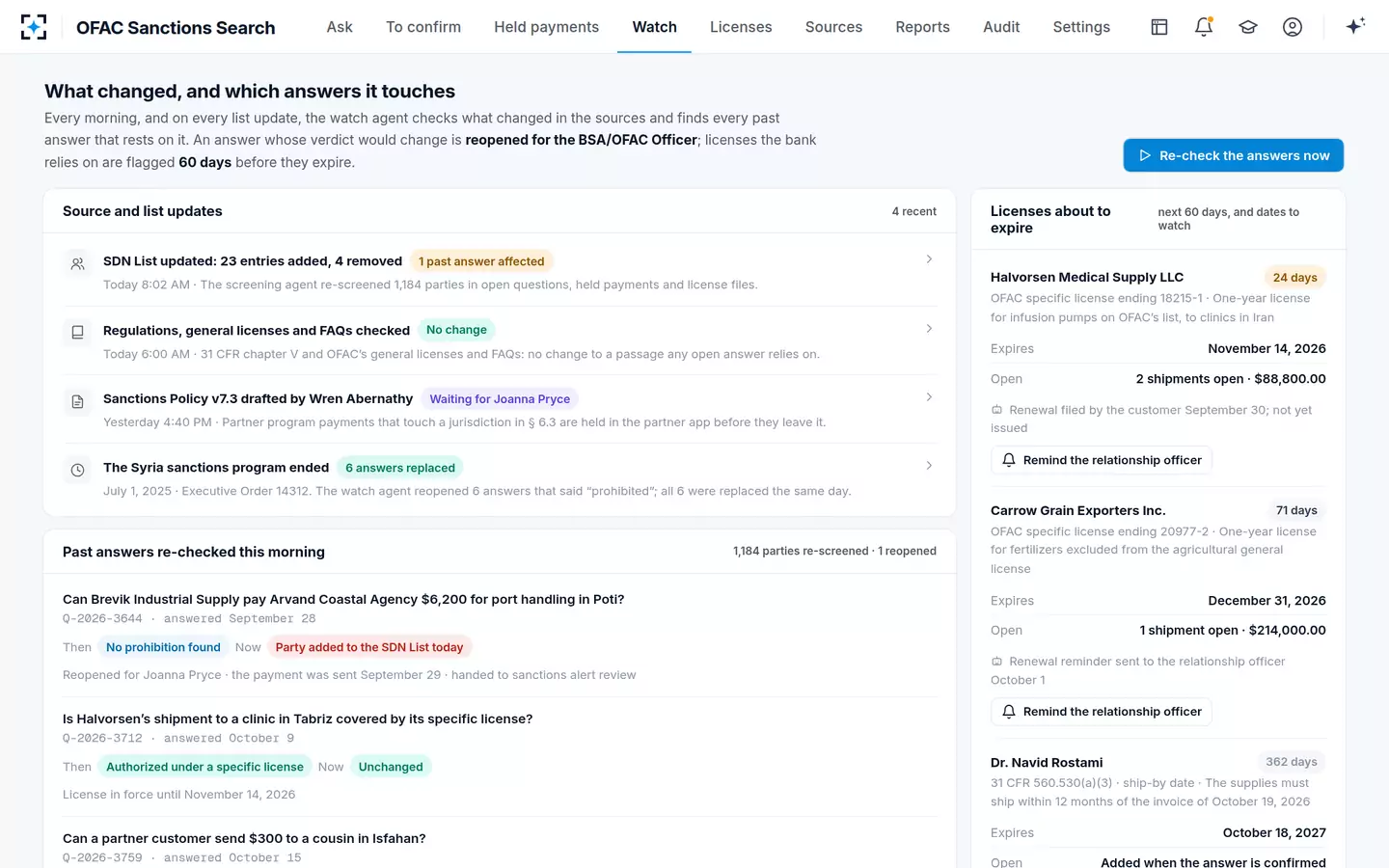
The myth survives because the old pages survive. FAQ 951 still names Syria among the comprehensive programs, and many bank procedures written before mid-2025 do too. In the solution's fictional sample bank, a branch employee asked exactly this: a customer wanted to send $800 to a cousin in Damascus, and "Our 2024 note says Syria is prohibited. Is it still?" The answer was "No prohibition found", and when the program ended the solution's watch agent had reopened six earlier answers that said "prohibited" so the BSA/OFAC Officer could replace them the same day.
When the law changes, the answers that rested on it are reopened
Is Russia sanctioned by OFAC? Yes, by list, not by border
Russia is the largest OFAC program by listed names, but it is not an embargo of the country. On October 26, 2026, 6,346 of the SDN List's 19,471 primary entries, 32.6%, carried the RUSSIA-EO14024 tag in OFAC's own data file. OFAC is explicit about what that does not mean: "the financial services sector of the Russian Federation economy is not comprehensively sanctioned", so U.S. persons "may also use non-sanctioned Russian financial institutions" for the authorized purposes FAQ 979 describes (OFAC FAQ 979).
Where the SDN List's names sit: one program tag carries a third of them
The practical consequence is that "is Russia sanctioned?" has no single answer for a payment. A wire to a Russian supplier is permitted unless a party, a bank in the chain or an owner is blocked, or the goods or services fall under a sector prohibition. That is a screening and ownership question, not a country lookup, and it is why the same payment can be fine on Monday and blocked on Tuesday after a designation.
Myth: "if the country is not sanctioned, the payment is fine"
Most of OFAC's reach has nothing to do with the destination country. OFAC's FAQ 10 says that where list-based blocking applies, "generally U.S. persons are prohibited from engaging in transactions involving blocked persons wherever such blocked persons are located", and that "not all sanctioned persons are located in sanctioned jurisdictions" (OFAC FAQ 10). Companies an SDN owns 50% or more are blocked too, listed or not (the arithmetic is in OFAC 50 rule explained). FAQ 91 goes further: some sanctions "block categories of persons even if those persons do not appear on the SDN List, including most Cuban nationals, blocked foreign governments, or persons blocked pursuant to OFAC's '50 Percent Rule'" (OFAC FAQ 91).
So a Cuban national living in Madrid can make a payment blocked though Spain is sanctioned by no one, and a company in Dubai owned by a listed Iranian bank is blocked though it appears on no list. A country list cannot capture either. The table below sets the common shortcuts against what OFAC's own pages say.
Five shortcuts people take with a 'sanctioned countries list', and what OFAC's pages say
The shortcut: OFAC publishes the list of sanctioned countries.
What OFAC says, and what it means for a bank: OFAC "does not maintain a specific list of countries"; it publishes programs and lists of persons.
The shortcut: Syria is embargoed.
What OFAC says, and what it means for a bank: The Syria program ended July 1, 2025; listed persons remain blocked under PAARSS.
The shortcut: Russia is fully sanctioned, so nothing can go.
What OFAC says, and what it means for a bank: List-based: the financial sector "is not comprehensively sanctioned" (FAQ 979); parties and owners decide.
The shortcut: A payment to an unsanctioned country is fine.
What OFAC says, and what it means for a bank: SDNs are blocked "regardless of location"; so are most Cuban nationals and 50%-owned entities.
The shortcut: Nothing may be sent to Cuba or Iran.
What OFAC says, and what it means for a bank: General licenses and exemptions apply: Cuban family remittances are authorized; Iran medicine and medical devices are under 31 CFR 560.530.
Myth: "we updated our country list last year, so we are current"
A list dated 2025 is wrong about at least two of the four embargoed jurisdictions in October 2026. Cuba's rules changed on September 30, 2026: OFAC prohibited indirect financial transactions with entities on the State Department's Cuba Restricted List, removed the authorization for "U-Turn" transactions and removed group people-to-people travel (91 FR 61741), and issued new Cuba Sanctions Regulations to implement a May 1, 2026 executive order (91 FR 61748).
Iran moved twice in a month. Effective August 24, 2026, OFAC stayed indefinitely the general licenses at 31 CFR 560.544, 560.550 and 560.554, including the one for "certain noncommercial, personal remittances to or from Iran" (91 FR 54957), and from September 10, 2026 a Statement of Licensing Policy presumes that license requests under the Iranian regulations will be refused, except where the law requires otherwise or in an emergency (OFAC). A personal remittance to Iran that a bank processed for a customer in July had no general license behind it by September.
How often do OFAC sanctions programs change?
Constantly, and without a timetable. OFAC's own answer for the SDN List is "There is no predetermined timetable, but rather names are added or removed as necessary and appropriate" (OFAC FAQ 20). For the programs themselves, the Federal Register carried 77 OFAC rule documents between January 1, 2025 and October 26, 2026, 54 of them in 2026, from new regulations to general licenses republished after issue (Federal Register API). On OFAC's program page, 25 of the 36 active programs show an update in 2026, and 18 since September 1.
That pace is why OFAC's country-list page closes with a warning rather than a list: "Because OFAC's programs are dynamic, it is very important to check OFAC's website regularly." For a bank the check cannot be a person re-reading 36 program pages each morning. It has to be a record of which answers rested on which passage, so a change to the passage finds them.
How a bank should answer a country question in 2026
Answer it as a program question, on the date asked, for the parties in the payment. The order below is the one OFAC's FAQ 5 and the program pages imply, written for the person at the branch or the wire desk.
Six steps for a country question, from the branch to the file
- Name the jurisdiction precisely
Sevastopol is Crimea; Donetsk city is in a sanctioned region; Yerevan, Dubai and Istanbul are not sanctioned places, but the parties may be.
- Find the program and read it as of today
Program page, regulations in 31 CFR chapter V and any recent action. Note the date you read it.
- Screen every party, bank and known owner
SDN and non-SDN lists, and the 50 percent rule for owners. Country status never clears a listed party.
- Look for a general license or exemption
Family remittances to Cuba, medicine to Iran under 560.530, personal communications. Check the version in force and every condition.
- Decide process, reject or block
A comprehensively sanctioned jurisdiction with no blocked interest means reject; a blocked person or government, an Iranian financial institution or a Cuban national with an interest means block.
- Write down the program, passage and date
Keep it 10 years with the payment, so a later change to the rule shows which answers it affects.
In OFAC Sanctions Search the same sequence runs as agents. The asker types the question and can attach the payment; agents name the jurisdiction from the payment's fields, screen every party, and find the program, the prohibition and every general license in force that day. The answer opens with one line, prohibited, authorized under a general license, or not covered, and shows the passage and dates behind it. In the sample bank, a held $18,640 wire to a furniture maker in Sevastopol came back prohibited under Executive Order 13685, rejected rather than blocked because no blocked person had an interest, and reported within 10 business days.
A country answer that names the program, the passage and the action
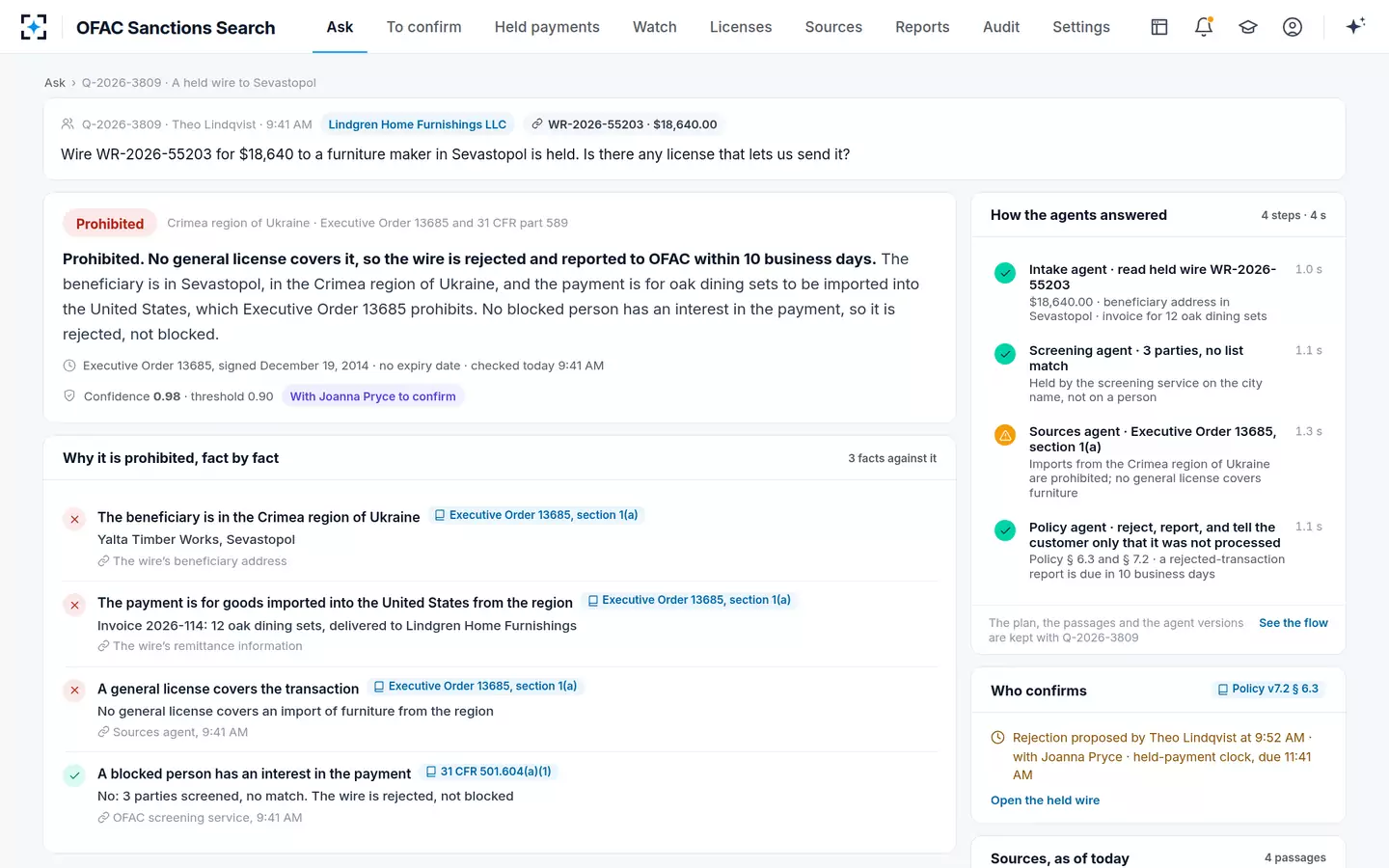
Where a general license is involved, the version matters as much as the country; which version of a general license applies on the payment date follows a single license through twelve versions.
Questions people ask
Is Cuba still sanctioned in 2026?
Yes, and more tightly than in 2025. The Cuban Assets Control Regulations remain a comprehensive embargo, OFAC added the Cuba Sanctions Regulations on September 30, 2026 to implement Executive Order 14404, and the same day it prohibited indirect dealings with Cuba Restricted List entities and ended U-turn processing.
What does comprehensively sanctioned mean?
OFAC's FAQ 10 describes programs that "broadly prohibit transactions or dealings involving an entire jurisdiction", as opposed to targeted programs that block listed people and companies. As of its October 26, 2026 update the group is Cuba, Iran, North Korea and the Crimea, so-called DNR and LNR regions of Ukraine.
Is Syria still on the OFAC list?
Syria is not under a country embargo since July 1, 2025, and its regulations were removed on August 26, 2025. Individuals and entities designated under the renamed PAARSS program remain on the SDN List, 174 entries in October 2026, so payments to Syria still need party screening.
Is Venezuela sanctioned by OFAC?
Not as a whole country. OFAC's FAQ 10 does not list Venezuela among the jurisdictions under broad sanctions, but it does list the Government of Venezuela among the blocked governments, so any payment in which that government has an interest is blocked. The rest of the program works through blocked persons and a long series of general licenses, and its page was updated on October 16, 2026. One oil-sector license, GL 46, went through six versions, from 46 to 46E, between January 29 and September 28, 2026, so any answer must name the version.
Does OFAC publish a list of sanctioned countries for download?
No. OFAC publishes the SDN List and the consolidated non-SDN lists as downloadable files, and a program page for each program. Lists of "sanctioned countries" found online are third-party summaries and should be checked against the program pages before use.