The OFAC 50 rule, explained in one sentence: any entity owned 50 percent or more in the aggregate, directly or indirectly, by one or more blocked persons is itself a blocked person, "regardless of whether the entity itself is listed" (OFAC, Revised Guidance, August 13, 2014). Three words carry the weight. "Aggregate" means the stakes of different blocked persons are added together. "Indirectly" means ownership through other entities counts, but only through entities that are themselves blocked. And "50 percent or more" means exactly 50% is enough. The rule is hard to apply because the company is on no list, so screening never fires; someone has to build the ownership tree and do the sums. Botminds' Sanctions Ownership & Control is an agentic solution that builds that tree from registry extracts, applies OFAC's method and cites every share, for a sanctions analyst to check and an officer to decide.
The OFAC 50 rule in four numbers
50%
or more, in the aggregate: exactly half is blocked
25+25%
two blocked holders of a quarter each block the entity (OFAC FAQ 399)
5
worked examples in OFAC FAQ 401; two of them are not blocked
10business days
to report property to OFAC once it is blocked (31 CFR 501.603)
What is the OFAC 50 percent rule?
The OFAC 50 percent rule is a guidance-based reading of what "property and interests in property" of a blocked person includes. OFAC's 2014 guidance says blocked persons "are considered to have an interest in all property and interests in property of an entity in which such blocked persons own, whether individually or in the aggregate, directly or indirectly, a 50 percent or greater interest". The consequence follows directly: such an entity "is itself considered to be a blocked person", and "a U.S. person generally may not engage in any transactions with such an entity, unless authorized by OFAC".
The rule began as guidance rather than one regulation, and OFAC said it "will incorporate this guidance as it issues regulations implementing new sanctions programs". OFAC's FAQ 91, on its lists, states it as a general rule: entities blocked under the 50 Percent Rule are among the categories blocked without appearing on any list, the rule covering "any entity owned individually or in the aggregate, directly or indirectly, 50 percent or more by one or more blocked persons" (OFAC FAQ 91). Some programs go further: the 2014 guidance notes that in programs such as Cuba "there is a broader category of entities whose property and interests in property are blocked based on, for example, ownership or control".
Enforcement treats unlisted owned entities as fully blocked. In OFAC's September 2025 settlement with the freight forwarder Fracht FWO, the carrier was a wholly owned subsidiary of a designated airline, and OFAC warned that property "may be blocked by virtue of their ownership by blocked persons, whether or not they are identified on OFAC's SDN List" (OFAC, Fracht FWO).
Does OFAC aggregate ownership across blocked persons?
Yes, and across programs. OFAC's FAQ 399 gives the plainest example: two blocked persons holding 25% each make the entity blocked, because together they own 50%. The same FAQ adds that the stakes of persons blocked under different OFAC sanctions programs are added together too (OFAC FAQ 399). A holder designated under a Russia program and a holder designated under a narcotics program are added together.
Aggregation is where the U.S. test parts company with the UK's. OFSI does not add different designated persons' holdings together unless there is a joint arrangement, and its line is "more than 50%". The EU aggregates, with a 30% plus 25% example of its own. The EU, UK and OFAC ownership tests compared sets the three side by side.
How is indirect ownership calculated under the OFAC 50 rule?
Indirect ownership counts only through entities that are themselves 50% or more owned by blocked persons, and when it counts, the whole stake counts. OFAC's FAQ 401 defines it: "'Indirectly,' as used in OFAC's 50 Percent Rule, refers to one or more blocked persons' ownership of shares of an entity through another entity or entities that are 50 percent or more owned in the aggregate by the blocked person(s)."
“Blocked Person X's 50 percent ownership of Entity A makes Entity A a blocked person. Entity A's 50 percent ownership of Entity B in turn makes Entity B a blocked person.”
OFAC FAQ 401, Example 1
Two consequences follow, and both surprise people who learned ownership arithmetic for tax or for beneficial ownership. First, there is no multiplication through a blocked entity: if X owns 50% of A and A owns 50% of B, OFAC treats B as 50% owned, not 25%. Second, there is no counting through an entity that is not blocked: if X owns 40% of A, A's holdings count for nothing, however large. The test is applied layer by layer, from the top: decide whether each intermediate entity is blocked, then add the whole stakes of the blocked ones.
How to apply the OFAC 50 rule to an ownership tree
Agent
Map every layerEvery shareholder of the counterparty, then every shareholder of each corporate shareholder, up to people or listed entities, each with a dated source.
Agent
Mark the blockedMatch every person and entity to the SDN List; mark each as listed, not listed or unknown.
Agent
Work from the top downAn intermediate entity is blocked if blocked persons own 50% or more of it in aggregate. Repeat until no new entity turns blocked.
Never: multiplies a percentage through a blocked entity
Agent
Add whole stakesAt the counterparty, add the direct stakes of blocked persons and the whole stakes of blocked entities.
Never: counts anything held through an entity that is not blocked
A person decides
DecideAt 50% or more the counterparty is blocked. Below 50%, look at control, proxies and recent transfers before clearing.
OFAC's five 50 rule examples, worked
OFAC's FAQ 401 gives five examples: three blocked and two not. The table works each one in the order an analyst would, deciding the intermediate entities first and adding at the target second.
OFAC 50 rule examples, step by step: three blocked, two not
| Example | Structure | Step 1: which entities above are blocked? | Step 2: add at the target | Result |
|---|---|---|---|---|
| 1 | X owns 50% of A; A owns 50% of B. | A: X holds 50%, so A is blocked. | A's whole 50% of B counts: 50%. | B blocked |
| 2 | X owns 50% of A and 50% of B; A and B each own 25% of C. | A and B: X holds 50% of each, so both are blocked. | 25% (A) + 25% (B) = 50%. | C blocked |
| 3 | X owns 50% of A and 10% of B; A owns 40% of B. | A: blocked at 50%. | 10% (X direct) + 40% (A) = 50%. | B blocked |
| 4 | X owns 50% of A and 25% of B; A and B each own 25% of C. | A: blocked. B: only 25% blocked-owned, so not blocked. | 25% (A) + 0% (B) = 25%. | C not blocked |
| 5 | X owns 25% of A and 25% of B; A and B each own 50% of C. | A and B: 25% each, neither blocked. | 0% + 0% = 0%, although X "touches" all of C. | C not blocked |
Example 5 is the instructive one. Multiply through, and X's look-through interest in C is 25% of 50%, twice: 25%, below the line, so multiplication reaches OFAC's answer for the wrong reason. Change the structure and the two methods split. If X owns 10% of C directly and 49% of A, which owns the other 90%, multiplying gives 10% plus 44.1%, or 54.1%; OFAC's method gives 10%, because A is not blocked. Run Example 1 the same way and multiplication gives 25%, where OFAC says 50% and blocked. The two methods are not approximations of each other; they answer different questions.
Example 3 shows that direct and indirect stakes add. Example 2 shows that two blocked intermediaries add. Together they explain why one aggregate percentage needs every path documented: a 50% made of four parts has four sources, and a reviewer must be able to open each one.
Is an entity owned 49% by an SDN blocked?
Not under the 50 Percent Rule, but that is not the same as safe to deal with. An entity in which blocked persons hold 49% is not automatically blocked. OFAC's 2014 guidance nonetheless advises caution with an entity in which blocked persons hold a significant interest below 50%, and warns that such entities may be designated or become the subject of enforcement.
Three things can still stop the transaction. A blocked person may control the entity or sign for it, and FAQ 400 rules out contracts a blocked individual signs, even on the entity's behalf. The 49% may be the result of a transfer made to get under the line, which OFAC's March 2026 advisory treats as a possible sham. Or another blocked holder may be hiding behind a nominee, so the true aggregate is higher. The OFAC 50 rule and control works through each.
What happens when blocked owners sell down below 50%?
It depends on where and when. OFAC's FAQ 402 says an entity whose blocked ownership falls below 50% "is no longer considered automatically to be a blocked entity", but only if the divestment occurs "entirely outside of U.S. jurisdiction" and does "not involve U.S. persons". OFAC urges that "sufficient due diligence should be conducted to determine that any purported divestment in fact occurred and that the transfer of ownership interests was not merely a sham transaction."
Property already blocked in U.S. hands stays blocked. When an entity's property has been blocked, FAQ 402 says it "remains blocked even if the blocked person's ownership of the entity subsequently falls below 50 percent", because OFAC "does not recognize the unlicensed transfer of the blocked person's interest". OFAC's 2026 advisory on sham transactions lists the warning signs of a divestment on paper only, among them transfers close to a designation and transfers to relatives or associates (OFAC, March 31, 2026).
How Sanctions Ownership & Control applies the 50 rule to one payment
Take the solution's sample case. Varnholt Logistics FZE, a fictional freight company in Dubai's Jebel Ali Free Zone, is on no sanctions list. Its registry shows four shareholders: Gennady Orlek with 280 of 1,000 shares, Halcyon Bay Ltd with 240, Calder Wynn Investments with 450 and Orrin Tradeco FZCO with 30. Orlek has been on the SDN List since June 12.
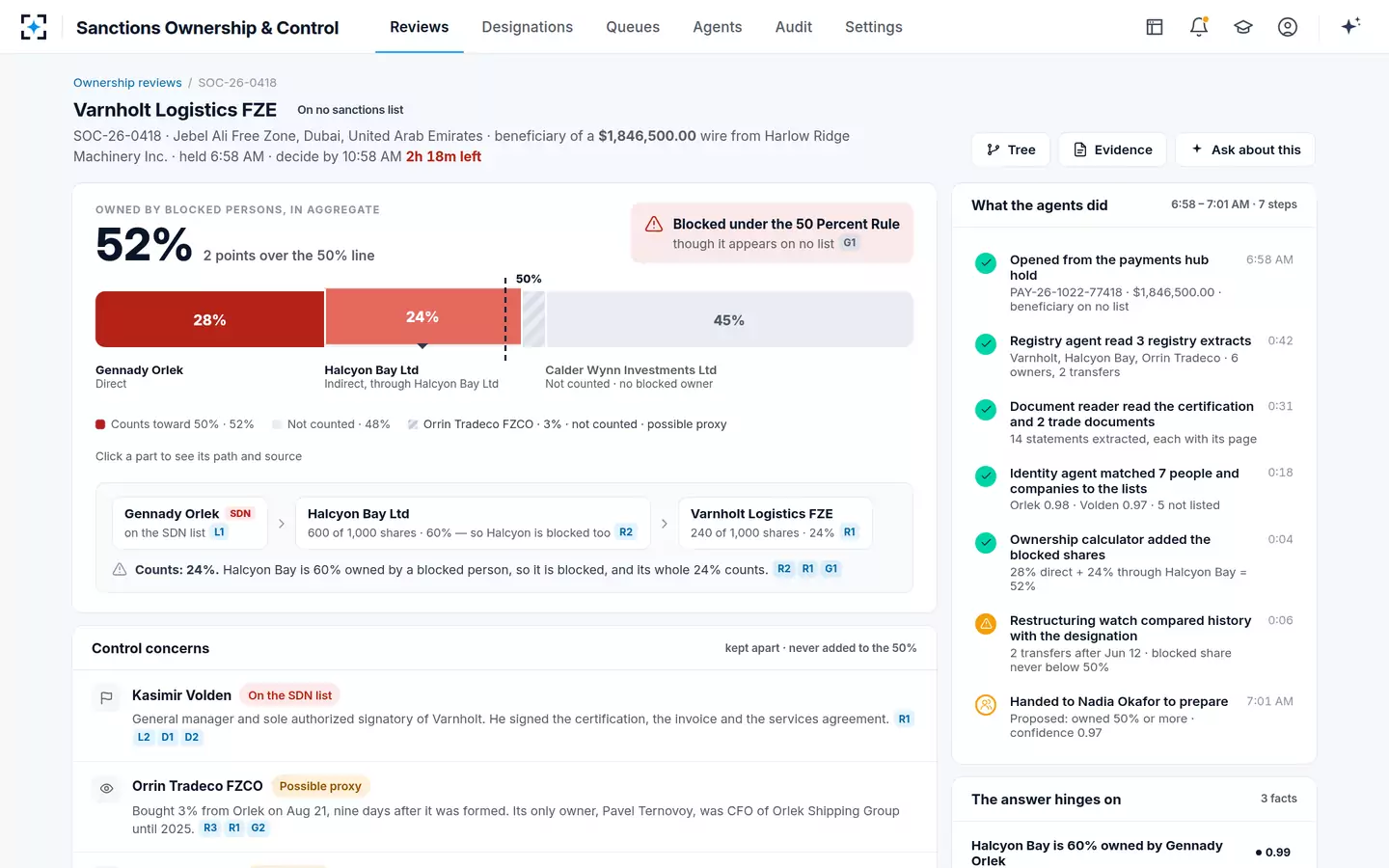
Step 1 asks which intermediate entities are blocked. Halcyon Bay's Cyprus registry shows Orlek with 600 of its 1,000 shares: 60%, so Halcyon Bay is blocked. Orrin Tradeco is owned by a person who is not listed, so it is not. Calder Wynn's owners are not listed. Step 2 adds whole stakes at Varnholt: 28% from Orlek directly and 24% from Halcyon Bay, for 52%.
The same tree, three ways to count it: only one is OFAC's
The path behind Halcyon Bay's 24%: one blocked company in the chain
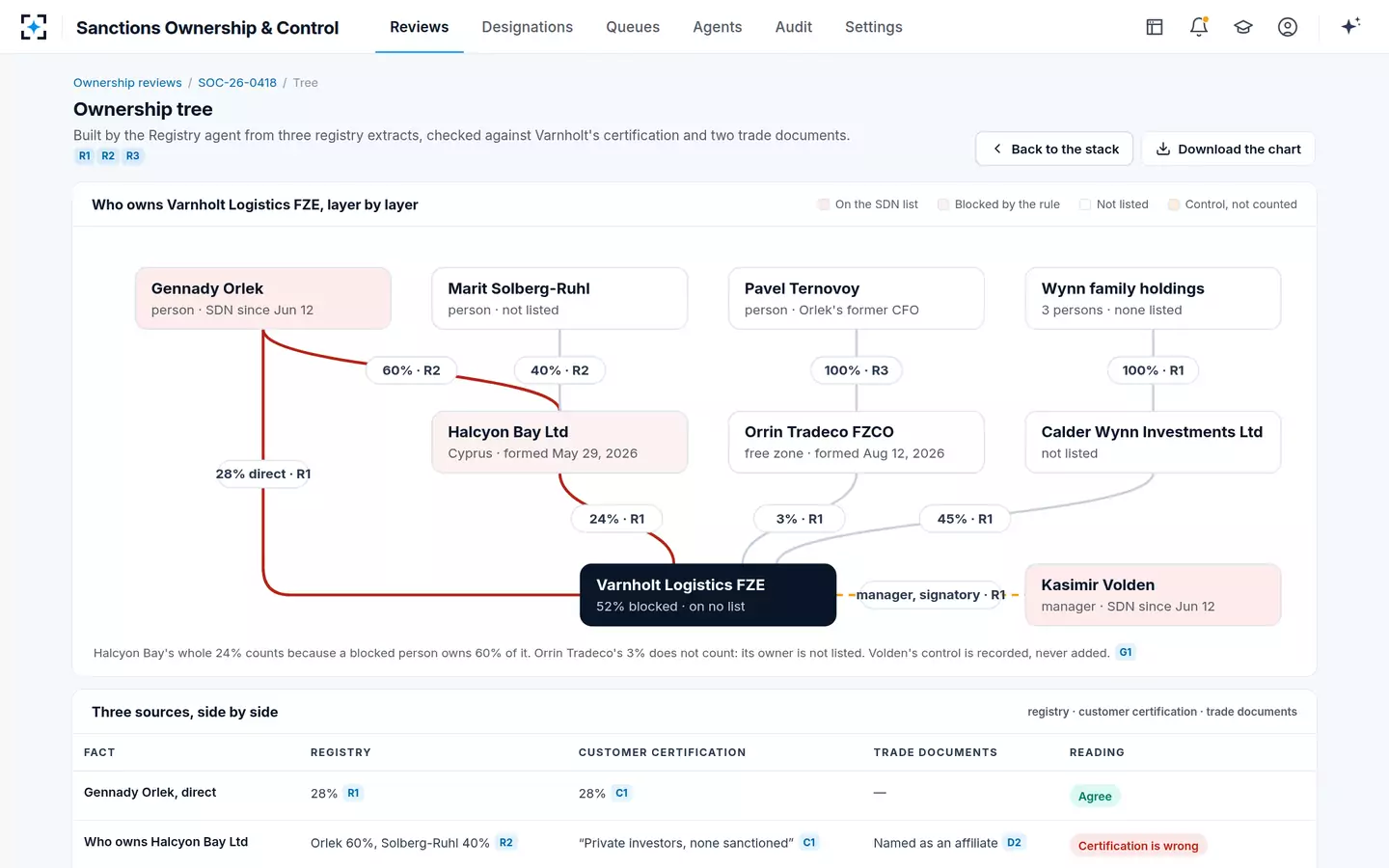
The margin is two points, and it rests on one registry line: if Orlek held under 50% of Halcyon Bay, its 24% would not count and Varnholt would be 28% blocked-owned. That is why the solution shows the answer as one stacked bar to the 50% line with the facts it hinges on listed beside it, rather than as a single percentage.
The OFAC 50 rule as one bar to the line in Sanctions Ownership & Control
Do other U.S. agencies use the same 50 percent rule?
The Commerce Department adopted the same standard for export controls, then paused it. Its September 2025 Affiliates rule extended Entity List restrictions to entities 50% or more owned by listed parties, and BIS said it chose the 50% standard to match Treasury's long-standing practice (90 FR 47201). The rule was stayed in November 2025 for a year; the BIS affiliates rule suspension sets out what returns on November 10, 2026.
For the work of applying the OFAC rule while a payment is held, with each share traced and the decision signed by two people, see Sanctions Ownership & Control.
Questions people ask
Does the OFAC 50 rule apply to entities that are not on the SDN list?
Yes; that is its purpose. OFAC's guidance says such an entity's property is blocked "regardless of whether the entity itself is listed", and OFAC's FAQ 5 chart puts entities blocked under the rule in the same block column as names on the SDN List (FAQ 5).
Is exactly 50 percent ownership blocked?
Yes. OFAC's wording is "50 percent or more", and Examples 1, 2 and 3 in FAQ 401 all reach exactly 50% and are blocked. The UK's line is different: "more than 50%".
Does the 50 rule apply to vessels and aircraft?
The rule speaks of entities, but property in which a blocked person has an interest is blocked whatever its form. In the Fracht FWO case OFAC said aircraft, vessels and other property "may be blocked by virtue of their ownership by blocked persons, whether or not they are identified on OFAC's SDN List".
Do I need a license to deal with an entity owned 50% by an SDN?
Generally, yes. The 2014 guidance says a U.S. person "generally may not engage in any transactions with such an entity, unless authorized by OFAC". FAQ 5 lists dealings "authorized by a general or specific license" among those that may proceed, so the question becomes whether a license's own text covers the transaction.
How do I calculate an indirect ownership percentage for OFAC?
Not by multiplying. Decide whether each intermediate entity is 50% or more owned by blocked persons; if it is, count its whole stake in the target, and if it is not, count none of it. Then add the direct and counted indirect stakes, as in FAQ 401's examples.
Does control count toward the OFAC 50 percent?
No. FAQ 398 says the rule covers ownership, not control. Control by a blocked person is a separate concern: OFAC may designate a controlled entity, and dealing through a blocked signatory is prohibited on its own.