Beneficial ownership screening for sanctions means tracing who owns each counterparty, through every layer, and testing whether blocked persons together hold 50% or more. The way to judge any tool for it is a pilot on your own closed reviews: replay a sample of last year's ownership reviews, including the hard ones and any later found to be wrong, through the new process without its answers, and score the result against tests agreed before the run. A replay works because the bank already knows what it decided and why, so every disagreement can be read and explained. Botminds' Sanctions Ownership & Control is designed to be piloted this way: agents rebuild each tree from registry extracts and cite every share, and the bank's own analysts and officers prepare and decide as they would in production. This guide sets out the sample, the tests, a six-week timeline and what to hand audit.
The pilot plan and its thresholds are our recommendation, not a regulatory standard. Where the guide uses the solution's sample data, the bank and companies are fictional.
A pilot on closed reviews, in four numbers
6weeks
from data agreement to audit read-out, in our suggested plan
5
OFAC worked examples to run first: three blocked, two not
0
“not blocked” answers allowed where a layer is unknown
100%
of counted shares citing a registry line or document: the solution’s design target
How do I pilot beneficial ownership screening for sanctions?
Replay, do not demonstrate. A vendor's demonstration shows the tool on cases it was built for; a replay shows it on yours, with your registries, your customers' certifications and your past decisions as the answer key. Run it in parallel with production, blind to the past outcome, and score it against tests written down before the first case runs. OFAC's compliance framework describes the purpose of testing in those terms: an "independent, and objective testing or audit function" that shows "where and how their programs are performing" (OFAC, A Framework for OFAC Compliance Commitments, 2019).
Write the tests first because the temptation afterwards is to grade on effort. OFAC made the point in its March 2026 TradeStation settlement: testing and audit are not boxes to tick, and a stack of tools switched on and left alone is not a program (OFAC, TradeStation Securities; the screening version of that test file is in sanctions screening testing).
Which past ownership reviews should a pilot replay?
A sample built to embarrass the tool, not to flatter it. Take a year of closed ownership reviews and choose across outcomes and difficulty: clear blocks, clean clears, the near-line cases, the ones with an unknown layer, and above all any review later found to be wrong. A sample of 40 to 60 is enough to see the pattern, by our estimate, if it is stratified this way.
A replay sample for beneficial ownership screening, by stratum
| Stratum | Why it is in the sample | Suggested share |
|---|---|---|
| Blocked at 50% or more | The tool must reproduce each block and its arithmetic, including whole stakes through blocked companies. | About 15% |
| Cleared, owners clearly not listed | The tool must not invent a blocked owner; this measures noise. | About 25% |
| Near the line, 40–49% | Small errors in a share count or a missed holder change the answer. | About 15% |
| A layer unknown or a registry silent | The tool must stop and say so, never clear. | About 15% |
| Ownership changed near a designation | Transfers must be replayed against the designation date and flagged. | About 10% |
| Certification conflicts with the registry | Conflicts must be shown, not averaged, and the stronger source preferred. | About 10% |
| Control without 50% ownership | Signatories, board rights and proxies must be flagged and kept apart from the percentage. | About 10% |
| Later found wrong | Any past review a later event showed to be wrong. The most valuable cases you have. | All of them |
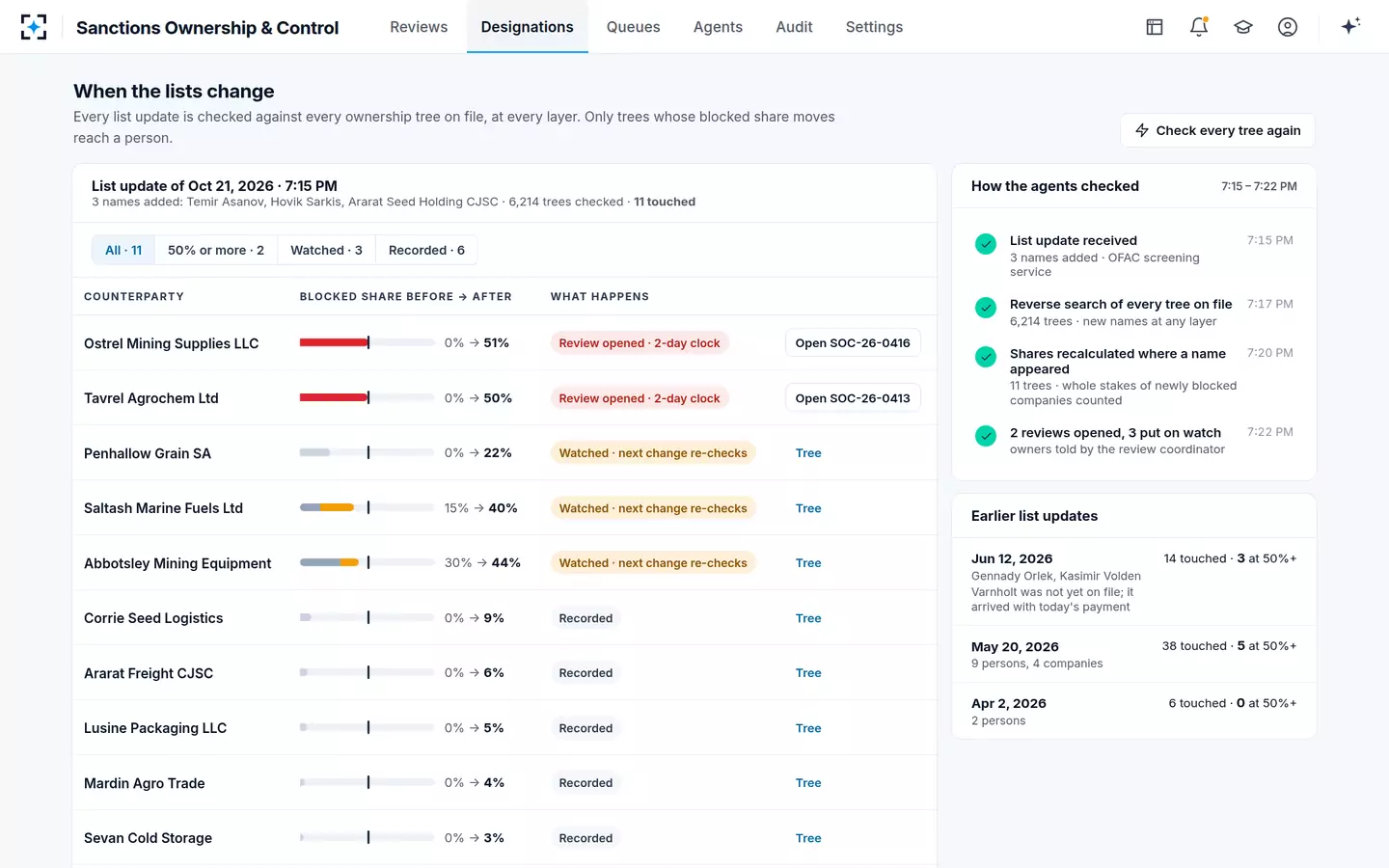
Add one list-change replay. Pick a past designation day, restore the trees on file as they stood, and ask the tool which counterparties the new names touched at any layer. In the solution's sample, one update with three new names touched 11 of 6,214 trees and put 2 at 50% or more. The bank's own answer on that day, and how long it took, is the baseline.
The list-change replay: which trees on file a designation touched
What pass and fail criteria should a beneficial ownership screening pilot use?
Criteria that a reviewer can check case by case, set before the run, with a few that allow no exceptions. The checklist below is what we would use; the first four are pass/fail on every case.
Pass/fail tests for a beneficial ownership screening pilot
- Every counted percentage traces to a dated source line
Open any share in the result and land on the registry or document passage it came from. A share without a source fails the case.
- No "not blocked" where a layer is unknown
Zero tolerance. An unknown layer must stop the clear and say which layer and why.
- Aggregation done the OFAC way
Whole stakes through blocked companies, nothing through unblocked ones, stakes across programs added. Calibrate first on OFAC's five FAQ 401 examples.
- Control flagged and kept apart
Blocked signatories, board rights, proxies and asset rights recorded with sources; none added to the percentage.
- Transfers near designations replayed
Every drop below the line after a designation shown with the traced blocked share beside the share on paper.
- Every past block reproduced, or the difference explained
A disagreement is read by a person; sometimes the tool is right and the file was wrong.
- Separation of duties holds under test
Try to decide as the preparer, and to have an agent decide; both must fail.
- Time measured against your own baseline
Analyst and officer minutes per review, by stratum, against the same cases' original times.
The calibration step costs an afternoon and catches the counting errors those examples were written to expose, before the real cases start. OFAC's five 50 rule examples, worked, include two structures that are not blocked; a tool that multiplies through intermediaries, or counts through an unblocked one, gets at least one of the five wrong.
How long does a beneficial ownership screening pilot take?
About six weeks in our plan, most of it in assembling the sample and reading the results, not in running the tool. The agents' run per case is minutes; the time goes into choosing cases, restoring the lists as they stood, and having analysts read every disagreement.
A six-week pilot of Sanctions Ownership & Control on closed ownership reviews
- Agree data and sign the testsWeek 1
- Build the sample; restore the listsWeek 2
- Calibrate on FAQ 401, then replayWeeks 3–4
- Read every disagreement and scoreWeek 5
- Audit read-outWeek 6
Plan the move to production with the same care, because the riskiest weeks come after the pilot. OFAC's October 2026 settlement with Bank of America describes an alert dismissed in error that then went unreviewed for months, because rescreening every customer on the move to a new screening platform buried the team in alerts it had not planned for (OFAC, Bank of America; the same trap in alert review is covered in automated sanctions screening). Re-running every ownership tree on file at go-live will produce its own wave of reviews; size the team for it.
What data does a beneficial ownership screening pilot need?
The closed files themselves, the lists as they stood, and access to the same sources production would use. Most of it the bank already keeps, because OFAC requires records of each transaction to be kept for 10 years after it (31 CFR 501.601).
What to hand over for the pilot, case by case
- The original review file
Memo, ownership chart, registry extracts and the customer's certification as they were on the day.
- The decision and its date
Block, reject or clear, who decided, and any later correction.
- The sanctions lists as of that date
So that a designation made later does not count against the original review.
- The trigger and its clock
Payment hold, trade finance, correspondent, onboarding or periodic review, and the time allowed.
- Your procedures and approval matrix
Watch bands, look-back periods, who may clear near the line; the tool runs on your settings.
- Access to your registry data service
The pilot should read the same sources production would, not a richer test feed.
How do I show pilot results to audit?
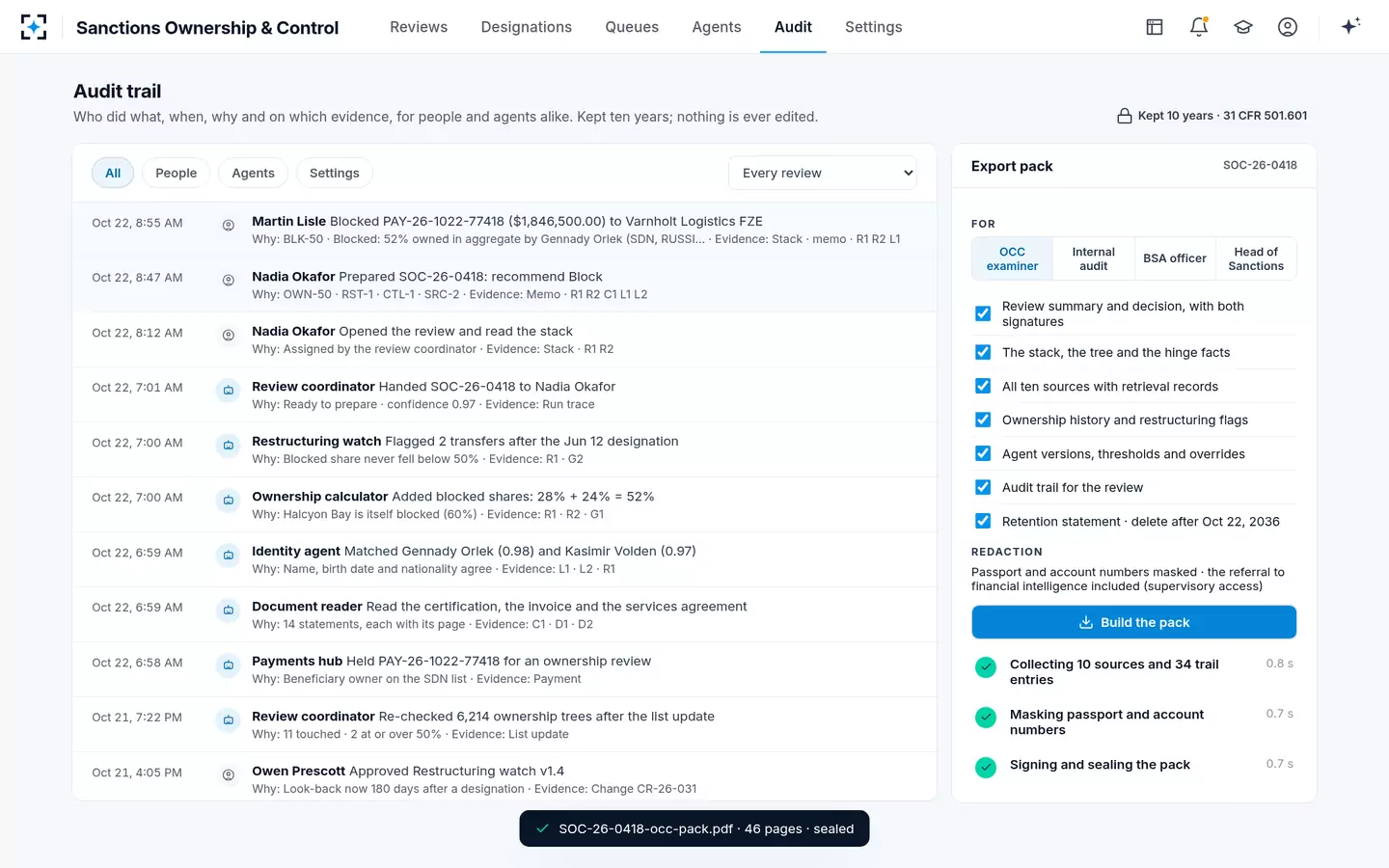
As a pack an auditor can re-perform: the tests as signed before the run, the sample and why each case is in it, the result case by case with every disagreement and its reading, the time measures, and the versions and settings used. Two pieces of guidance frame what an auditor will look for. The Federal Reserve's SR 26-2 leaves generative and agentic AI outside its model-risk guidance, but expects a bank's own risk management and governance to set the controls for them all the same (SR 26-2, April 17, 2026). The Wolfsberg Group asks firms to keep checking, after go-live, that an AI system performs as steadily as it did when approved (Wolfsberg, 2022), which is the pilot's tests run again on a schedule.
The audit pack in Sanctions Ownership & Control: who did what, on which evidence
Five ways an ownership screening pilot can mislead
A pilot can be designed, without anyone intending it, to pass. Five design errors make that happen, and each is avoidable before the first case runs.
The first is cases chosen by the vendor or for convenience: clean structures in well-filed jurisdictions, which every tool handles. The second is today's lists: replaying a 2025 review against the 2026 SDN List credits the tool with designations nobody knew about at the time, or penalizes the file for them. The third is a richer data feed than production will have; if the pilot reads a registry service the bank does not license, the result describes a different system. The fourth is grading on agreement with past decisions, which rewards a tool for repeating the bank's own mistakes. The fifth is no time baseline: without the original minutes per review, by stratum, "faster" is an impression.
The remedies are in the plan above: a stratified sample that keeps every case later found wrong, lists restored as they stood, production sources only, every disagreement read by a person, and times measured in week one. The pilot is then a test the tool can fail, which is the only kind worth passing.
What a good pilot result looks like, and what a bad one tells you
A good result is not 100% agreement with the past. It is every block reproduced or explained, no clear proposed over an unknown layer, every counted share sourced, control kept apart, and a measured drop in analyst time on the deep strata. Disagreements are where the value is: some will show the tool wrong, and some may show a past file that should have been escalated.
A bad result is informative too. If the tool proposes clears where the registry went silent, it will do so in production. If it adds a listed manager to the ownership percentage, it will overstate cases and train analysts to distrust it. If its numbers cannot be opened to a source, the officer will rebuild them, and the time saving will vanish. Each of these is a reason to stop, whatever the speed. For where the line between agent and officer should sit, see agents trace, an officer decides; for the cost side of the case, what one ownership review costs.
The pilot also answers a scope question that is easy to blur: this is screening for sanctions, against a 50% line, not collection of beneficial owners for customer due diligence at 25%, which Beneficial Ownership Verification covers. To run the replay on a sample of your own reviews, start from Sanctions Ownership & Control.
Questions people ask
What is ultimate beneficial owner screening?
It is checking the people and companies that ultimately own a customer or counterparty against sanctions and other lists. For sanctions it includes adding up what blocked persons own: under OFAC's rule, an entity 50% or more owned by blocked persons together is blocked even if no listed name appears on it.
Should a pilot use live payments?
Not at first. A replay on closed reviews tests the tool against known answers without risk to customers; a short parallel run on live reviews, with the bank's own decision still governing, can follow before go-live.
How many cases are enough for an ownership screening pilot?
Enough to cover each stratum several times; 40 to 60 closed reviews is our suggestion for a first replay, plus every case later found wrong and one list-change replay. The point is to see each kind of failure, not to estimate an error rate to two decimals.
Who should sign off the pilot?
The head of sanctions as owner of the policy, with internal audit reading the pack independently. The tests should be signed before the run by the same people who sign the result.
Does a pilot need the EU and UK tests as well as OFAC's?
If the bank has EU or UK obligations, yes: include cases at exactly 50% and with two designated holders, where the UK answer differs from the EU and OFAC answers. The tree is the same; the reading differs by regime.