The EU sanctions ownership and control test has two limbs. An entity is owned by a designated person if that person holds "50% or more of the proprietary rights of an entity or having majority interest in it", and designated holders are added together: "if one designated person owns 30% of the entity and another designated persons owns 25% of the entity, the entity should, in principle, be considered as owned by designated persons" (Council of the EU, Best Practices, July 2024). An entity is controlled if any of eight criteria is met, from appointing the board to having the right to use its assets. The UK draws its line at "more than 50%", does not add different designated persons' holdings by default, and asks whether a designated person could steer the entity if they chose to. OFAC counts 50% or more, in aggregate, and ownership only. The same company can be frozen in Brussels and free in London. Botminds' Sanctions Ownership & Control builds one ownership tree and can apply each test to it as a setting, so a team with EU, UK and U.S. obligations reads three answers from one set of sources.
One ownership tree, three thresholds
≥50%
EU: 50% or more, designated holders aggregated (since the July 2024 update)
>50%
UK: more than 50%, not aggregated by default
≥50%
OFAC: 50% or more, aggregated; control not counted
8
control criteria in the EU Best Practices, any one of which is enough
What is the EU ownership and control test?
It is the Council's guidance on when the assets of an unlisted entity must be treated as belonging to a listed one. The Best Practices start from the freeze: funds and economic resources "belonging to, owned, held or controlled by a listed natural or legal person must be frozen", and that includes "assets owned by non listed entities, that are owned or controlled by listed persons or entities" (paragraph 62). Ownership is the 50% test with aggregation. Control is a list of criteria. Either is enough.
The EU frames the consequence as indirect making available, and that is where it differs most in practice. If ownership or control is established, making funds available to the entity "will in principle be considered as making them indirectly available to the latter, unless it can be reasonably determined, on a case-by-case basis using a risk-based approach, taking into account all of the relevant circumstances … that the funds or economic resources concerned will not be used by or be for the benefit of that listed person or entity" (paragraph 68). The guidance then names the factors: the contractual links between the entities, how relevant the unlisted entity's sector is to the listed one, and how easily the funds could pass to it. OFAC's test has no such rebuttal; an entity owned 50% or more is blocked.
Does the EU aggregate ownership?
Yes, since the Council's July 2024 update. The 2024 text says that when assessing ownership, "the aggregated ownership of the entity" should "also be taken into account", with the 30% plus 25% example quoted above. The 2022 version of the same paragraph set the test as "the possession of more than 50% of the proprietary rights of an entity" and said nothing about adding holders together (ST 10572/22, June 27, 2022). In two years the EU moved from the UK's position to OFAC's on both points.
The phrase "in principle" matters. The EU presumes an entity owned 55% by two designated persons is owned by designated persons, but the Best Practices also say "the fulfilment of the above criteria of ownership or control may be refuted on a case by case basis" (paragraph 66). The burden sits with whoever wants to rebut it, and the record of why it was rebutted belongs in the file.
Is the threshold 50% or more than 50%?
It depends on the regime: 50% or more for the EU and OFAC, more than 50% for the UK. An entity in which a designated person holds exactly half is owned for EU purposes and blocked for OFAC purposes, but not owned under the UK's share test. The UK may still catch it through control: a 50% holder often has the power to block resolutions or appoint half the board.
The UK line may move. HM Treasury's call for evidence on the ownership and control test, open from 16 February to 20 April 2026, says: "On ownership, HMG continues to actively explore options to respond to calls for greater alignment with international partners, including adopting an aggregation model and amending the 50% ownership rule to “50% or more”, in line with the EU and US sanctions frameworks" (HM Treasury, 2026). No response had been published on the call's page when we checked on October 26, 2026.
How the three ownership tests have moved since mid-2022
- More than 50%, no aggregation25 months
- 50% or more, aggregatedsince July 2024
- More than 50%, not aggregated by defaultunchanged
- Call for evidence, Feb–Apr 2026
- Response pendingpending
- 50% or more, aggregated; ownership onlysince August 2014
What control criteria does the EU use?
The EU lists eight, and meeting any one makes the entity controlled "unless the contrary can be established on a case by case basis" (paragraph 65). They are, in the Council's words: (a) the right or power "to appoint or remove a majority of the members of the administrative, management or supervisory body"; (b) having appointed a majority of those members "solely as a result of the exercise of one's voting rights"; (c) controlling, under an agreement with other shareholders, "a majority of shareholders' or members' voting rights"; (d) a right "to exercise a dominant influence" under an agreement or the articles; (e) the power to exercise that influence de facto "without being the holder of that right", including by a front company; (f) "having the right to use all or part of the assets"; (g) managing the business "on a unified basis, while publishing consolidated accounts"; and (h) "sharing jointly and severally the financial liabilities of a legal person or entity, or guaranteeing them".
Paragraph 67 adds indicators that call for a closer look rather than a conclusion: a designated person who is the largest shareholder, "the designated person has 40%, whereas the other shareholders each have 10%"; a buyback option at favourable terms; a share transfer "shortly before or after" a designation, including a sale of just enough shares to take the listed seller below the threshold (the proxy patterns are worked in sanctions evasion red flags); front persons such as "a family member or former employee/business partner"; and needlessly complex structures of shells and trusts.
How does the UK ownership and control test differ?
The UK test has two conditions, and either is enough. The first is mechanical: the designated person "holds directly or indirectly more than 50% of the shares", or more than 50% of the voting rights, or "the right directly or indirectly to appoint or remove a majority of the board of directors". The second is the control test: "it is reasonable, having regard to all the circumstances, to expect that P would (if P chose to) be able, in most cases or in significant respects, by whatever means and whether directly or indirectly, to achieve the result that affairs of C are conducted in accordance with P's wishes" (Russia (Sanctions) (EU Exit) Regulations 2019, regulation 7, as set out in HM Treasury's call for evidence).
On aggregation, OFSI is explicit: it "would not simply aggregate different designated persons' holdings in a company, unless, for example, the shares or rights are subject to a joint arrangement between the designated parties or one party controls the rights of another" (OFSI guidance 4.1.4). Two unconnected designated persons with 30% and 25% leave the company outside the UK ownership test, though OFSI adds that control may still bring it in.
The second condition is hypothetical, and firms say so. The call for evidence explains that evidence a designated person "has not exercised control does not mean they do not have the ability to do so". Its own worked example: a designated founder transfers all his shares to three associates and resigns, but a deed still lets him nominate and remove a majority of the directors by written notice; there is "no evidence that Person A is currently exercising control", yet "there is good reason to believe that Person A could, if they chose to do so, exercise control".
EU vs UK ownership and control test, point by point (OFAC in the notes)
EU (Council Best Practices, 2024): "50% or more of the proprietary rights" or a "majority interest". OFAC: also 50% or more.
UK (regulation 7 and OFSI guidance 4.1): "More than 50%" of shares or voting rights.
EU (Council Best Practices, 2024): Yes: 30% + 25% is owned "in principle". OFAC: yes, across programs.
UK (regulation 7 and OFSI guidance 4.1): Not by default; only for a joint arrangement or where one controls the other's rights.
EU (Council Best Practices, 2024): Eight criteria (a)–(h); any one is enough unless rebutted case by case. OFAC: not counted; may designate.
UK (regulation 7 and OFSI guidance 4.1): Board appointment right, or a reasonable expectation the person could steer the entity "if P chose to".
EU (Council Best Practices, 2024): Funds to the entity are presumed made available indirectly to the listed person, unless it is reasonably determined they will not benefit it.
UK (regulation 7 and OFSI guidance 4.1): Financial sanctions apply to the entity "in its entirety"; its assets are frozen.
EU (Council Best Practices, 2024): Updated July 2024 (from more than 50%, without aggregation).
UK (regulation 7 and OFSI guidance 4.1): Call for evidence 2026, including aggregation and "50% or more".
The same company, three answers: worked cases
The fastest way to see the gaps is to run one structure through all three tests. The cases below are ours; the outcomes follow each regulator's text as quoted above, and a real case would turn on its facts.
Ownership and control test outcomes by regime, case by case
| Structure | OFAC | EU | UK |
|---|---|---|---|
| One designated person holds exactly 50%. | Blocked (50% or more). | Owned (50% or more). | Not owned by shares (needs more than 50%); look at control. |
| Two unconnected designated persons hold 30% and 25%. | Blocked (55% aggregated). | Owned "in principle" (the EU's own example). | Not owned unless a joint arrangement; look at control. |
| One designated person holds 40%; five others hold 10% each. | Not blocked; caution. | Indicator of control "may warrant further analysis". | Not owned; control depends on whether 40% lets them steer. |
| A designated person holds 10% but can appoint a majority of the board. | Not blocked by the rule; may be designated. | Controlled (criterion a). | Owned or controlled (board appointment right). |
| A designated founder transferred all shares but keeps a deed to nominate the directors. | Not blocked by the rule; sham and interest questions. | Controlled (right to appoint, criterion a) unless rebutted. | Controlled: HM Treasury's own hypothetical-control example. |
A transfer just after designation: the EU control indicator, in one chart
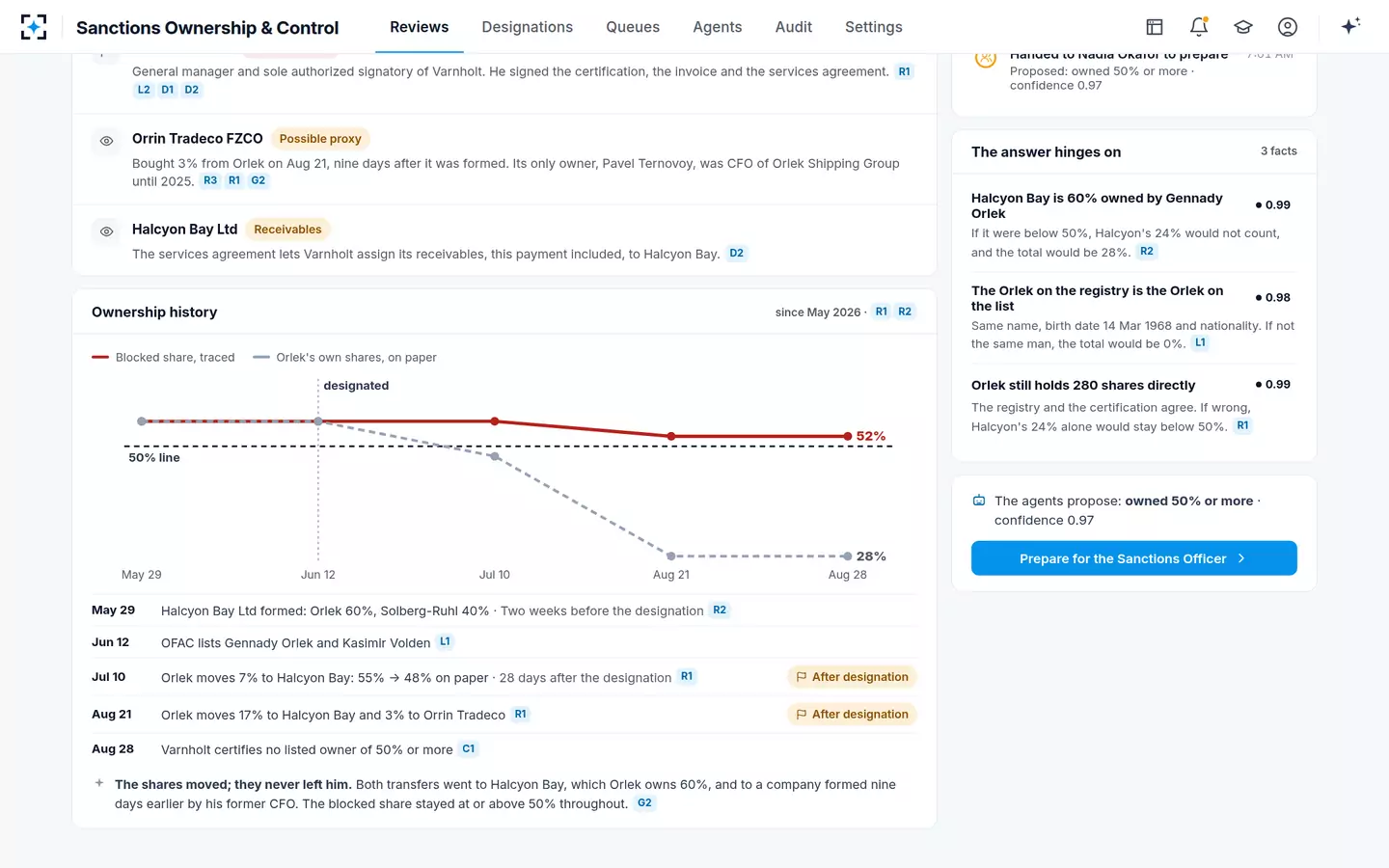
Two patterns stand out. The EU now matches OFAC on ownership and adds a broad control test that works as a presumption. The UK is narrower on ownership and broader in one specific way, hypothetical control, which neither of the others writes in those words. A bank with a single "50% or more, aggregated" rule in its procedures applies the U.S. and EU ownership tests correctly and the UK one too strictly on shares and too loosely on control. The OFAC 50 rule and control covers the U.S. side of that gap.
Which ownership test applies to a cross-border payment?
Every regime that has a person in the chain. UK sanctions "apply to all persons within the territory and territorial sea of the UK and to all UK persons, wherever they are in the world" (OFSI). OFAC's prohibitions bind U.S. persons, which include U.S. banks clearing a dollar payment. A euro payment from a Paris branch to a Dubai company, routed through a London correspondent, can put EU and UK obligations on two different banks in the same chain.
That is why the test is a property of the bank and the transaction, not of the currency. OFSI made the point about downstream data in its 2026 Deutsche Bank notice: a London branch paid "a company wholly owned by the designated person JSC New Opportunities" because its vendor's lists carried no ownership data for that company, and OFSI noted that "UK financial sanctions apply to any conduct in the UK and to all UK persons" (OFSI, April 30, 2026). The penalty was £165,000 after discounts.
Running three ownership tests on one counterparty, as Sanctions Ownership & Control does
- Build one tree, with dated sources
Shares, voting rights and board rights at every layer; the three tests read the same evidence differently.
- Compute three ownership answers
OFAC and EU: 50% or more, aggregated. UK: more than 50%, aggregated only for joint arrangements or where one holder controls another's rights.
- Record control separately, criterion by criterion
EU (a)–(h); UK board rights and the "if P chose to" condition; for OFAC, a signatory or proxy is the live risk.
- Name which regimes bind this payment
Which bank, which branch, which correspondent; each regime that binds a party must be satisfied.
- Write down any rebuttal
The EU presumption can be refuted "on a case by case basis"; the reason and the evidence belong in the file.
What are banks expected to have in place from 2025?
In the EU, a supervisory layer now sits on top of the Council's guidance. The European Banking Authority's guidelines on restrictive measures, which "apply from 30 December 2025", tell payment service providers to "set out in their policies and procedures how they will assess whether a legal person or entity is owned or controlled by a designated person or entity". They are to apply "the criteria set out in EU Council Sanctions Guidelines and in Section VIII EU Council Best Practices", the criteria for beneficial owners, and "available public sources of information, such as registers of owned and controlled entities and beneficial ownership registers" (EBA Final Report, November 2024).
The guidelines also say what to do when the research runs out: "If an assessment remains inconclusive, PSPs and CASPs should consider engaging with the national authority competent for the implementation of restrictive measures. The ultimate responsibility for complying with the restrictive measures lies with the PSPs and CASPs." An inconclusive file is a reason to ask, not a reason to clear.
In the UK, HM Treasury's call for evidence says firms are "expected, and required by law, to assess ownership and control in line with existing UK financial sanctions guidance", and that it "does not prescribe the level or type of due diligence", recommending research, requests for information and legal advice "where obligations are unclear". Until the response arrives, the 2026 guidance stands.
Sanctions Ownership & Control queue: exactly 50%, and a listed chairman at 46%
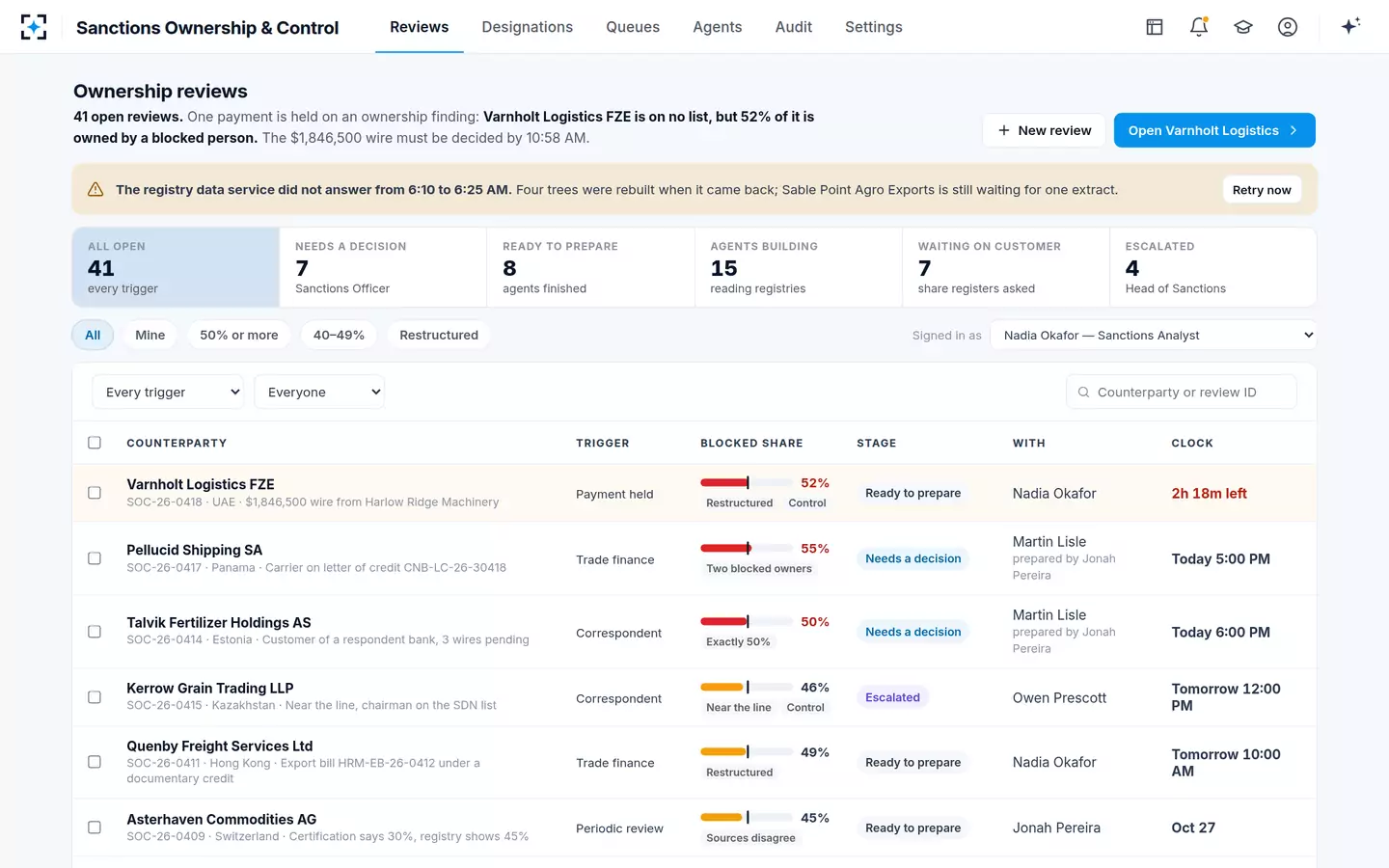
For the U.S. calculation in detail, OFAC's five 50 rule examples, worked, goes step by step. To see the tree, the stack and the decision in one place, start from Sanctions Ownership & Control.
Questions people ask
Is the EU ownership test the same as OFAC's 50 percent rule?
On ownership, it is now close: both use 50% or more and both add designated holders together. The EU differs in counting control as a test of its own and in letting the presumption be rebutted case by case; OFAC's rule covers ownership only and has no rebuttal.
Does OFSI aggregate the holdings of different designated persons?
Not by default. OFSI's guidance says it does not add different designated persons' holdings together unless the shares are subject to a joint arrangement or one party controls the rights of another. HM Treasury said in 2026 that it is exploring an aggregation model.
What is hypothetical control under UK sanctions?
It is the part of the UK control test that asks what a designated person could do, not what they have done: whether it is reasonable to expect that they "would (if P chose to) be able" to have the entity's affairs run their way. A dormant right to appoint the board is HM Treasury's own example.
Did the EU change its ownership threshold?
Yes. The Council's 2022 Best Practices used "more than 50%" of proprietary rights; the July 2024 update uses "50% or more" and adds aggregation of designated holders, with the 30% plus 25% example.
Can the EU ownership and control presumption be rebutted?
Yes, case by case. The Best Practices say the criteria "may be refuted on a case by case basis", and funds to an owned or controlled entity are not treated as made available to the listed person if it "can be reasonably determined" they will not be used by or benefit it.
Which test should a global bank use?
Each one that binds a person in the transaction, applied to the same ownership tree. A single internal rule cannot reproduce all three, because the UK's share line is higher than the others while its control test reaches hypothetical influence.