The sanctions evasion red flags for ownership are the signs that a blocked person still holds an interest the share register no longer shows. OFAC's March 2026 advisory names them: commercially unreasonable transfers, "transfer to family members or close associates", an unclear purpose, "unduly complex corporate structures involving higher-risk jurisdictions", the "continued involvement of a blocked person", a "transfer near the time of designation" and "evasive responses" (OFAC, Guidance on Sham Transactions and Sanctions Evasion, March 31, 2026). They matter because a sanctioned owner who gives up shares "on paper only" keeps a blocked interest, and a bank that relies on the paper deals in blocked property. The flags are hard to act on because none decides a case on its own. Botminds' Sanctions Ownership & Control replays every dated transfer against designation dates and flags these patterns beside the ownership calculation, never inside it, for an investigator and a sanctions officer to judge.
What relying on the owner on paper has cost
$216M
GVA Capital: the statutory maximum, after working through a blocked oligarch’s nephew
$1.3B
held by the Kerimov family trust OFAC blocked in June 2022
45months
Gracetown, by then owned by the oligarch’s relative, went without reporting blocked assets
7
red flags in OFAC’s 2026 sham-transactions advisory; none decisive alone
What are the red flags for sanctions evasion through ownership?
OFAC's seven indicia of a sham transfer are the reference list, and OFAC is careful about how to use them: "The set of factors listed below is not exhaustive, and no factor—alone or in combination with others—is determinative. A functional approach that considers the totality of circumstances is critical." The advisory applies them where "a blocked person possessed a prior, documented interest in property", which is exactly the situation after a designation, when the owners of a company a sanctioned person used to control start to change.
OFAC's red flags of a sham ownership transfer, and what to look for in the file
| Red flag (OFAC, 2026) | What OFAC says | What to look for in an ownership review |
|---|---|---|
| Commercially unreasonable transactions | Terms "lacking adequate consideration, or otherwise not suggestive of an arm's length transaction". | The price paid for the shares, if any; who funded the buyer. |
| Transfer to family members or close associates | They "may be acting as a proxy, facilitator, money manager, or agent for the blocked person". | The new owner's relationship to the blocked person: relative, employee, former officer, adviser. |
| Unclear purpose of transfer | Including transfers "to an individual with little or no relevant experience or expertise". | Whether the new owner runs anything similar; whether the business changed. |
| Unduly complex structures in higher-risk jurisdictions | Layers "without a discernible legitimate purpose", in jurisdictions with "little connection to the property they hold". | Offshore or free-zone holding layers, shared registered offices, shells formed recently. |
| Continued involvement of a blocked person | The blocked person "remains involved in the use, management, or disposition of property". | Signatures, board seats, instructions, receivable or asset rights that still run to the blocked person. |
| Transfer near the time of designation | A transfer "immediately before or after a designation". | Dated transfers within months of the designation, especially those that drop a holding just under 50%. |
| Evasive responses | "Evasive or vague responses, or failures to respond to questions". | Unanswered requests for share registers; certifications that omit the transfers. |
How do sanctioned people hide ownership?
Through people and structures that hold title for them. OFAC says it "has encountered numerous instances where blocked persons have employed opaque legal structures (including trusts), proxies, straw owners, and front businesses, among other mechanisms, to conceal their continuing interest", in property from bank accounts and real estate to private jets, yachts and companies. Its examples are concrete: a jet transferred to a trust whose sole beneficiary was the oligarch's wife "while the oligarch continued to use the jet"; funds moved into trusts for minor children; a company that, after designation, "was reincorporated under a different name with new nominal owners while continuing the blocked company's operations".
The Potanin case in the same advisory shows the pattern at company level. Before his December 2022 designation Vladimir Potanin owned the Cyprus company Sentimare Enterprises; he "transferred ownership of Sentimare to four Liechtenstein-based foundations, each with a single beneficiary of one of Potanin's four minor children". OFAC concluded he "retained an interest in the foundations" and stopped their funds moving through U.S. banks, and in June 2024 the company and the foundations were designated for being controlled by him.
What is a proxy or nominee owner?
A proxy or nominee owner is a person who holds title, shares or an account in their own name while acting for someone else, here a blocked person. OFAC describes them as family members or close associates who "may be acting as a proxy, facilitator, money manager, or agent for the blocked person", and says "formal or informal agreements, agent-principal or other close relationships" may show "the nominal owner is not independent from the blocked person".
The EU and UK use different words for the same thing. The EU's Best Practices list "use of front persons", where "a new owner is closely connected to the designated previous owner, e.g. a family member or former employee/business partner, and, possibly, the sale price was too low or otherwise abnormal" (Council of the EU, 2024). OFSI's guidance gives the example of an unlisted family member or friend where "there is evidence that Person B is using Person A to enter into transactions", and concludes that "Person A is also subject to the same restrictions" (OFSI guidance 4.1). Under all three, a proxy's holding can be the blocked person's holding.
“Blocked persons give up their property on paper only, in an attempt to evade sanctions, while their interests in property remain unchanged.”
OFAC, Guidance on Sham Transactions and Sanctions Evasion, March 31, 2026
What did OFAC find in the GVA Capital case?
It found that a venture capital firm kept managing a blocked oligarch's investment for three years after his designation by dealing with the man it knew spoke for him, and it imposed the statutory maximum of $215,988,868. GVA Capital's senior managers had flown to Suleiman Kerimov's estate in France in 2016 to win his approval; after that, they were told to work with his nephew, Nariman Gadzhiev, his "primary financial facilitator". The money came in through Prosperity Investments, a Guernsey entity "in which Kerimov retained an interest at all relevant times" (OFAC, GVA Capital).
GVA Capital: the owner on paper changed, the interest did not
- Approval in France; $20M in via Prosperity22 months
- After designation: assignment, two sale attempts, a planned distribution38 months
- Heritage Trust blocked, June 202213 mo
- Investigation to the statutory maximum, June 202536 months
One step in that chronology is the whole lesson in miniature. In December 2018 Prosperity agreed to transfer its interest, then valued at $18,500,000, to Definition Services, a British Virgin Islands entity. OFAC's finding: "Because Definition and Prosperity were both owned by Heritage Trust, this transfer did not change the ultimate beneficial ownership of the investment." It counted the assignment as a prohibited dealing in blocked property. OFAC's closing note warned against "relying on formalistic ownership arrangements that obscure the true parties in interest behind an entity or investment, without sufficiently considering factors such as control or influence over that investment".
Transfers timed to a designation: Gracetown, and the sample case
A change of owner just before or after a designation is the flag OFAC, the EU and the cases agree on. Gracetown, a New York property manager, had been ultimately owned by Oleg Deripaska from 2006; "in the months leading to Deripaska's designation as a blocked person, a relative and known associate of Deripaska, became the ultimate beneficial owner of Gracetown" (OFAC, Gracetown). It kept receiving payments for a Deripaska company and reported the blocked funds more than 45 months late. The penalty was $7,139,305.
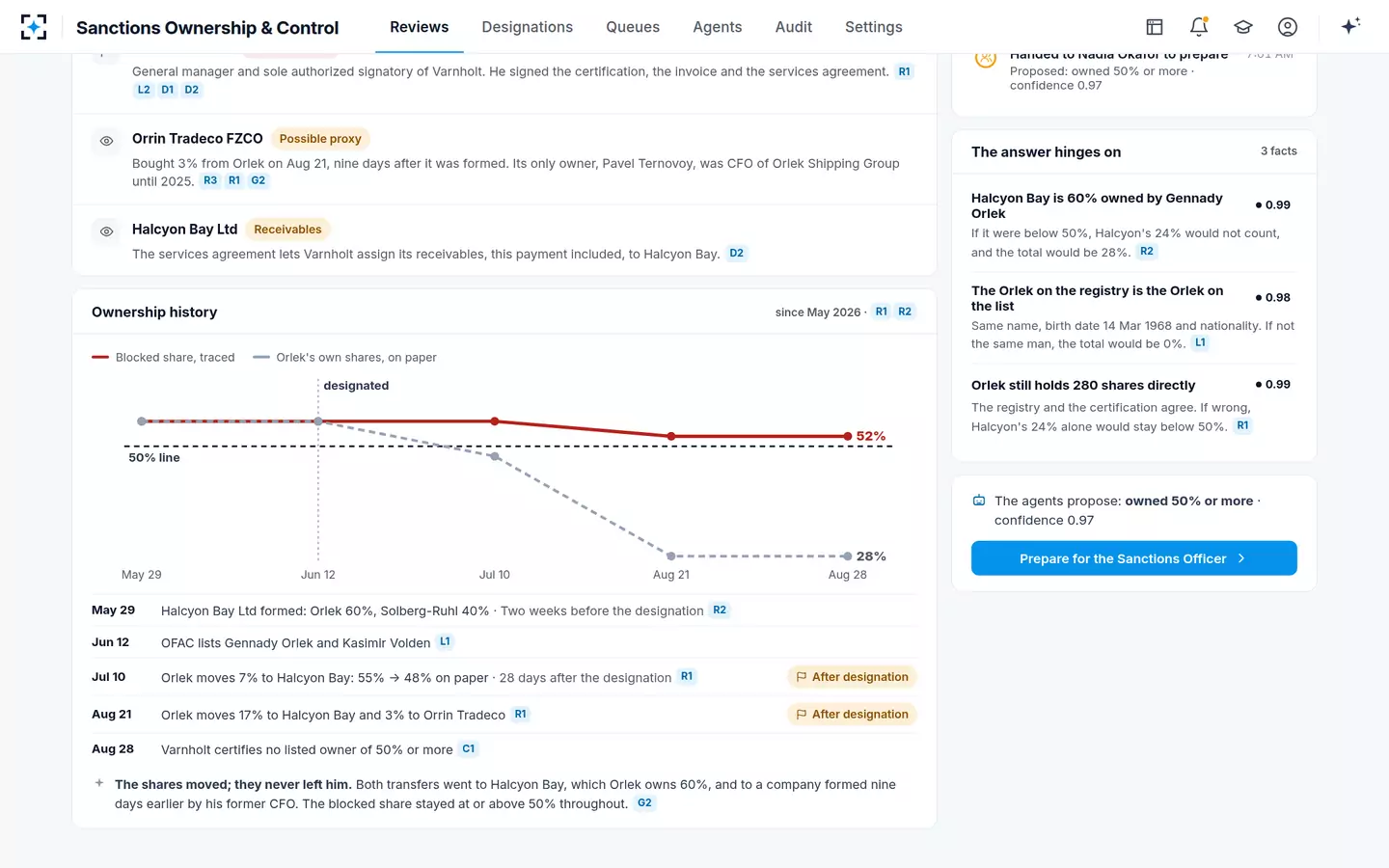
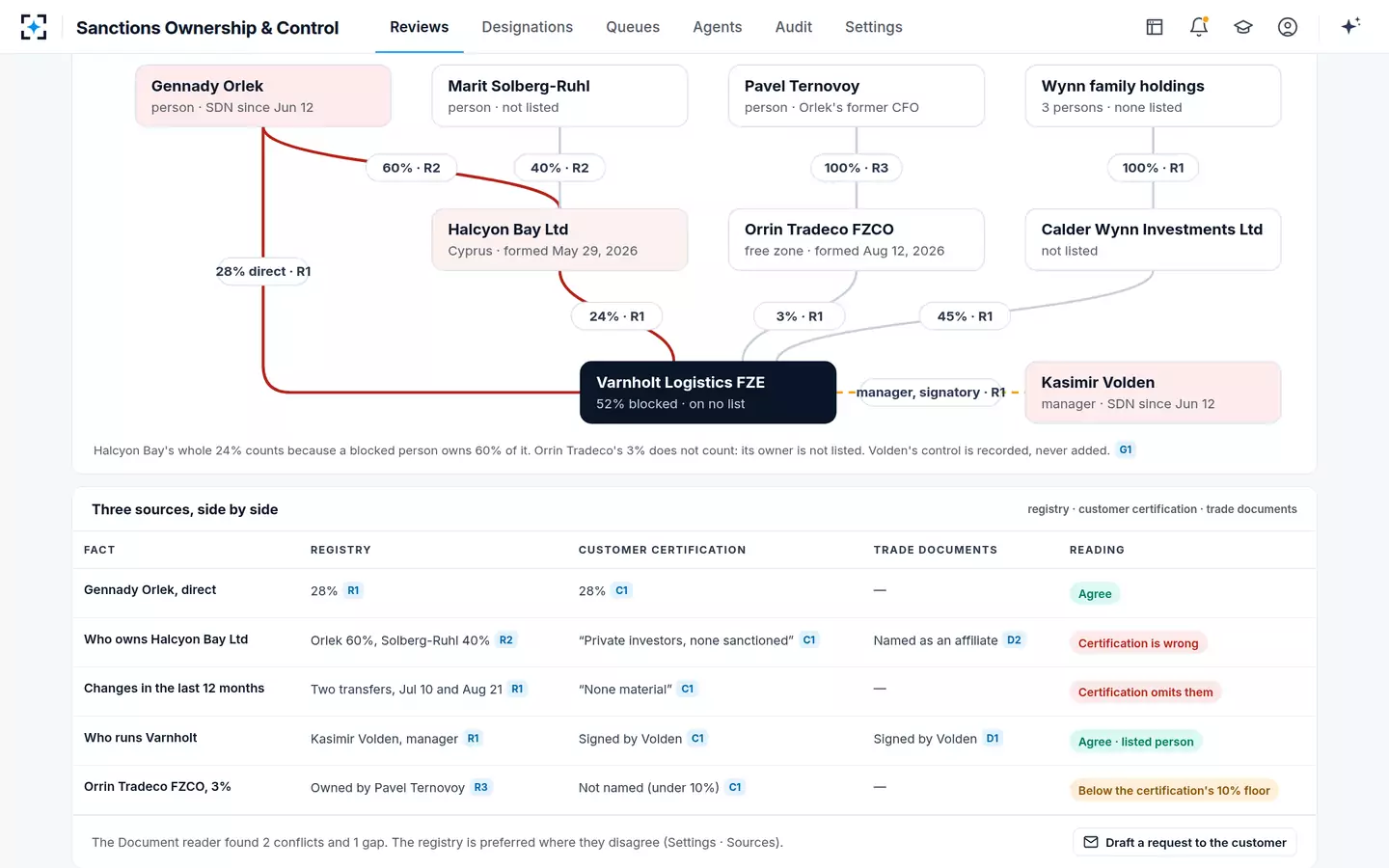
The EU writes the same flag with a sharper edge: a transfer of "a relevant number of shares" near a designation, where relevant includes "smaller numbers which enable the listed seller, for instance, to fall below the ownership threshold". The fictional sample case in Sanctions Ownership & Control is built on that pattern. Gennady Orlek held 55% of Varnholt Logistics FZE before his June 12 designation. On July 10 he moved 7% to Halcyon Bay, a Cyprus company formed on May 29 that he owns 60% of; on August 21 he moved 17% more to Halcyon Bay and 3% to Orrin Tradeco, formed nine days earlier and owned by his former chief financial officer. On paper he fell to 28%. Traced through Halcyon Bay, the blocked share never fell below 50%.
Shares on paper against the traced blocked share, transfer by transfer
Sanctions Ownership & Control: the certification said nothing changed; the registry disagreed
When documents and names change: ALICO and Pegasus
Some red flags sit in the paperwork rather than the register. In ALICO's case a sales agent was refused a policy for a UAE entity whose trade license said, in Arabic, that its owner was the Iranian embassy. Seven days later he applied again through a third-party administrator with a copy of the license that, "despite having the same print date as the previously submitted license, named the same individual referenced above as the manager but this time listed no owner, Iranian embassy or otherwise" (OFAC, ALICO, November 14, 2024). Two versions of one document with different owners is a flag on its own.
Names change too. In October 2026 OFAC settled with Pegasus Worldwide Logistics, which shipped equipment from a designated Chinese supplier that had "changed its name" after designation while its other identifiers "remained unchanged". OFAC's comment: "Sanctions screening against names on the SDN List, while critically important, is a baseline tool. Firms should ensure their sanctions compliance controls take into account efforts by SDNs to obfuscate their involvement" (OFAC, Pegasus, October 9, 2026).
What does FinCEN list as sanctions evasion red flags?
FinCEN's March 2022 alert on Russian sanctions evasion lists ownership red flags among its first: "use of corporate vehicles (i.e. legal entities, such as shell companies, and legal arrangements) to obscure (i) ownership, (ii) source of funds, or (iii) countries involved, particularly sanctioned jurisdictions", and "use of third parties to shield the identity of sanctioned persons and/or PEPs seeking to hide the origin or ownership of funds" (FIN-2022-Alert001). Like OFAC, it warns that "no single financial red flag indicator is determinative", and asks banks to use the key term "FIN-2022-RUSSIASANCTIONS" in suspicious activity reports.
The June 2022 alert FinCEN issued with the Commerce Department adds the trade view: "transactions involving entities with little to no web presence", parties "with addresses that do not appear consistent with the business", and companies that share an address or owners with a party on the Entity List or the SDN List (FinCEN and BIS, June 2022). In the sample, Halcyon Bay's registered office is a corporate services address shared by 212 companies.
When should sanctions ownership analysis go deeper?
When any of the red flags is present and the arithmetic alone would clear the counterparty. A clean 52% or a clean 10% needs little more; a 48% reached by transfers after a designation, or a 30% owner whose co-owners are his relatives, needs an investigator. OFAC drew the line in its IPI settlement: equity analysis may suffice in some cases, but where structures are opaque or proxies are involved, more is expected, and a party with reason to know cannot rely on the blocked person's absence from the share register.
Where the arithmetic stops in Sanctions Ownership & Control and an investigator takes over
Agent
Trace and addBuilds the tree from dated registry extracts and adds blocked shares the OFAC way.
Never: adds a suspected proxy's shares to the blocked total
Agent
Replay the historyReplays every transfer from 30 days before to 180 days after a designation; compares the owner's shares on paper with the traced blocked share.
Agent
Flag the patternsDrops to just under 50%, transfers to relatives, former officers or companies under 90 days old, continued control.
Never: calls a transfer evasion
A person decides
InvestigatorWeighs the flags against price, purpose and relationships; requests documents; decides whether the new owner is independent.
A person decides
Sanctions officerDecides block, reject or clear with the flags in view; a clear near the line needs a third signature.
The design choice in the middle matters. A suspected proxy's 3% is shown, sourced and flagged, but not added to the blocked total: whether Orrin Tradeco holds for Orlek is a finding for a person to make, and adding it silently would turn a judgement into arithmetic. For how flags sit beside the percentage on the decision screen, see the OFAC 50 rule and control; for how each percentage in the file is sourced, see one aggregate percentage, traced. The solution itself is at Sanctions Ownership & Control.
Questions people ask
What are common sanctions evasion typologies?
For ownership, OFAC's 2026 advisory names trusts, proxies, straw owners and front businesses, with examples such as assets moved to a spouse's trust, funds placed in trusts for minor children, and a designated company reincorporated under a new name with new nominal owners. FinCEN's 2022 alert adds shell companies used to obscure ownership, source of funds or countries involved.
Does a transfer below 50% after designation end the block?
Not necessarily. OFAC's FAQ 402 says a divestment counts only if it occurs entirely outside U.S. jurisdiction, and asks for due diligence that it really happened and was not a sham (OFAC FAQ 402). Property already blocked in U.S. hands stays blocked.
Is a relative of a sanctioned person automatically blocked?
No. A relative is not blocked by family ties alone. But OFAC treats a transfer to family members or close associates as a sham indicator, and if the relative holds for the blocked person, the property in their name may still be blocked property.
Should a bank file a SAR for suspected sanctions evasion?
FinCEN's 2022 alert reminds banks of their reporting obligations and asks them to reference "FIN-2022-RUSSIASANCTIONS" in SARs related to Russian sanctions evasion. Whether to file is the BSA officer's decision; in the sample, the referral goes to the financial intelligence unit, and the BSA officer decides whether a SAR is also needed.
Can a red flag alone justify blocking?
No; OFAC says no factor, alone or with others, is determinative. A red flag justifies a deeper look, a request for documents and, in the UK view, often a restriction while the research runs. The block itself needs a finding that a blocked person has an interest.