OFAC aggregate ownership is the sum of every blocked person's stake in an entity, direct and indirect, whichever program each was designated under: "if Blocked Person X owns 25 percent of Entity A, and Blocked Person Y owns another 25 percent of Entity A, Entity A is considered to be blocked", and "the ownership interests of persons blocked under different OFAC sanctions programs are aggregated" (OFAC FAQ 399). Indirect stakes count in full when they run through an entity that blocked persons themselves own 50% or more of. Getting the number right is half the job; the other half is showing where every part of it came from, because OFAC expects a full record of how each potential match was investigated and what the decision rested on (OFAC FAQ 5), kept for ten years. Botminds' Sanctions Ownership & Control builds the aggregate from registry extracts and opens the source behind every part of it. This guide follows one percentage, 52%, from the registry lines it rests on to the officer's signature.
The 52% belongs to the solution's fictional sample: Varnholt Logistics FZE, a freight company in Dubai's Jebel Ali Free Zone, beneficiary of a $1,846,500 payment held at a fictional U.S. bank on October 22, 2026.
One aggregate percentage, and what stands behind it in the sample
52%
blocked persons’ aggregate share of Varnholt: 28% direct plus 24% through a blocked company
3
registry extracts, plus the customer’s certification and two trade documents
14
citations in the six-paragraph decision memo
10years
that the review and its sources are kept (31 CFR 501.601)
How do I document aggregate ownership for OFAC?
Document every link the total depends on, each with its source and date: the shareholders and share counts of the counterparty, the status of every owner against the lists, the ownership of every corporate owner that counts, the arithmetic, and the decision. OFAC does not prescribe a form. What it asks, in FAQ 5, is a record of each step of the investigation and of the information the final call relied on, and it adds that "OFAC may request these records" (OFAC FAQ 5; the six steps themselves are in OFAC hit: what to do).
The regulation sets the horizon. Under 31 CFR 501.601 the record of each transaction must stay available to examiners for 10 years after it (eCFR), up from five since March 2025. An ownership file opened today has to make sense to a reader in 2036, who will not have the analyst to ask.
One 52%, link by link
A percentage in a memo looks like a single number. Taken apart, the sample's 52% is six links, and each one can break on its own. The table follows them in the order the review established them.
The 52% in a Sanctions Ownership & Control memo, traced link by link to its sources
| Link | What it establishes | Source and date | What would break it |
|---|---|---|---|
| 1. Varnholt's shareholders | Orlek 280, Halcyon Bay 240, Calder Wynn 450, Orrin Tradeco 30 of 1,000 shares. | Varnholt registry extract (R1), with dated transfers. | An older or incomplete extract; unregistered share issues. |
| 2. Orlek is the listed Orlek | The registry's Gennady Orlek is the person added to the SDN List on June 12. | SDN entry (L1): name, birth date, nationality all agree; match 0.98. | A namesake: the total would be 0%. |
| 3. Halcyon Bay is blocked | Orlek holds 600 of Halcyon Bay's 1,000 shares: 60%, over the line. | Halcyon Bay registry extract, Cyprus, dated October 20, 2026 (R2). | Under 50%: Halcyon Bay's 24% would not count, total 28%. |
| 4. What does not count | Calder Wynn's owners are not listed; Orrin Tradeco's owner is not listed. | R1 and R3; list checks on each owner. | A later designation of either owner. |
| 5. The arithmetic | Orlek's 28% plus Halcyon Bay's whole 24% = 52%. | OFAC FAQ 401 method; no multiplication through a blocked company. | Multiplying (28% + 60% of 24% = 42.4%) would wrongly clear. |
| 6. The decision | Blocked under the 50 Percent Rule; payment blocked at 8:55 AM. | Memo with 14 citations; preparer and decider are different people. | A decision without the five checks, or by the preparer. |
The chain shows why a single "52%" field in a case system is not enough. Links 2 and 3 carry the whole result: if either fails, the answer moves by more than 20 points. Link 4 is the one most often left out of files, and it is the one an auditor asks about first: why did the other 48% not count? OFAC's five 50 rule examples, worked, explain the counting rule behind link 5.
Where does an ownership percentage come from?
From share counts on a dated source, divided by the total issued, not from a percentage someone typed. The sample's 24% is 240 of Varnholt's 1,000 shares as the registry records them; Halcyon Bay's 60% is 600 of its 1,000. Keeping the counts, not only the percentages, lets a reviewer catch the two common errors: a denominator that ignores a later share issue, and a percentage copied from a certification that the registry contradicts.
In Sanctions Ownership & Control every number opens its source: the deciding registry line
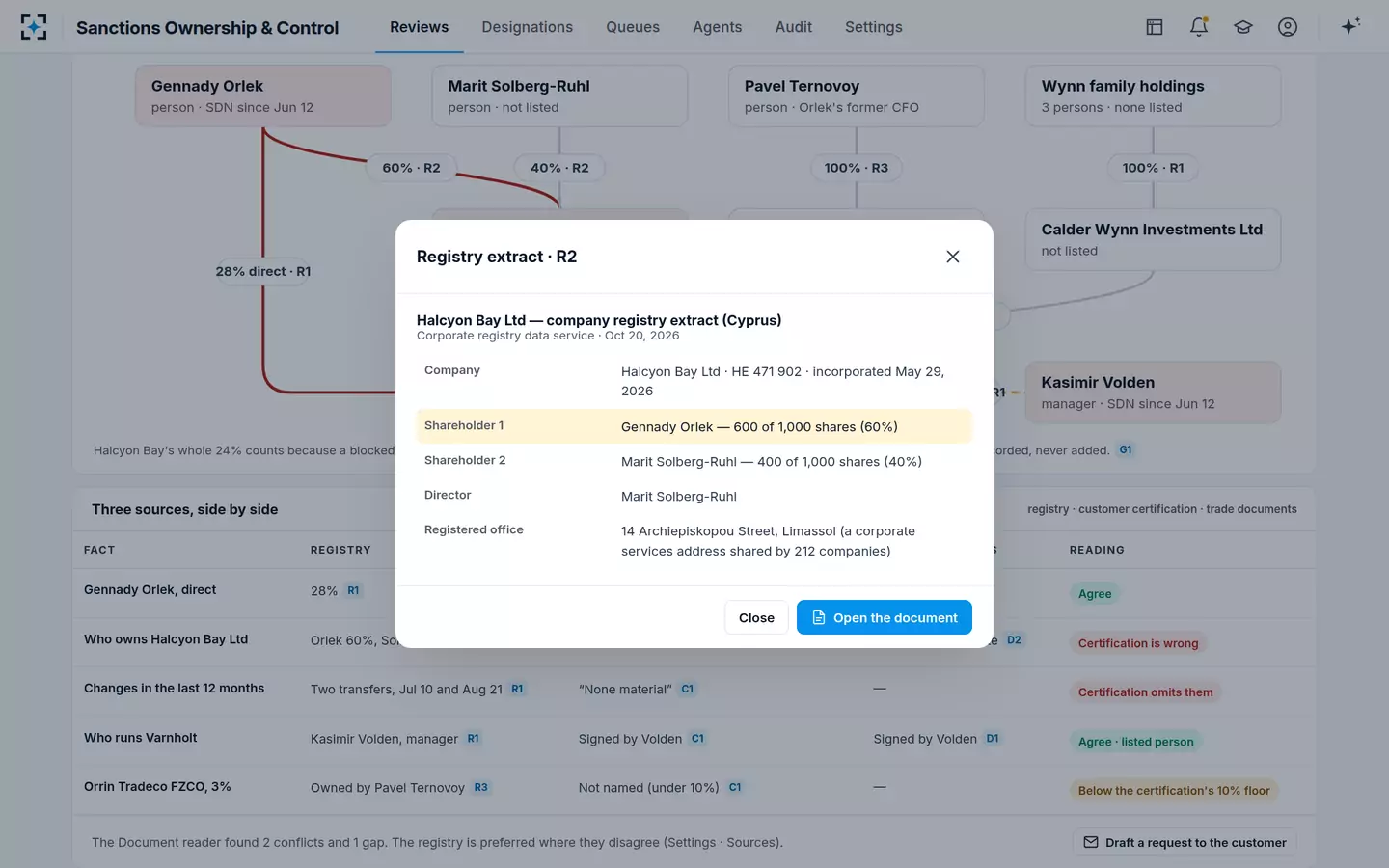
Where share classes differ, record which class each count is in. OFAC's FAQs speak of "ownership of shares", while the UK test counts "more than 50% of the shares or voting rights" as separate limbs, so a file that holds only a blended percentage cannot be re-read under a second regime. The EU, UK and OFAC tests compared covers where that difference changes the answer.
What if registries and the customer disagree on ownership?
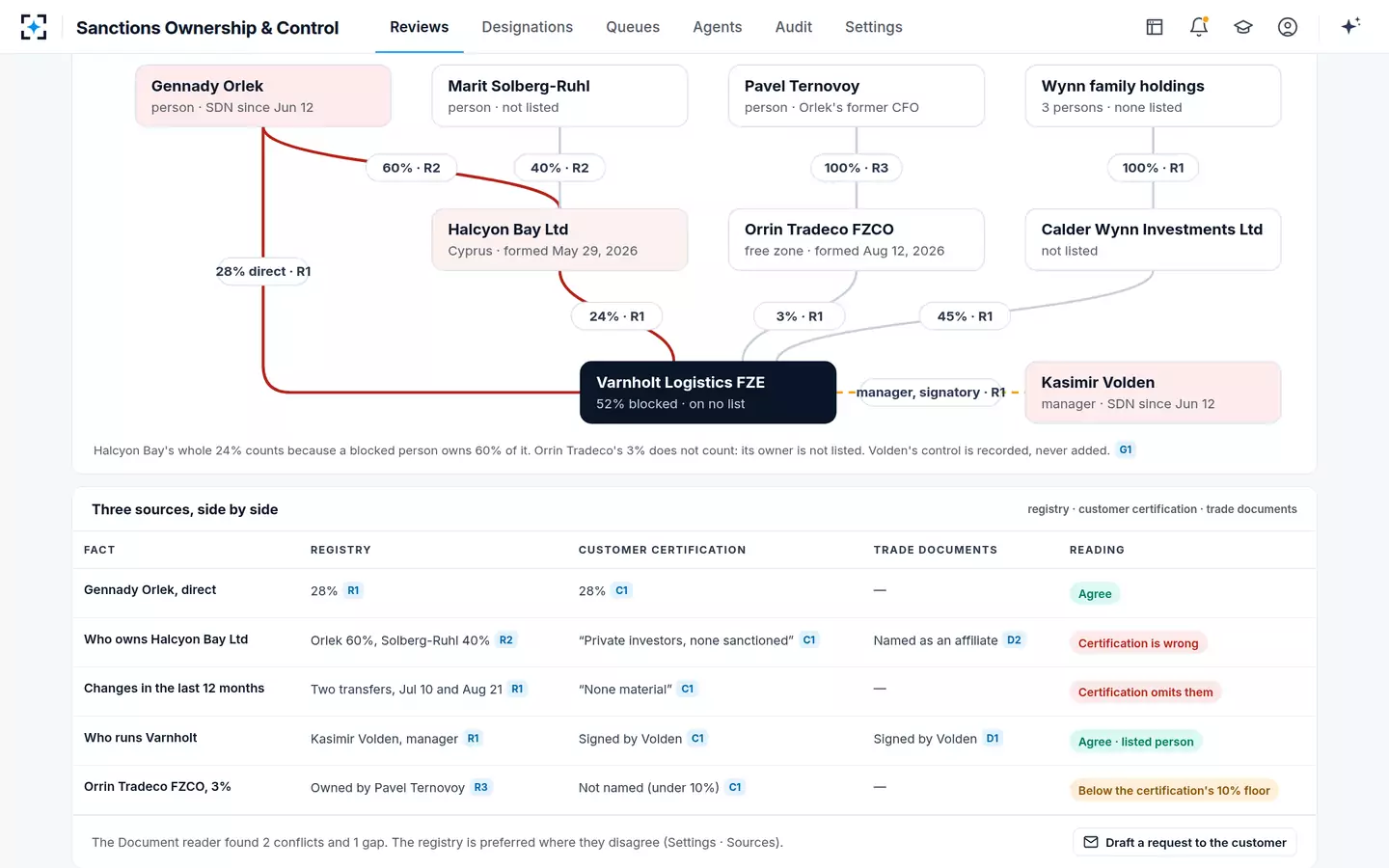
Show the conflict, prefer the stronger source, and ask; never average. In the sample, the customer's August 28 certification said Halcyon Bay was owned by "private investors, none sanctioned" and that nothing material had changed in twelve months. The Cyprus registry showed Orlek at 60% of Halcyon Bay, and Varnholt's own registry showed two transfers in July and August. The solution's settings prefer the registry, show both values, and draft a request for documents that a second person approves.
Three sources side by side: two conflicts and a gap, shown and not averaged
A reasonable conclusion is one the information supports. OFSI's August 2026 notice against Citibank's London branch treated an incorrect ownership call as aggravating because "the conclusion of minority ownership was not a reasonable one to draw from the information available to CBNA London" (OFSI). For files that stay unresolved, the EU's banking supervisor tells payment providers to consider going to the national competent authority (EBA guidelines, 2024).
How current must ownership data be?
Current enough to reflect the last designation and the last transfer, and OFAC sets no fixed age. The sample bank's own rule is a registry extract no older than 30 days for every company in the chain and a customer certification valid for twelve months; both are settings, not regulation. The cases show why age alone is the wrong test. Okko LLC, the beneficiary in OFSI's 2026 Deutsche Bank case, was sold by a designated bank in May 2022 to a company that was itself designated on June 29, 2022; as OFSI put it, "as soon as JSC New Opportunities was designated, Okko again became subject to the prohibitions" (OFSI, Deutsche Bank AG London).
The same notice shows where fresh data stops helping. OFSI pointed to "the withdrawal of information from Russian corporate registries (EGRUL) in mid-2022 and the passing of Russian legislation allowing the suppression or concealment of information in national public registers". Where the registry itself has gone dark, a recent extract is not a complete one, and the file should say which layer is unknown.
What if ownership changes after onboarding?
Then the aggregate has to be recomputed, and two kinds of change trigger it: a change in who owns the entity, and a change in who is on the list. The FFIEC manual expects existing customers to be checked again whenever OFAC adds or changes an entry (FFIEC); for ownership that means searching every tree on file, at every layer, for the new names. On the other side, a fall below 50% after a designation counts only under OFAC's FAQ 402 conditions, entirely outside U.S. jurisdiction and not a sham, and property already blocked stays blocked.
In the sample's history the two meet. Orlek's own holding fell from 55% to 48% on July 10 and to 28% on August 21, after his June 12 designation; traced through Halcyon Bay, the blocked aggregate went 55%, 55%, 52%. A file that recorded only the latest direct holding would show a counterparty below the line. The red flags of a proxy owner covers how such transfers are judged.
What each link changes: the answer's sensitivity
The best test of a documented aggregate is to ask what would move it. The sample's decision screen lists the three points the 52% hinges on, each with the alternative result, so the officer reads the risk in the answer as well as the answer.
What the 52% becomes if one link fails
Read that way, the 52% is robust on the arithmetic and fragile on identity and on one registry line. That tells the analyst where to spend the checking time, and it tells an examiner which sources to open first. In the sample the analyst cannot send the review to the officer until five checks are ticked, three of them these hinges.
Five ways an aggregate percentage goes wrong in the file
When an aggregate is wrong, the error is usually in one of five places, and each is visible in a well-kept chain. A denominator taken from an old extract, before a share issue that diluted or concentrated the holders. A stale extract that misses a transfer made after a designation. The wrong list date: the review checks owners against today's list when the payment was decided weeks ago, or against an old list when it was decided today. Multiplying through a blocked company, which understates the aggregate, as the sample's 42.4% shows. And control added to ownership, which overstates it.
The first three are dating errors and are caught by keeping the date of every source beside its number. The last two are method errors and are caught by writing the method into the file: which intermediate entities were found blocked, and why each excluded holding did not count. A reviewer who can see both can re-perform the calculation without asking anyone, which is the standard an examiner applies.
How do I show the ownership calculation to an examiner?
Give the examiner the chain, not the conclusion: every percentage with its source, the reasons the other shares did not count, the history, and who decided. An examiner reading a blocked-property report also checks the figures against what was filed with OFAC, which must include "the date the property was blocked" and its value, within 10 business days (31 CFR 501.603). Errors in that chain are their own violation: OFAC's 2022 Finding of Violation against Nodus International Bank faulted both its records of the blocked property and what it reported to OFAC about it (OFAC, Nodus International Bank; the report itself is taken field by field in OFAC blocked property report template).
What an examiner needs to follow one aggregate percentage
- The tree, with every edge sourced and dated
Share counts and totals, not only percentages; the extract date for each layer.
- The list status of every owner
Listed, not listed or unknown, with the identifiers compared for each match.
- Why each excluded share did not count
Owner not listed; intermediary under 50%; unknown layer escalated.
- The ownership history
Every transfer near a designation, the shares on paper and the traced blocked share.
- Control concerns, kept apart
Signatories, board rights, proxies and asset rights, each sourced, none added to the percentage.
- The memo, the checks and two signatures
Preparer and decider named; reason codes; any override with its reason.
- The tools and settings used
Versions and thresholds in force on the day, so the answer can be reproduced.
Sanctions Ownership & Control builds that chain as it works rather than after the fact: each part of the stack, each hinge, memo sentence and report field opens the passage it came from. See how the review runs from hold to report at Sanctions Ownership & Control.
Questions people ask
What is OFAC indirect ownership?
It is ownership held through other entities, which FAQ 401 counts only where blocked persons own 50% or more of the entity in between. The intermediate entity must itself be blocked; if it is, its whole stake counts toward the aggregate, and if not, none of it does.
Do I add the stakes of SDNs from different programs?
Yes. FAQ 399 says the ownership interests of persons blocked under different OFAC sanctions programs are aggregated. A Russia-program designee's 30% and a counter-narcotics designee's 20% make an entity 50% blocked-owned.
Can I rely on the customer's ownership certification?
As one source, compared against the registry, not as the answer. In OFAC's IPI case a written assurance from the investor that the oligarch had no connection to it did not protect the firm, which had reason to know otherwise.
How long must ownership research be kept?
At least ten years for records of transactions subject to OFAC's regulations, under 31 CFR 501.601 as amended in 2025. Keep the sources themselves, not just links to registries that may change or disappear.
What if one layer of ownership cannot be found?
Record it as unknown, not zero, and escalate. An unknown layer can hide a blocked holder, so a clear decision built on it is a guess; the EU's banking supervisor suggests engaging the competent authority when an assessment stays inconclusive.