An ultimate beneficial owner search, done for sanctions, traces a counterparty's owners layer by layer until every branch ends in a person or a listed party, then adds what blocked persons own under the 50% test. Software can do most of that tracing: pull registry extracts, read certifications and filings, match every owner to the lists and compute indirect stakes. What it should not do is declare an entity blocked or clear, because the decision freezes money, starts a ten-business-day reporting clock, and turns on judgements about proxies and unknown layers that no registry answers. Botminds' Sanctions Ownership & Control is built on that split: seven agents trace, add and cite; a sanctions analyst checks and prepares; a sanctions officer, never the same person, decides. This guide sets out the authority line, what to test before buying, and where the approach fits and where it does not.
Examples come from the solution's sample data, on fictional people and companies: Corvane National Bank and a held payment to Varnholt Logistics FZE.
An ultimate beneficial owner search, one held payment
3min
for the agents to read three registries, a certification and two trade documents and build the cited tree
9
nodes in the ownership tree, each edge with its share and source
0
decisions taken by agents: they propose, a person decides
2
people on every decision; three for a clear near the line
Can software trace ultimate beneficial owners automatically?
Yes, as far as the sources go. Where registries file shareholders with share counts and dated transfers, agents can pull an extract for every company in the chain, follow each corporate owner up a layer, and stop when they reach people or listed entities. In the sample, that took three minutes for three registries, a certification and two trade documents, and produced a nine-node tree in which every edge carries its share and the extract it came from.
The limit is the data, not the software. OFSI's 2026 Deutsche Bank notice is the clearest statement on record: the screening lists the bank bought "did not, at that point in time, include data in relation to Okko or its ownership", which OFSI said illustrated "some of the risks of relying on such providers for ownership data", risks made worse by Russia withdrawing registry information in mid-2022 (OFSI, April 30, 2026). An automated search over a registry that has gone dark returns an incomplete tree quickly. The question to ask of any tool is what it does at that point.
How many ownership layers can an ultimate beneficial owner search follow?
As many as there are; the rule sets no depth. OFAC's test covers entities owned "directly or indirectly", and FAQ 401 counts ownership through intermediate entities without any limit on the length of the chain (OFAC FAQ 401). A search should therefore end on a reason, not a count: every branch ends in a person, a listed party, or a layer marked unknown.
This is where a sanctions search differs from beneficial ownership collection under FinCEN's customer due diligence rule, which looks for individuals at 25% and can stop there; how to verify beneficial ownership covers that job. A sanctions search cares about companies as owners, because a blocked company's whole stake counts, and about holders below 25%, because two blocked 25% holders already reach the line; OFAC's five 50 rule examples show the counting.
Who decides an entity is blocked in an ownership search?
A named officer at the bank, on a prepared case, and not the person who prepared it. OFAC will not decide for the bank: FAQ 5 leaves match decisions to the organization's own risk-based judgement (OFAC FAQ 5). The table below is the authority line as the sample bank draws it, and as we would recommend testing in any tool.
Who may do what in an ultimate beneficial owner search for sanctions
| Step | Agents | Sanctions analyst | Sanctions officer | Head of sanctions |
|---|---|---|---|---|
| Pull registries and documents | Do it; mark a missing layer unknown | Request more from the customer | — | — |
| Match owners to the lists | Propose matches with scores | Confirm any match below 0.90 | — | — |
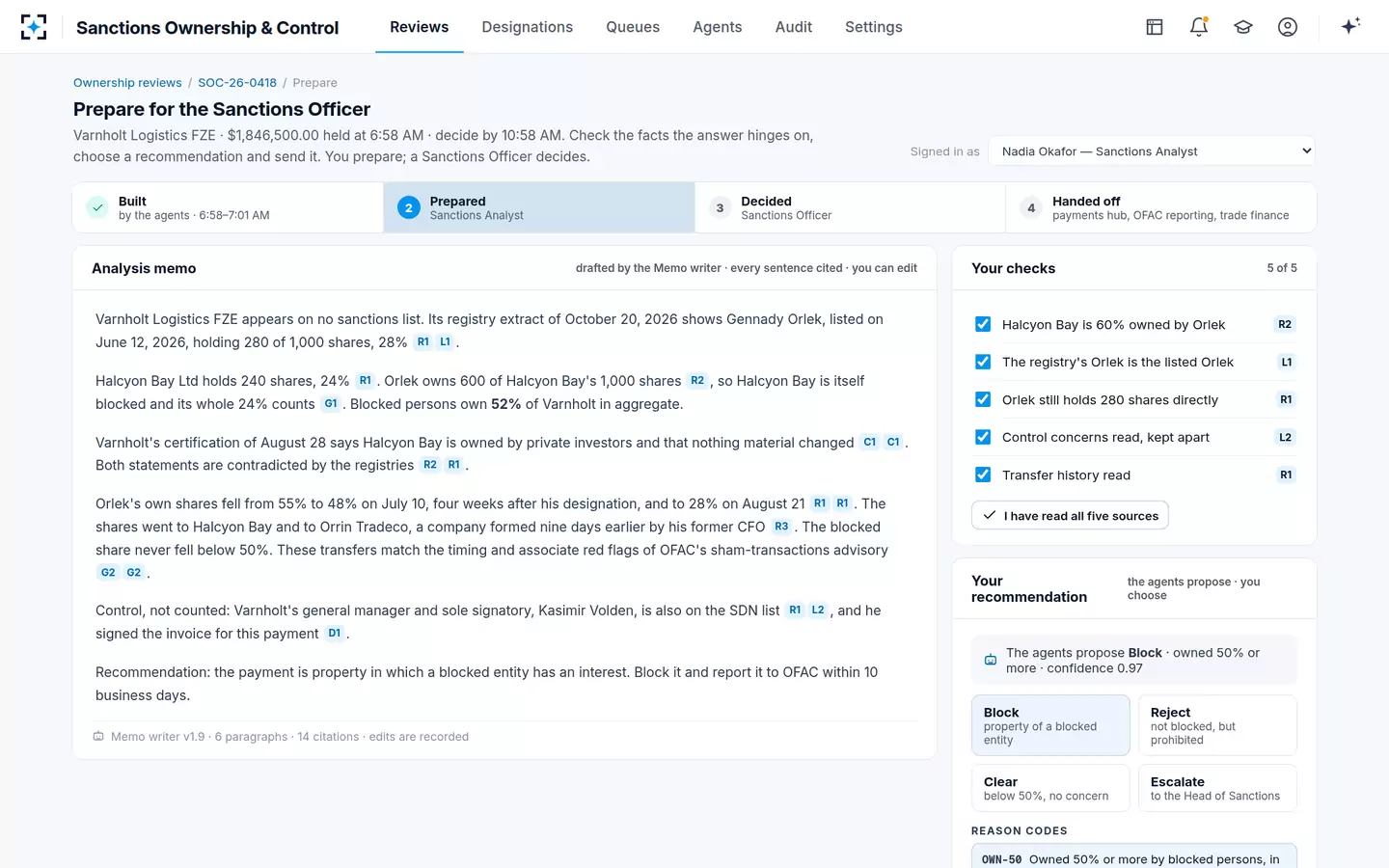
| Add blocked shares to 50% | Compute, OFAC method, every part cited | Check what it hinges on | Read | — |
| Control, proxies, transfers | Flag and source; never add, never call evasion | Assess and note | Weigh in the decision | — |
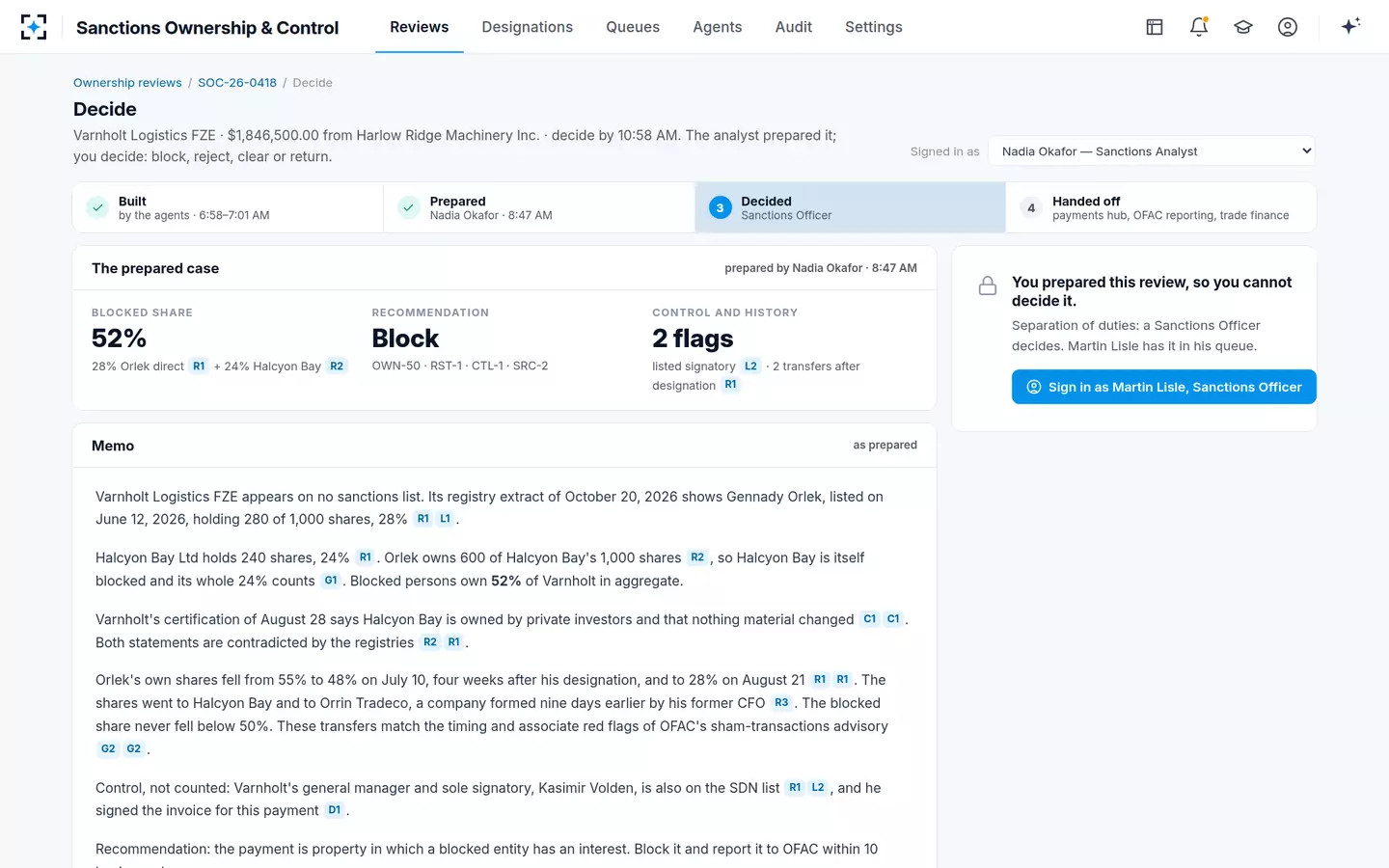
| Block, reject or clear | Propose with a confidence | Recommend; cannot decide | Decide with a reason code | Co-sign a clear near the line or with a listed person in control |
| Report, notice, list changes | Draft | Draft or review | Approve | Approve internal blocked-entity list changes and settings |
Two cells carry the design. The analyst "cannot decide" because separation of duties is a cheap, well-understood control against a tired person clearing their own work. And the agents' column says "propose", never "decide", because an agent that clears a counterparty is exactly the automation OFAC has penalized: in its October 2026 Bank of America settlement, payments to blocked banks went out because a rule silenced any new alert that matched one an analyst had once closed as a false positive (OFAC, Bank of America, October 13, 2026; the rule is taken apart in OFAC false positive procedures). The penalty was $11,662,930.
The analyst prepares: five checks before the case can go to the officer
What if ownership is unknown at some layer?
Then the answer is "not known", never "not blocked". An unknown layer can hold a blocked owner, so a clear decision built on it is a guess. The Commerce Department wrote this rule down for its own 50% test: an exporter who "cannot determine the ownership percentage" must resolve the red flag or get a license before proceeding. The EU's banking supervisor says much the same to payment providers: an inconclusive assessment is a reason to consider going to the competent national authority, and responsibility stays with the provider (EBA, 2024).
In practice an unknown layer has three causes, and a good tool says which. The registry files nothing for that company type. The registry service did not answer, as in the sample's 6:10 to 6:25 AM outage, after which four trees were rebuilt and one review still waited for an extract. Or the registry contradicts the customer and the conflict is open. Each needs a different next step: a request to the customer, a retry, or an investigator.
Can agents read foreign company registries and documents?
They can read what a registry data service returns and what the customer provides, which is why the sources a bank connects matter more than the agents. The harder question is language and format. In OFAC's ALICO case, the decisive fact sat in a UAE trade license that said "in Arabic that the owner of the Entity was the Iranian embassy" (OFAC, ALICO). A tool that extracts owners only from English fields would have missed it; so did the people. Test any tool on source-language documents from the jurisdictions you actually see, and check that each extracted owner cites the page it came from.
What should agents never decide in a sanctions ownership review?
Anything that changes a customer's position or the bank's legal exposure: blocking, rejecting, releasing, reporting, adding to a blocked-entity list, or concluding that a transfer was a sham. Supervisory guidance points the same way. FATF's 2021 report on new technologies keeps people in the loop, saying that "human actors must be relied upon" to assess the risks new technologies leave behind (FATF, 2021). The Wolfsberg Group's principles ask firms to make sure, before go-live, that an AI system's results will be fair, effective and explainable (Wolfsberg, 2022); for an ownership review, explainable means every percentage opens its source.
Seven agents in Sanctions Ownership & Control, each with a line it does not cross
Agent
Review coordinatorOpens the review from a payment hold, trade finance request, list update or periodic review, runs the others, keeps the clock.
Never: decides; it stops and alerts when a source does not answer
Agent
Registry agentAn extract no more than 30 days old for every company in the chain: shareholders with counts, officers, dated transfers.
Never: guesses a missing layer
Agent
Document reader and Identity agentRead the certification and trade documents with their pages; match every person and company to the lists.
Never: fills a field it cannot cite; matches below 0.90 go to a person
Agent
Ownership calculator and Restructuring watchAdd blocked shares the OFAC way; replay transfers against designation dates and flag patterns.
Never: adds control to ownership, multiplies through an unblocked company, or calls a transfer evasion
Agent
Memo writerDrafts the memo, the report of blocked property, the customer notice and requests for documents.
Never: sends anything outside the bank without a second person
A person decides
Analyst, then officerThe analyst checks the hinges and prepares; the officer decides with a reason code.
Separation of duties in Sanctions Ownership & Control: the preparer cannot decide
How to check if a company is sanctioned, beyond the list
Search the lists first, then the owners. OFAC's free Sanctions List Search answers whether the company itself is named. It cannot answer whether blocked persons own half of it, and OFAC's FAQ 91 counts companies owned 50% or more by blocked persons among those blocked though they appear on no list (OFAC FAQ 91). The second step is the ultimate beneficial owner search; the third, for EU and UK obligations, is the control test.
For a single company a person can do this by hand in an afternoon. For a bank, the work repeats on every new counterparty and again on every list change, which is where automation pays, as the cost of one ownership review, by depth, sets out.
What to ask before you buy an ultimate beneficial owner search tool
Ask for evidence on your own past cases, not demonstrations; a pilot on closed ownership reviews sets out how to run one. The checklist below is what we would want answered in writing.
Questions for any ultimate beneficial owner search tool used for sanctions
- Which registries and data services does it read, and who pays for them?
The agents are only as complete as the sources; check what the bank already licenses.
- What does it do at an unknown layer?
The right answer is "stop and say so"; a tool that returns a percentage anyway is guessing.
- Does it count whole stakes through blocked companies and nothing through unblocked ones?
Run OFAC's five FAQ 401 examples through it, including the two that are not blocked.
- Can every number be opened to its source line and date?
An examiner will ask; so will the officer who signs.
- Is control kept apart from ownership?
Adding a listed manager to the percentage overstates the case; leaving him out hides a separate prohibition.
- Who can decide, and can the preparer decide their own case?
Agents should propose; a named officer, not the preparer, should decide.
- Does it re-run every tree when a list changes, at every layer?
A new designation two layers up can block an existing counterparty overnight.
- Can it apply the EU and UK tests to the same tree?
Thresholds, aggregation and control differ by regime.
Where agent-led ownership search fits, and where it does not
It fits a bank that holds payments, finances trade or clears for correspondents, sees counterparties in jurisdictions whose registries file shareholders, and needs a defensible answer inside a clock. It fits less well where the registries that matter file nothing: agents will mark those layers unknown faster than a person would, but they cannot fill them. It does not replace name screening, which still finds the listed names, nor beneficial ownership collection for customer due diligence, which Beneficial Ownership Verification covers.
Sanctions Ownership & Control applies OFAC's test by default and can apply the EU and UK tests as settings; it works with the bank's registry data service, screening service, payments hub, trade finance system and case management rather than replacing them. To see the full review, from hold to block to report, start from Sanctions Ownership & Control.
Questions people ask
Is an ultimate beneficial owner search the same as UBO verification?
Not for sanctions. UBO verification for customer due diligence confirms the individuals who own 25% or more. A sanctions ownership search follows companies as well as people, adds every blocked holder against a 50% line and must be re-run when the lists change.
Can a tool clear a counterparty automatically if no blocked owner is found?
It can propose a clear, but a person should decide it, and never where a layer is unknown or a proxy is suspected. OFAC's Bank of America settlement shows what automatic release looks like when it goes wrong: payments to blocked banks released by a suppression rule built on past dispositions.
How accurate are automated ownership trees?
As accurate as their sources and their rules for gaps. The useful measure is not a single accuracy figure but whether every percentage traces to a dated source and whether unknown layers are marked; test both on your own closed reviews before relying on a tool.
Do I need a registry data subscription as well as the software?
Usually yes. The agents read what the bank's registry data service and the customer provide; the software does not make dark registries visible. OFSI's Deutsche Bank notice is a reminder that the bank stays responsible for gaps in purchased ownership data.
Who is liable if the tool gets ownership wrong?
The bank. In the Deutsche Bank case OFSI held the branch responsible for its own compliance even though it relied on a third-party provider for ownership data, and OFAC's rules apply to the U.S. person that deals in blocked property.