To verify beneficial ownership under the US Customer Due Diligence Rule, a bank does two things. It verifies the identity of each person the customer names, using at least the elements of its Customer Identification Program: documents such as a passport or driver's license, which may be photocopies, or non-documentary checks. And it relies on the customer's statement of who those people are only until it learns something that gives it reasonable cause to doubt that statement (31 CFR 1010.230(b)(2)). The first half is routine. The second half, noticing when the paper is complete but wrong, is where the hard cases and the enforcement actions sit. Botminds' Beneficial Ownership Verification was built for that second half: agents compare each certification with the entity's own documents and list what calls it into question, and the analyst decides.
"Customer B provided a letter from a law firm and other documentation purporting … to represent the beneficial ownership information for the British Virgin Islands company. However, Bancrédito did not independently verify the claims made in the letter, including corroborating the beneficial ownership information, which was unusual in that Customer B was a minor at the time that Company 1 was incorporated in his name."
FinCEN consent order against Bancrédito International Bank and Trust, September 2023
What does the rule actually require you to verify?
Identity, not status. The rule requires a bank to "verify the identity of each beneficial owner identified to the covered financial institution, according to risk-based procedures to the extent reasonable and practicable", using at least the elements it uses for individual customers under its CIP (1010.230(b)(2)). It does not require the bank to prove that the person owns what the form says. FinCEN's proposal said so expressly: "FinCEN is not proposing that financial institutions verify the status of a beneficial owner", and the final rule replaced the ambiguity with the reliance clause (81 FR 29398, note 42).
That reliance is generous by design. FinCEN anticipated that "in the overwhelming majority of cases" banks should be able to rely on the owners the customer names, because usually nobody but the company itself can tell a bank who owns it. The condition is the whole of the analyst's job: reliance ends at knowledge, and knowledge includes what is already in the bank's file.
Two different questions under one word
Verifying identity: Is this person who the form says, with this name, date of birth, address and ID number?
Verifying status: Does this person actually own 25% or more, or control the business?
Verifying identity: Yes, for every person named, to CIP elements at a minimum.
Verifying status: No: the bank may rely on the customer’s statement, absent knowledge to the contrary.
Verifying identity: An ID document or a photocopy, or non-documentary checks against other sources.
Verifying status: Operating agreements, registers, articles, trust deeds: whatever the bank holds or asks for.
Verifying identity: A discrepancy the bank cannot resolve, or no reasonable belief in the person’s identity.
Verifying status: Knowledge of anything that reasonably calls the certification into question.
Verifying identity: Expired or mismatched identifiers; unresolved discrepancies left undocumented.
Verifying status: Contradictions sitting in the file unread; third-party letters taken at face value.
What documents verify beneficial ownership?
For identity, the same documents and methods as the bank's CIP, with one concession. Documentary verification may use a current government-issued photo ID that shows nationality or residence, a driver's licence or passport being the usual examples, and unlike the CIP rule, the CDD Rule "expressly authorizes covered financial institutions to use photocopies or other reproduction documents" (FAQ B.14). Non-documentary methods may include "contacting a beneficial owner", comparing the information with other sources, asking other financial institutions for references and requesting a financial statement.
For ownership, nothing is prescribed, which is why banks differ so much. In a GAO study of eleven banks, several said business accounts meant checking state records such as good-standing certificates, and collecting and reviewing customer information took more than an hour for a new business account against about half an hour for a personal one (GAO-20-574, 2020). A certificate of good standing shows the entity exists; it rarely says who owns it. The documents that do are the customer's own: the operating agreement and its schedules, the share or member register, the articles, and for each owning entity, the same again.
What documents verify beneficial ownership, and what each proves
- Government ID, or a photocopy of it
Proves identity for each person named. Photocopies are allowed for beneficial owners, not for CIP customers (FAQ B.14).
- Non-documentary checks
An identity service, a reference from another bank, a call to the owner: identity again, by other means.
- Operating agreement and its member schedule
Proves who holds what in an LLC, and often who manages it. The single most useful ownership document.
- Share or member register, cap table
Proves current holdings, if it is dated and complete. Check the date against any later issuance.
- Each owning entity’s own agreement
Without it, an indirect owner cannot be found. One layer per document.
- Trust deed or certificate of trust
Names the trustee, who is the owner of record when the trust holds 25% or more.
- Registry extract or good standing certificate
Proves the entity exists and is in good standing; whether it names owners depends on the jurisdiction.
- A letter from a lawyer or formation agent
Proves what the writer asserts, no more. Corroborate it with the documents it describes.
Must beneficial owner verification match CIP?
It must contain the same elements, not repeat the same steps. FinCEN's answer is no: the procedures must, "at a minimum, contain the same elements as required for verifying the identity of customers that are individuals under the applicable CIP rule", but "they are not required to be identical" (FAQ B.2, B.14). The address may be residential or business, as under CIP (FAQ B.15). An owner who does not appear in person may be verified from a photocopy or by non-documentary means (FAQ B.16). And an owner who already banks with you under your CIP may be covered by the existing verification, if the customer's representative confirms that the information is accurate (FAQ B.17).
The CIP's discipline for failure does carry over. FAQ B.14 says the procedures must cover the cases where the bank cannot reach a reasonable belief that it knows who the company's owners really are. Under CIP that means deciding when not to open, the terms on which an account may be used while verification continues, when to close, and when to file a suspicious activity report (31 CFR 1020.220(a)(2)(iii)).
Where reliance ends: what calls a certification into question
The rule's test is whether the bank knows facts that would give it reasonable grounds to doubt the certification, and no regulator has published a list. What a bank can do is write its own, and train analysts to look for each item in the file before the account opens. The catalogue below is ours, built from FinCEN's enforcement record and from the structures that can hide an owner. Each of these, once in the bank's possession, is knowledge.
Eight things that end reliance on a beneficial ownership certification
01
The packet contradicts the form
An operating agreement or member register collected at opening shows a different split from the certification.
Sample: a 27% owner missing from a form that names one owner at 34%.
02
The arithmetic was never done
Two paths, each below 25%, that add to more than 25% when someone adds them.
Sample: 18% direct plus 60% of a 15% holder.
03
The named person could not plausibly hold the role
An owner too young, too remote or too unconnected to the business to own or run it.
Bancrédito: a company incorporated in the name of a minor.
04
A third party’s word replaces documents
A letter from a lawyer, accountant or formation agent asserting ownership, with nothing to corroborate it.
Bancrédito: a law-firm letter accepted without corroboration.
05
Signs of a nominee
One registered-agent address behind many entities that disclose no members; a director who serves dozens of companies.
Sample: one address behind six entities in the bank’s own book.
06
Holders that cannot be known
Articles that allow bearer shares, or a register that is missing or undated.
Sample: verification held until a certified share register arrives.
07
Money that does not fit the story
Flows far beyond the expected activity the customer described when it opened the account.
Bancrédito: $13.6 million into an account expecting $50,000 to $100,000 a month.
08
A screening hit on a named or connected person
Sanctions, adverse media or a criminal case involving an owner, the controller or a close relative.
Bancrédito: a close relative convicted in a bribery and money laundering case.
Can we rely on a law firm letter for beneficial ownership?
A letter can support a certification; it cannot replace the bank's own look at what it describes. Bancrédito International Bank and Trust, a Puerto Rico international banking entity, opened an account in June 2016 for Company 1, a Florida company wholly owned by a customer the order calls Customer B. The account was described as a real estate business expecting one to five transactions a month, totalling $50,000 to $100,000. From July 2016, attorneys for a close relative of Customer B, an executive at a Venezuelan state-owned bank convicted in 2013 in a foreign bribery and money laundering case, moved more than $13.6 million into it (FinCEN, 2023).
Customer B supported the transfers with a law-firm letter that purported to show who beneficially owned a British Virgin Islands company from which some of the funds came. FinCEN found that the bank "did not independently verify the claims made in the letter, including corroborating the beneficial ownership information", which was "unusual in that Customer B was a minor at the time that Company 1 was incorporated in his name". The order imposed a $15 million civil money penalty for failures of the bank's anti-money laundering program and suspicious activity reporting over October 2015 to May 2022; the bank had begun a voluntary liquidation in 2022.
The account opened before the beneficial ownership rule applied in May 2018, so this is not a case under 1010.230. It is a case about what verification is for. Three items from the catalogue above sat in one file: a third party's word in place of documents, a named owner who could not plausibly have set up the company, and money far beyond the account's stated purpose. Any one of them, once known, would end reliance on a certification today.
One account, three reasons to look again
$15M
civil money penalty, for AML program and suspicious activity reporting failures
FinCEN, 15 September 2023
$13.6M
moved into an account whose stated activity was $50,000 to $100,000 a month
from July 2016
1
law-firm letter accepted without corroborating the ownership it described
6.5yrs
of conduct the order covers, from October 2015 to May 2022
How to identify the beneficial owner of a company from its own documents
Start from the customer's operating agreement or share register and treat every holder that is not an individual as a question. For each entity holder, ask for its own agreement or register and repeat until every path ends at a person, a trust, or an entity the rule excludes, such as a listed company. Multiply down each path and add the paths that end at the same person; the method, with worked examples and loops, is in how to calculate beneficial ownership percentage. Then compare the result with the certification line by line. A person on the form but not in the documents, or in the documents but not on the form, is the question to resolve before the account opens.
Read for control as well as equity. The control person must be a senior official who answers for how the business is run (FAQ B.9), so a certification naming a junior officer, or someone the operating agreement gives no management role, is worth a question. And read dates. A cap table dated before a later issuance of units will give a different answer from the operating agreement that records it; the documents decide which governs, and the file should say why.
Every certification in the queue, with what the agents found in the documents
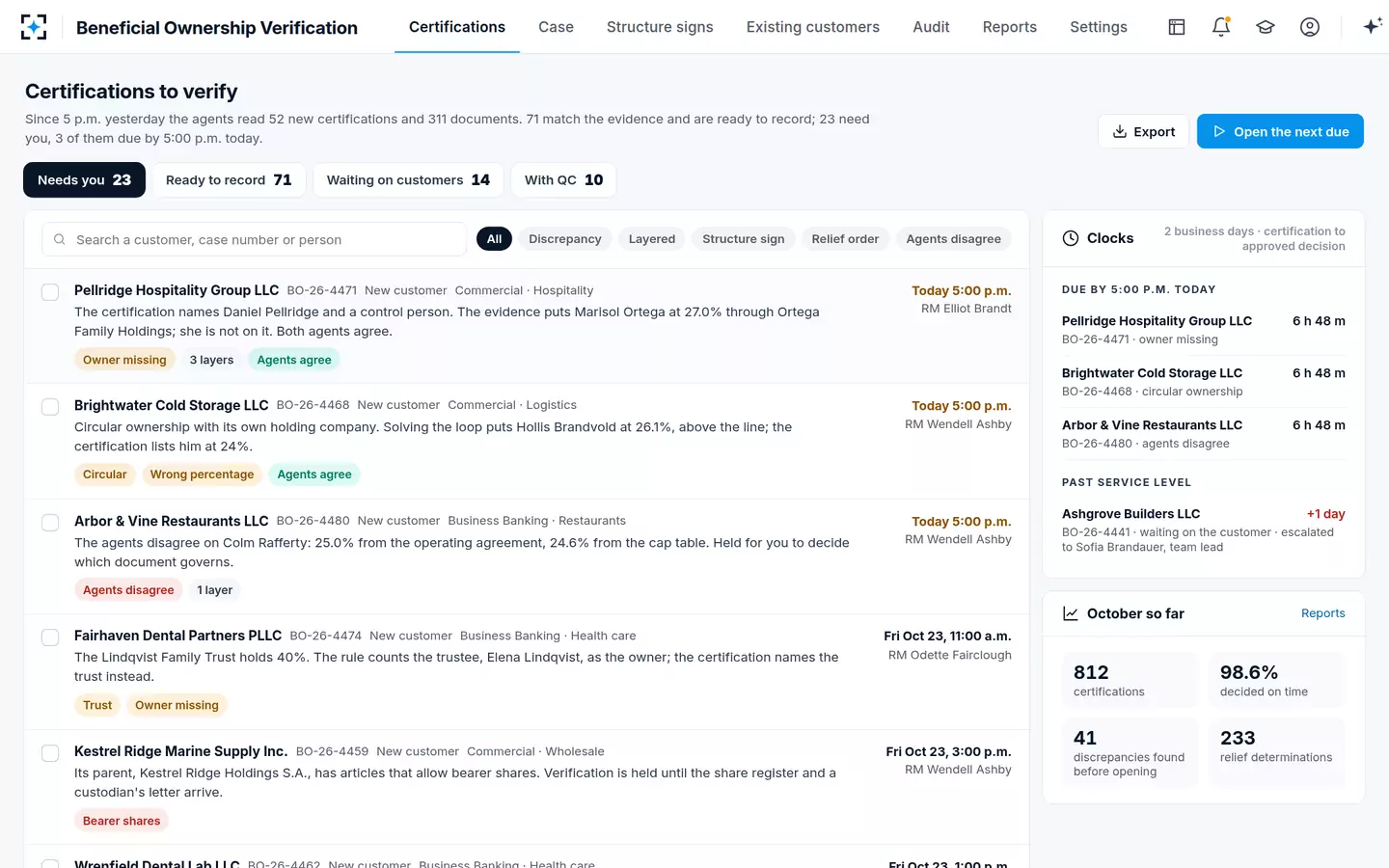
Filters across the top separate discrepancies, layered structures, structure signs, relief determinations and the files where two agents disagree.
How to confirm beneficial ownership when the documents and the form disagree
Ask the customer, in writing, for a corrected certification, and explain the difference from the customer's own documents. The bank cannot certify on the customer's behalf, and the rule puts the duty to identify owners on the customer, so the fix is a new signature, not an internal edit. Keep the request, the reply and how the difference was resolved: the verification record must include "the resolution of each substantive discrepancy" and is kept five years after it is made (1010.230(i)).
When the customer cannot or will not resolve it, the bank's lack-of-verification procedure applies: do not open, or restrict, or close, and consider a suspicious activity report. Examiners test exactly this. The FFIEC procedure asks whether the bank "appropriately resolved situations in which beneficial owner's identity could not be reasonably established" and "filed SARs as appropriate" (FFIEC examination procedures, as published in April 2026). How each step of one owner's verification is evidenced, from the clause to the approved decision, is traced in UBO verification, traced.
Each owner's identity verified, with one difference explained
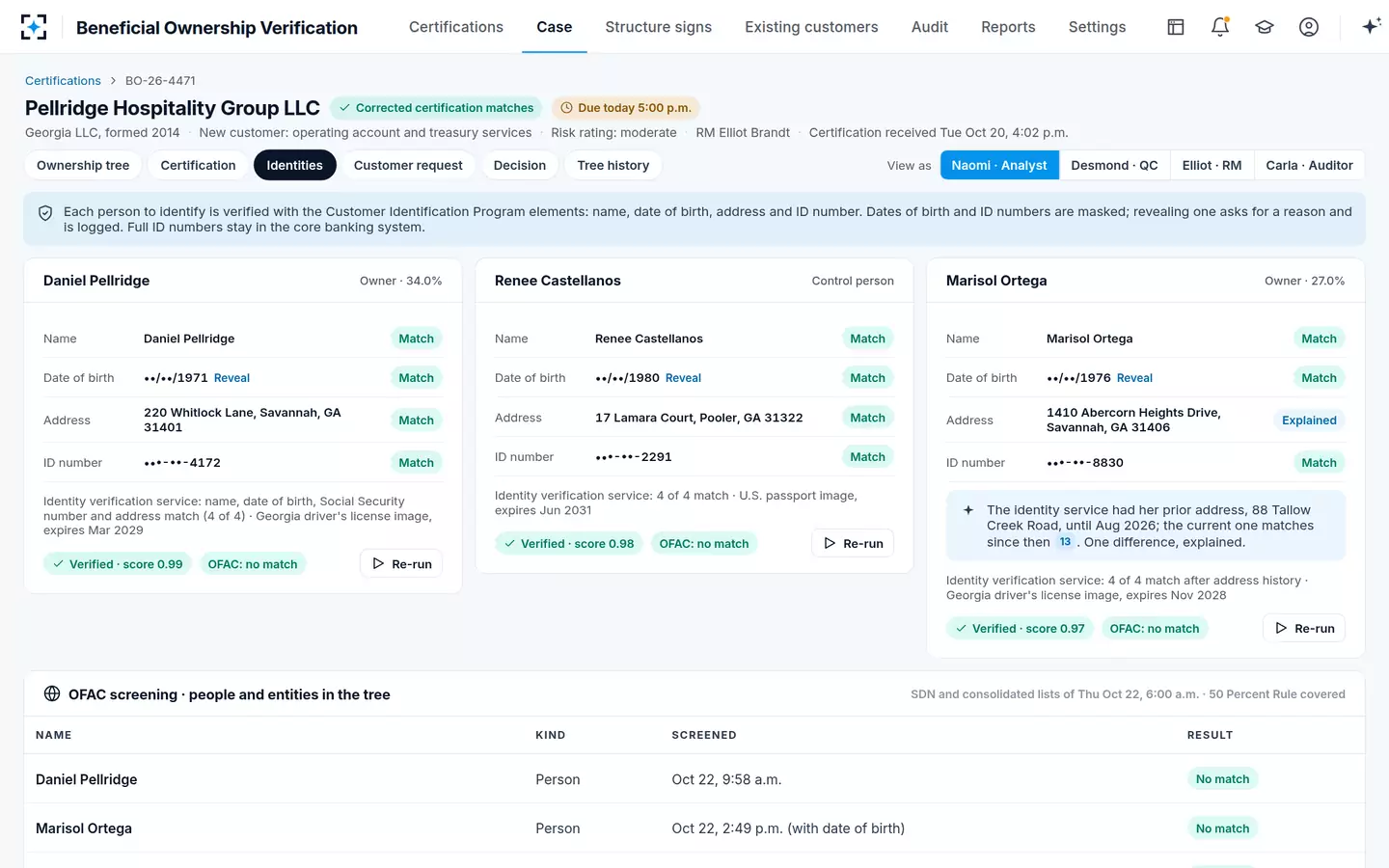
Where Beneficial Ownership Verification fits in the verification work
The solution does the reading a careful analyst would do on every file and leaves the judgment where the rule puts it. A Document Reader agent extracts each stake and officer designation with its passage and page, and marks a missing page as missing rather than guessing. Two agents build and recompute the ownership tree. A Structure Risk agent flags loops, nominee signs, trusts and bearer shares, and hands anything needing enhanced due diligence to the BSA officer; it never decides that a customer is a risk. An Identity Verification agent checks each person's four identifiers and screens people and entities against OFAC, and never clears a potential match itself.
The analyst sees the certification compared with the evidence, person by person, records the decision with a reason, and a QC reviewer approves it before the customer record changes. What no software can do is read a document the bank never collected, or see a side agreement that exists only between the customer and its nominee. Banks that ask for operating agreements and owning-entity documents at opening give their analysts, and the agents, the material that knowledge is made of. The certification itself, and who is accountable for it, is covered in beneficial ownership certification: who signs.
Questions people ask
How do you check beneficial ownership of a US company?
Ask the company. Since 2025 US companies do not report owners to FinCEN, and a state registry extract may not name owners at all, so the operating agreement, member or share register and the agreements of any owning entities are the evidence. Verify each named person's identity to CIP standards and compare the documents with the certification.
Do we have to verify that a person really owns 25%?
Not as a matter of routine. The rule requires identity verification and lets the bank rely on the customer's statement of ownership unless it knows something that reasonably calls it into question. Documents in the bank's own file that show a different split are that kind of knowledge.
Can beneficial owners be verified without meeting them?
Yes. FinCEN's FAQ B.16 allows verification of an owner who does not appear in person from a photocopy of a valid identity document or by non-documentary means, such as an identity service or a reference from another financial institution.
What if a beneficial owner refuses to provide ID?
Then the bank cannot form a reasonable belief that it knows that owner's identity, and its lack-of-verification procedure applies: decide whether to open, restrict or close the account, and whether to file a suspicious activity report. The decision and its reason belong in the file.
Is a certificate of good standing enough to verify a business owner?
No. It shows that the entity is registered and authorized to do business. It does not verify any person's identity, and it usually says nothing about who owns the company.
How long do we have to verify beneficial owners after opening?
The FFIEC examination procedure asks whether the bank verified owners "within a reasonable time after account opening", the same standard as CIP. The bank's procedure should say what reasonable means, and what the customer may do with the account until verification is complete.