A beneficial ownership chart tool draws a business customer's ownership structure and computes each person's effective share through every layer, so a KYC team can see who reaches the 25% line under FinCEN's Customer Due Diligence Rule. A spreadsheet can do the same arithmetic, and a registry lookup can fill in some of the boxes. On a simple LLC all three give the same answer. On a three-layer structure they diverge, not mainly in the number but in what the bank can show afterwards: where each stake came from, who checked the multiplication, and what the chart looked like on the day the account opened. Botminds' Beneficial Ownership Verification builds the chart from the customer's own documents, twice, and keeps every version. This guide compares the three approaches on one sample entity, says what to look for in each, and how to switch without breaking the first-account rule.
The test entity, in four numbers
9docs
read to build one structure: the certification, agreements, registers and registry extracts
10
stakes held by six holders, three layers deep
2
people at 25% or more; the certification named one
0.05pp
the tolerance within which two independent computations must agree
What a beneficial ownership chart tool must prove, not just draw
It must prove three things to someone who was not there: that each stake on the chart is what the customer's documents say, that the arithmetic through the layers is right, and that the bank compared the result with the customer's certification and acted on any difference. The rule makes the customer responsible for naming its owners and lets the bank rely on that unless it knows better (31 CFR 1010.230(b)(2)). A chart is how the bank shows what it knew. Examiners sample new legal-entity accounts and check that the bank kept each owner's identifying information, the way it verified them and the outcome (FFIEC examination procedures, as published in April 2026). A drawing without sources answers none of that.
"A covered financial [institution] need not independently investigate the legal entity customer's ownership structure and may accept and reasonably rely on the information regarding the status of beneficial owners presented …, provided that the institution has no knowledge of facts that would reasonably call into question the reliability of the information."
FinCEN CDD Rule FAQs, B.13
The quotation cuts both ways. A bank need not build a chart for every customer. But a bank that collects the documents and builds one knows what the chart shows, and a chart that contradicts the certification is knowledge. The question for any tool is whether it surfaces that contradiction, with its evidence, before the account opens.
The test: one three-layer entity, three approaches
Pellridge Hospitality Group, a fictional Georgia LLC, has five members: Daniel Pellridge at 34%, Marisol Ortega at 18%, Ortega Family Holdings LLC at 15%, Seabright Lodging Investors LLC at 21% and an employee incentive trust at 12%. Ortega Family Holdings is owned 60% by Marisol and 40% by Tomas Ortega. Seabright is owned half by Annika Voss and half by Calder Point Holdings LLC, whose sole member is Corin Halloway, and Calder Point's registered address is shared by five other entities that disclose no members. The president's certification names Daniel Pellridge alone. The right answer is two owners: Daniel at 34.0% and Marisol at 27.0%, through two paths. Each approach below is worked on that structure by the method it uses.
Approach 1: the spreadsheet, or the beneficial ownership calculator in Excel
A spreadsheet gets the arithmetic right if someone types the right numbers into the right cells. The analyst reads each operating agreement, enters a row per path with its factors, multiplies across and sums by person. For Pellridge that is six rows and a pivot, and a careful analyst will reach 27.0% for Marisol. The weaknesses are not in Excel's multiplication. They are in what the file cannot show: where each 60% or 15% came from, whether a third-layer holder was missed, whether a loop was cut, and who checked it.
Spreadsheets fail quietly in this work. A path left out does not produce an error, it produces a smaller number. A stake rounded to a whole percentage at each layer can move a holder across the line. A loop, a company holding part of its own owner, needs algebra a template rarely includes; the method is set out in how to calculate beneficial ownership percentage. And the file is overwritten: the version the bank relied on at opening may be gone by the time an auditor asks.
Can a registry lookup verify beneficial ownership?
For a US company, rarely. The federal source that was meant to help no longer covers US companies: FinCEN exempted them from reporting their owners in March 2025 and made it final in August 2026 (91 FR 52508), and bank access to its database always required "the consent of the reporting company" (31 U.S.C. 5336(c)(2)(B)(iii)). State registries confirm that an entity exists, its registered agent and its standing; what they show about members varies by state and is rarely a full ownership picture. Commercial data sets add officers, filings and corporate group links, strongest for listed groups and foreign parents.
On Pellridge, a lookup can confirm that each of the four entities exists and is in good standing, and may surface one useful signal: the same registered-agent address behind Calder Point and five other entities. It cannot produce Marisol Ortega's 27%, because nothing outside the company's own agreements records that she holds 60% of Ortega Family Holdings. Lookups are a good second source and screening input; they are not a chart of who owns a private US LLC.
Approach 3: a chart built from the documents, by agents
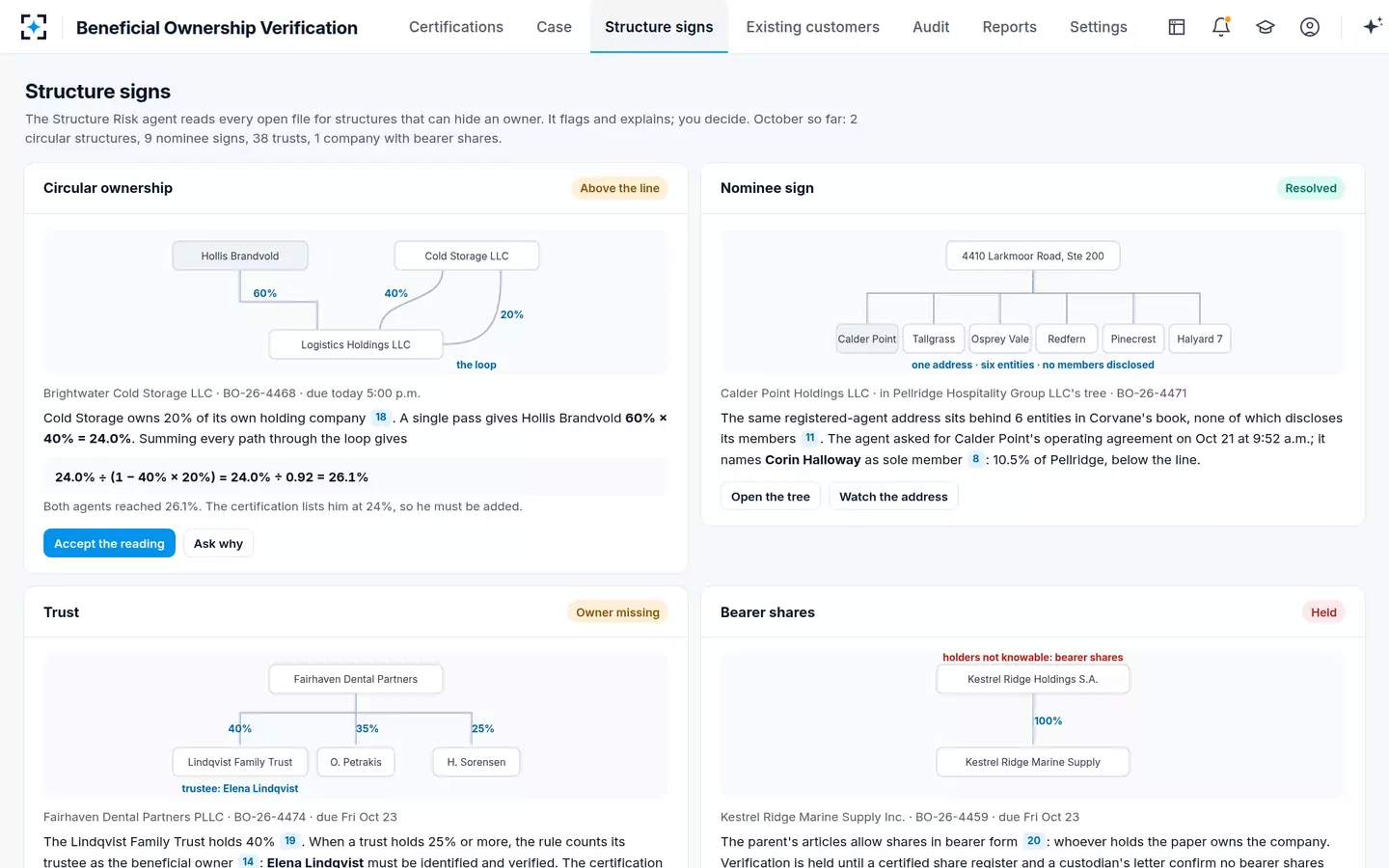
The third approach starts from the customer's packet. In Beneficial Ownership Verification a Document Reader agent extracts each stake with its passage and page, an Ownership Builder agent builds the tree and writes out each person's multiplication, and an Ownership Checker agent recomputes every holder on a different model before comparing. A Structure Risk agent flags the shared address behind Calder Point; on the sample file the agent asked for Calder Point's operating agreement, which named Corin Halloway as sole member at 10.5% of Pellridge, below the line. The chart is compared with the certification person by person, and the missing 27% owner becomes a corrected-certification request that a QC reviewer approves before it is sent.
What this approach adds is not a better number but a reproducible one: every figure opens its source, two computations agree to within 0.05 percentage points or the file is held, and every version of the chart is kept by date. Its limits are the documents themselves. It cannot chart a layer for which the bank holds no agreement; it can only say the layer is missing and draft the request.
Beneficial ownership chart tool, spreadsheet and registry lookup, on the same entity
| What the bank needs to show | Spreadsheet | Registry lookup | Chart built from documents by agents |
|---|---|---|---|
| Each stake’s source | Only if the analyst adds notes by hand | For what the registry holds; US LLC members rarely | Passage and page on every stake |
| Indirect owners through layers | If every path is typed in; a missed path gives a smaller number, not an error | Only as deep as the data; stops at private holders | Every layer for which a document exists; missing layers flagged |
| The arithmetic, checked | A formula, checked if someone re-checks it | Not applicable | Two independent computations on two models, 0.05 pp tolerance |
| Loops | Usually cut, unless the template solves them | Not applicable | Solved exactly, with the working shown |
| Comparison with the certification | A separate manual step | A separate manual step | Person by person, differences in plain words |
| Nominee and structure signs | Whatever the analyst notices | Shared addresses and officers, a real strength | Flagged and explained; never decided |
| The chart as of the opening date | Usually overwritten | A search result and timestamp | Every version kept and exportable by date |
| Result on the sample entity | Correct, if the analyst finds both of Marisol’s paths | Entities confirmed; owners not found | Two owners found, with sources and a corrected-certification request |
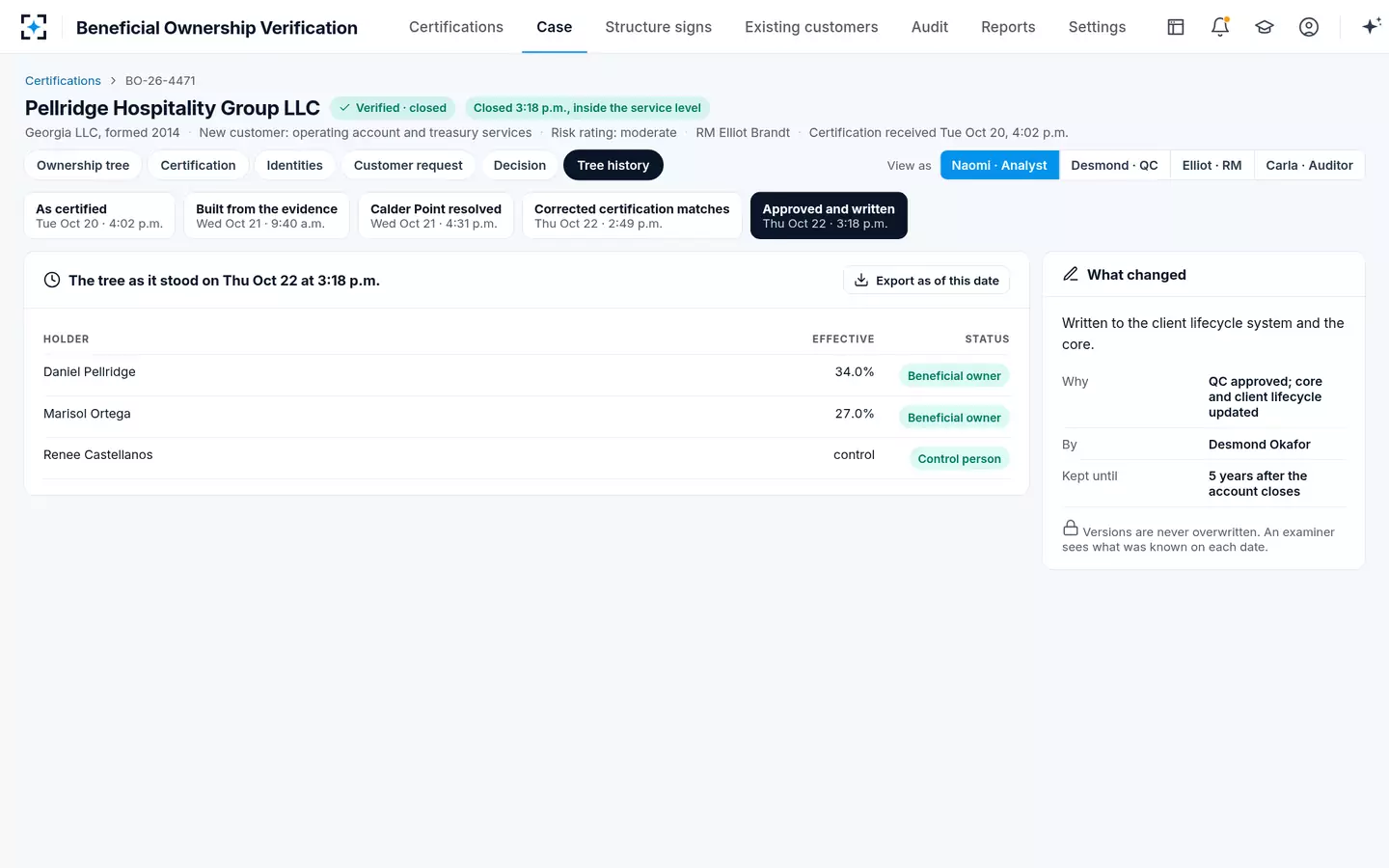
A chart that keeps its own history
How to draw an ownership structure chart for KYC
Whichever tool draws it, a KYC ownership chart should follow conventions that let another person check it. The customer sits at the top; every holder is followed down until the path ends at an individual, a trust, or an entity the rule excludes; and each arrow carries its stake and the document it came from. People and entities should look different. The 25% line, and the one control person the customer names, should be on the chart, not in a separate note. A beneficial ownership diagram template that draws boxes and arrows but leaves out the sources and the working leaves out the parts an examiner reads.
Conventions for a beneficial ownership diagram that survives review
- Customer at the top, every path to its end
An individual, a trust, or an excluded entity such as a listed company. No path stops at a private holding company.
- A stake and a source on every arrow
The percentage, the document and the section: “15% · Schedule A”.
- Each person’s working beside the person
18% + 60% × 15% = 27.0%, rounded once.
- Trusts with their trustee named
A trust at 25% or more is represented by its trustee under 1010.230(d)(3).
- Loops drawn and solved
With the convention the procedure names, and the result shown.
- The 25% line and the controller marked
Who must be identified, who need not be, and the one control person.
- Structure signs called out
Shared registered addresses, bearer shares, nominee directors: noted on the chart, decided by a person.
- A date and a version
The chart as of account opening is the one an examiner will ask for.
Structure signs, called out on the chart
Choosing: by evidence trail, not by drawing
Choose the approach whose output another person can check without redoing the work. For a bank whose business customers are mostly single-layer LLCs, a disciplined spreadsheet with a source column and a second-person check may be enough; the honest answer is that it is cheap and adequate there. For a bank with layered commercial clients, the spreadsheet's silent failures, the missed path and the overwritten version, are the risk. Registry lookups belong in both settings as a screening and existence check, not as the source of US owners. A chart built from documents earns its cost where structures are deep and the cost of a missed owner, set out in what a missed owner costs, is high.
The EU is about to make the arithmetic a legal requirement rather than a practice: from 10 July 2027 an indirect stake is found by multiplying the percentages held at each layer and adding the chains together (Regulation (EU) 2024/1624, Article 52; how to calculate beneficial ownership percentage works the arithmetic). A US bank with European customers or affiliates will want one method, written down, for both.
Where Beneficial Ownership Verification fits, and where a spreadsheet is enough
The solution is the third approach, built for banks whose legal-entity customers come with layers. Its agents read the certification, operating agreements, member registers, cap tables, trust agreements and registry extracts; build the tree twice; flag loops, shared addresses, trusts and bearer shares; verify each person's identity and screen OFAC; and draft any corrected-certification request. The KYC analyst records each decision, a QC reviewer approves it, and only then are owners written to the client lifecycle and core banking systems. On its sample data the design target is that every legal-entity file carries two independent computations that agree before any owner is settled; a bank should test that target on its own files before relying on it.
It is not a registry and does not replace one where registries exist; it uses registry extracts as one input among the customer's documents. It does not draw a chart for an entity whose documents the bank never collected; it says which layer is missing and drafts the request. And where a bank's book is almost entirely one-layer companies whose certifications match their agreements, the spreadsheet with a source column and a second-person check is a defensible choice, and we would say so.
Planning the switch around the first-account rule
Since February 2026 the first certification carries more weight. Under FinCEN's optional relief order a bank may identify and verify owners at a customer's first account, and afterwards only when it knows something that calls the information into question or its own risk procedures call for it (FIN-2026-R001). A new tool should therefore start where the stakes are: new customers' first accounts. Existing customers' later accounts need a recorded determination instead, which is set out in FinCEN CDD rule relief (Feb 2026).
The back book is a risk decision, not a rule. Accounts opened before 11 May 2018 were never covered (FAQ C.3). Accounts opened since then were, and they are the population the FFIEC's published procedure samples, so a bank adopting a better method may want to re-run its layered files from that period before an examiner does. Which files, and in what order, belongs in the BSA officer's plan.
A switch plan that tests the tool on your own files first
- Past files, results held back3 wk
- Compare and write procedure2 wk
- Parallel run on first accounts4 wk
- Go live; back book by risk3 wk
Questions people ask
Is there a free beneficial ownership calculator in Excel?
Templates circulate, and any spreadsheet can multiply. The method is the same as FinCEN's FAQ B.13 example: multiply along each path, add the paths. What a template cannot do is show the source of each figure or stop a missed path, so add a source column and a second-person check.
What is the difference between a beneficial ownership calculator tool and a chart tool?
A calculator computes effective percentages from stakes you enter. A chart tool also draws the structure, and the better ones keep the source of each stake and the version history. For KYC the sources and history matter more than the drawing.
Do examiners expect a beneficial ownership diagram in every file?
No rule requires one. Examiners test whether owners were identified, verified and recorded, and whether the bank resolved what it could not establish. For layered entities a chart with sources is usually the clearest way to show that.
Can we use the FinCEN BOI database instead of a chart?
Not for US companies. They no longer report owners to FinCEN, and bank access always needed the company's consent. A chart built from the customer's own documents is now the main evidence for a US company's owners.
How many layers deep should a KYC ownership chart go?
Until every path ends at an individual, a trust or an excluded entity, because the rule counts ownership held "directly or indirectly". A depth limit in a tool's settings is a reason to ask what happens to the layers below it.
Can a chart tool find a nominee owner?
Not by arithmetic. A nominee holds a stake on paper for someone else, so the chart shows the nominee. What a tool can do is flag the signs, such as one registered address behind many entities or a member who appears across unrelated companies, so an analyst asks the question FinCEN's FAQ B.8 says the customer must answer: who is the ultimate owner.