A beneficial ownership certification is the statement a business customer gives a US bank under FinCEN's Customer Due Diligence Rule, 31 CFR 1010.230, naming each individual who owns 25% or more of the business, directly or indirectly, and one individual who controls it. The person opening the account signs it "to the best of the individual's knowledge", and the bank may rely on it until it learns something that gives it reasonable cause to doubt it. The hard part is that signers tend to list the stakes they see on the cap table, and an owner who reaches 25% through a family holding company never appears. Botminds' Beneficial Ownership Verification exists for that gap: agents compare every beneficial ownership certification with the entity's own documents, and a KYC analyst decides what any difference means.
Two changes in 2025 and 2026 put more weight on that one signature. US companies no longer report their owners to FinCEN: the exemption began with an interim rule in March 2025 and was made final on 14 August 2026 (Federal Register, 91 FR 52508). And since 13 February 2026 a bank may identify and verify a business customer's owners at its first account, and afterwards only when something casts doubt on them or its own risk procedures call for it, instead of at every account (FinCEN order FIN-2026-R001). The first certification now has to carry a relationship for years.
Who signs, who relies, who notices: the chain behind one certification
A person decides
The customer’s representativeOpens the account and certifies the owners and the controller, to the best of his or her knowledge.
A person decides
Business banker or deposit operationsCollects the certification, or the same information on the bank’s own form, before the account opens.
Agent
Document Reader and Ownership agentsRead the operating agreements and registers in the file, build the ownership tree and compare it with the form.
Never: settles an owner or decides reliance
A person decides
KYC analystRecords anything in the bank’s own file that calls the certification into question, and what was done about it.
A person decides
QC reviewer and BSA officerQC approves each decision before the customer record changes; the BSA officer owns the written procedure examiners test.
What is a beneficial ownership certification?
It is the customer's own account of who owns and controls it, given at account opening and kept by the bank. The rule offers a model, the certification form in Appendix A to section 1010.230, but does not require it: a bank may collect the same information "by another means, provided the individual certifies, to the best of the individual's knowledge, the accuracy of the information" (31 CFR 1010.230(b)(1)). FinCEN's consolidated FAQs say the form "is optional and provided for the convenience of covered financial institutions", and that banks "should retain the form and not file it with FinCEN" (FAQ D.1).
Whatever the format, the content is fixed. For each person named, the bank collects the four identifiers it collects under its Customer Identification Program: name, date of birth, address, and a Social Security number or, for a foreign person, a passport or similar number (FAQ B.7). The certification is therefore both an ownership statement and an identity form, and the two halves fail in different ways. Identity errors surface when the bank verifies each person. Ownership errors surface only if someone compares the form with documents that show the actual split.
"Identify the beneficial owner(s) of each legal entity customer at the time a new account is opened … by obtaining a certification … from the individual opening the account on behalf of the legal entity customer … provided the individual certifies, to the best of the individual's knowledge, the accuracy of the information."
31 CFR 1010.230(b)(1), the identification requirement
Who signs the beneficial ownership certification?
The individual opening the account on behalf of the business signs it, and that person need not be an owner. FinCEN puts it plainly: the rule requires banks to obtain the information "from the individual seeking to open a new account … on behalf of the legal entity customer. This individual could, but would not necessarily, be a beneficial owner" (FAQ B.6). The bank does not have to contact the owners themselves.
In the 2016 rule's preamble FinCEN pictured the signer as the same officer who certifies the account resolutions: "the secretary or other officer of a corporation, a member or manager of an LLC, or partner of a partnership". It also said why the standard is "to the best of" that person's knowledge rather than absolute. Such a person "may not have personal knowledge of individuals having an indirect ownership interest through, for example, intermediate legal entities or contractual arrangements with nominal owners, and would have to rely on others for any such information" (81 FR 29398, 2016). The regulator anticipated, in other words, exactly the miss that analysts see most: the indirect owner the signer did not think to count.
The signer's knowledge standard does not excuse the company. FinCEN expects the business to name the real people at the top of its ownership, never stand-ins or front men, and repeats that "it is the responsibility of the legal entity customer to identify its ultimate beneficial owners" (FAQ B.8). A company that lists a nominee has not given a certification the bank can rely on, however sincerely the representative signed it.
Does the beneficial ownership certification need to be notarized?
No. Commenters asked FinCEN to make the form a sworn government document, to require notarization or board approval, and FinCEN declined all three because "any such requirement would increase the amount of time to open an account, without commensurate benefit" (81 FR 29398). The one place it suggested a notary is narrow: where the person signing the documents "does not deliver such documentation to the financial institution, it may be appropriate that the individual's signature be notarized". A bank's own procedure can ask for more, but the rule itself asks for a signature and a knowledge standard.
What does the certification ask? Up to four owners and exactly one controller
The form has two prongs, and they work differently. The ownership prong names every individual, if there is one, who holds a quarter or more of the equity, whether outright or indirectly, including by contract, understanding or other arrangement. The control prong names "a single individual with significant responsibility to control, manage, or direct" the business, such as a chief executive, managing member, general partner, president or treasurer (31 CFR 1010.230(d)). Four people at most can each hold 25%, so a certification names between one and five people, and the same person may appear under both prongs (FAQ B.5).
What the beneficial ownership certification form asks, and the rule behind each line
| Line on the form | What the customer gives | Where the requirement sits |
|---|---|---|
| The person opening the account | Name and title of the individual who signs | 1010.230(b)(1): the certification comes from this person |
| The business | Legal name and address of the legal entity customer | 1010.230(e): it must be a legal entity customer, not an excluded one |
| Owners of 25% or more | Zero to four individuals, counting stakes held directly and through other entities | 1010.230(d)(1); a trust’s stake is named through its trustee, (d)(3) |
| The controller | Exactly one individual with significant responsibility to manage the business | 1010.230(d)(2); FAQ B.9: a high-level official who runs it |
| Each person named | Name, date of birth, address, Social Security number or passport number | FAQ B.7: the same elements as the Customer Identification Program |
| The signature | A statement that the information is accurate to the signer’s knowledge | 1010.230(b)(1); no notary, no oath |
Two features of the ownership prong trip people up. It counts equity, not votes or profit shares, and it counts it through every layer, so an individual who owns 60% of a holding company that owns half the customer holds 30%: that is FinCEN's own example in FAQ B.13. And it reaches stakes held "through any contract, arrangement, understanding", which is how the rule catches a person who owns through a nominee. The arithmetic gets its own guide, how to calculate beneficial ownership percentage through layers. A bank may also ask for more than the rule's minimum: a lower ownership line, or more than one controller, is allowed as a matter of its own risk policy (FAQ B.11).
Some customers sit outside the form or inside only half of it. Sixteen kinds of entity are excluded from the definition of legal entity customer, among them regulated banks, companies listed on US exchanges, SEC-registered investment advisers, bank holding companies and state-regulated insurers (1010.230(e)(2)). Nonprofit corporations and some pooled investment vehicles answer only the control prong. Trusts are their own question, set out in does a trust need beneficial ownership.
Beneficial owner vs controlling person: one controller under the CDD rule, any number under the CTA
Under the bank's rule, the controlling person is one individual, chosen by the customer from its senior managers. The Corporate Transparency Act defines a beneficial owner more widely, as anyone who "exercises substantial control over the entity" or "owns or controls not less than 25 percent of the ownership interests" (31 U.S.C. 5336(a)(3)), with no limit on how many people the control test can catch. A business that filed a report with FinCEN before 2025 may therefore have named three or four senior officers there and will name only one on its bank certification. Neither list is wrong; they answer different statutes.
The difference matters less than it did. Since FinCEN's 2025 interim rule, made final in August 2026, US companies do not file beneficial ownership reports at all, and the reports of foreign companies registered to do business in the US leave out their US-person owners (91 FR 52508). For a US business opening a bank account, the CDD Rule's definition is the one that governs, and the bank's certification is the only place it is applied. An authorized signer on the signature card is a third category: signing authority alone does not make someone an owner, or the one control person the customer names.
Can the bank rely on the beneficial ownership certification?
Yes, until it knows better. The rule says a bank "may rely on the information supplied by the legal entity customer regarding the identity of its beneficial owner or owners, provided that it has no knowledge of facts that would reasonably call into question the reliability of such information" (1010.230(b)(2)). FinCEN explained the choice in 2016: "the customer is generally the best source of this information, and … there is generally no other source of beneficial ownership information available to covered financial institutions, aside from the legal entity itself" (81 FR 29398). A bank "need not independently investigate the legal entity customer's ownership structure" (FAQ B.13).
The condition is where the work lives. Reliance is lost on knowledge, not on suspicion, and the knowledge that matters most is often already in the bank's own file: an operating agreement collected with the account resolutions that shows a different split, a registry extract naming a member the form leaves out, an owner who appears on a sanctions or adverse-media alert. A file that holds such a document and a certification that contradicts it is a file where the bank knew. The catalogue of those signals, and the case of a law-firm letter accepted without question, is in how to verify beneficial ownership when the paper looks complete.
The beneficial ownership certification in four numbers
1–5
people a certification names: zero to four owners of 25% or more, plus one controller
FAQ B.5
25%
the ownership line, counted directly or indirectly, through any arrangement
1010.230(d)(1)
5years
the certification is kept after the account closes
1010.230(i)(2)
0
notaries, oaths or board approvals the rule requires
FinCEN, 2016
The accountability chain inside the bank: who notices, who records, who approves
The rule assigns two duties: the customer identifies its owners, and the bank keeps written procedures "reasonably designed to identify and verify" them (1010.230(a)). Inside the bank, the second duty breaks into roles. The banker or operations clerk collects a complete form. The KYC analyst verifies identities and notices anything that calls the ownership into question. A QC reviewer or the BSA officer checks the analyst. When examiners test the program they sample new legal-entity accounts and check, among other things, that the bank kept the identifying information, how it verified each person and what the verification found (FFIEC examination procedures, as published in April 2026).
Five roles carry one beneficial ownership certification
Today
Gathers the form with the resolutions and signature cards, often as the account is being priced.
With agents
Sends one approved request when the form needs correcting, in plain words the client can act on.
Still theirs: The relationship and the conversation
Today
Checks that every line is filled and the four identifiers are present for each person.
With agents
Sees the certification already compared with the documents, with gaps listed.
Still theirs: Account opening and the core record
Today
Draws the ownership chart by hand and decides whether anything in the file contradicts the form.
With agents
Starts from a tree built from the documents, and spends the time on the difference and its reason.
Still theirs: The decision, and the reason it is recorded
Today
Samples files after the account is open and redoes the arithmetic.
With agents
Approves each decision and each customer request before it takes effect.
Still theirs: Maker and checker separation
Today
Answers examiners from files that hold a checkbox rather than reasoning.
With agents
Sets the ownership line and reliance policy, and hands examiners each decision with its evidence.
Still theirs: The written procedure
What happens when a beneficial ownership certification is wrong?
The bank asks for a corrected one and, until it is right, does not treat the customer's owners as settled. Take Pellridge Hospitality Group, a fictional Georgia LLC, as its certification runs through Beneficial Ownership Verification at a fictional bank, Corvane National Bank. Its president signs a form naming one owner, Daniel Pellridge at 34%, and herself as controller. The operating agreements in the same packet show Marisol Ortega holding 18% directly and 60% of a family holding company that owns 15%: 27% in all. The certification and the evidence disagree on one line, and the bank's own documents are the reason it can no longer rely on the form as signed.
The certification set beside the evidence, one person per row
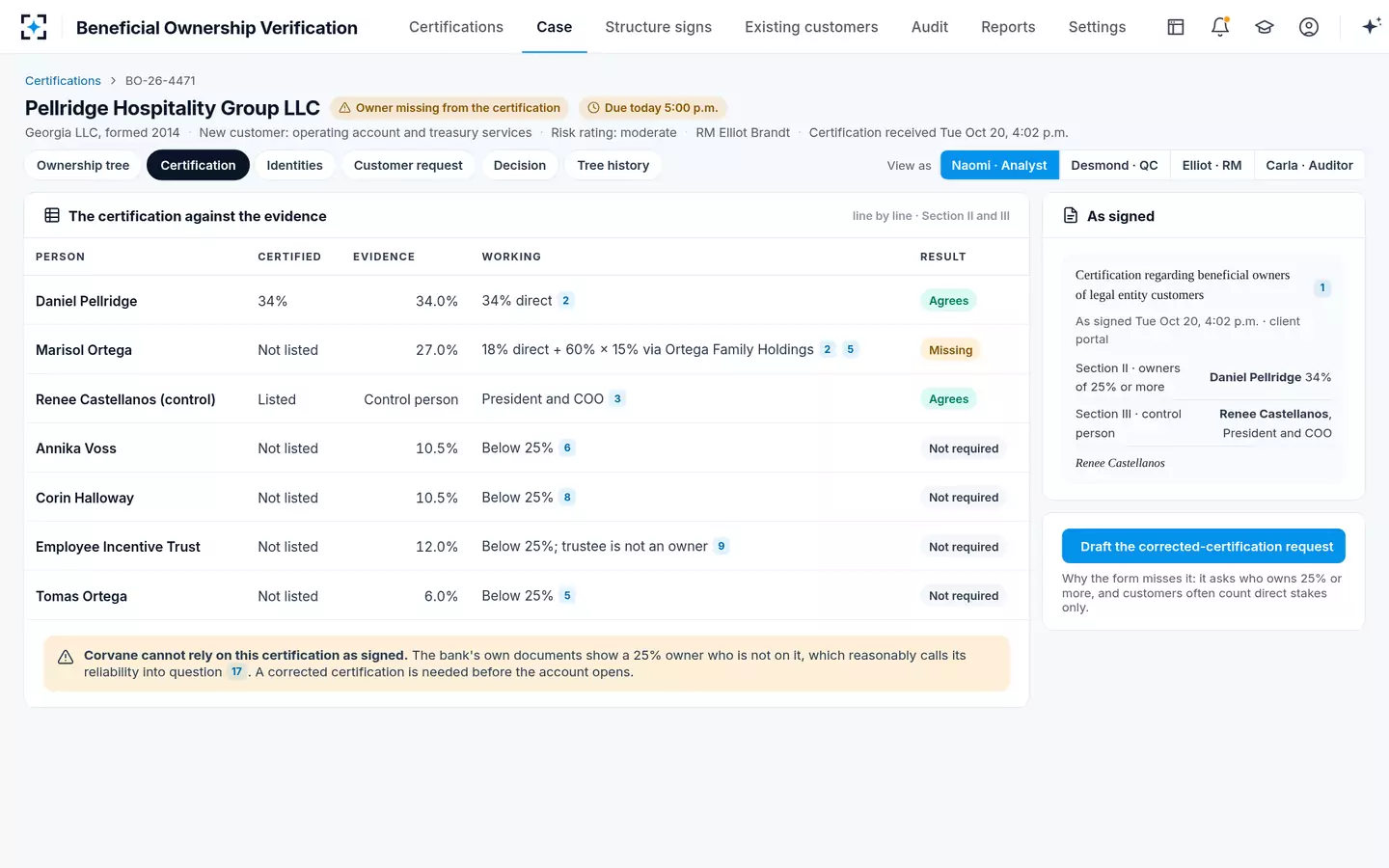
The note under the table is the reliance question answered in the file: the bank's own documents show a 25% owner who is not on the certification.
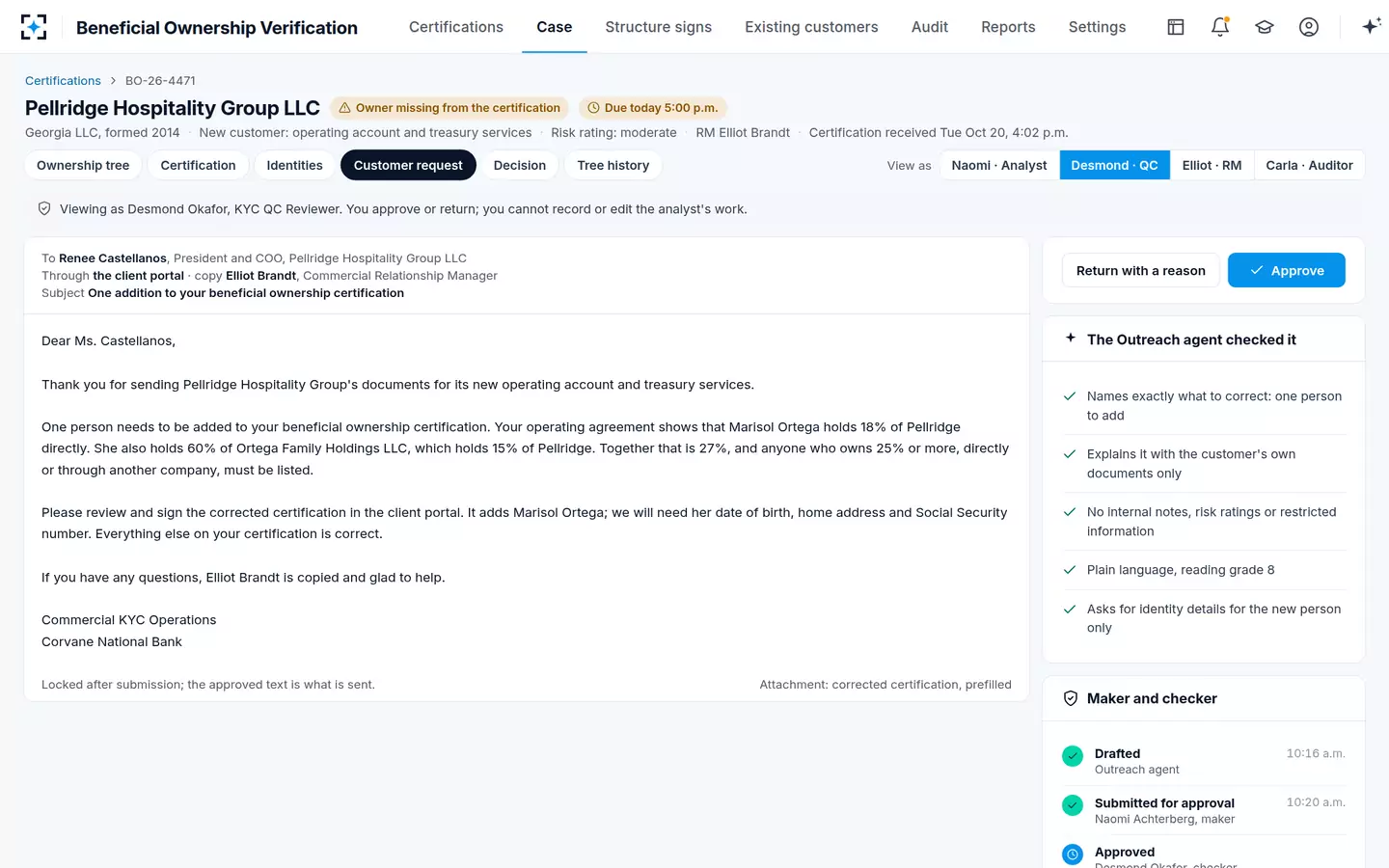
The correction is a request to the customer, not an edit by the bank. The bank cannot add Marisol Ortega itself: the rule asks the customer to identify its owners and the person opening the account to certify them. So the analyst's request explains the arithmetic from the customer's own documents and asks for a corrected, signed certification and the new owner's identifiers. In the solution, an agent drafts that request and a QC reviewer approves it before anything goes out; the reply is compared with the tree when it arrives.
A corrected-certification request, held until QC approves it
The same rule governs changes after opening. If a business later reports a new address for a known owner, a verbal confirmation may be enough; if the owners themselves change, the new owner has to be identified, certified and verified like the first ones (FAQ B.19; beneficial owner declarations for existing customers covers the back book).
How long to keep the beneficial ownership certification, and what else goes in the file
Keep the certification for five years after the account closes, and the verification records for five years after each is made (1010.230(i)(2)). The two clocks differ because they protect different things: the certification is the customer's statement for as long as the relationship lasts, while a verification record documents one check at one time. The verification record must describe "any document relied on", any non-documentary method and its results, and "the resolution of each substantive discrepancy".
The 2026 relief adds a third kind of document. A bank that relies on an earlier certification when the same customer opens another account must keep the customer's verbal or written confirmation that the information is still accurate (FIN-2026-R001); FAQ D.2 says to keep the original set, any update and the confirmation until five years after the new account closes. What changed at the second account, and what still needs a written procedure, is in FinCEN CDD rule relief (Feb 2026).
What a complete beneficial ownership certification file holds
- The signed certification, or the bank’s equivalent form
With the signer’s name and title, kept five years after the account closes.
- Zero to four owners and exactly one controller
Each with name, date of birth, address and identification number.
- The documents the bank compared it with
Operating agreement, member or share register, registry extract: whatever was in the packet.
- The working behind any indirect stake
Which path, which percentages, multiplied how: the arithmetic a reviewer will redo.
- Verification of each person
The document or non-documentary method, its result, and how each discrepancy was resolved.
- The reason for each person below the line
So the file answers why someone at 20% was not identified, not just who was.
- Any correction, with the customer’s signed reply
The request, who approved it, and the corrected certification.
- Later confirmations under the 2026 relief
Verbal or written, dated, with who took them.
Where Beneficial Ownership Verification fits on a certification, and where it does not
The solution reads what the customer gave the bank and says where it disagrees with the form; it does not sign, and it does not decide. Its agents extract each stake with the passage it came from, build the ownership tree twice on two different models, verify each person's identity, and draft any corrected-certification request. The KYC analyst records the decision, a QC reviewer approves it, and nothing reaches the customer or the core banking system before then. The bank sets its own ownership line, its reliance policy and its service levels; on the sample data the target is a decision within one business day when a certification needs correcting.
Its limits follow from the rule. It cannot find an owner whose stake is written nowhere in the documents the bank holds: a side agreement with a nominee that never reaches the file is invisible to any reader, human or machine. It does not replace the customer's duty to identify its owners or the representative's signature. And a bank that does not collect operating agreements at opening gives it, and its analysts, less to compare. The full workflow, from queue to examiner file, is on the Beneficial Ownership Verification page.
Questions people ask
Is the FinCEN beneficial ownership certification form mandatory?
No. FinCEN's FAQ D.1 says the Appendix A form "is optional", and a bank may use its own form or any other means, as long as the person opening the account certifies the same information to the best of his or her knowledge. Banks keep the form; they do not file it with FinCEN.
Where do I find the FinCEN beneficial ownership certification form?
The model form is Appendix A to 31 CFR 1010.230, and FinCEN's FAQ D.1 points to fillable and non-fillable copies on its filing-information page. A bank may instead fold the same questions into its own account-opening forms, which the rule allows.
Who counts as the control person on a beneficial ownership certification?
One individual with significant responsibility to control, manage or direct the business, such as a chief executive, finance chief, managing member or general partner. FinCEN expects "a high-level official in the legal entity, who is responsible for how the organization is run" (FAQ B.9). The control prong always applies, even when nobody reaches 25%.
Is a beneficial ownership certification still required after the CTA change?
Yes. The 2025–26 changes exempted US companies from reporting to FinCEN under the Corporate Transparency Act; they did not change the bank's CDD Rule, which FinCEN says serves "different purposes" under "different legal authorities". A business opening its first account at a bank still certifies its owners and controller.
Does an existing business customer have to certify again for a new account?
Not if the bank has adopted FinCEN's February 2026 relief, which is optional. The bank then identifies and verifies owners at the first account, when it knows something that calls the information into question, and as its risk-based procedures require; at later accounts it may rely on a recorded confirmation that the information is still accurate.
Can the person who signs the certification be an employee who is not an owner?
Yes. The rule asks for the certification from whoever opens the account for the business, who "could, but would not necessarily, be a beneficial owner" (FAQ B.6). That is why the standard is knowledge, not certainty: a non-owner officer may not know about stakes held through other companies.