To calculate beneficial ownership percentage for a person who holds a business through other companies, multiply the percentages along each chain from that person down to the customer, add the results of every chain that ends at the same person, and compare the total with the 25% line. Someone who owns 60% of a holding company that owns 15% of the customer holds 9% through that path; if she also owns 18% directly, her effective ownership is 27%, and she must be named on the beneficial ownership certification. The calculation is simple; finding every path in a stack of operating agreements is not, and the customer's own form does not ask anyone to do it. Botminds' Beneficial Ownership Verification builds the ownership tree from the documents, writes each person's multiplication out with the passage behind every factor, and has a second agent recompute it before an analyst relies on it.
The examples below use one fictional company throughout: Pellridge Hospitality Group, a Georgia LLC, as its ownership runs through the solution at a fictional bank. Its president certified one 25% owner. The documents show two.
Pellridge's ownership, multiplied down every path
How do you calculate beneficial ownership percentage? Multiply each path, then add the paths
Three operations cover nearly every structure a bank sees. Along one chain, multiply: each layer passes on only its share of the layer below. Across chains that end at the same person, add. And where a company owns part of its own owner, so that the chain loops back on itself, sum the loop as a series instead of cutting it. Round only at the end: rounding each layer can move a 24.96% holder over the line or a 25.04% holder under it.
The 25% test applies to the total, not to any single path. Marisol Ortega's direct 18% and her indirect 9% are each below the line, and neither alone makes her an owner. The rule counts what an individual "directly or indirectly … owns", so the sum is the number that matters, and it is the number the certification form does not ask anyone to compute.
Three operations, and the line they are tested against
| Operation | Formula | Worked example | Where it is written |
|---|---|---|---|
| One path | stake × stake × … × stake | Marisol through Ortega Family Holdings: 60% × 15% = 9.0% | FinCEN FAQ B.13 example; EU AMLR Art. 52(1) |
| Several paths | path 1 + path 2 + … | Marisol in total: 18% direct + 9.0% = 27.0% | EU AMLR Art. 52(1): “adding together the results” |
| A loop | single pass ÷ (1 − loop product) | Hollis at Brightwater: 24.0% ÷ (1 − 40% × 20%) = 26.1% | Not in either text: a convention the bank writes into its procedure |
| The line | total ≥ 25% → identify | Round once, at the end; a trust’s stake names its trustee | 31 CFR 1010.230(d) |
What the US rule says, and FinCEN's own worked example
The rule's text gives a definition, not a formula. A beneficial owner under the ownership prong is "each individual, if any, who, directly or indirectly, through any contract, arrangement, understanding, relationship or otherwise, owns 25 percent or more of the equity interests of a legal entity customer" (31 CFR 1010.230(d)(1)). It does not say how to combine stakes through intermediate companies. In 2016 commenters asked FinCEN for "additional guidance and examples of how legal entity customers should calculate ownership interests when natural persons have indirect equity interests", and FinCEN declined to add narrower examples to a definition it meant to be "broadly applicable" (81 FR 29398).
Two years later its own FAQ settled the method by example. In FAQ B.13 a customer is owned half by Company A and half by Company B. Allan owns 60% of Company A, so he "owns indirectly 30%"; Betty owns 40% of A and a third of B, so she holds "20% … plus 16⅔% … for a total of indirect ownership interest of 36⅔%"; Carl and Diane, a third of B each, hold 16⅔% and are not owners (FinCEN CDD Rule FAQs, B.13). Every one of those figures is the multiplication method: 60% × 50% = 30%, 40% × 50% + ⅓ × 50% = 36⅔%. The same answer also frees the bank from researching the ownership structure on its own: it may rely on the customer's figures unless it knows something that contradicts them. The arithmetic is the customer's duty; noticing when it is wrong is the bank's.
Note what FinCEN's example does not do. Allan controls Company A, with 60%, and Company A holds 50% of the customer. FinCEN still credits him with 30%, not 50%. Under the US rule, control of an intermediate company does not carry its whole stake up the chain; the control question is answered separately, by the one control person the customer names.
Worked example: one owner, two paths
Pellridge's operating agreement lists five members. Daniel Pellridge holds 34% directly: the only figure on the certification, and correct. Marisol Ortega holds 18% directly, which on its own is below the line. Ortega Family Holdings LLC holds 15%, and its own operating agreement shows Marisol at 60% and Tomas Ortega at 40%. Seabright Lodging Investors LLC holds 21%, split evenly between Annika Voss and Calder Point Holdings LLC, whose sole member is Corin Halloway. An employee incentive trust holds the last 12%.
Multiplied out, the six holders come to 34.0% (Daniel), 27.0% (Marisol), 12.0% (the trust), 10.5% (Annika), 10.5% (Corin) and 6.0% (Tomas), and they add back to 100%, which is the first check on any chart. Two cross the line. Corin Halloway, three layers down, is the one most likely to be missed on a hand-drawn chart and the one least likely to matter here: 100% × 50% × 21% is 10.5%. The person who matters is Marisol Ortega, whose two paths only add to 27.0% when someone adds them.
Effective ownership of Pellridge, by person
The ownership tree with each person's math written out
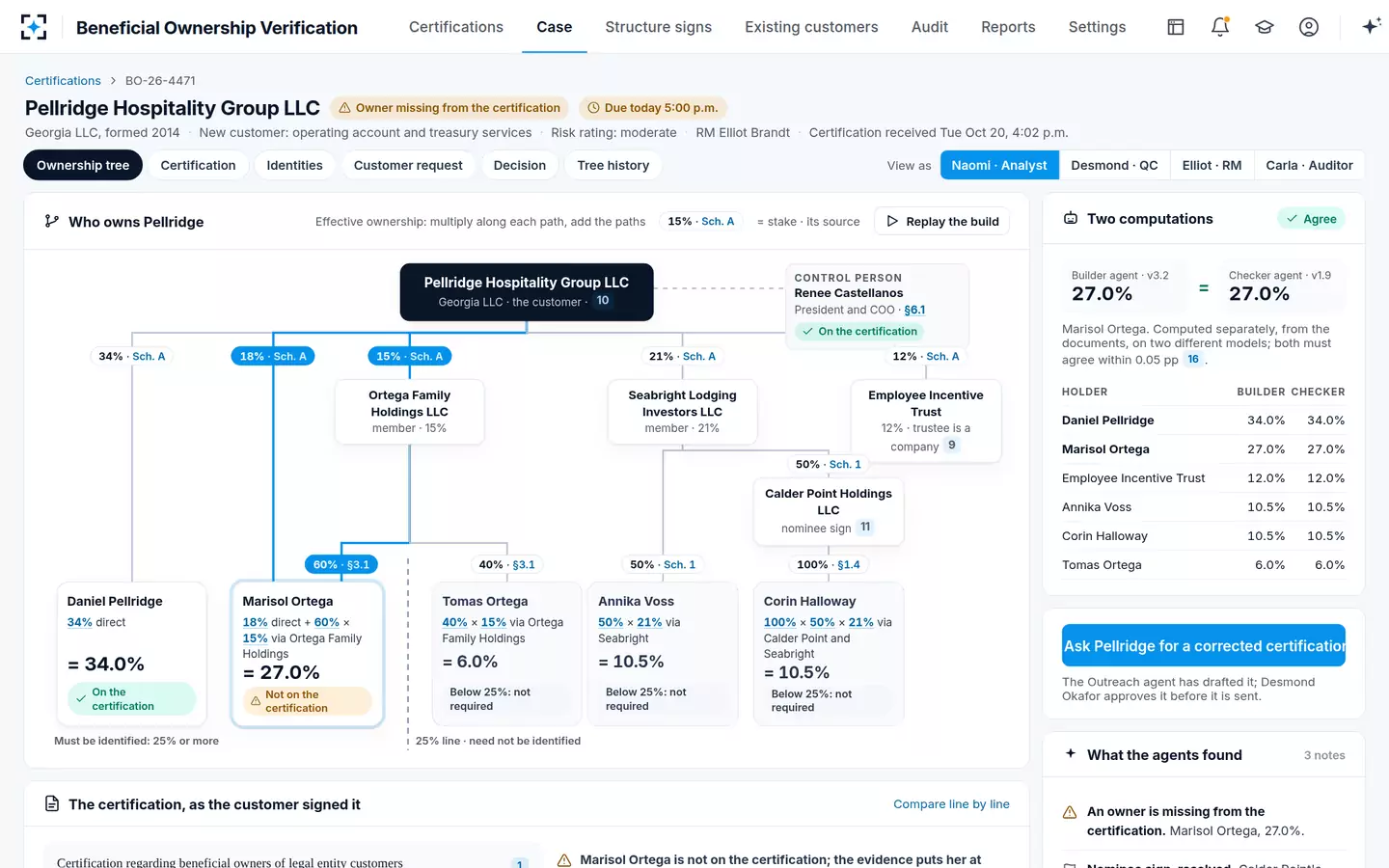
The side panel is the control on the arithmetic: the Builder and Checker agents compute separately, and a difference above 0.05 percentage points holds the file for an analyst.
Who counts when two people own 24.9% each?
Under the US ownership prong, neither. Each individual is tested on his or her own direct and indirect stake, so two holders at 24.9% are both below the line, and a company with five equal members of 20% has no one to name under that prong at all. The rule still requires one control person, so the certification is never empty (FAQ B.10). And it allows the bank to go further: a bank "may choose … to collect such information on natural persons who own a lower percentage" (FAQ B.11), and some set a lower line for customers they rate high risk.
Two words in the rule keep near-misses honest. A stake held for someone else, by a nominee or under a side agreement, counts as the real owner's, because the definition reaches equity owned "through any contract, arrangement, understanding, relationship or otherwise". FinCEN says the customer must name its "ultimate beneficial owner or owners and not 'nominees' or 'straw men'" (FAQ B.8). The US rule does not, by itself, add relatives' stakes together; a structure split into 24.9% slices among family members is a risk signal for the analyst, not an automatic aggregation. The EU regulation, by contrast, lists "relationships between family members" among the means of control.
Circular ownership: solve the loop, do not cut it
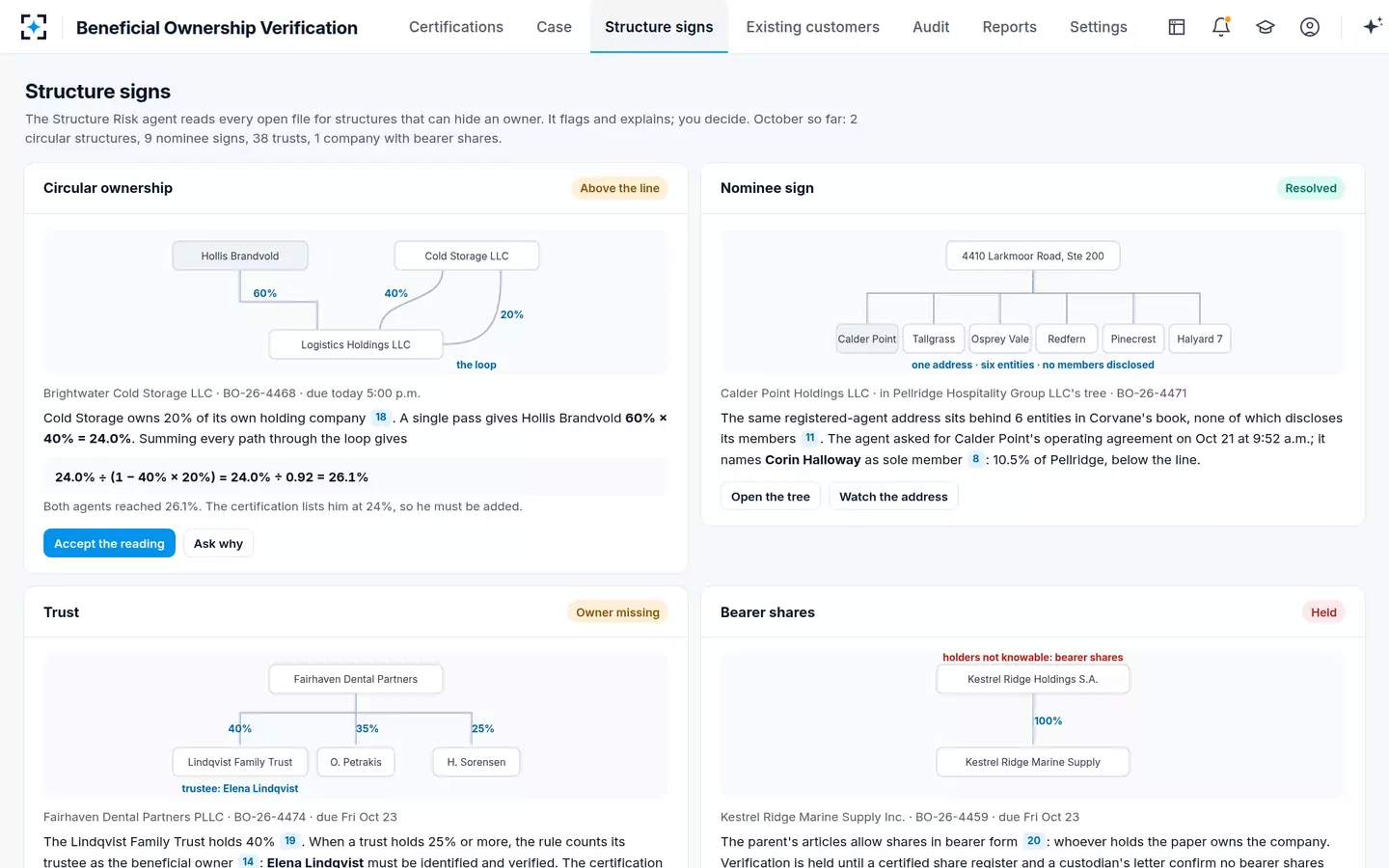
A loop appears when a company holds part of one of its own owners, directly or further up. Cutting the loop at an arbitrary point understates the people above it. Take Brightwater Cold Storage, another fictional sample customer. Hollis Brandvold owns 60% of Logistics Holdings, which owns 40% of Brightwater, which in turn owns 20% of Logistics Holdings. A single pass gives Hollis 60% × 40% = 24.0%, below the line, which is what the certification said.
But the 20% of Logistics Holdings that Brightwater owns passes Hollis a further share every time the chain goes round: 40% × 20% = 8% of his single-pass figure on each lap. Summed, the series is 24.0% ÷ (1 − 0.08) = 26.1%, over the line. The US rule does not prescribe a convention for loops, and an alternative, such as treating the company's indirect holding of itself like treasury stock, can give a different number. Whichever the bank chooses belongs in its written procedure, so that every analyst solves every loop the same way.
Structure signs that can hide an owner: a loop, a nominee address, a trust, bearer shares
Trusts, nonprofits and excluded owners in the chain
Three kinds of holder change the calculation rather than the arithmetic. A trust that owns 25% or more of the customer, directly or indirectly, is represented by its trustee, who is named in the trust's place (1010.230(d)(3); does a trust need beneficial ownership covers the other trust cases). Pellridge's employee trust, at 12%, is below the line, so no trustee is named. An entity on the rule's exclusion list, such as a listed company or a regulated bank, that owns 25% or more breaks the chain: "no individual need be identified … with respect to that entity's interests". And a nonprofit customer has no equity to calculate, only a controller to name. Each of these is set out with its own decision steps in does a trust need beneficial ownership.
How to determine the ultimate beneficial owner under the EU method from July 2027
The EU writes the multiplication into law. From 10 July 2027, Regulation (EU) 2024/1624 defines an ownership interest as "direct or indirect ownership of 25 % or more of the shares or voting rights or other ownership interest", and says the indirect share "shall be calculated by multiplying the shares or voting rights or other ownership interests held by the intermediate entities in the chain … and by adding together the results from those various chains" (AMLR Article 52(1)). That is FinCEN's FAQ example made statutory.
The two regimes then part in three places. The EU counts voting rights and profit rights as well as shares, where the US counts equity. The EU allows lower lines by category: the Commission may set a threshold for higher-risk kinds of company, "at a maximum of 15 %" unless it concludes a higher one is proportionate, "in any case … less than 25 %" (Article 52(2)). And the EU adds a rule for chains where control and ownership mix (Article 54), so a bank working in both regimes should not assume that the multiplied figure is the last word in Europe.
How the US and EU calculate beneficial ownership percentage
US CDD Rule (31 CFR 1010.230): Equity interests, held directly or indirectly, including through any arrangement or nominee.
EU AMLR (Regulation 2024/1624), from 10 July 2027: Shares, voting rights or other ownership interest, including rights to profits or liquidation balance.
US CDD Rule (31 CFR 1010.230): Not written in the rule; FinCEN FAQ B.13 multiplies down each chain and adds the chains.
EU AMLR (Regulation 2024/1624), from 10 July 2027: Written in Article 52(1): multiply along each chain and add the chains together.
US CDD Rule (31 CFR 1010.230): 25%, for up to four people. A bank may choose a lower line on risk (FAQ B.11).
EU AMLR (Regulation 2024/1624), from 10 July 2027: 25%, with lower lines of up to 15% (and below 25% in any case) for higher-risk categories the Commission names.
US CDD Rule (31 CFR 1010.230): Does not carry the company’s whole stake; one control person is named separately.
EU AMLR (Regulation 2024/1624), from 10 July 2027: Article 54 adds rules where ownership and control coexist at different layers of a chain.
US CDD Rule (31 CFR 1010.230): The certification still names one control person.
EU AMLR (Regulation 2024/1624), from 10 July 2027: Control via other means applies, including agreements, family relationships and nominee arrangements (Article 53).
KYC complex ownership structures: what to write down so the calculation survives QC
A correct percentage that nobody can reproduce is a weak file. The QC reviewer, internal audit and an examiner will each want to redo the arithmetic, and each needs the same three things: the source of every stake, the path that was multiplied, and the reason anyone near the line was or was not named. FinCEN's rule requires a description of each document relied on for verification and "the resolution of each substantive discrepancy" (1010.230(i)); the working behind a percentage is the natural place to record why a certification and the documents disagreed.
What to keep with every beneficial ownership calculation
- The source of each stake
Document, section and date: Schedule A of the operating agreement, a member register, a registry extract.
- Every path, written out
60% × 15% = 9.0%, not just 27.0%: a reviewer should be able to redo it with a pencil.
- The total for each person, rounded once
And the check that effective percentages add back to 100% of the customer.
- The convention used for loops
Named in the procedure, applied the same way to every file.
- A reason for everyone near the line
Why a person at 24% or a trust at 22% was not named, in a sentence.
- What changed the answer
Units issued after the cap table’s date, a corrected register: which document governs and why.
- A second computation
Done independently, by a colleague or a second system, before the number is relied on.
That last item is where most hand processes stop. In Beneficial Ownership Verification two agents compute each percentage separately, on two different models, and compare only after each has written its own answer; a difference of more than 0.05 percentage points goes to an analyst with both workings side by side. On one fictional sample file the two disagreed by 0.4 points because a cap table dated 1 September did not show units issued on 28 August, which is exactly the kind of difference a person should decide. How a spreadsheet, a registry lookup and an agent-built chart compare on the same structure is tested in beneficial ownership chart tool vs spreadsheet vs registry, and the agent that builds the tree is examined in UBO software, inside one agent.
Questions people ask
How do you calculate effective ownership percentage?
Multiply the percentages along each chain from the person to the company, then add the chains that end at the same person. FinCEN's FAQ B.13 example does exactly this: 60% of a company that owns 50% is 30% effective ownership.
How do you calculate indirect ownership through a holding company?
Multiply the person's stake in the holding company by the holding company's stake in the customer. A 40% member of a holding company that owns 15% has 6.0% indirect ownership; add any direct stake to get the total tested against 25%.
Does a person who controls a holding company get its whole stake?
Not under the US rule. FinCEN's own example credits a 60% owner of a company holding 50% with 30%, not 50%. The EU regulation adds separate rules for chains where control and ownership mix, so the answer can differ there.
Is beneficial ownership 25% or more, or more than 25%?
Twenty-five percent or more, in both the US CDD Rule ("owns 25 percent or more") and the EU regulation ("25 % or more"). A person at exactly 25.0% must be identified, which is why rounding only at the final step matters.
Should we lower the 25% threshold for high-risk customers?
The US rule allows it but does not require it. FinCEN's FAQs B.11 and B.12 say a bank may collect owners below 25% on risk, and also that it may reasonably decide a lower line would not help, using enhanced monitoring instead. Whatever the bank chooses belongs in its written procedure.
Do effective ownership percentages have to add up to 100%?
Across all holders, including entities that stop the chain such as trusts and excluded companies, yes. A chart whose effective percentages do not sum to 100% has a missing holder or a misread stake, which makes the total a cheap first check before anyone is compared with the line.