Beneficial ownership software is bought to identify and verify the owners of business customers under FinCEN's Customer Due Diligence Rule, and the obvious way to justify it, minutes saved per account, is the weakest. FinCEN's own analysis priced the rule at 20 to 40 extra minutes for each new legal-entity account, and a small bank's annual cost at a few thousand dollars. The cost that actually moves compliance budgets is the owner a bank misses or never properly verifies: a file that cannot answer an examiner, a look-back across years of accounts, a consent order, a penalty. This guide prices both sides with public figures and shows how to build a case a CFO will accept. Botminds' Beneficial Ownership Verification appears where it answers the question, and its limits are stated with it.
The visible cost and the cost that moves budgets
20–40min
extra staff time FinCEN assumed per new legal-entity account, plus 10–15 per owner
FinCEN, 2016 final rule
$15
average cost of all customer due diligence per new account at 11 banks, range $5 to $44
GAO-20-574, 2018 data
$3.7M
one-time cost for a very large bank to add beneficial ownership, with 4,000 staff trained
GAO-20-574
$15M
civil money penalty after a law-firm letter on ownership was accepted without corroboration
FinCEN consent order, Bancrédito, 2023
What does beneficial ownership verification cost per account?
About an hour of staff time for a simple business file, on the public estimates. FinCEN's final regulatory impact analysis for the 2016 rule assumed "8 million new accounts per year" and "a range of 20 to 40 minutes of additional time on average to open an account under the CDD rule", raised from 15 to 30 minutes after commenters said the first figures were too low; banks it surveyed estimated "an additional 10 to 15 minutes per beneficial owner" (FinCEN, 81 FR 29398). Its small-bank example, 471 legal-entity accounts a year at a new-accounts clerk's wage of $16.77 an hour, came to "$2,550 to $5,100" a year.
GAO's field work puts the whole onboarding file in context. Across eleven banks, staff spent about half an hour, on average, gathering and checking customer information for a new personal account, and more than an hour for a business account, largely because the owners had to be identified as well. All customer due diligence cost an average of $15 per new account, from $5 to $44 (GAO-20-574, 2020). Those are 2018 figures and they are averages: they describe the simple LLC with two members, not the three-layer structure where an owner hides.
The visible cost: staff minutes per account
National totals are larger but not decisive. On FinCEN's figures, 8 million accounts at 20 to 40 minutes is 2.7 to 5.3 million staff hours a year; at the median pay of new accounts clerks, $47,670 a year or about $23 an hour (BLS Employment Projections), that is roughly $61 million to $122 million in wages. That is our arithmetic, and it now overstates the work: since February 2026 a bank may stop re-identifying owners at each new account for an existing customer (FIN-2026-R001). Spread across thousands of banks and credit unions, the time case for any one institution is modest.
What happens if a bank misses a beneficial owner?
Usually nothing, until something does, and then the cost is not one file. A missed owner is invisible to everything downstream that depends on knowing who owns the customer: sanctions screening of that person, the customer's risk rating, the profile monitoring compares activity with, the information law enforcement receives in a suspicious activity report or a subpoena. When the miss surfaces, it surfaces as a pattern, because the process that missed one owner missed others like it.
That is why remediation, not the single file, is the cost unit. When the OCC replaced Blue Ridge Bank's formal agreement with a consent order in January 2024, it required the board to adopt a program to obtain "customer due diligence ('CDD'), enhanced due diligence ('EDD'), and beneficial ownership ('BO') information for all Bank customers at the time of account opening and on an ongoing basis", including a way to resolve cases where the information collected is incomplete or wrong, and an expanded suspicious activity look-back covering September 2022 to August 2023 (OCC, AA-ENF-2023-68). The FDIC's 2024 consent order with Lineage Bank lists among its required controls that "beneficial ownership information is documented and maintained" (FDIC-23-0041b). Neither order carried a penalty; both carried years of work.
Penalties for beneficial ownership failures
Penalties attach to the program, not to the form, and they are counted by the day. In its 2023 action against Bancrédito International Bank and Trust, FinCEN noted that for violations of the requirement to implement an effective, risk-based anti-money laundering program it "may impose a Civil Money Penalty of up to $67,544", and that "a separate violation occurs for each day that an adequate AML program has not been implemented". It imposed $15 million (FinCEN, 2023). Among the failures it described: a customer's law-firm letter about the beneficial owner of a British Virgin Islands company accepted without corroboration, although the man it named as owner had been a minor when the company was set up in his name. That account predated the beneficial ownership rule; the lesson about reliance on unverified paper did not. The full case is in how to verify beneficial ownership.
Two ways to price beneficial ownership software
The minutes case: Staff time per account to read documents, chart, multiply and check.
The error case: The expected cost of files that cannot stand up: look-backs, remediation, orders, penalties.
The minutes case: FinCEN: 20–40 min per account, 10–15 per owner; GAO: over 1 hour per business file.
The error case: Blue Ridge: beneficial ownership for all customers, plus a year-long look-back; Bancrédito: $15M.
The minutes case: Thousands of dollars a year at a small bank; more at a commercial bank with layered clients.
The error case: One remediation programme can cost more than years of licences.
The minutes case: Operations and finance, from the bank’s own volumes and wages.
The error case: The BSA officer and CCO, from exam history and the bank’s risk assessment.
The minutes case: Quality: faster charting of the wrong owners saves nothing.
The error case: Probability: no bank can say precisely how likely an order is.
What a beneficial ownership program has to pay for
The rule requires written procedures "reasonably designed to identify and verify" owners, included in the bank's anti-money laundering program (1010.230(a)). That program, in turn, needs "a system of internal controls", "independent testing", a designated BSA officer, "training for appropriate personnel" and risk-based procedures for ongoing customer due diligence (31 CFR 1020.210). A beneficial ownership program is that structure applied to one obligation, and each pillar has a cost the software decision touches.
Software can cut the cost of internal controls, by checking every file rather than a sample, and of independent testing, by leaving a trail a tester can reproduce. It does not remove training or the BSA officer's judgment. And it adds one cost banks often forget: validating and governing the tool. Since SR 26-2 places generative and agentic AI outside the interagency model risk guidance and leaves them to each bank's own risk management and governance (SR 26-2), the bank must budget its own review.
How to build a business case for beneficial ownership software
Write the return as a sum the bank can price with its own numbers, and keep the error term honest. The four terms below are the ones we would expect a CFO to accept; each names who in the bank owns the input. On Beneficial Ownership Verification's sample data the design targets are that every legal-entity file has two independent computations that agree before an owner is settled, and that no account opens with a 25% owner missing from the certification and no recorded reason. Those are targets for the bank to test on its own files, not results we claim for it.
The return on beneficial ownership software, term by term
Analyst time
first accounts × layered share × hours saved × loaded rate
Reading, charting and multiplying on layered files; simple files save little.
Operations and finance
Rework avoided
files corrected after opening × hours per correction
QC redoing arithmetic, corrected certifications chased after the account is live.
KYC QC lead
Error cost avoided
probability of a finding × cost of a look-back
Price a look-back from your own book: accounts in scope × hours per file.
BSA officer and CCO
Cost of the tool
licence + integration + validation
Include the bank’s own governance review and the IT work to connect document and core systems.
CFO, CIO, model risk
Two inputs deserve care. The "layered share" matters more than the account count: a book of two-member LLCs will not pay for software on time savings, and a commercial book full of holding companies, trusts and private equity structures may pay on that term alone. And the error term should be priced from the bank's own exposure, not from a well-known penalty: how many legal-entity accounts have opened since 11 May 2018, and what would it cost to reopen and re-verify them if an examiner found the process unreliable? That second figure is the one to write down first.
How the 2026 relief changes the numbers in the case
It shrinks the volume term and enlarges the error term. Before February 2026 every new account for a legal entity customer carried an identification step, so a bank's account count was the right multiplier for time saved. Under FinCEN's optional relief order, a bank may identify and verify owners at the customer's first account and afterwards only when it knows something that calls the information into question or its own risk procedures call for it (FIN-2026-R001). For a bank that adopts it, the multiplier becomes first accounts plus triggered updates, and repeat accounts become a quicker determination with a recorded reason.
The first certification, meanwhile, now has to carry the relationship for years without being refreshed at each new account, and US companies no longer report their owners to FinCEN as a separate record. A missed owner at the first account therefore persists longer and is less likely to be caught by a later step. A business case written in 2025 that leaned on per-account minutes should be rewritten around first-account quality; why the bank's file now stands alone is set out in beneficial ownership information at banks.
What to look for in beneficial ownership compliance software
The useful questions are about evidence and cost drivers, not features. A demonstration shows a chart; the questions below show whether the product will leave the bank with files that stand up and a bill that matches its volume. The technical questions about how a product reads documents are in UBO software, inside one agent, and a side-by-side test of approaches in chart tool vs spreadsheet vs registry.
Nine questions for the buyer, not the demonstrator
- What volume is it priced on?
Accounts, entities, documents or users? Under the 2026 relief, first accounts are the work; repeat accounts are a determination.
- Does it check every file, or a sample?
The error case depends on coverage. Sampling after opening is the gap.
- What evidence does each file keep?
Source passage for every stake, the arithmetic, the comparison with the form, the decision and who approved it.
- Can it produce the file as of the opening date?
A look-back or an exam asks what the bank knew then.
- Who can decide, and who can approve?
Maker and checker enforced by the system, not by habit.
- What does integration cost?
Document imaging, client lifecycle, core, identity and sanctions services: which are standard and which are projects?
- What will validation cost?
Ask for the material a model risk or internal audit team needs, and budget the review.
- How does it handle the back book?
Accounts opened since 2018 that a look-back would reopen: can it read them in bulk?
- Will it run on our own past files first?
A test on certifications your team already reviewed, results compared, before a contract.
Where Beneficial Ownership Verification fits, and where the case is weak
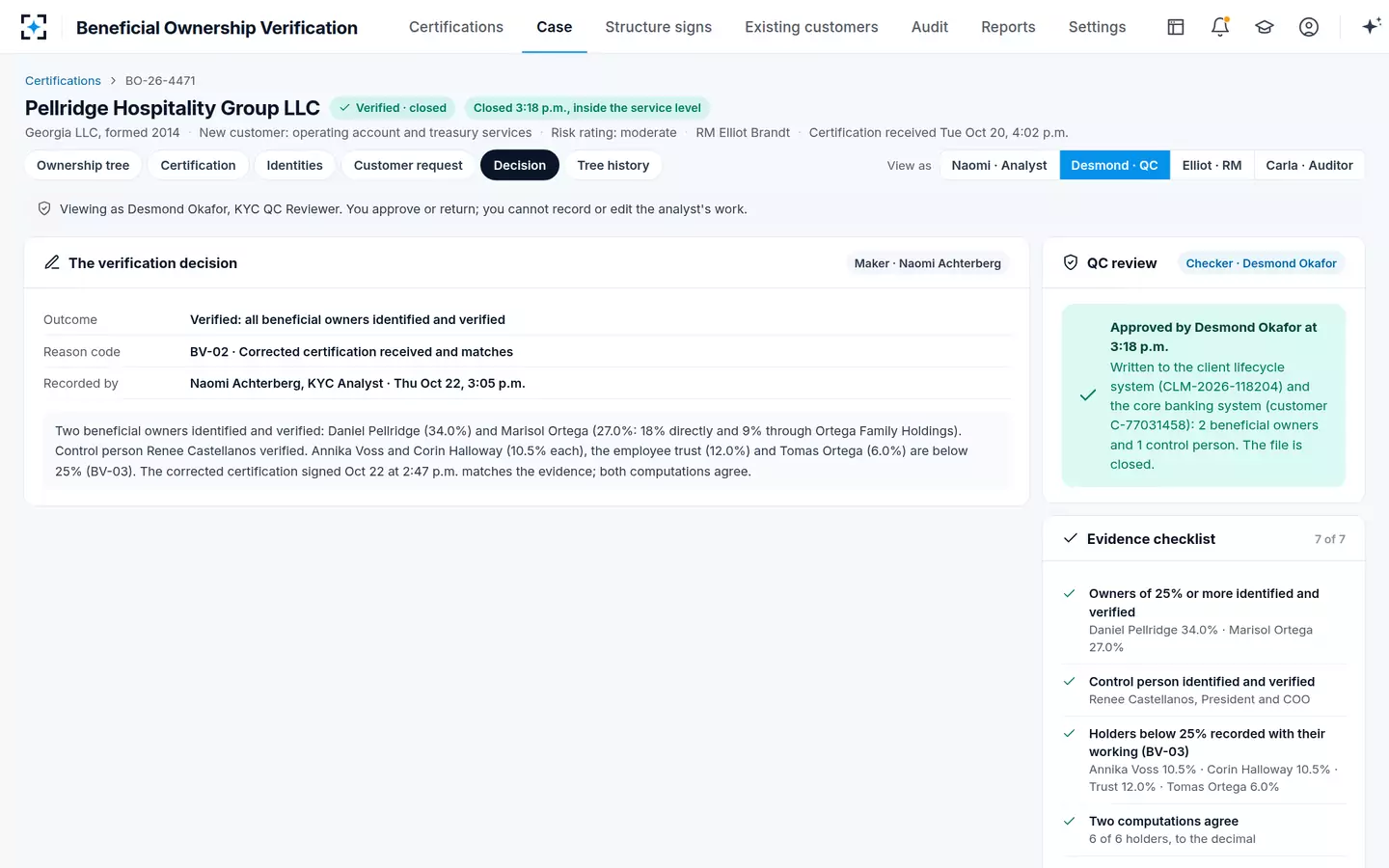
The case is strongest where files are layered, volumes of new business customers are meaningful, and the bank already collects operating agreements and owning-entity documents at opening. There, the solution's agents read every document, build each ownership tree twice on two models, compare it with the certification person by person, verify identities and screen OFAC, and draft any corrected-certification request; the analyst decides and QC approves before anything reaches the customer or the core. Every action is kept with its evidence, and a sealed pack hands an examiner the documents, every version of the tree and each decision with its maker and checker.
What the error case is buying: a file that answers for itself
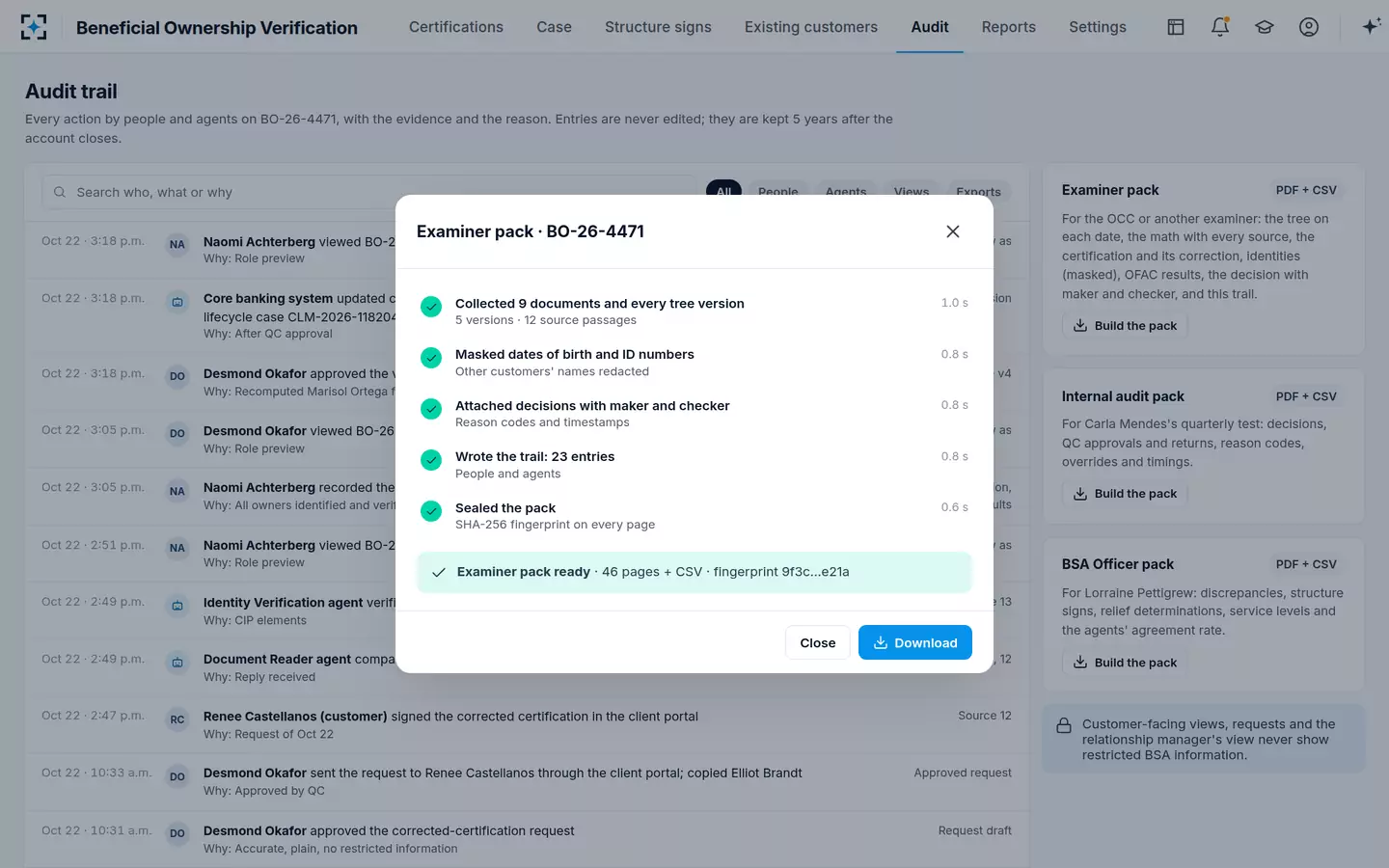
The case is weak for a bank whose legal-entity customers are mostly single-member or two-member LLCs, where the form and the documents rarely disagree and the arithmetic is trivial. It is also weak where the bank does not collect the documents: no software can compare a certification with papers the bank never asked for. In those settings the honest first step is a procedure change, asking for operating agreements on layered entities, not a licence. And the solution does not set the bank's ownership line, its reliance policy or its use of FinCEN's relief; those remain the BSA officer's decisions.
The decision the cost case rests on: recorded, reasoned, approved
Questions people ask
How much does beneficial ownership software cost?
Vendors rarely publish prices, and what drives them varies: entities, accounts, documents or users. Compare quotes with the bank's own cost of the work, using FinCEN's 20 to 40 minutes per account as a floor and your own hours on layered files as the real figure, plus validation and integration.
Is a beneficial ownership program required for every bank?
Every bank, credit union and other covered institution under the CDD Rule must have written procedures reasonably designed to identify and verify the owners of legal entity customers, included in its AML program. The rule requires the procedures, not software.
Can a bank be fined for missing a beneficial owner?
Enforcement usually cites the program rather than a single file: inadequate controls, testing or due diligence. FinCEN can impose penalties for each day an adequate program is not in place, and supervisors can order remediation and look-backs, as the OCC did at Blue Ridge Bank in 2024.
Does FinCEN's 2026 relief reduce the need for beneficial ownership software?
It reduces repeat work at existing customers' later accounts, if the bank adopts it. It raises the stakes on the first certification, which now carries the relationship, and adds a determination at each later account that must be reasoned and kept.
What is the cheapest way to reduce beneficial ownership risk?
Collect the documents. A bank that asks for operating agreements and owning-entity agreements on layered customers gives its analysts the means to notice a missing owner; without them, neither people nor software can compare the certification with anything.
How do we measure whether beneficial ownership software works?
Run it on past files your team reviewed and count agreements, owners it found that you missed, and owners you found that it missed. Then track, in production, corrected certifications before opening against corrections after it.