Does a trust need beneficial ownership? It depends on whether the trust is the bank's customer or an owner of the customer. A trust that opens an account in its own name is generally not a "legal entity customer" under FinCEN's Customer Due Diligence Rule, because only statutory trusts created by a filing with a state office are, so it does not give a beneficial ownership certification; the bank identifies it under its Customer Identification Program and, in practice, its trustees. A trust that owns 25% or more of a business customer is different: for that stake "the beneficial owner … shall mean the trustee", and the business must name the trustee on its certification. Analysts get this wrong in both directions, and Botminds' Beneficial Ownership Verification flags every trust in an ownership tree so an analyst can apply the right rule. The same logic sorts nonprofits, churches, partnerships and the excluded entities, set out below as one decision order.
A trust, an LLC and a nonprofit under the beneficial ownership rule
| Question | A trust (not statutory) | An LLC or corporation | A nonprofit corporation |
|---|---|---|---|
| Is it a legal entity customer? | No, unless it is a statutory trust created by a filing with a state office (FAQ E.3) | Yes (1010.230(e)(1)) | Yes, if it filed its organizational documents with the state |
| When it is the bank’s customer | CIP for the trust; trustees identified as signatories, settlor or others for some revocable trusts | Certification: owners of 25% or more and one controller | Certification of one controller only |
| When it owns 25% of a business customer | Its trustee is named for that stake (1010.230(d)(3)) | Look through it to the individuals behind it | Rare; look through to whoever controls it |
| Ownership prong | Not applicable as a customer | Up to four individuals at 25% or more | Does not apply (1010.230(e)(3)(ii)) |
| Control prong | Not applicable as a customer | One individual, always | One individual, always |
Does a trust have beneficial owners under the CDD Rule?
Not in the rule's sense, when the trust is the customer. FinCEN left trusts out of the definition of legal entity customer, except statutory trusts, "because a trust is a contractual arrangement between the person who provides the funds or other assets and specifies the terms (i.e., the grantor/settlor) and the person with control over the assets (i.e., the trustee), for the benefit of those named in the trust deed (i.e., the beneficiaries). Formation of a trust does not generally require any action by the state" (FAQ E.3). In 2016 it added that identifying a "beneficial owner" from among those parties, on the rule's definition, "would not be possible" (81 FR 29398).
That does not leave trust accounts unexamined. FinCEN says the rule "does not supersede existing obligations and practices regarding trusts generally", that banks "generally also identify and verify the identity of trustees, because trustees will necessarily be signatories on trust accounts", and that while banks "are not required to look through a trust to its beneficiaries", they "may need to take additional steps to verify the identity of a customer that is not an individual, such as obtaining information about persons with control over the account" (FAQ E.3).
Who is the beneficial owner of a revocable trust?
Under the CDD Rule, no one is named as such when the revocable trust is the customer, because it is not a legal entity customer. The bank's CIP and supervisory guidance decide what to collect, and FinCEN quotes that guidance directly: "in certain circumstances involving revocable trusts, the bank may need to gather information about the settlor, grantor, trustee, or other persons with the authority to direct the trustee, and who thus have authority or control over the account, in order to establish the true identity of the customer" (FAQ E.3). For a revocable living trust, where the grantor can revoke it and take the assets back, the grantor is the obvious candidate.
When a revocable trust owns 25% or more of a business customer, the ownership rule applies like any other trust: the trustee is named for that stake. In many family arrangements the grantor and the trustee are the same person, so the question answers itself; when they are not, the bank names the trustee and may, on risk, ask about the grantor too.
Beneficial ownership for trust accounts depends on which side of the account the trust sits
The trust is the customer: No, unless it is a statutory trust.
The trust owns 25% of the customer: Yes: the business customer certifies, and the trust is one of its owners.
The trust is the customer: The trust under CIP; in practice its trustees, who sign on the account.
The trust owns 25% of the customer: The trustee, for the ownership prong; at least one trustee if there are several (FAQ B.22).
The trust is the customer: Identified under CIP like any non-individual customer.
The trust owns 25% of the customer: May be named for the ownership prong; no natural person is required for that stake (FAQ B.23).
The trust is the customer: Not required to look through to beneficiaries; may need the settlor or others for revocable trusts.
The trust owns 25% of the customer: Not named under the rule; a bank may collect more on risk.
The trust is the customer: Not applicable.
The trust owns 25% of the customer: Still one natural person who runs the business customer.
When a trust owns 25%: the trustee is the beneficial owner
The rule is one sentence: "If a trust owns directly or indirectly, through any contract, arrangement, understanding, relationship or otherwise, 25 percent or more of the equity interests of a legal entity customer, the beneficial owner for purposes of paragraph (d)(1) of this section shall mean the trustee" (31 CFR 1010.230(d)(3)). The 25% is measured like any other stake, through every layer, so a trust that owns half of a holding company with a 50% stake in the customer holds 25% and its trustee must be named. The arithmetic is set out in how to calculate beneficial ownership percentage.
Two FAQs settle the common follow-ups. Where a trust has several trustees, banks must collect and verify "at a minimum, one trustee" and may identify more on risk (FAQ B.22). Where the trustee is itself an entity, such as a law firm or a bank trust department, "the beneficial owner for purposes of the ownership/equity prong is the trustee, regardless of whether the trustee is a natural person or a legal entity"; no natural person is identified for that stake, though the bank should collect identifying information on the trustee entity under its CIP (FAQ B.23). FinCEN adds that the two prongs "are independent requirements": the business must still name one natural person as its controller.
The trustee rule in four numbers
25%
a trust’s stake, direct or indirect, at which its trustee must be named
1010.230(d)(3)
1
trustee at minimum when a trust has several; more on the bank’s risk assessment
FAQ B.22
0
natural persons required for a trust’s stake when the trustee is a company
FAQ B.23
1
natural-person controller still required for the business customer
FAQ B.23
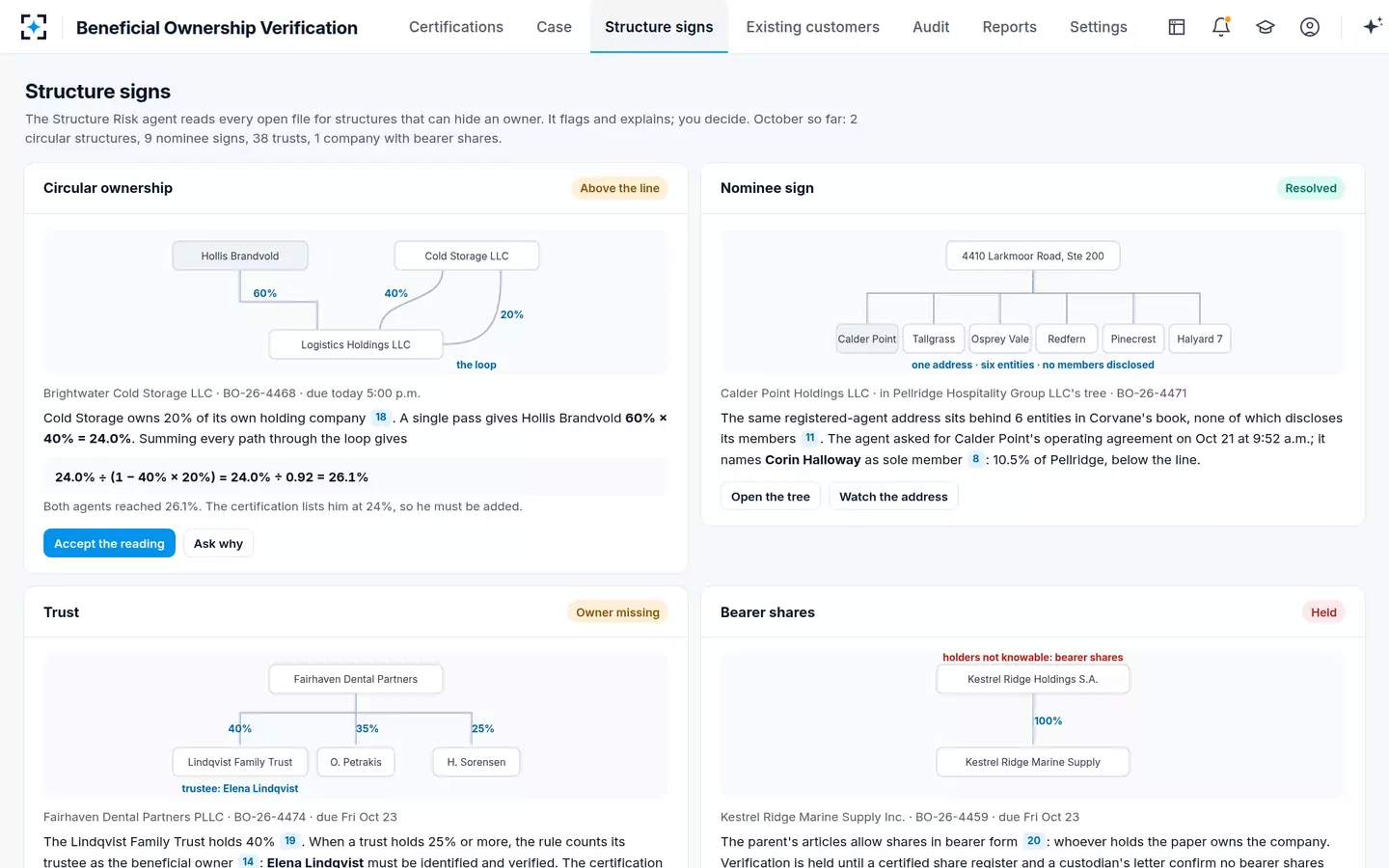
The most common mistake runs the other way: the customer names the trust itself as the owner. On Beneficial Ownership Verification's sample data, Fairhaven Dental Partners, a fictional professional company, certified that the Lindqvist Family Trust holds 40%. The Structure Risk agent found the trust and its trustee in the documents, and the file was held: the rule counts the trustee, Elena Lindqvist, who must be identified and verified like any owner.
Structure signs: a trust whose trustee must be named
Is beneficial ownership required for nonprofits?
Only the control person. A nonprofit corporation whose organizing documents are on file with the state, as required, is "subject only to the control prong" (1010.230(e)(3)(ii)), because "nonprofit entities generally do not have ownership interests". The test is how the entity was organized, not its tax status: the exclusion is "not limited to those entities that meet the definition or description of charitable, nonprofit, or similar entities under the IRC", and covers "all nonprofit entities—whether or not tax-exempt—that are established as a nonprofit, or nonstock corporation" (FAQ E.6). So a nonprofit's certification names one individual, typically an executive director, president or treasurer.
Does beneficial ownership apply to churches?
It depends on how the church is organized, not on its being a church. A church incorporated as a nonprofit or religious corporation with the state is a legal entity customer subject only to the control prong: it names one person who runs it. A church that operates as an unincorporated association is not a legal entity customer at all, since "sole proprietorships … and unincorporated associations are not legal entity customers as defined by the Rule" (FAQ E.4); the bank applies its CIP to the association and the people who open and sign on the account. The bank's question is therefore the same as for any customer: what filing, if any, created it?
Does beneficial ownership apply to partnerships?
Yes. The rule names "a general partnership" in the definition of legal entity customer, and FinCEN's FAQ adds that the definition "also includes limited partnerships, business trusts that are created by a filing with a state office, and any other entity created in this manner" (FAQ E.1). Both prongs apply: each partner, general or limited, with 25% or more of the equity, and one controller, for which the rule's own examples include a "General Partner". A sole proprietorship, including one run by spouses, is not a legal entity customer even if it registers a trade name with the state (FAQ E.4).
Beneficial ownership exemptions: the excluded entities and exempt accounts
Two lists take customers or accounts out of the rule. The first, sixteen excluded types in 1010.230(e)(2), removes entities whose ownership is already visible to a regulator or the public: banks regulated by a federal or state regulator, companies listed on US exchanges and their 51%-owned US subsidiaries, SEC-registered issuers, investment companies and advisers, exchanges and clearing agencies, CFTC registrants, registered public accounting firms, bank and savings and loan holding companies, pooled vehicles run by excluded institutions, state-regulated insurers, designated financial market utilities, some foreign financial institutions and foreign governmental bodies, and private banking accounts covered by a separate rule. Companies listed on foreign exchanges are not excluded (FAQ E.7).
The second list, in 1010.230(h), exempts four kinds of account: point-of-sale retail credit up to $50,000, and accounts financing postage, insurance premiums or equipment where the bank pays the provider directly. The exemptions fall away for transaction accounts that make or receive third-party payments, and where a cash refund is possible. A bank may rely on the customer's information to decide that an exclusion applies, absent knowledge to the contrary, and its procedures should say what evidence it accepts (FAQ E.5).
Which beneficial ownership rule applies: a decision order
1Is the customer a legal entity customer?
If yesA corporation, LLC or other entity created by a filing with a Secretary of State, a general or limited partnership, a statutory trust, or a similar foreign entity.
If noA natural person, sole proprietorship, unincorporated association, or a trust that is not a statutory trust: no certification under the rule; the bank’s CIP applies.
2Is it on the exclusion list?
If yesOne of 16 excluded types, such as a regulated bank, a listed company or its 51% subsidiary, an SEC-registered adviser, a bank holding company or a state-regulated insurer: no beneficial owners to collect.
If noContinue.
3Is the account exempt?
If yesPoint-of-sale credit up to $50,000, postage finance, insurance premium finance, or equipment finance paid directly to the vendor, with no third-party payments or cash refunds.
If noContinue.
4Is it a nonprofit, or a pooled fund with a non-excluded adviser?
If yesControl prong only: name one individual who controls, manages or directs it.
If noBoth prongs apply.
5Does anyone reach 25% through any path?
If yesAn individual: name that person. A trust: name its trustee. An excluded entity: no individual for that stake.
If noNo one is named under the ownership prong; continue.
6Who is the one control person?
AnswerAlways required: a senior official who runs the entity, even when a trustee or no one is named above.
What the US rule leaves out, and the EU and FATF do not
The US trustee rule is deliberately narrow: it names the person who controls the trust's assets, not the people who benefit. International standards ask for more. FATF Recommendation 25 requires countries to ensure information on express trusts covering the settlor, the trustee and the beneficiaries (FATF Recommendations, February 2025). The EU regulation that applies from 10 July 2027 looks through: where a legal arrangement has an ownership interest in a company, "the beneficial owners shall be the natural persons who are the beneficial owners of … the legal arrangements" (Regulation (EU) 2024/1624, Article 55). A US bank whose procedure stops at the trustee is compliant with the CDD Rule; a bank serving European structures will need both answers on file.
What to collect when a trust appears in an ownership tree
- The trust’s stake, through every layer
If it reaches 25%, the trustee must be named; below 25%, record why no one was.
- The trust instrument or a certificate of trust
Names the trustee or trustees, and whether the trust is revocable.
- The trustee’s four identifiers
Name, date of birth, address and ID number, verified like any owner; at least one trustee if there are several.
- For a corporate trustee, the entity’s identity
Collected under the bank’s CIP; no natural person is required for the stake (FAQ B.23).
- The controller of the business customer
Still one natural person, whatever the trust holds.
- A note on the grantor and beneficiaries, on risk
Not required by the US rule; often needed for revocable trusts and for EU or FATF-aligned procedures.
Where Beneficial Ownership Verification applies the decision order
Every certification in the solution runs through the same questions before any arithmetic is trusted. A Document Reader agent extracts trust agreements and registry extracts along with the operating agreements; the Ownership Builder agent places each trust in the tree and computes its effective stake; and the Structure Risk agent flags trusts and their trustees, hands anything needing enhanced due diligence to the BSA officer, and never decides that a customer is a risk. If the trust reaches the line, the trustee joins the list of people to verify, and if the certification named the trust instead, an agent drafts the corrected-certification request for QC to approve.
Exclusions and exemptions are the analyst's call, recorded with the evidence relied on. The solution shows what the documents say; whether a customer's listing, regulator or account type takes it out of the rule is a judgment the bank's procedure assigns to a person. Who signs the certification that all of this is compared against is covered in beneficial ownership certification: who signs, and what it means.
Questions people ask
Does a trust need a beneficial ownership form to open a bank account?
Usually not. Only statutory trusts created by a filing with a state office are legal entity customers under the CDD Rule. Other trusts are identified under the bank's CIP, and banks generally identify and verify the trustees who sign on the account.
What is the beneficial owner percentage for a trust?
The same 25% as any owner. If a trust owns 25% or more of a business customer, directly or indirectly, the trustee is named as the beneficial owner for that stake. A trust below 25% is not named, though the bank may record why.
Is the beneficiary of a trust a beneficial owner?
Not under the US CDD Rule, which names the trustee. FinCEN said in 2016 that identifying a beneficial owner from among a trust's parties would not be possible on the rule's definition. The EU regulation and FATF standards do look through to beneficiaries.
Do pooled investment funds need beneficial ownership?
A pooled vehicle advised by an excluded institution is excluded. One advised by a non-excluded firm is subject only to the control prong: banks are "not required to look through a pooled investment vehicle", but must name an individual who controls it, such as a portfolio manager or general partner (FAQ B.21).
Are sole proprietorships subject to beneficial ownership?
No. A sole proprietorship, including one formed by spouses, is not a legal entity customer, even if it registers a trade name with the state, because it is not a separate legal entity from its owner (FAQ E.4).
Is an LLC owned by a trust a legal entity customer?
Yes. The LLC is the customer and certifies its owners; if the trust holds 25% or more, the LLC names the trustee for that stake and still names one individual as its controller.