The cost of UBO screening for sanctions, the check of who ultimately owns a counterparty against the lists and the 50% rule, is mostly the cost of an analyst's time, and the time depends on depth. Where every owner is a person named in one registry extract, a review takes about an hour and a half by our estimate; a three-layer tree with an offshore layer takes about seven and a half hours; a five-layer, three-country structure can take a day and a half. At the mean wage of a compliance officer in U.S. credit intermediation, that is roughly $70 to $520 in wages per review, before data, overhead and the officer's time. Against it sits the cost of a miss: a payment to a company 50% owned by blocked persons is a dealing in blocked property, and the cases below run from £165,000 to the statutory maximum. Botminds' Sanctions Ownership & Control is designed to cut the deep review to under an hour of analyst and officer time, a target, by having agents do the tracing and arithmetic.
The time estimates on this page are ours, built from the sample bank's design in Sanctions Ownership & Control and labelled as estimates; they are not measured results. The penalty figures are from regulators' published notices.
The two sides of the sum
$45.24/hour
mean wage of a compliance officer in U.S. credit intermediation ($94,090 a year ÷ 2,080 hours)
7.5hours
one deep review by hand: three layers, one offshore (our estimate)
< 1hour
analyst and officer time with agents: a design target
$3.69M
IEEPA maximum civil penalty for the sample’s $1,846,500 payment: twice the transaction
How much does UBO screening cost per entity?
In analyst wages alone, from about $70 for a simple structure to about $520 for a deep one, by our estimate; fully loaded, more. The arithmetic is hours times an hourly cost, plus the officer's time to decide, plus the registry extracts the review consumes. The Bureau of Labor Statistics puts the annual mean wage of compliance officers in credit intermediation at $94,090, or $45.24 an hour over 2,080 hours (BLS, May 2025). BLS has no separate sanctions-analyst occupation, so this is the closest published figure; a bank should use its own loaded rate.
The cost of one UBO sanctions screening review
Analyst time
hours by depth × loaded hourly cost
1.5 to 11.5 hours by hand, by our estimate; $45.24 an hour in wages before benefits and overhead.
Sanctions operations
Officer time
minutes to decide × officer hourly cost
Reading the prepared case and deciding; longer when the memo's numbers cannot be traced.
Sanctions officer
Data
extracts per review × price per extract
One registry extract per company in the chain; the bank's own contract sets the price.
Procurement
Delay
hours a payment or trade is held
A held payment or a letter of credit waiting on the review has its own cost to the customer and the bank.
Business line
How long does a deep ownership review take?
About seven and a half hours by hand for a three-layer tree with one offshore layer, by the sample bank's design estimate, and the hours rise with every layer, jurisdiction and transfer. The bars below scale that estimate up and down. They are our estimates, meant to show the shape of the cost rather than any bank's measured time.
Hours per UBO sanctions screening review, by structure depth (our estimate)
Where the hours go matters as much as how many there are. In the three-layer estimate, two hours are spent pulling registry extracts one layer at a time and another three on reading documents, matching names and adding shares: mechanical work. An hour and a half goes to the memo and the decision, which is judgement. A tool that halves the judgement time has probably removed something it should not have; one that removes the mechanical hours has not.
What drives UBO screening cost?
Five things, roughly in this order. Layers, because each corporate owner means another extract, another set of names to match and another percentage to carry. Jurisdictions, because registries differ in what they file, how they are reached and in what language. Transfers, because a change near a designation has to be replayed against the designation date. Conflicts, because a certification that disagrees with the registry needs a request, a wait and a second look. And the clock, because a held payment is reviewed now, by whoever is free, rather than when the right analyst is.
The fifth driver hides in the others. OFSI's penalty against Citibank's London branch described a top review tier so swamped by potential matches, each needing a person, that some alerts sat undecided for weeks (OFSI, August 11, 2026; the queue arithmetic is in sanctions screening analyst job description). Ownership reviews that take a day each are the reviews that build such a backlog after a large designation.
Is it cheaper to buy ownership data?
Buying ownership data cuts the collecting hours, not the deciding ones, and it moves a risk rather than removing it. OFSI "acknowledges the value that third-party data providers can afford firms", particularly where a bank has no direct relationship with a payment's beneficiary. In the same notice it found that the bank's purchased lists had no ownership data for the company it paid, and that the bank "remained ultimately responsible for ensuring it acts in compliance with financial sanctions" (OFSI, Deutsche Bank AG London).
The useful comparison is not data versus people but what each review consumes: extracts, matching, arithmetic, a memo and a decision. Data subscriptions supply extracts. Agents can do the matching, arithmetic and first draft from those extracts. People remain the cost of the decision, and they should. Sanctions Ownership & Control works with the bank's registry data service rather than replacing it.
What does a missed 50%-owned entity cost?
The legal ceiling is high and the cases show it is used. Under IEEPA the maximum civil penalty is $377,700 or twice the value of the transaction, whichever is greater, per violation (31 CFR 505; how OFAC gets from that ceiling to an actual figure is in OFAC penalty calculation). For the sample's single $1,846,500 payment, twice the transaction is $3,693,000. Actual penalties depend on egregiousness, voluntary disclosure and cooperation under OFAC's enforcement guidelines; the table shows the range in ownership cases.
What missing or misreading ownership has cost, in published cases
| Case | What was missed | Outcome |
|---|---|---|
| Deutsche Bank AG London (OFSI, April 2026) | Two payments of £635,618.75 to a company wholly owned by a designated person; vendor lists had no ownership data. | £165,000 after a 45% discount from a £300,000 baseline. |
| Citibank N.A. London (OFSI, August 2026) | Accounts of companies owned or controlled by a designated individual left unrestricted; 242 payments, about £5.9 million, among 970 breach payments in all. | £4,732,830.58 for the whole case. |
| Fracht FWO (OFAC, September 2025) | A charter with a wholly owned subsidiary of a designated airline. | $1,610,775 settlement. |
| Gracetown (OFAC, December 2025) | Payments for a company owned by a designated oligarch; blocked funds reported 45 months late. | $7,139,305 penalty. |
| IPI Partners (OFAC, December 2025) | An investor below 50% on paper, funded and directed through a blocked oligarch's representatives. | $11,485,352 settlement. |
| GVA Capital (OFAC, June 2025) | An investment managed through a blocked oligarch's nephew. | $215,988,868, the statutory maximum. |
Set the two sides next to each other. At our estimate, a bank could run more than 480 deep reviews by hand for the wage cost of the smallest penalty in the table, converted at any plausible exchange rate. The cheapest review is not the goal; the goal is that every review that matters is deep enough, documented, and finished while the payment is held.
How many entities need a deep ownership review?
Fewer than all, chosen by risk. The FFIEC manual lists examples of "products, services, customers, and geographic locations that may carry a higher level of OFAC risk", among them "international funds transfers", "commercial letters of credit and other trade finance products", "foreign correspondent bank accounts" and "foreign customer accounts" (FFIEC). Counterparties in those lines, with corporate owners abroad, are where a deep review earns its cost. A domestic customer owned by named individuals usually needs the short review.
List changes add a second stream. In the solution's sample, three list updates touched 6, 38 and 14 ownership trees on file, and 0, 5 and 3 of them reached 50%; the October 21 update touched 11 of 6,214 trees, with 2 at 50% or more. Each touched tree is a review to reopen. A bank that cannot search its trees in reverse after a designation will either re-review everything or miss the few that moved.
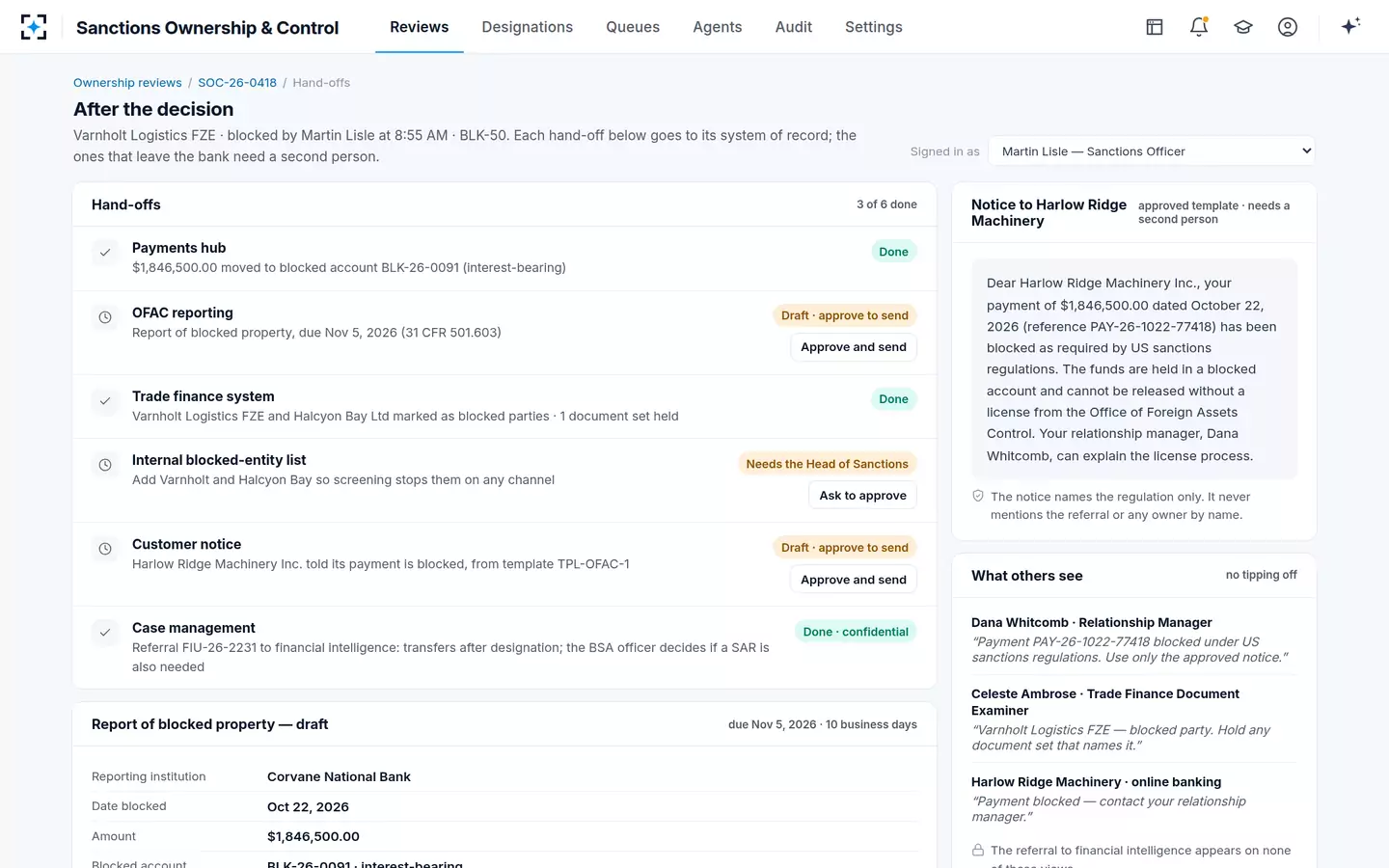
What follows a block in Sanctions Ownership & Control: the work a missed review skips
A worked budget: one year of ownership reviews
Put the per-review estimates into a year and the shape of the budget appears. Take an illustrative bank that opens 600 ownership reviews a year: 360 where the owners are people in one registry, 150 with two layers, 72 with three layers and an offshore layer, and 18 with five layers across three countries. The mix is our assumption; a bank should use its own.
At our hours, that is 540 + 675 + 540 + 207 = 1,962 analyst hours, a little under one full-time analyst at 2,080 hours, or about $88,760 in wages at $45.24 an hour. The 90 deep reviews, three layers and more, take 747 of those hours, 38% of the time for 15% of the cases. If the deep reviews met the solution's design target of under an hour of analyst and officer time, those 747 hours would fall below 90; the 510 simpler reviews would change much less, because they were never mostly collecting.
Two things this budget leaves out are the ones that hurt. The surge after a large designation, when touched trees all need reopening at once, and the cost of the wrong answer in the review that was rushed. Capacity for the week after a designation, not the annual average, is the number that decides whether reviews stay deep enough. In the sample, one list update put five counterparties at 50% or more, and the bank's settings give each such review a two-day clock.
What Sanctions Ownership & Control changes in the sum, and what it does not
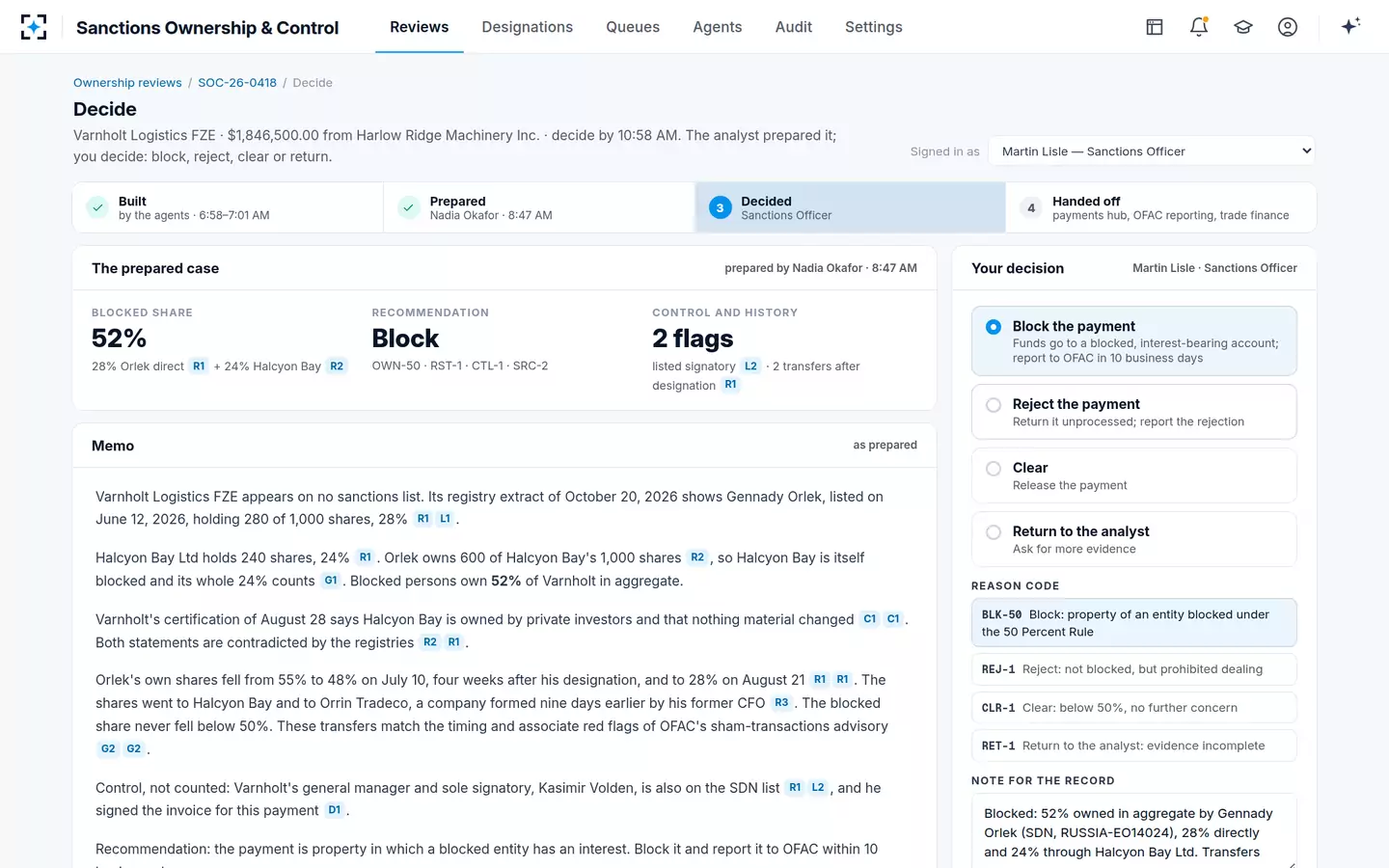
It changes the mechanical hours. In the sample, the agents read three registries, a certification and two trade documents and built a cited tree in three minutes; the analyst's work moved from building to checking, and the design target for a deep review is under an hour of analyst and officer time. It does not change the decision cost, by design: an analyst still checks what the answer hinges on, and an officer still decides. It does not remove data costs, and it cannot make a registry file what it does not file.
The officer's time is spent on the decision, not on rebuilding the numbers
For the evidence a buyer should ask for before trusting those numbers, see a pilot on closed ownership reviews; for where software's authority should stop, agents trace, an officer decides. The solution is at Sanctions Ownership & Control.
Questions people ask
What is UBO screening?
UBO screening checks a company's ultimate beneficial owners against sanctions, PEP or other lists. For sanctions it has to go further than matching names: OFAC's 50% rule means a company owned half or more by blocked persons together is blocked even when no owner's name is on the company's own record.
Why is UBO sanctions screening more expensive than name screening?
Because name screening compares one name with a list, while an ownership review builds a tree, matches every owner, adds the blocked shares and documents the result. In our estimate a deep review takes 7.5 hours by hand; the screening of one name takes seconds of machine time.
Can we screen ownership only at onboarding?
Not safely. Ownership changes and so do the lists; the FFIEC expects existing customers to be checked when the OFAC list changes, and a designation two layers up can block an existing counterparty overnight. In the sample, one list update touched 38 trees on file.
Do the hours change with the EU and UK tests?
Somewhat. The tree is the same, but each regime reads it differently: the UK needs more than 50% and does not add holders by default, while the EU counts control as its own test. Recording control indicators properly adds time to every review, but less than building a second tree.
What is the biggest hidden cost in ownership reviews?
Backlog. The CBNA case shows alerts left unadjudicated for weeks after a wave of designations, and the bank's response, relaxing when accounts were restricted, became part of a £4.73 million penalty. Capacity for the week after a large designation is the number to plan for.