Is the BIS affiliates rule suspended? Yes, until November 9, 2026. The Bureau of Industry and Security's interim final rule of September 30, 2025 extended Entity List restrictions to "any entity that is at least 50 percent owned by one or more entities on the Entity List" (90 FR 47201). Six weeks later BIS stayed it: "Effective November 10, 2025, the amendments … are stayed until November 9, 2026", and in a second phase, "effective November 10, 2026 and extending indefinitely", the rule's changes "will be added back into the EAR" (90 FR 50857). When we checked on October 26, 2026, the Federal Register showed no rule extending the stay, and the regulations on bis.gov still carried BIS's notes that the affected paragraphs are "stayed, effective until Nov. 9, 2026" (15 CFR part 744). The rule matters to banks because it reuses OFAC's ownership arithmetic on a different list, and because name screening cannot see an unlisted affiliate. Botminds' Sanctions Ownership & Control builds the ownership trees that question needs; its sample data covers the OFAC lists.
The affiliates rule, by the numbers BIS published
42days
in force before the stay: September 29 to November 9, 2025
365days
stayed: November 10, 2025 to November 9, 2026
170
extra license applications a year BIS expected from the Entity List and MEU List changes alone
50%
or more, directly or indirectly, individually or in aggregate: the same line as OFAC
Is the BIS 50 percent rule suspended?
Yes. The suspension took effect on November 10, 2025 and "is set to end November 9, 2026, absent a future extension". BIS designed it in two phases: the first removed the affiliates provisions from the Export Administration Regulations for a year; the second, already written into the same rule, puts them back on November 10, 2026. A business that does nothing gets the rule back automatically.
BIS said what it would do during the year: "BIS will continue to evaluate U.S. national security and foreign policy interests related to these non-listed foreign affiliates of listed entities." It did not promise an outcome. Any extension or change would have to be published, and BIS's page in the Federal Register is where it would appear first. Our check of the Federal Register's search on October 26, 2026 found BIS rules on other subjects after the stay, and none on affiliates.
The BIS affiliates rule, from effective date to return
- In force42 d
- Stayed until Nov 9, 2026365 days
- Returns Nov 10, 2026
What does the BIS affiliates rule require?
It treats an unlisted foreign company as if it were on the Entity List when listed parties own 50% or more of it. The regulatory text, as it stands in the stayed § 744.11(a)(1), says the Entity List license requirements and other restrictions "also apply to any foreign entity that is owned, directly or indirectly, individually or in aggregate, 50 percent or more by one or more listed entities or unlisted entities that are subject to Entity List license requirements or other Entity List restrictions based upon their ownership". The same approach applies to the Military End-User List and to SDNs designated under the programs listed in § 744.8.
Four features shape the compliance work. First, where several restricted owners add up to 50%, the affiliate takes "the most restrictive license requirements, license exception eligibility, and license review policy applicable to one or more of its owners". Second, a new Red Flag 29: an exporter who "cannot determine the ownership percentage" must "resolve the Red Flag or obtain a license from BIS prior to proceeding … unless a license exception is available". Third, an affiliate is not caught merely because its owner sits at an address listed on the Entity List, if the owners at that address are not themselves named. Fourth, liability is strict: exporters "can be held liable for unauthorized exports, reexports, or transfers (in-country) on a strict liability basis, so due diligence must be conducted".
“The application of the Affiliates rule creates an affirmative duty to determine the ownership of other parties to the transaction in order to comply.”
BIS, interim final rule, 90 FR 47201
BIS explained why it moved. Under the old approach an affiliate "legally distinct from the listed entity" was outside the restrictions unless separately listed, and BIS was "concerned that the old approach can enable diversionary schemes, such as the creation of new foreign companies to evade Entity List restrictions". The affiliates rule is meant to end that chase, in which BIS "frequently published additional final rules to identify legally distinct foreign affiliates".
When does the BIS affiliates rule come back?
On November 10, 2026, unless BIS publishes a further stay or change before then. The stay rule itself contains the amendatory instructions that restore the provisions; each, in BIS's words, "begins with the wording 'Effective November 10, 2026, amend'". The return does not need a new rule. A further suspension would.
The dates carry one trap. The original rule's temporary general license for some non-listed affiliates, in supplement no. 1 to part 736 paragraph (g), was stayed with everything else, according to the note on bis.gov's text of part 736. How any transition relief applies after November 10 is a question for the text in force on that day, not for the 2025 rule as first published.
Does the BIS affiliates rule match the OFAC 50 rule?
On the arithmetic, deliberately so. BIS wrote that "the 50 percent ownership standard in this IFR is designed to be consistent with longstanding Department of the Treasury practice, so as to limit the additional burden on the business community", and its new Supplement No. 8 to part 744 "provides similar guidance as is contained in the guidance document from OFAC" of August 13, 2014. Beyond the arithmetic, the two differ in what they protect and what follows.
BIS affiliates rule vs OFAC 50 rule: same line, different consequences
OFAC 50 Percent Rule: Blocked persons: SDNs and others blocked by law, across all OFAC programs.
BIS affiliates rule (from Nov 10, 2026): Entity List and MEU List entities, and SDNs under the programs in § 744.8, plus affiliates already restricted by ownership.
OFAC 50 Percent Rule: 50% or more, directly or indirectly, in the aggregate.
BIS affiliates rule (from Nov 10, 2026): The same: "directly or indirectly, individually or in aggregate, 50 percent or more".
OFAC 50 Percent Rule: Property: the entity's property and interests in property are blocked.
BIS affiliates rule (from Nov 10, 2026): "The EAR requirements are not focused on property, but rather on identifying foreign affiliates" that could divert items to listed parties.
OFAC 50 Percent Rule: Block, report within 10 business days; no dealings without a license.
BIS affiliates rule (from Nov 10, 2026): The owner's license requirements and review policy; the most restrictive where owners differ.
OFAC 50 Percent Rule: No written rule; OFAC urges due diligence and caution.
BIS affiliates rule (from Nov 10, 2026): Red Flag 29: resolve it, get a license, or use a license exception before proceeding.
OFAC 50 Percent Rule: Caution where blocked persons hold a significant minority or control.
BIS affiliates rule (from Nov 10, 2026): Significant minority ownership or "other indicia of control" is a red flag of diversion risk.
The practical upshot: an ownership tree built once can answer both questions, if it records every owner against every list it matters for. OFAC's five 50 rule examples, worked, apply line for line to the BIS rule's arithmetic; what changes is the list of owners that count and the action that follows.
A worked example: one export, two listed owners
Take an illustrative case. A bank's customer exports machine parts to Company C abroad, financed under a letter of credit. Company C is on no list. Its registry shows Entity E1, on the Entity List with a presumption-of-denial review policy, holding 30%, and Entity E2, on the Military End-User List, holding 25%. Neither holds a majority, and a screen of the beneficiary's name returns nothing.
From November 10, Company C is restricted. The stayed text counts holdings "individually or in aggregate", so 30% plus 25% is 55%, over the line. Because its owners sit on different lists, the "most restrictive" rule gives Company C the strictest license requirement, exception eligibility and review policy of the two. And if the registry had shown a third holder as "unknown", Red Flag 29 would apply: the exporter must resolve the gap, obtain a license or rely on an exception before shipping. The arithmetic is OFAC's; the consequence is a license question rather than a frozen payment.
Before November 10 the same structure is not restricted by ownership, but the joint FinCEN and BIS alert already lists shared ownership with an Entity List party as a red flag for banks. A trade finance team that waits for the effective date to build the tree will be building it while the documents are on the desk.
Do banks need to screen for Entity List affiliates?
The rule binds exporters, reexporters and transferors, but BIS named banks in the same breath: "As with any export transaction, other parties, e.g., freight forwarders and financial institutions, may also have compliance obligations." The EAR's General Prohibition Ten bars anyone who would "finance" or "otherwise service" an export "with knowledge that a violation … has occurred, is about to occur, or is intended to occur" (15 CFR 736.2(b)(10)). A bank financing an export to an affiliate it knows is caught is exposed.
Trade finance is where that knowledge sits. FinCEN and BIS told banks in their June 2022 joint alert that "financial institutions directly involved in providing trade finance for exporters also may have access to information relevant to identifying potentially suspicious activity", such as "end-use certificates, export documents", and listed among its red flags companies that share an address or owners with a party on the Entity List (FinCEN and BIS, June 2022). From November 10, shared ownership of 50% or more will be more than a red flag for the exporter in the transaction.
What should a bank prepare before November 10, 2026?
Treat the return as the default and prepare for it in the two weeks left. Most of the work is the same ownership research a sanctions team already does for OFAC, pointed at more lists and fed by trade documents.
Readiness for the BIS affiliates rule's return on November 10, 2026
- Watch the Federal Register through November 9
An extension or amendment would be published there; the return needs no new rule.
- Decide which business lines it touches
Trade finance, export financing and correspondent flows for exporters; document who in the bank owns the question.
- Add the Entity List and MEU List to ownership trees
Mark every owner against them as well as the SDN List; the arithmetic is the same.
- Write the unknown-ownership rule
Red Flag 29 says an exporter that cannot determine ownership must resolve it, get a license or use an exception; a bank financing the export needs an equivalent stop.
- Flag significant minority ties
BIS treats significant minority ownership, "overlapping board membership or other indicia of control" as a diversion red flag.
- Re-run trees when the lists change
An Entity List addition can turn an existing customer's affiliate into a restricted party overnight; check every tree on file, at every layer.
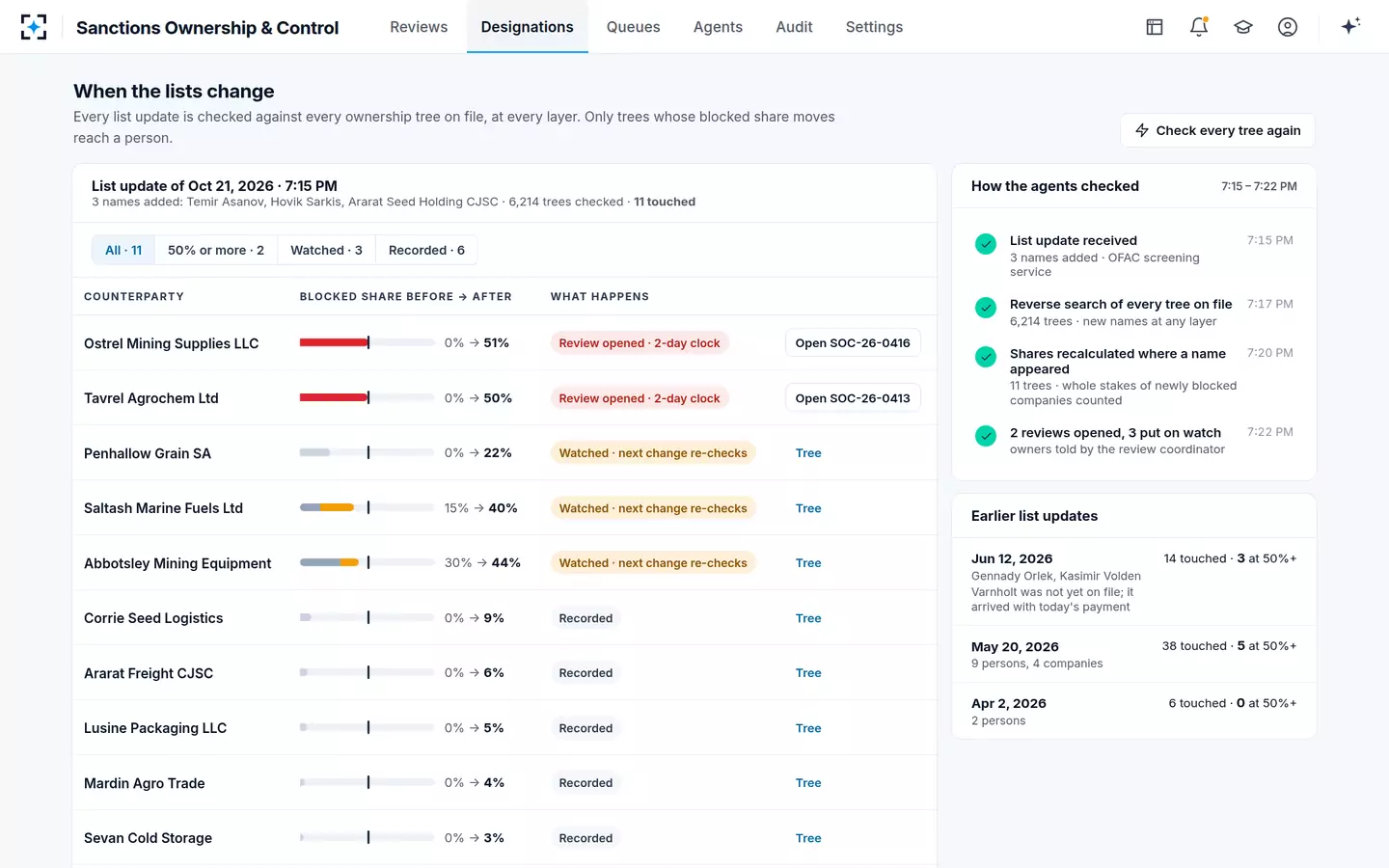
Why name screening misses an unlisted affiliate: the reverse search in Sanctions Ownership & Control
An affiliate caught by ownership is, by definition, not on the list being screened. That was BIS's own complaint about the old approach, and it is the reason the same problem exists under OFAC: screening matches names, and the names that matter are one or two layers up. The control that works is a reverse search: when a list changes, look for the new names at every layer of every ownership tree on file, and recompute.
Sanctions Ownership & Control: when the lists change, every tree on file is searched
One tree, every owner marked against the lists that apply
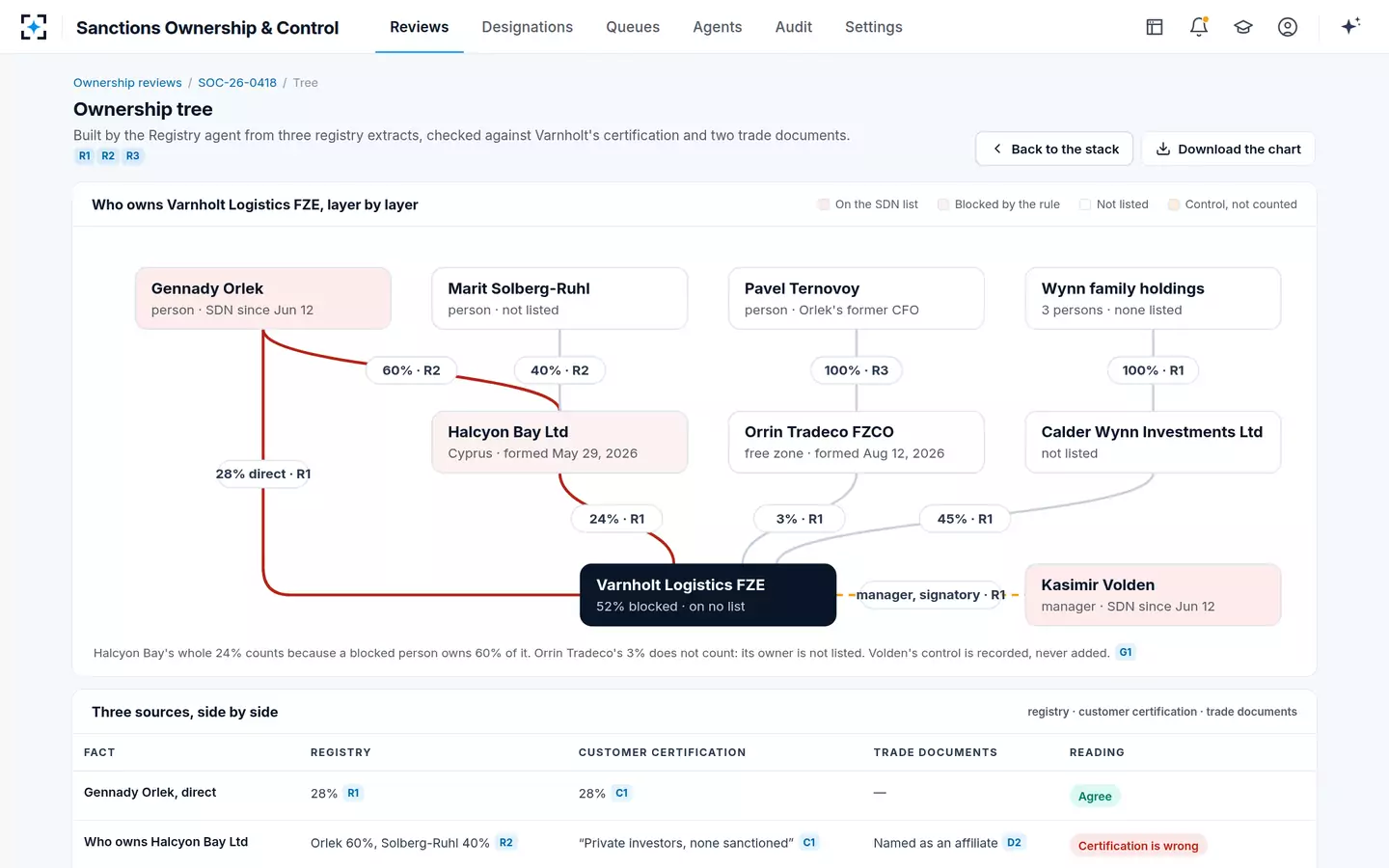
Sanctions Ownership & Control runs that search on the OFAC lists in its sample bank, and keeps control concerns apart from the percentage, as both agencies' guidance does. To see the ownership tree and the stack behind each answer, start from Sanctions Ownership & Control; for the full U.S., EU and UK picture on ownership, see the EU sanctions ownership and control test, compared.
Questions people ask
What is the BIS 50 rule's effective date?
It first took effect on September 29, 2025, under the interim final rule published the next day. It was stayed from November 10, 2025, and the stay rule restores it effective November 10, 2026, unless BIS extends the suspension.
What is the Entity List 50 rule?
It is the BIS affiliates rule: Entity List license requirements and restrictions extend to any foreign entity 50% or more owned, directly or indirectly, individually or in aggregate, by listed entities or by entities restricted because of their ownership. It mirrors OFAC's 50 Percent Rule for the Entity List.
Why did BIS suspend the affiliates rule?
The stay rule explains its two phases and says BIS "will continue to evaluate U.S. national security and foreign policy interests related to these non-listed foreign affiliates of listed entities" during the year. The rule's text gives no further reason, though BIS estimated the year's pause would mean 245 fewer license applications.
Does the affiliates rule apply to SDNs?
To SDNs designated under the programs listed in § 744.8(a)(1) of the EAR, yes: once the rule returns, their 50%-owned affiliates take on the EAR license requirements that apply to them. OFAC's own 50 Percent Rule already blocks the property of entities owned 50% or more by any blocked person.
What if we cannot find out who owns a foreign customer?
Under the rule, an exporter that "cannot determine the ownership percentage" must resolve Red Flag 29, obtain a license or rely on a license exception before proceeding. For a bank, an unknown layer in an ownership tree should stop a clear decision in the same way.