Does the OFAC 50 rule cover control? No. OFAC's FAQ 398 is direct: "OFAC's 50 Percent Rule speaks only to ownership and not to control. An entity that is controlled (but not owned 50 percent or more) by one or more blocked persons is not considered automatically blocked" (OFAC FAQ 398). But a company a blocked person controls is rarely a company a U.S. bank can deal with freely. OFAC can designate it; any contract a blocked person signs for it is off-limits; and where a minority owner on paper is a proxy, the blocked person may hold an interest in its property after all. Sorting those cases is the hard half of sanctions ownership and control. Botminds' Sanctions Ownership & Control adds blocked ownership to a 50% line and lists control concerns beside it, never inside it, so the officer who decides sees both.
The sample case on this page comes from the solution's fictional data: Corvane National Bank and a held payment to Varnholt Logistics FZE. The rules and enforcement cases are real and linked.
What control has cost when the 50% arithmetic said no
$216M
GVA Capital: statutory maximum, for managing a blocked oligarch’s money through his proxy
$11.49M
IPI Partners: 51 dealings after counsel said the oligarch did not “formally own 50% or more”
£4.73M
Citibank London (OFSI): included guidance to restrict only on evidence of 50% ownership
2014
OFAC’s revised guidance, still current, urging caution with entities a blocked person controls without owning half
Does the OFAC 50 rule cover control?
No: it counts shares, not influence. A blocked person who chairs the board, appoints the managers or holds a veto, but owns 30%, does not make the company blocked under the 50 Percent Rule. Nor does control get added to ownership: a blocked 40% shareholder who also runs the company is still 40%, not "50% in effect".
“OFAC may, however, designate the entity under an available sanctions criteria or otherwise identify the entity as blocked property if determined to be controlled by one or more designated persons.”
OFAC FAQ 398, released August 11, 2020
The same FAQ explains why the line exists and what lies beyond it. The 50 Percent Rule is a bright line that anyone can apply from a share register. Control is a judgement, and OFAC keeps that judgement for itself: it may designate a controlled entity, and then the entity appears on the SDN List by name. Until it does, the controlled entity is not blocked by operation of law, and its property is not frozen by the bank on that ground alone.
What does OFAC mean when it urges caution below 50%?
It means the entity is lawful to deal with, at the dealer's risk, and that OFAC expects the risk to be managed rather than ignored. The 2014 guidance advises U.S. persons "to act with caution when considering a transaction with a non-blocked entity in which one or more blocked persons has a significant ownership interest that is less than 50 percent or which one or more blocked persons may control by means other than a majority ownership interest", warning that such entities "may be the subject of future designation or enforcement action by OFAC" (OFAC, 2014).
In practice caution has three parts. Look for a blocked person acting for the entity, because that alone prohibits the dealing. Look for signs that the minority owner on paper is holding for a blocked person, because then the blocked person's interest may be larger than the share register says. And plan for a designation: an entity a blocked person controls is a natural candidate, so the exposure should be small enough to unwind quickly.
What if a blocked person signs the contract?
Then the transaction is prohibited, whatever the ownership. FAQ 400 asks whether U.S. persons can negotiate, contract or "process transactions involving a blocked individual when that blocked individual is acting on behalf of the non-blocked entity that he or she controls". The answer is "No. OFAC sanctions generally prohibit transactions involving, directly or indirectly, a blocked person, absent authorization from OFAC, even if the blocked person is acting on behalf of a non-blocked entity" and "U.S. persons may not, for example, enter into contracts that are signed by a blocked individual" (OFAC FAQ 400).
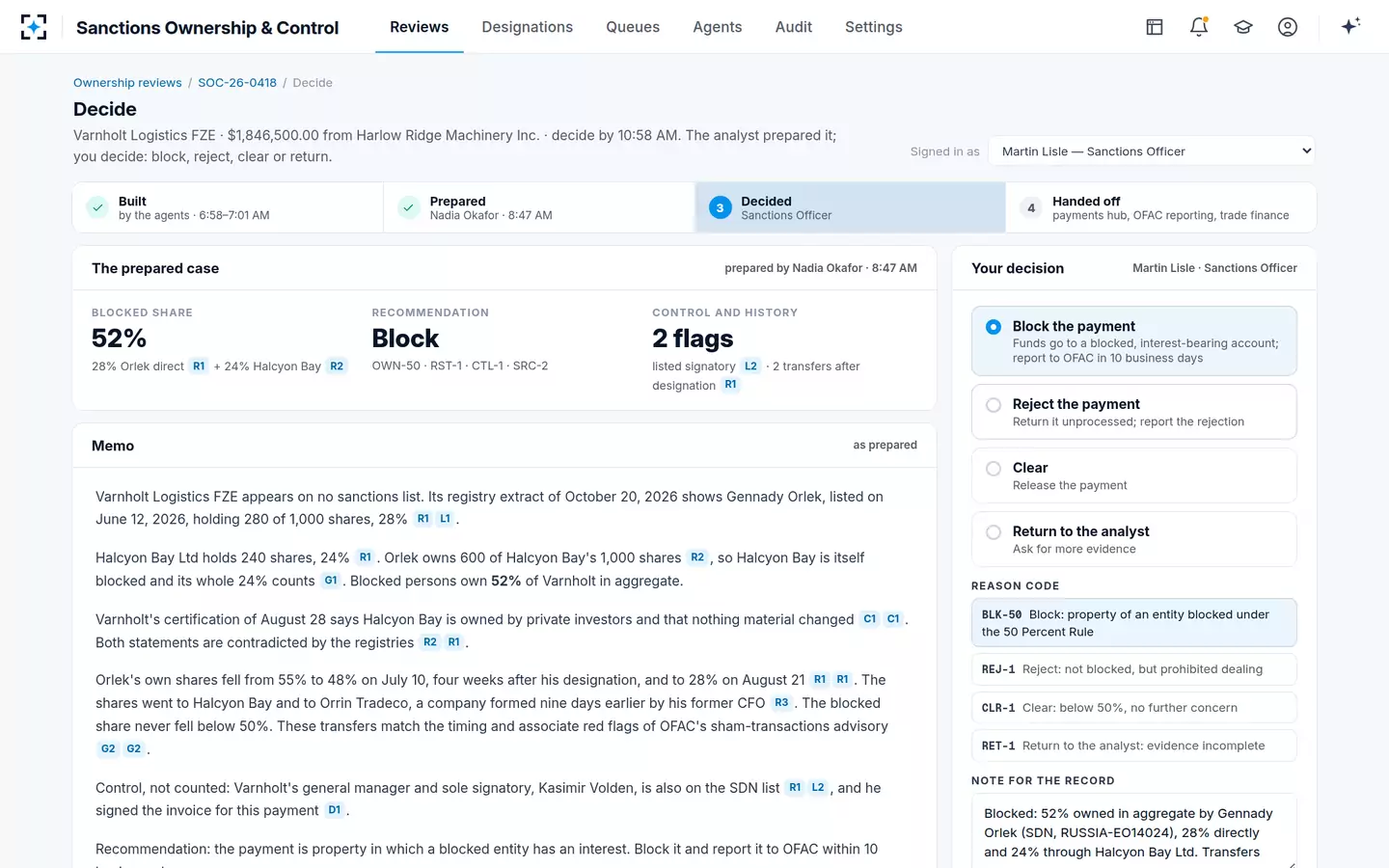
The sample case shows why this matters even when the percentage does the work. Varnholt Logistics FZE is 52% owned by blocked persons, so it is blocked under the rule. But its general manager and sole signatory, Kasimir Volden, is also on the SDN List, and he signed the certification, the invoice and the services agreement behind the payment. Had the ownership come to 28%, a transaction in which Volden acts for Varnholt would still fall under FAQ 400. The solution records him as a control concern with its own reason code, and the officer sees it on the decision screen.
Can I deal with a company a blocked person controls?
Sometimes, with care, and never through the blocked person. If a blocked person controls but does not own 50% of an entity, and nobody blocked acts for it in the transaction, the entity is not blocked by the 50 Percent Rule and the dealing is not prohibited on that ground. The risk is in the facts that make the control real: who signs, who decides, who benefits, and whether the owners on paper are independent.
Owned or controlled: what the 50% arithmetic said, and what control showed
What the ownership arithmetic said: A legal opinion concluded the investing vehicle was not blocked "because it was not nominally owned 50 percent or more by a person on the SDN List".
What control and proxies showed: GVA worked "through Kerimov's nephew, Nariman Gadzhiev, who GVA Capital knew served as Kerimov's proxy". Statutory maximum: $215,988,868.
What the ownership arithmetic said: Counsel advised no blocking was needed "because Kerimov did not formally own 50% or more" of the investor.
What control and proxies showed: IPI knew Kerimov was the source of funds and dealt with his representatives; OFAC: parties "cannot later claim ignorance even if a blocked person has no nominal ownership or overt role". $11,485,352.
What the ownership arithmetic said: Ownership moved from Vladimir Potanin to four Liechtenstein foundations, each for one of his minor children.
What control and proxies showed: The company and foundations were designated in June 2024 "for being controlled by Potanin"; OFAC had already stopped the foundations' funds moving through U.S. banks.
What the ownership arithmetic said: 52% blocked: Orlek 28% directly and Halcyon Bay's whole 24%.
What control and proxies showed: A listed general manager signs; a company formed nine days before buying 3% belongs to Orlek's former CFO; a clause lets receivables go to Halcyon Bay.
Where ownership ends and an interest in property begins
The cases above were not lost on the 50 Percent Rule; they were lost on the older idea underneath it. A blocking order freezes property in which a blocked person has "any interest", and OFAC reads interest functionally. In the IPI settlement it said controls "should reflect that OFAC authorities incorporate broad definitions of 'interest' and 'property interest' that look beyond legal formalities to underlying practical and economic realities" (OFAC).
That is why a 30% shareholding can still put a payment out of reach. If the other 70% is held by a nephew, a trust for the children or a former employee who acts on instructions, the blocked person may have an interest in the whole. GVA's opinion was wrong for exactly this reason: OFAC found that Kerimov "does, in fact, retain a property interest in Prosperity through his property interest in Heritage Trust", the trust OFAC blocked in 2022 when it held about $1.3 billion (OFAC, GVA Capital). The red flags of a proxy owner sets out how such holdings look in the records.
Can OFAC designate a company for being controlled by a blocked person?
Yes, and it does. FAQ 398 reserves the power, and OFAC's 2026 sham-transactions advisory gives an example: after Vladimir Potanin's December 2022 designation, the Cyprus company Sentimare Enterprises and the four foundations he had transferred it to were designated in June 2024 "for being controlled by Potanin" (OFAC, March 31, 2026). Once designated, the controlled entity is on the list, and entities it owns 50% or more of are blocked under the 50 Percent Rule in turn.
The Commerce Department draws a similar line for export controls. Its 2025 Affiliates rule tells exporters that a significant minority stake held by a listed entity, or ties such as shared board members, is a red flag of diversion risk even below 50% (90 FR 47201).
The UK trap: waiting for evidence of 50% before restricting
The UK's 2026 penalty against Citibank's London branch turned partly on a policy, not a calculation. OFSI found that Citibank's London branch "temporarily changed its guidance to sanctions staff in May 2022 such that it did not require them to request restrictions on an account which was subject to further investigation for sanctions exposure unless they had evidence of 50% or greater ownership of that entity by a designated person" (OFSI, CBNA London). Before the change, staff restricted every account potentially associated with designated persons "regardless of the percentage".
OFSI said the change "increased both the risk of accounts being left unrestricted and the duration", and it found that staff had reached an incorrect ownership and control determination for one of the companies. The UK test counts control in its own right, so a bank that waits for proof of majority ownership has already applied the wrong test. The lesson travels: a restriction while research runs is cheap; a release on a provisional "under 50%" is not.
How do the EU and UK treat control?
Both count it. The EU's Best Practices list eight control criteria, from the power to appoint or remove most of the board to a right to use the entity's assets, and meeting any one of them makes the entity controlled unless shown otherwise case by case (Council of the EU, 2024). The UK's test includes being able to appoint or remove a majority of the board and a broader condition: that "it is reasonable to expect that the person would be able to ensure the affairs of the entity are conducted in accordance with the person's wishes" (OFSI guidance 4.1).
The UK condition is the one firms find hardest. HM Treasury's 2026 call for evidence says industry "has reported particular difficulty with the hypothetical choice element of the test", that a designated person "would, if they chose to, be able" to steer the entity (HM Treasury, 2026). The EU sanctions ownership and control test, compared with the UK's and OFAC's, works through both with examples.
Owned, controlled or cautioned: how Sanctions Ownership & Control sorts a case
Every ownership review lands in one of four buckets, and each has a different action. Owned means blocked persons hold 50% or more in aggregate under OFAC's method: block or reject as the program requires. Acting means a blocked person signs or negotiates for the entity in the transaction: the dealing is prohibited, whatever the ownership. Controlled means a blocked person directs the entity but neither of the first two applies: lawful under the 50 Percent Rule, but a candidate for designation, and caught by EU and UK control tests where those laws apply. Cautioned means significant blocked ownership below 50% or ties without control: proceed only with the facts documented and the exposure watched.
Four outcomes of a sanctions ownership and control review under OFAC
| Bucket | Test | What the bank does | Example |
|---|---|---|---|
| Owned | Blocked persons own 50% or more in aggregate, counting whole stakes of blocked intermediaries. | Block the property; report to OFAC within 10 business days of blocking. | Varnholt, 52%. |
| Acting | A blocked person signs, negotiates or acts for the entity in the transaction (FAQ 400). | Do not proceed; the dealing is with the blocked person. | A contract signed by a listed general manager. |
| Controlled | A blocked person directs the entity by board, veto, agreement or proxy, without 50% ownership. | Not blocked by the rule; escalate, document, limit exposure; apply EU or UK tests where they bind. | A 30% owner who appoints the board. |
| Cautioned | Significant blocked ownership below 50%, or a recent transfer below the line. | Proceed only with the findings on file and a watch on the next change. | A 46% blocked holding. |
The officer sees the 52% and the control flags on one screen
Control indicators worth recording in every review, apart from the percentage
- Who signs for the entity
A blocked signatory turns a lawful counterparty into a prohibited dealing (FAQ 400).
- Who appoints or removes the board
A control criterion in both the EU and UK tests, even with a minority stake.
- Agreements that move value
Assignment of receivables, guarantees, buyback options and shared liabilities; the EU lists the right to use the entity's assets.
- Who the minority owners are
Relatives, former employees, trusts and companies formed days before buying: the proxy indicators in OFAC's 2026 advisory.
- When ownership changed
A transfer just before or after a designation is a red flag in OFAC's advisory and an EU control indicator.
Control concerns in Sanctions Ownership & Control, listed apart from the 52%
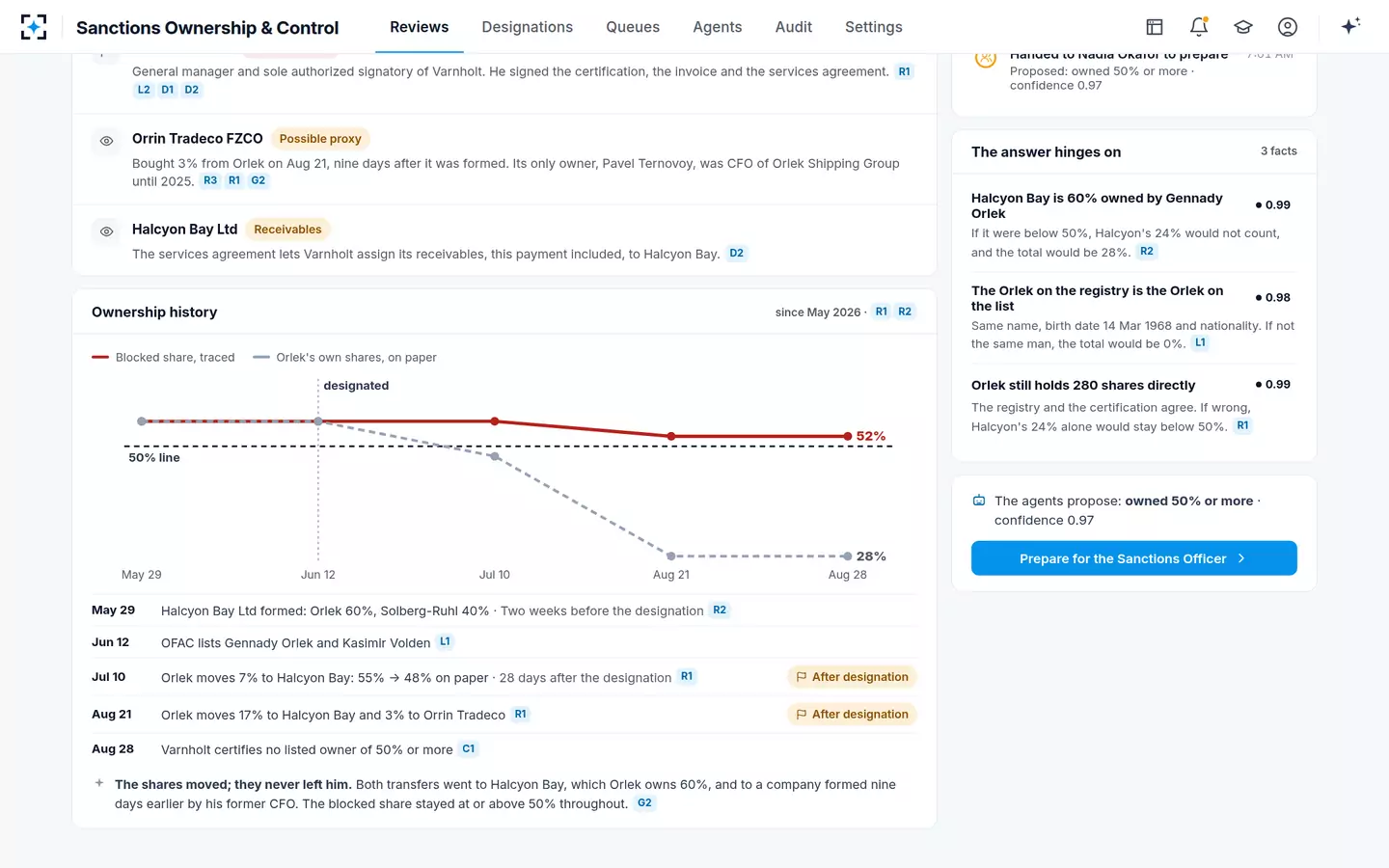
To see how the solution keeps control and ownership apart through a whole review, from the held payment to the officer's decision, start from Sanctions Ownership & Control.
Questions people ask
Is a company controlled by an SDN blocked?
Not automatically under OFAC's rule, which "speaks only to ownership and not to control". It becomes blocked if OFAC designates it, and a dealing in which the SDN acts for it is prohibited in any case. Under EU and UK law, control by a designated person can bring the entity within the asset freeze without a separate listing.
Can a blocked person sit on the board of a company I do business with?
The company is not blocked for that reason alone, but you may not deal with the blocked director. FAQ 400 says U.S. persons "should be careful when conducting business with non-blocked entities in which blocked individuals are involved" and may not enter into contracts the blocked individual signs.
Does a blocked person's control add to their ownership for the 50% test?
No. Ownership and control are assessed separately under OFAC's rule; a 40% holder who runs the company is still a 40% holder. Adding them overstates the ownership case, and ignoring control hides a separate risk, which is why the two are best shown side by side.
What happens if a blocked owner transfers shares to a relative?
The transfer may not change anything. OFAC's 2026 advisory treats transfers to relatives and associates as possible evidence of a sham, and says sham transactions "do not terminate a blocked interest in property". FAQ 402 adds that a divestment must occur entirely outside U.S. jurisdiction to count at all.
Should a bank restrict an account while ownership research is under way?
Where the facts point to a designated owner, OFSI's CBNA notice suggests yes. The bank's decision to restrict only on "evidence of 50% or greater ownership" was found to have increased both the risk and the duration of accounts left open, in a case that ended in a £4.73 million penalty.