The OFAC blocked property report template is OFAC's own: initial reports on blocked property are filed on a form built into the OFAC Reporting System, and the annual report of blocked property must be filed on the current version of OFAC's TD F 90-22.50 spreadsheet, uploaded through the same system. No other template is accepted for the annual report, and OFAC's 2026 filing guidance says it returns filings whose content or format does not follow the form. But a filled template only proves the report is complete. Whether each row is the right property, at the right value, under the right authority, tied to the right blocking report is a separate question, and it is the one examiners and OFAC's enforcement staff ask. Botminds' OFAC Reporting drafts the template from the bank's own records with a source on every value, and runs the accuracy checks below before the OFAC Officer signs.
The worked examples come from a fictional sample bank, Tessaly Community Bank, and its 2026 annual report in the solution; the people and companies named are fictional. OFAC's guidance and its Finding of Violation against Nodus International Bank are quoted from the source.
Twelve checks that make a blocked property report accurate, not just accepted
- Every blocked asset on its own row
Omnibus accounts broken out; Part A’s count equals the number of Part B rows.
- Each row traced to its initial blocking report
The Blocked/Rejected Report ID from ORS, not a submission or internal number.
- Values as of June 30
Balances with interest credited; securities at the June 30 close; other assets at June 30 market value.
- Foreign currency converted, with the rate shown
Dollars in the value column; the foreign amount and notional rate in the narrative.
- Loans, receivables and trade documents at $0.00
The amount owed or shipment value written in the Additional Description.
- Program tags, never “SDN”
Tags from OFAC’s Program Tag Definitions, as of June 30, separated by commas without spaces.
- The target named as OFAC lists it
Spelling and order from Sanctions List Search or the Federal Register.
- The target’s interest explained where not evident
Ownership, control or a blocked government’s interest, in the narrative.
- Owner, owner type, asset type, account type
From OFAC’s categories, consistent with last year’s report.
- New Item marked Y or N
Y only for property not on the previous year’s report.
- The total tied to the general ledger
Report total equals the blocked funds account at June 30, to the cent.
- Last year’s lines all accounted for
Each line that left has its release, delisting or transfer, and its report.
Is there a template for OFAC blocked property reports?
Yes, and only OFAC's own will do. For the initial report of a block, "Report forms for initial blocked property reports and rejected transactions reports are integrated within ORS", OFAC's reporting page says. For the annual report, "ARBP filers must use the TD-F 90-22.50 spreadsheet form provided below. Completed ARBP forms must then be submitted through ORS" (OFAC Reporting System). The 2026 guidance tells filers to download the current version each year, because "Previous versions are no longer approved by the Office of Management and Budget and will not be accepted" (OFAC ARBP guidance, 2026).
The spreadsheet has two parts. Part A identifies the holder, the individual the institution has empowered to file, and the total number of blocked assets; Part B has one row per asset, with columns for the date of blocking, value, legal authority, sanctions target, owner, owner type, asset type, account type, account number, additional description, location, whether it is a new item, and the ORS report ID. Templates circulating outside OFAC, including a bank's own copy of an older year's form, are not the template.
Why did OFAC return my blocked property report?
Usually for one of five reasons, which OFAC lists in its 2026 guidance as "among the most common reasons OFAC returns ARBP filings for correction". The table restates them with the rule each one breaks. The guidance's general warning is short: "OFAC will return initial ARBP filings if the content or format does not comply with these standards."
OFAC's five most common reasons for returning an annual report
| What OFAC found | What the form requires | How to prevent it |
|---|---|---|
| A submission number, internal tracking number or other wrong identifier in the ORS Report ID column | The Blocked/Rejected Report ID of the initial blocking report, or “N/A” if it was not filed through ORS | Store the report ID with each block when it is filed |
| A sanctions target field without the primary name of the SDN, blocked person or blocked government | The target, spelled and ordered as OFAC publishes it | Copy the name from Sanctions List Search, last name first |
| No explanation of the target’s interest where it is not evident | A narrative in the Additional Description of the Property | Write the ownership or control link for every 50%-rule or government block |
| Account number, owner, types, authority, program tag, location or New Item missing, incomplete or inconsistent | Every Part B column completed, consistently | Validate each row against last year’s report and the core |
| A file that is missing, inaccessible, password protected or reformatted | The current spreadsheet, unaltered | No merged cells, renamed columns, added tabs or special characters in the file name |
Format errors deserve more respect than they get. The guidance is explicit: "Do not merge cells or manipulate the order of the data fields in Parts A or B (e.g., amending the name the column titles, adding additional tabs)", and the file name must not include special characters, which the guidance lists as "!,&,#,*,-,$,%,^,.", before it is uploaded to ORS. A returned report is not yet filed, and the guidance is clear about what that means for the deadline: "A report is complete only when all reporting requirements are met."
Valid is not accurate: what the Nodus finding shows
A report can pass every format test and still be wrong, and that is the failure OFAC penalizes. In 2022 OFAC issued a Finding of Violation to Nodus International Bank, a small international financial entity in Puerto Rico, for violations of the Venezuela program and of the reporting regulations. The reporting part was not a late filing; it was that the bank's annual reports did not agree with each other.
Nodus also submitted several inconsistent Annual Reports of Blocked Property (ARBP) to OFAC. For example, in Nodus's 2018 ARBP, the bank did not include the blocked credit card, but in its 2019 report, the bank reported the blocked credit card account.
OFAC, Finding of Violation, Nodus International Bank, Inc., 2022
The blocked person held two time deposits, a savings account and an outstanding credit card balance with the bank. A credit card balance is exactly the kind of asset a template invites a filer to skip, because its value is reported as $0.00 with the amount owed in a narrative. OFAC found that Nodus "failed to report the blocked accounts accurately in violation of § 501.603(b)(ii)" and described the RPPR violations as "inaccurate reporting of the blocked property to OFAC" (OFAC, Nodus). The same bank had let an automatic debit move money between the blocked person's accounts and had written off the blocked card balance, so the inconsistent reports were the visible symptom of property that was not being handled as blocked.
What a template checks, and what accuracy needs
Valid: the template is satisfied: Every row has every column filled
Accurate: the report is right: Every blocked asset has a row, including $0.00 loans and card balances
Valid: the template is satisfied: A number in U.S. dollars
Accurate: the report is right: The June 30 value, including interest, tied to the general ledger
Valid: the template is satisfied: Something other than “SDN”
Accurate: the report is right: The program tags that applied to this target on June 30
Valid: the template is satisfied: An identifier in the column
Accurate: the report is right: The ID of this asset’s own initial blocking report
Valid: the template is satisfied: Each year stands alone
Accurate: the report is right: Every change from last year is explained by a release, a delisting or a new block
Valid: the template is satisfied: Whoever typed it
Accurate: the report is right: A preparer and a different signer, each with the sources in front of them
How do you report foreign currency on an OFAC report?
In dollars, with the original currency shown. The rule for every blocked property report is that "Transactions blocked in foreign currencies must be reported in U.S. Dollars with the foreign currency amount and notional exchange rate in the narrative" (31 CFR 501.603(b)(1)(ii)(F)), and the annual report repeats it, with the narrative going in the column titled Additional Description of the Property.
Two details make the difference between a valid and an accurate entry. The annual report's value is "as of June 30", so a foreign-currency balance has to be converted at a June 30 rate, not the rate used in the initial report. And the rate is "notional", so the narrative should say where it came from. As an illustration: a blocked balance of €12,000.00 converted at a notional rate of 1.0850 dollars per euro is reported as $13,020.00, with "EUR 12,000.00 at 1.0850 USD per EUR, June 30 rate, source named" in the narrative. A report that shows only $13,020.00 is complete; one that shows the euros and the rate can be checked.
What goes in the Additional Description of the Property?
Everything the other columns cannot hold that a reader at OFAC needs to understand the row. OFAC's guidance gives the column three standard jobs, "the number of shares held, or a short narrative of why there is no SDN involved", and the rule and guidance add three more: the amount owed on a loan or card reported at $0.00, the value of a shipment behind blocked trade documents, and the foreign amount and rate behind a converted value. Where the sanctions target's interest in the property is not evident, its explanation also goes here, and a missing explanation is one of the return reasons OFAC lists.
The sample bank uses the column for one more thing: changes to the property during the year. When its July review found that one blocked account had been opened in a product that paid no interest, the account was moved to the blocked savings product at 3.85% and $99.93 was back-credited, and that line's narrative says so. An examiner who compares this year's value with last year's will see the jump, and the explanation is already on the report.
The 2026 report in OFAC Reporting, built from the tie-outs and filed six days early
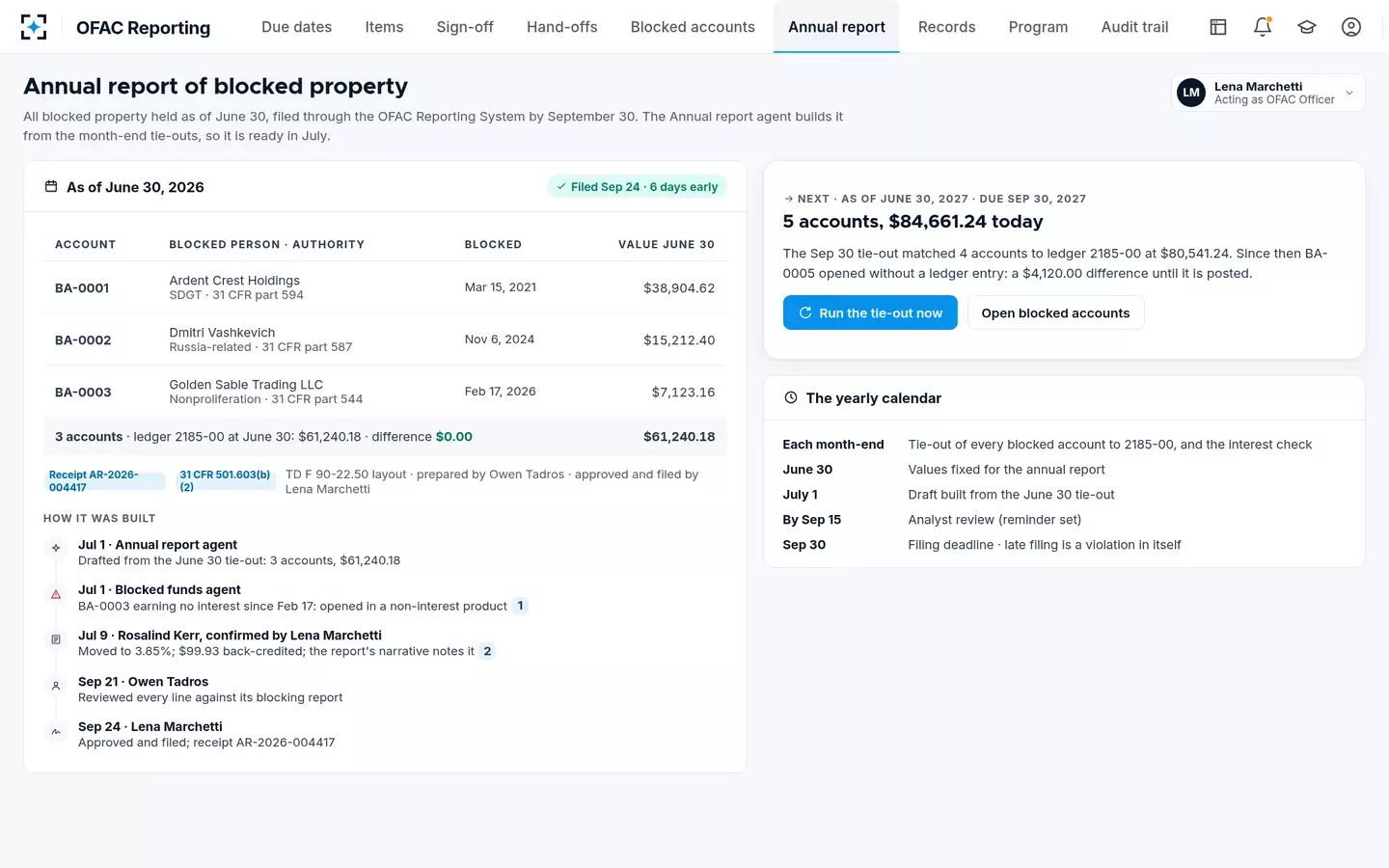
Program tags, target names and the ORS Report ID
Three columns follow OFAC's own vocabulary exactly, and each has its own rule. The legal authority is the program tag or tags "associated with the sanctions target as of June 30", from OFAC's Program Tag Definitions page, and for a target designated under several authorities, "separate each sanctions program tag with a comma (no spaces)". Where the block is for a nexus to a government that is a state sponsor of terrorism but not an SDN, the tag is IRAN, CUBA or DPRK. The target's name must follow OFAC's form: "The spelling and ordering of a SDN name (last name first, first name last) must mirror the version published on OFAC's Sanctions List Search or the Federal Register" (OFAC ARBP guidance).
The ORS Report ID ties each row to the initial report that announced the block. It is the Blocked/Rejected Report ID, which OFAC's guidance shows how to export from the ORS dashboard, and it is the identifier filers most often get wrong; what the OFAC Reporting System does explains where it comes from. A bank that records the ID with the item when it files the initial report never has to search for it in September.
Omnibus accounts: one row for every blocked asset
A pooled account is acceptable for holding blocked funds, but not for reporting them. The rule says "While blocked funds may be maintained in omnibus accounts, the Annual Reports of Blocked Property must contain a disaggregated list showing each blocked asset contained within the omnibus account" (31 CFR 501.603(d)(1)), and OFAC's guidance tells filers to "List each discrete block in separate rows within Part B". Part A's count of blocked assets must match: OFAC's own example lists a quantity of 4 in Part A, "which means that there should be four rows in Part B, each row representing one blocked asset".
The practical consequence is that the bank's systems must know the blocks inside the pool, not just the pool's balance, including each block's date, target, program and accrued interest. That is also what OFAC's FAQ on blocked accounts requires for release: either method of holding funds is acceptable as long as specific funds can be unblocked with their interest. A report built from the general ledger balance alone cannot meet either test.
Checking this year's report against last year's
The single most useful accuracy test is a roll-forward: last year's rows, plus new blocks, minus releases, should equal this year's rows. The form itself supports it. Every row carries a New Item flag, "Y" for property "not reported on the previous year's ARBP" and "N" if it was, so a filer who marks a row "N" is asserting that it appeared last year, and a row that vanished needs a reason. OFAC's 2026 guidance lists the legitimate reasons for leaving a row out: property unblocked under a license or tied to an SDN delisted before July 1, property freed when its program ended, and assets that are only immobilized or restricted rather than blocked.
Run the roll-forward for value as well as count. A deposit line should grow by its interest, and a line whose value is flat or lower needs an explanation in the narrative: a fee debited under the program's service-charge license, a correction, or a rate problem like the sample bank's. The Nodus finding turned on a row that was missing one year and present the next; a roll-forward would have flagged it before either report was filed.
The sample bank's report, measured against its own books
3rows
one per blocked account held on June 30, 2026
$61,240.18
report total, equal to general ledger 2185-00 at June 30
$0.00
difference between the report and the general ledger
6days early
filed September 24 against a September 30 deadline
What to look for in software that fills the OFAC template
Look for the checks, not the form. Any tool can produce a spreadsheet with OFAC's column headings; the questions that separate them are where each value comes from, what the tool checks before the officer signs, and what it does with the year before. Six questions are worth putting to any provider, ourselves included:
- Where does each value come from? A value with a link to the core balance, the blocking report or the journal entry can be checked; a value typed into a cell cannot.
- Does it tie the total to the general ledger, and when? Monthly tie-outs find gaps in weeks; a September tie-out finds them in September.
- Does it compare this year's report with last year's? The Nodus finding was about exactly that comparison.
- Does it keep each block's ORS Report ID from the day it was filed?
- Who signs, and can the preparer sign? The report should show what changed from any draft, and the signer should be someone else.
- What can it not see? A tool only knows the property in the systems it reads.
The last question is where we would be candid about OFAC Reporting too. The solution drafts the annual report from the blocked accounts in the core and the blocked funds account on the general ledger, the blocking reports it has filed, and last year's report; it proposes entries and flags gaps, and the analyst and officer decide. A debt the bank owes a blocked person that sits in no blocked account, or securities held in a custody system it is not connected to, will not appear until someone connects that system or records the item. The template's completeness checks are the easy part; knowing what the bank holds is the part that needs every system connected.
In OFAC Reporting, every change to a draft is shown to the signer, with its reason
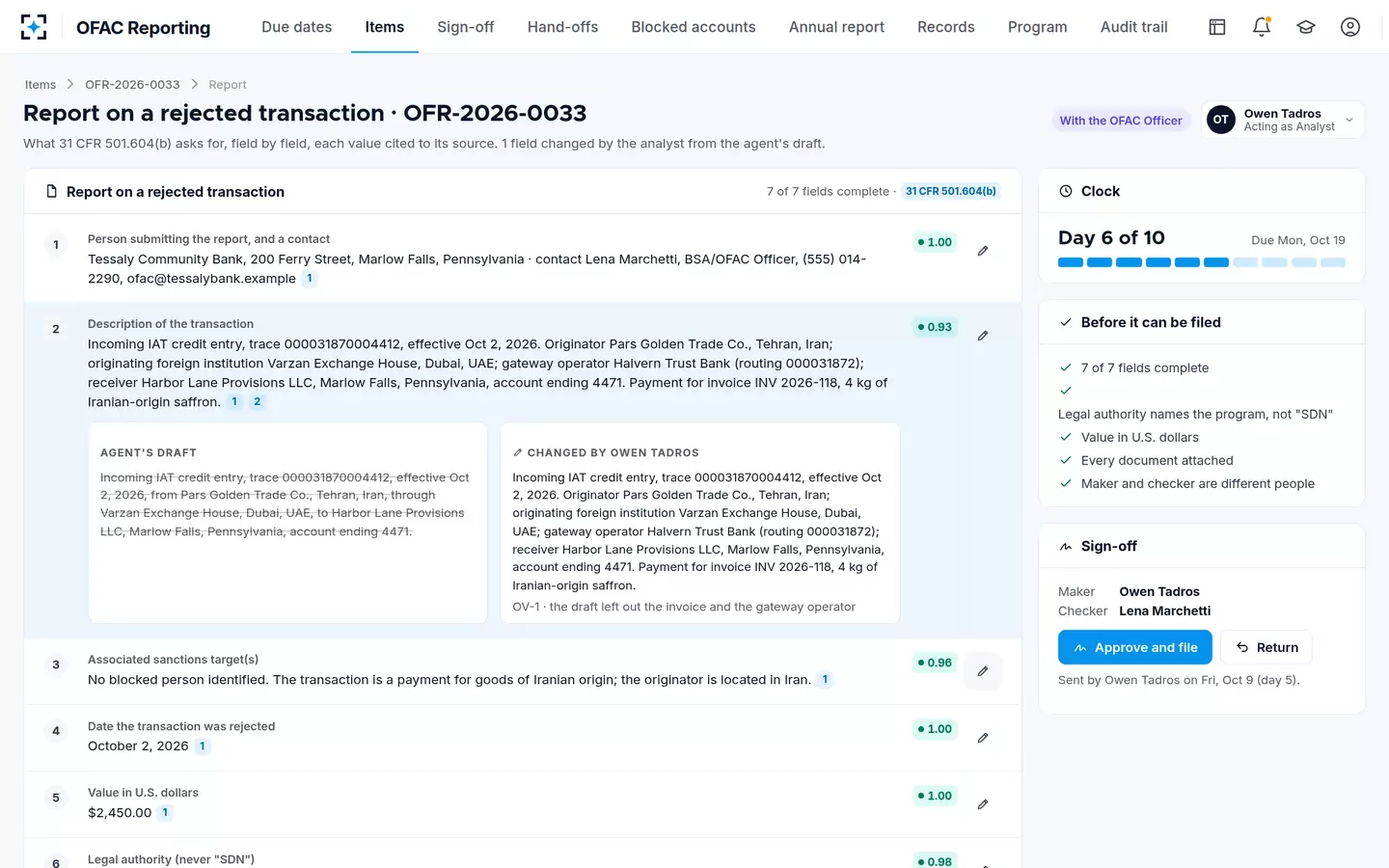
The fields the initial reports require are listed in OFAC's reporting requirements, field by field, and what belongs on the annual report at all, including the debts that are easy to miss, in the guide to the annual report of blocked property. The whole flow is on the OFAC Reporting page.
Questions people ask
Where do I download the OFAC blocked property report template?
From OFAC's OFAC Reporting System page, which links the current Annual Report of Blocked Property form, TD F 90-22.50, and the year's filing guidance. Download it again each year: OFAC says earlier versions are no longer approved and will not be accepted.
Can I add columns, tabs or notes to the ARBP spreadsheet?
No. OFAC's 2026 guidance says not to merge cells, rename columns, change the order of fields or add tabs, and it returns filings that do. Anything that does not fit a column goes in the Additional Description of the Property.
How do I amend an annual report OFAC returned?
Follow the instructions in the Return Reason, correct the spreadsheet, then upload the new file over the original in ORS and click Submit. OFAC asks filers not to create a new annual report for an amendment, to avoid duplicate records.
What if the initial blocking report was not filed through ORS?
Then the ORS Report ID column takes "N/A", according to OFAC's 2026 guidance. The row still needs every other column, and the bank's own file should hold a copy of the original report.
Is the initial blocked property report the same form as the annual report?
No. The initial report is a form inside ORS with the nine elements of 31 CFR 501.603(b)(1), due within 10 business days of each block; the annual report is the TD F 90-22.50 spreadsheet covering every asset held on June 30, due September 30.