OFAC block vs reject comes down to whether anyone whose property is blocked has an interest in the transaction. If a blocked person or a blocked government does, directly or indirectly, the bank must block: freeze the funds in a segregated, interest-bearing blocked account and report the block to OFAC within 10 business days. If the transaction is prohibited but no blocked person has an interest, typically a payment involving a sanctioned country or sector, the bank must reject: refuse to process it, return it, and report the rejection within 10 business days. If it is licensed, exempt or has no real OFAC nexus, the bank may process it. The two outcomes look alike on the day and diverge for years afterwards, because a block creates an account, an annual report and a future release, while a reject ends with one report. Botminds' OFAC Reporting picks up at that decision, and builds the report the branch owes.
The examples come from OFAC's own FAQs and from a fictional sample bank, Tessaly Community Bank, as its items run through the solution; the people and companies in the sample are fictional.
OFAC block vs reject as a decision tree: four questions, three outcomes
- 1Does the alert involve an OFAC sanctions program at all?
A hit on another agency’s list, or a name that is not a valid match after comparing every identifier, has no OFAC nexus.
NoProcessNo OFAC nexus. Keep the record of how the match was cleared.
YesNext question - 2Is the transaction exempt, or authorized by a general or specific license?
Check the license’s terms and dates, not just its existence.
YesProcessUnder the license or exemption. Keep a copy and meet its own reporting conditions.
NoNext question - 3Does a blocked person or blocked government have any interest, direct or indirect?
SDNs, blocked governments, Iranian financial institutions, Cuba or certain Cuban nationals, entities owned 50% or more by blocked persons.
YesBlockFreeze into a blocked interest-bearing account. Report within 10 business days of blocking. List it on every annual report until released.
NoNext question - 4Would processing it still violate a prohibition?
A sanctioned jurisdiction, sector or activity, with no blocked person involved.
YesRejectDo not process; return it. Report within 10 business days of the rejection. No annual report.
NoProcessProhibited by nothing. Document the analysis.
Block or reject: the one-line rule
Block when there is a blockable interest; reject when the transaction is prohibited but there is none. OFAC's FAQ on the difference puts it in two sentences, and every procedure on the subject is an elaboration of them.
In the case of certain sanctions programs, a transaction may be prohibited for U.S. persons, but there may be no blockable interest (i.e., no interest of a Specially Designated National (SDN), blocked government, or other blocked person) in the transaction. In this situation, the transaction should be rejected and returned to the originator.
OFAC FAQ 36, updated October 26, 2026
The rewritten FAQ adds the line that matters for operations: rejected transactions "must not be processed forward to the beneficiary". A reject is a return, never a late release.
OFAC's updated FAQ 5 (September 9, 2026) lists who sits on each side. Block: "Individuals or entities on the SDN List", "Blocked governments", "Iranian financial institutions", "Cuba or certain Cuban nationals" and "Entities blocked under OFAC's 50 Percent Rule". Reject or do not proceed: "Sanctioned jurisdictions but no blocked person" and "Sanctioned sector or activity, but no blocked person". Process: "No true OFAC nexus or match", exempt transactions, and transactions "authorized by a general or specific license". Certain activities with persons on non-SDN lists can fall in either of the first two columns, depending on the program (OFAC FAQ 5).
Blocking is the heavier act. In OFAC's words it "immediately imposes an across-the-board prohibition against transfers or dealings of any kind with regard to the property", and while "Title to the blocked property remains with the blocked person", the "exercise of powers and privileges normally associated with ownership is prohibited without authorization from OFAC" (OFAC FAQ 9). A reject leaves no such residue: the money goes back the way it came.
What is a blocked account?
A blocked account is where blocked funds must sit: segregated, interest-bearing, at a federally insured U.S. institution, and open to debits only with OFAC's authorization. FAQ 5 says blocked funds "should be placed into a qualifying, segregated, interest-bearing account located at a federally insured financial institution in the United States, from which only OFAC-authorized debits may be made" (OFAC FAQ 5). The program regulations set the rate: the Global Terrorism Sanctions Regulations, for one, require a commercially reasonable rate, meaning what the bank pays other depositors for deposits of comparable size and maturity (31 CFR 594.203).
Banks may hold blocked funds in one account per blocked item or in an omnibus account, as long as each item can be traced and released with its own interest; the annual report must break any omnibus account into one row per blocked asset. The account is therefore as much a general ledger matter as a compliance one. In the sample bank, five blocked accounts sit on one general ledger account, and the solution ties them out at each month-end and whenever an account opens.
A block creates an account; a reject does not
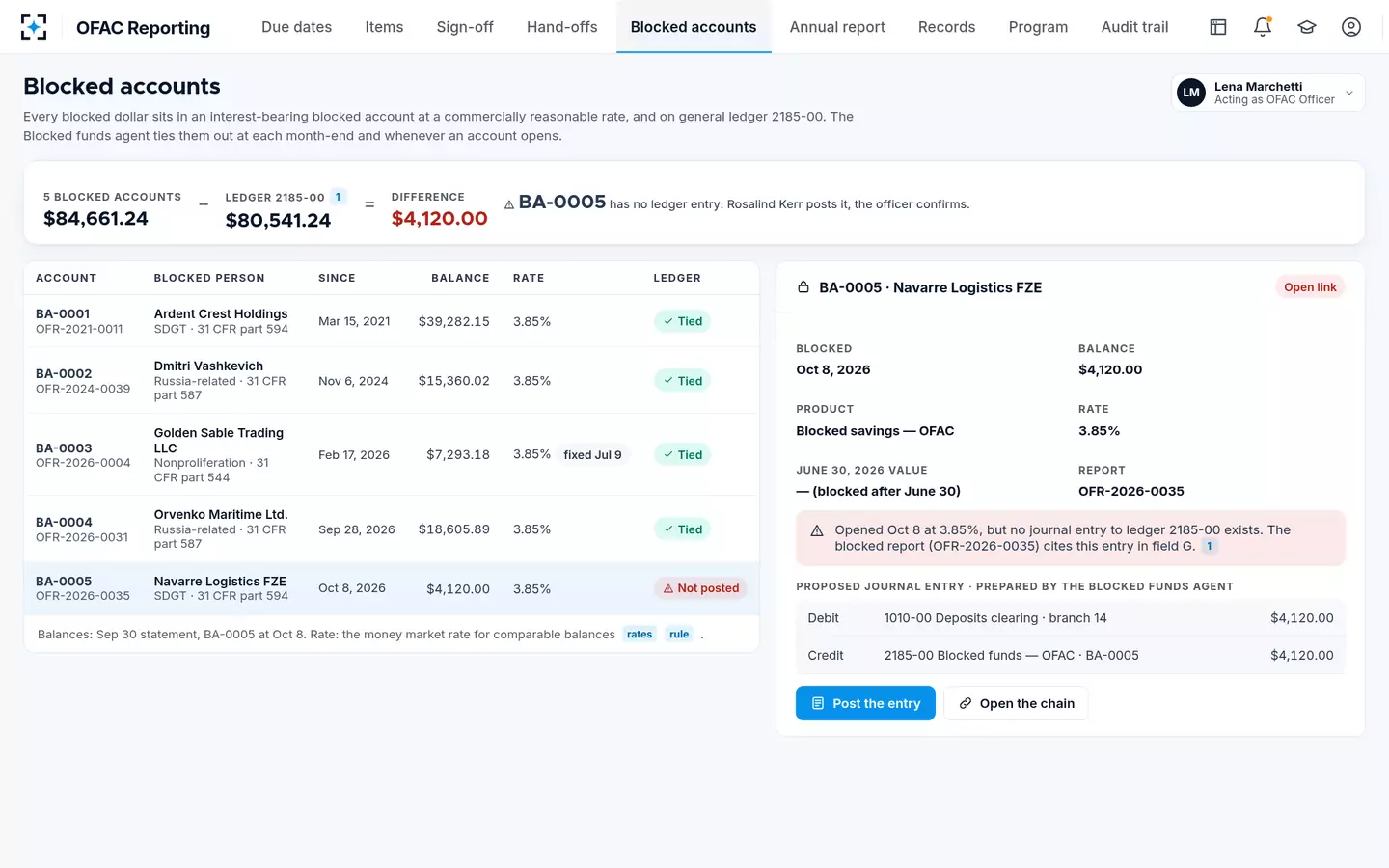
When do you reject instead? A sanctioned country, but no blocked person
You reject when the program prohibits the transaction itself but nobody in it is blocked. Country-wide programs work this way: they prohibit exports, imports and services involving the jurisdiction, while the blocking provisions reach only the government, designated persons and, in some programs, certain institutions. The FFIEC manual's general description is that "the transaction is simply rejected, (i.e., not processed)" where "there is no blockable interest in the transaction" (FFIEC manual).
A reject still owes a report. Since 2019 the rule has covered any U.S. person that rejects "a transaction that is not blocked under the provisions of this chapter, but where processing or engaging in the transaction would nonetheless violate a provision contained in this chapter" (31 CFR 501.604(a)). The most common error in rejects is not the decision but the follow-through: the payment is returned and the report never filed, because nothing was frozen and nothing reminds anyone.
The same payment, two answers: OFAC's Tehran examples
OFAC's FAQ 36 gives a pair of examples that show how thin the line is. The difference between them is one bank in the payment chain. (A third example, a wire to a person in the Crimea region of Ukraine with no blocked party involved, is also a reject.)
Two payments to Tehran: one blocked, one rejected
Payment to XYZ Import-Export at Bank of XYZ, Iran: Bank of XYZ, “an Iranian financial institution and wholly-owned by the Government of Iran”
Payment to ABC Import-Export in Tehran, at a third-country bank: ABC Import-Export, which “is not a blocked person”
Payment to XYZ Import-Export at Bank of XYZ, Iran: Yes: Bank of XYZ “is blocked pursuant to 31 CFR § 560.211”
Payment to ABC Import-Export in Tehran, at a third-country bank: No: “there is no blockable interest in this payment”
Payment to XYZ Import-Export at Bank of XYZ, Iran: Yes
Payment to ABC Import-Export in Tehran, at a third-country bank: Yes: processing it would mean “facilitating trade with Iran, exporting a service to Iran”
Payment to XYZ Import-Export at Bank of XYZ, Iran: “The U.S. bank must block the payment.”
Payment to ABC Import-Export in Tehran, at a third-country bank: “the U.S. bank must reject the payment.”
Payment to XYZ Import-Export at Bank of XYZ, Iran: Blocked interest-bearing account; blocking report in 10 business days; on every annual report until released
Payment to ABC Import-Export in Tehran, at a third-country bank: Return to the sender; rejected transaction report in 10 business days; nothing further
The sample bank's item OFR-2026-0033 sits on the right-hand side. It is an incoming international ACH credit of $2,450.00 from Pars Golden Trade Co. in Tehran, for Iranian-origin goods, and the payment message names a Dubai exchange house as the originating institution and a U.S. bank as the gateway operator. The analyst found no listed person and no Iranian financial institution, so the officer rejected it under the Iranian Transactions and Sanctions Regulations and the entry went back to the gateway. Had the originating institution been an Iranian bank, the same $2,450.00 would have had to be blocked, and OFAC's 2026 annual report guidance even names the program tag to use for it: "IRAN" for "assets blocked due to a nexus to an Iranian crypto exchange or financial institution" (OFAC ARBP guidance).
Are entities owned 50 percent by an SDN blocked or rejected?
Blocked. An entity owned 50 percent or more, directly or indirectly, by one or more blocked persons is itself blocked, whether or not it appears on any list, and OFAC adds up the stakes: two blocked owners with 25 percent each make the company blocked, though neither holds a majority alone (OFAC FAQ 399; the sum is traced layer by layer in OFAC aggregate ownership). A payment to such an entity is blocked like a payment to the SDN itself, and the blocking report must explain the target's interest, because the entity's name will match nothing on the SDN List.
For a bank acting only as an intermediary, OFAC has said it would not expect research into non-account parties that are not on the SDN List, and would not pursue enforcement where the bank had no relationship with the entity and did not "know or have reason to know" of its blocked status. Once the bank does know, "the bank will be held responsible if it does not take appropriate steps to ensure that the wire transfer is blocked" (OFAC FAQ 116). Its own customers are another matter: OFAC "expects banks to conduct due diligence on their own direct customers (including, for example, their ownership structure)".
What if a general license applies?
Then the bank may process, provided the transaction fits the license's terms. A general license is public and "self-executing", meaning those who meet its conditions need no further authorization; a specific license is a non-public document issued to a named party. Either way, OFAC warns that persons relying on a license "must comply with all license terms, including conditions and recordkeeping and reporting requirements, as applicable" (OFAC FAQ 74). The FFIEC manual tells banks to check a customer's specific license against its terms and conditions, its effective dates included (FFIEC manual; how a license is applied for and read is in the OFAC license application process).
A license also changes what an unblocking owes. Release of blocked property "explicitly authorized by a specific or general license" needs no unblocking report, "unless the specific or general license includes a condition requiring the submission of a separate unblocking report" (31 CFR 501.603(b)(3)(i)(C)). An analyst who processes under a license should therefore record which license, which version and which condition, in the same file as the decision.
What each branch owes afterwards: the OFAC reporting consequences
The decision takes minutes; its consequences run for years. The table sets the three outcomes side by side, from the money to the records.
Block, reject or process: what each one leaves behind
| Block | Reject | Process under a license | |
|---|---|---|---|
| The money | Frozen in a blocked, interest-bearing account; title stays with the blocked person | Returned to the sender, or not sent | Moves as instructed |
| Report to OFAC | Initial blocking report, 10 business days from the date blocked | Rejected transaction report, 10 business days of the rejection | Only if the license requires one |
| Annual report of blocked property | Every year it is still held on June 30 | Never | Not for the payment processed |
| Later | An unblocking or transfer report within 10 business days of release, unless an exception applies | Nothing | License terms and expiry tracked |
| The general ledger | A journal entry to the blocked funds account, tied out monthly | The return entry | Ordinary posting |
| Records | 10 years after the property is unblocked | 10 years after the transaction | 10 years after the transaction |
The block column is why blocking errors are expensive to unwind and blocking omissions are expensive to discover. A missed annual report line can go unnoticed for years, which is the subject of blocked property nobody filed. The report fields themselves differ by branch, and the reporting requirements, field by field compares the blocked and rejected lists line by line.
Inquiry or instruction: when is there something to block?
Only once the bank holds property or instructions. A customer asking whether a payment is allowed creates nothing to block or reject; a customer instructing the payment does. OFAC's FAQ on opening accounts gives the analogy most trainers borrow.
This can be likened to a bouncing ball — once the ball starts moving, it must be stopped if it comes into your possession.
OFAC FAQ 42, updated October 26, 2026
The same FAQ draws the account-opening line: when an SDN applies to open an account and sends "an initial deposit", the bank "is obligated to decline to open the account and block the initial deposit" (OFAC FAQ 42). The application is refused; the deposit that came with it is blocked and reported.
Blocked in error: the way back
A bank that blocks property because of mistaken identity or a typographical error may unblock it and file an unblocking report, citing OFAC's FAQ 1196 in place of a license, or ask OFAC for a "Compliance Release" under 31 CFR 501.806 (OFAC FAQ 1196). The route is narrow: it is "solely for cases of mistaken identity or typographical or similar error, in which there was never a blockable interest". Where the property was rightly blocked and something has since changed, such as a blocked person's share of ownership, the answer is a specific license.
The cheaper path is not to block in error. OFAC's rewritten FAQ 42 puts the check first: "Before taking action, it is important to verify that the individual or entity attempting to open the account or involved in the customer's transaction is the same as the person listed on OFAC's SDN List", and it expects further due diligence, such as asking for more identifying information, where a name is similar but the rest does not match (OFAC FAQ 42). OFAC no longer publishes FAQ 48, which advised discussing a near match with OFAC before blocking; FAQ 5 now says OFAC does not confirm matches, though questions about the guidance can still go to its Compliance Hotline. That is why the decision belongs to an officer, with the analyst's comparison of identifiers in front of her.
Before choosing block or reject, check these five things
- Every party, not just the customer
Originator, beneficiary and every bank in the chain, including intermediaries and the originating institution.
- Owners of the counterparties you know
Aggregate blocked stakes; 25% plus 25% is blocked.
- The program, not the list
Country and sector prohibitions reject even when no one is listed.
- Licenses and exemptions, with their dates
In 2026 the Federal Register published four versions of one Venezuela general license: 5U, 5V, 5X and 5Y.
- The event date
The day the property was blocked or the transaction rejected starts the 10 business days.
Can a bank tell a customer their funds are blocked?
Yes. OFAC's FAQ 41, rewritten on October 26, 2026, lets the bank tell the customer that it blocked the property under OFAC's regulations and name the sanctions program, and says the customer may apply to OFAC for a license to release the funds (OFAC FAQ 41; what the customer sees is in why a bank holds a wire transfer). For a loan declined because of a confirmed SDN match, OFAC's FAQ 46 adds that "there is no reason not to explain that to the customer" (OFAC FAQ 46). What the bank may never disclose is a suspicious activity report, which a BSA rule keeps confidential, together with anything that would let the customer infer one was filed (31 CFR 1020.320(e)).
Many banks still choose neutral wording at the branch, because a sanctions file can sit beside a SAR and the front line cannot tell which. In the sample bank, the customer whose Iranian credit was rejected sees only "Returned to the sending bank", and branch staff have a script that hands any question to the BSA/OFAC Officer. A customer whose funds are blocked receives a written notice, prepared by the officer and approved by her deputy.
What the customer and the branch see after a reject, in OFAC Reporting
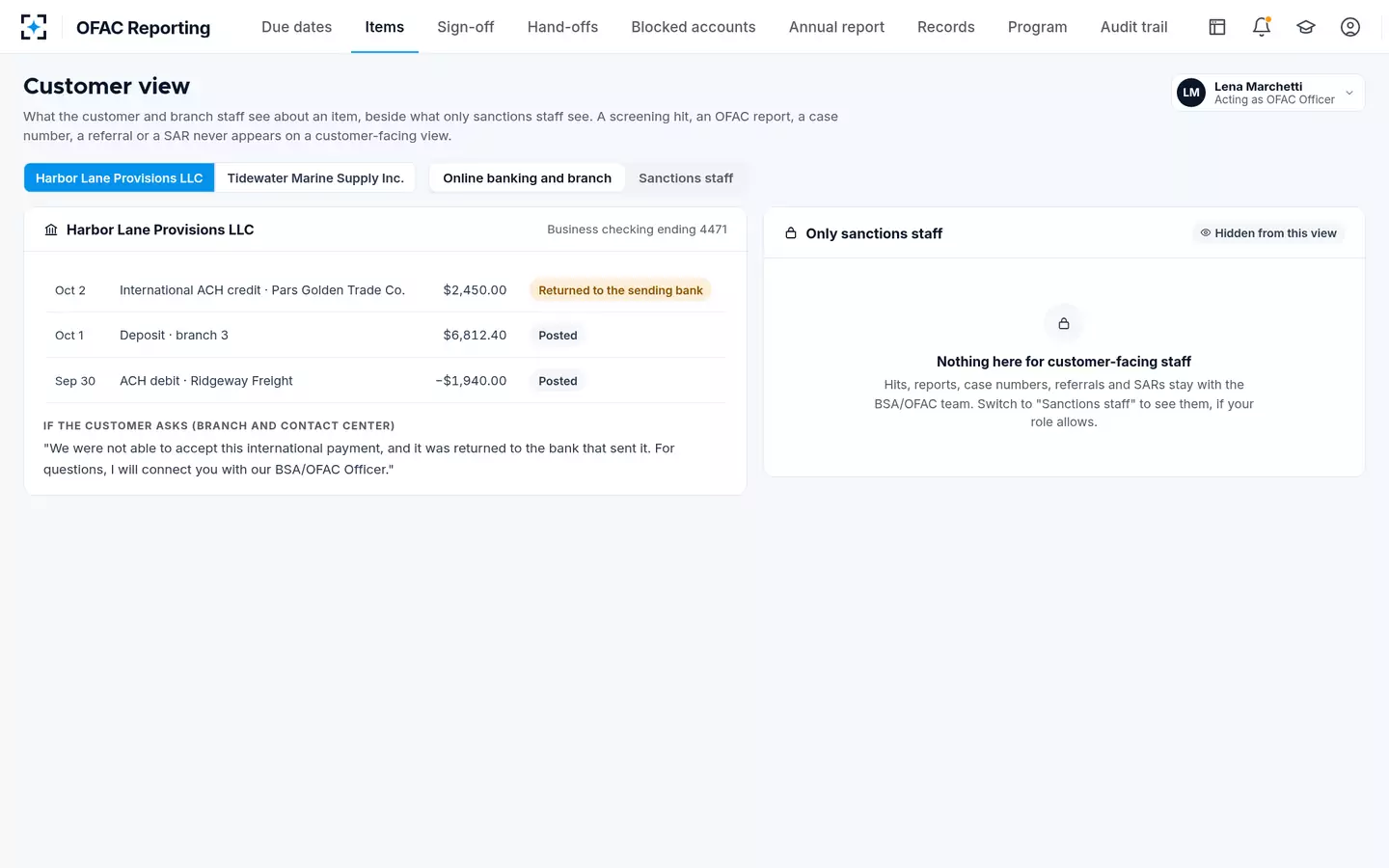
Every item in the solution starts from the decision recorded at this point, with the reasons the analyst and the officer gave; the OFAC Reporting page follows one item from there to the receipt.
Questions people ask
Is a rejected payment reported to OFAC?
Yes. Under 31 CFR 501.604 a rejected transaction is reported within 10 business days, through the OFAC Reporting System, with seven elements to the extent the bank has them when it rejects. The rule has applied to all U.S. persons, not only banks, since the June 2019 amendment.
Do blocked funds have to earn interest?
Yes, in programs with blocking provisions. FAQ 5 calls for a segregated, interest-bearing account at a federally insured U.S. institution, and OFAC's FAQ 33 says funds must "earn interest at a commercially reasonable rate", the rate offered to other depositors for comparable size and maturity.
What if only the country is sanctioned and no SDN is involved?
Then the payment is usually rejected, not blocked, if the program prohibits it. OFAC's FAQ 5 chart puts "Sanctioned jurisdictions but no blocked person" in the reject column, with the caveat that each program differs: Cuba, for example, appears in the block column because the program blocks property of Cuba and certain Cuban nationals.
Can a bank deduct fees from a blocked account?
Generally, yes. OFAC's FAQ 34 says most programs let a bank debit blocked accounts for normal service charges "in accordance with a published rate schedule for the type of account"; such debits also need no unblocking report under 31 CFR 501.603(b)(3).
What happens to blocked funds when the person is delisted?
The property is no longer blocked on account of that person, and the bank may release it without a license or a Compliance Release, according to OFAC's FAQ 1196. Release following an SDN delisting is also one of the four cases in which no unblocking report is due, provided no other blocked person has an interest in the property.