An OFAC compliance officer is the individual a bank designates to run its sanctions compliance day to day: tracking changes to sanctions programs, deciding what to block or reject, filing the reports OFAC requires within 10 business days, and overseeing the funds the bank holds frozen. No regulation creates the title. The FFIEC examination manual recommends that every bank name such a person, OFAC's own compliance framework treats a dedicated officer as evidence of management commitment, and the reporting rule puts the legal duty on the bank that holds or rejects the property. What makes the job hard is not the title but the chain of signatures behind each report, in which one person's error is signed for by another. Botminds' OFAC Reporting is built around that chain: agents count the days and draft every field with its source, the BSA/OFAC Analyst prepares, and the OFAC Officer approves and files.
The worked example on this page is one rejected payment at a fictional sample bank, Tessaly Community Bank, as it runs through the solution; every person and company named in it is fictional. The rules and enforcement cases are OFAC's and the FFIEC's, linked where they appear.
A small seat with a 10-day clock and a 10-year memory
10days
business days to report a blocked property or a rejected transaction to OFAC
10years
that OFAC records must stay available for examination, double the old five
417,070
compliance officers employed in the United States in May 2025; sanctions officers are counted inside this group
$94,090
mean annual wage of compliance officers in banking and other credit intermediation, May 2025
What does an OFAC compliance officer do?
The OFAC compliance officer keeps the bank's sanctions program running between examinations: following program changes, owning the decisions on valid matches, reporting blocked and rejected items to OFAC and watching over blocked funds. The FFIEC's manual, which bank examiners work from, describes the role in one sentence that is worth reading slowly, because every clause is a separate duty.
It is recommended that every bank designate a qualified individual(s) to be responsible for the day-to-day compliance of the OFAC compliance program, including changes or updates to the various sanctions programs, and the reporting of blocked or rejected transactions to OFAC and the oversight of blocked funds.
FFIEC BSA/AML Examination Manual, Office of Foreign Assets Control
Read as a job description, that sentence has four parts. Program changes: OFAC adds names, issues and amends general licenses and rewrites whole programs, and someone has to decide what each change means for the bank's screening and its open items. Decisions: when an analyst cannot rule a hit out, the officer decides whether the bank blocks, rejects or processes. Reporting: every block and every reject goes to OFAC within 10 business days, every unblocking or transfer of blocked property within 10 business days of the event, and every blocked asset on the annual report. Blocked funds: the money the bank holds frozen has to sit in the right kind of account, earn interest and be traceable to the dollar.
The officer also answers to two audiences that ask different questions. OFAC is not the bank's supervisor: its own FAQ says it "is not itself a bank regulator; its basic requirement is that financial institutions not violate the laws that it administers" (OFAC FAQ 25). The bank's examiner, by contrast, judges the program: whether it is written down, risk-based, independently tested and staffed. The officer is the person who can show both that no prohibited payment went through and that the controls which stopped it are deliberate.
Does a bank need a designated OFAC officer?
Not by regulation, but in practice yes. The FFIEC manual is explicit that a written OFAC program is "not required by specific regulation" and is instead "a matter of sound banking practice", and the program it describes should "designate a bank employee or employees as responsible for OFAC compliance" (FFIEC manual). OFAC's 2019 framework, its own statement of what a sanctions compliance program should contain, lists as the first measure of adequate resources that "The organization has appointed a dedicated OFAC sanctions compliance officer" (A Framework for OFAC Compliance Commitments).
The designation matters most after something goes wrong. OFAC's Enforcement Guidelines list eleven General Factors that shape its response to an apparent violation, and General Factor E is "the existence, nature and adequacy of a Subject Person's risk-based OFAC compliance program at the time of the apparent violation" (31 CFR part 501, appendix A). A bank that cannot name who owned the program on the day of the violation has a weak answer to that factor before it says anything else.
Can the BSA Officer also be the OFAC officer?
Yes. OFAC says so in a footnote to the same criterion: the dedicated sanctions compliance officer "may be the same person serving in other senior compliance positions, e.g., the Bank Secrecy Act Officer or an Export Control Officer, as many institutions, depending on size and complexity, designate a single person to oversee all areas of financial crimes or export control compliance" (OFAC Framework, note 1). At most community banks that is exactly how it works: one BSA/OFAC Officer, one or two analysts, and a deputy who stands in.
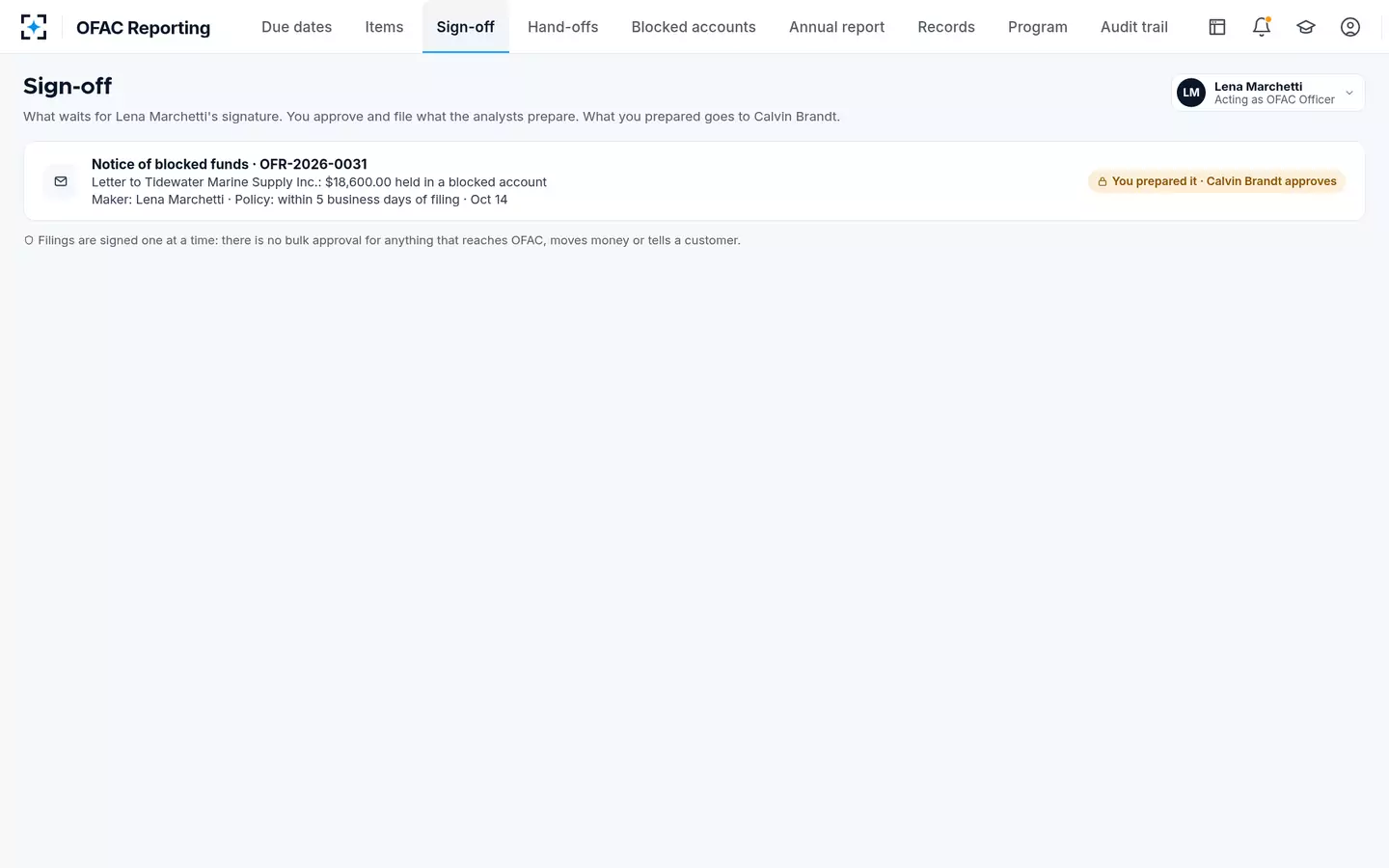
The combined role creates one structural problem that has nothing to do with workload. When the same person prepares and approves, nobody checks. A bank where the officer drafts the annual report, or the letter telling a customer that funds are blocked, needs a second signer for exactly those items. In the sample bank's settings, what the officer prepared goes to the Deputy BSA Officer, and no filing, money movement or customer letter is approved in bulk.
What the officer prepared goes to her deputy
Who signs an OFAC report, and what each signature attests
Legally, the report belongs to the bank: "Primary responsibility for reporting, however, rests with the actual holder, transferrer, or releaser of the property", and a report "may be filed on behalf of" the holder "by an attorney, agent, or other person" (31 CFR 501.603(a)(2)). Inside the bank, though, one report carries several decisions, each made by a different person, and the officer's signature at the end is only as good as the ones before it. Naming what each signature attests is the fastest way to find where a bank's chain is thin.
One rejected payment, five signatures, five different promises
| Signature | Who gives it | What it attests | What backs it up |
|---|---|---|---|
| The disposition | BSA/OFAC Analyst | Which list or program the hit relates to, and whether a listed person is involved | The alert, the list entry compared, the identifiers checked |
| The decision | OFAC Officer | Block, reject or process, under which program | The disposition and the program regulation relied on |
| The return or the block | Deposit Operations | That the money went where the decision says: returned to the sender, or into a blocked interest-bearing account | The return entry or the journal entry to the blocked funds account |
| The prepared report | BSA/OFAC Analyst | That each field is complete and matches its source, with any change from the draft explained | The payment message, the decision, the return file |
| Approve and file | OFAC Officer | That she has read the report and its sources and files it with OFAC under her name | The prepared report, the change log, the due date |
Two points in that table are easy to miss. The money-movement signature is not a compliance signature at all; it belongs to deposit operations, and a bank whose blocked funds never reach the blocked account has made a reporting error that the report itself cannot reveal. And the officer's approval is a promise about the sources, not only about the form. A report that is complete but wrong in one field, such as an omitted intermediary bank, is the officer's error once she signs it.
One rejected payment, signer by signer
Take the sample bank's item OFR-2026-0033: an incoming international ACH credit of $2,450.00 for a business customer, from an originator in Tehran, raised by payment screening at 2:36 PM on Friday, October 2, 2026. The chain below is how it moved through the solution, with each person's step in green and each agent's step with the one thing it may never do.
Nine steps from the disposition to the receipt; five of them need a person
A person decides
Analyst: disposition2:51 PM. No listed person; a payment for Iranian-origin goods. Escalated to the officer.
A person decides
Officer: decision2:58 PM. Reject, under the Iranian Transactions and Sanctions Regulations.
A person decides
Deposit Operations: return3:12 PM. Entry returned to the gateway with Nacha code R16; the suspense entry cleared.
Agent
Intake agentTakes the decision, attaches the payment message, disposition and customer record, opens the chain.
Never: changes a decision
Agent
Clock agentCounts 10 business days from the rejection: due Monday, October 19.
Never: counts a calendar day
Agent
Report drafting agentDay 1: drafts all seven fields the rule asks for, each with a confidence and a source.
Never: writes “SDN” as the legal authority, or submits
A person decides
Analyst: preparesDay 5: changes one field, adds the invoice and the gateway operator, gives reason code OV-1.
A person decides
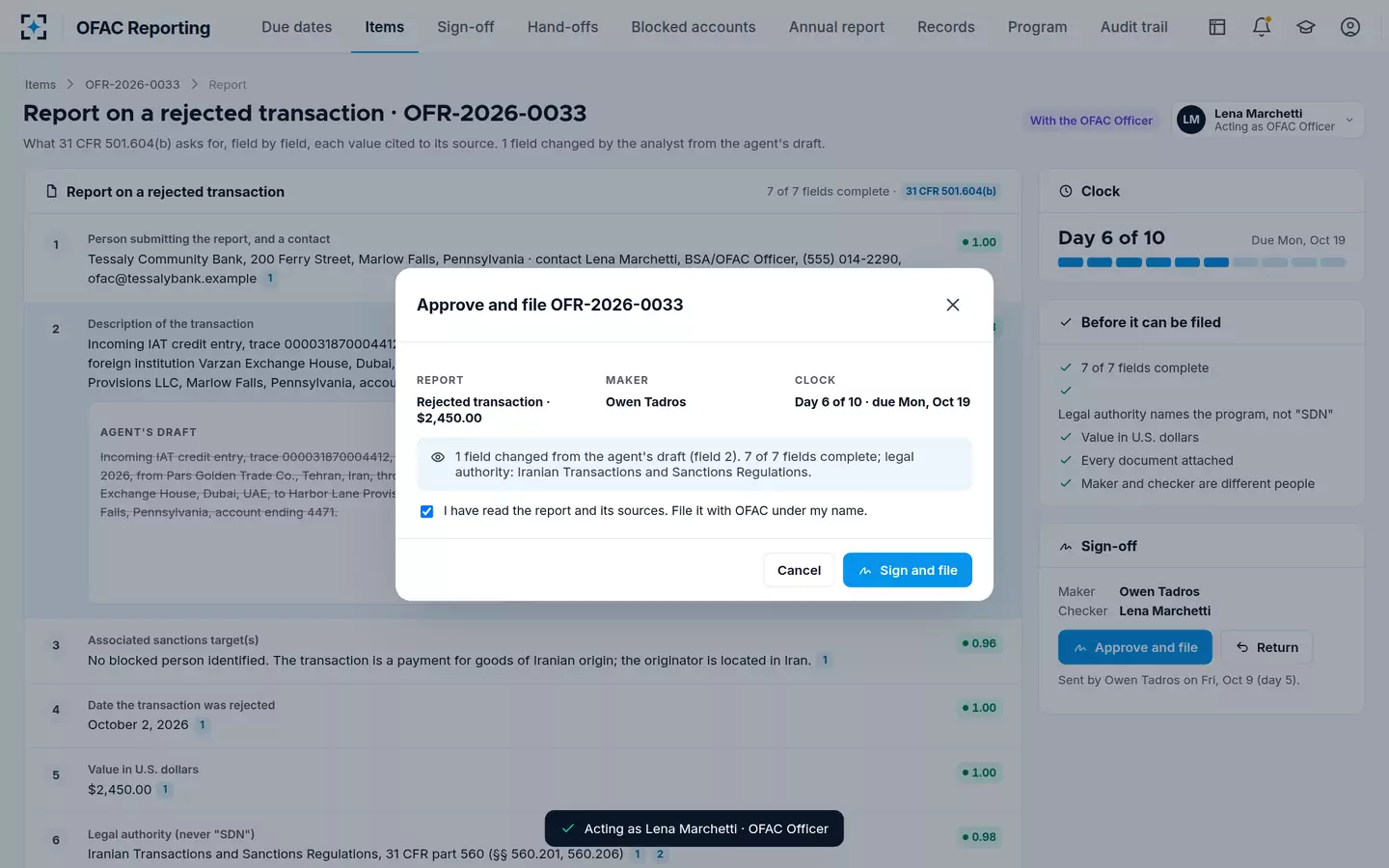
Officer: approves and filesDay 6: reads the change beside the draft, confirms she has read the sources, signs.
Agent
Filing and records agentSubmits through the OFAC Reporting System, records the receipt, keeps the file to 2036.
Never: submits without the officer’s signature
Three details in that chain are the officer's real protection. The analyst's change sits beside the agent's draft with a reason code, so the officer reviews one field that moved rather than re-reading seven. The clock that shows "day 6 of 10" was counted from the rejection, not from the day the report reached her desk. And the record that will answer an examiner's question in 2034 was sealed the moment she signed, not reconstructed from email later.
In OFAC Reporting, the officer signs under her own name after reading what changed
Who is responsible when a report is late or wrong?
The bank is, and through it the officer who owns the program. The reporting rule does not let a holder hand its duty to someone else: the agent, attorney or service provider may file, but primary responsibility stays with the holder. The FFIEC manual makes the same point for screening done by others, and it applies to reporting by a processor or fintech partner just as well. Late filing carries its own civil penalty under OFAC's Enforcement Guidelines, separate from any penalty for the payment itself, and how OFAC calculates a penalty for a late or missed report is worked through with real cases elsewhere.
The quieter failure is the one where the officer leaves. In 2022 OFAC issued a Finding of Violation to Nodus International Bank, a small international financial entity in Puerto Rico, partly for recordkeeping. During the investigation the bank told OFAC "that it no longer maintained access to all records or communications related to the bank's handling of the blocked property as the bank's compliance officer had since left the bank and, unbeknownst to the bank, its systems did not effectively retain such records or communications" (OFAC, Nodus International Bank, 2022). OFAC counted the missing records as an aggravating factor because they "may have impaired its ability to provide full and accurate information to OFAC".
The lesson for any officer is that the program has to survive her absence. Every decision, change and approval needs to live in a file that a successor, an auditor or OFAC can read without her, for ten years. That is a design requirement for whatever system the bank uses, not a habit to encourage.
Who files the annual report of blocked property?
The holder files it, and the officer usually signs it. The rule requires a report of all blocked property held on June 30 to be filed by September 30 (31 CFR 501.603(b)(2)), and OFAC's 2026 filing guidance asks for "the name and contact information of the individual empowered by the holding institution to file the ARBP" in Part A of the form (OFAC ARBP guidance, 2026). Only registered users can submit it: OFAC registers an institution for its OFAC Reporting System with a primary contact and "any additional persons authorized to file reports".
At the sample bank, the analyst reviewed every line against its blocking report and the officer approved and filed on September 24, six days early. The work that made that possible happened in July, when an agent drafted the report from the June 30 tie-out to the general ledger. What belongs on the annual report of blocked property, including the debts and $0.00 lines most banks miss, has its own guide.
OFAC sanctions compliance officer: job description and pay
The job description follows from the FFIEC sentence above, and its one stated qualification is knowledge: the designated individual "should have an appropriate level of knowledge about OFAC regulations commensurate with the bank's OFAC risk profile" (FFIEC manual). No license or certification is required by OFAC or the examination manual. A bank with international wires, trade finance or a fintech partner program needs far deeper knowledge than one whose only exposure is domestic deposits.
The Bureau of Labor Statistics does not count sanctions officers separately; they sit within compliance officers, SOC 13-1041. In May 2025 that occupation employed 417,070 people at a mean annual wage of $88,400 and a median of $80,730; in banking and other credit intermediation, 19,850 compliance officers earned a mean of $94,090 (BLS OEWS). Those are averages across every kind of compliance work; a sanctions officer at a large bank with a payments business will sit well above them, and a combined BSA/OFAC officer at a small bank often near them.
What an examiner can ask the OFAC officer to show
- Who owns the program, in writing
The designation, the deputy, and the reporting line to senior management OFAC’s framework expects.
- Every block and reject this year, with its report
Each with the decision, the date of the event, the date filed and the OFAC receipt.
- The blocked accounts, tied to the general ledger
Balances, interest at a commercially reasonable rate, and the owner of every dollar.
- Last year’s annual report and its support
One row per blocked asset, values as of June 30, filed by September 30.
- What changed in the draft, and why
Who prepared, who approved, and the reason for every edit before filing.
- Records back ten years
Under 31 CFR 501.601, kept for blocked property while blocked and ten years after it is unblocked.
What changes when OFAC Reporting agents draft the report
Agents change where each person's hours go, not who signs. The four people who carry a report at the sample bank keep their decisions; what moves to agents is the finding, typing, counting and tying out that used to fill the gaps between them. OFAC's framework asks that senior management ensure "the existence of direct reporting lines between the SCP function and senior management, including routine and periodic meetings" (OFAC Framework); an officer who is not typing fields has the time to hold those meetings with something to show.
The four seats on one OFAC report, before and after
Today
Finds the payment message, the core record and the disposition by hand; types every field into OFAC’s form; counts the due date on a desk calendar.
With agents
Starts from a drafted report with a source on every field and a due date that explains itself; changes what needs changing, with a reason code.
Still theirs: the disposition and the prepared report
Today
Reads reports by email without seeing what the analyst changed; learns of a late hand-off or a gap in the general ledger when it is already a problem.
With agents
Sees exactly what changed from the draft, signs and files in one step, and builds an examiner’s file in minutes.
Still theirs: every block or reject decision and every filing
Today
Posts blocked-funds entries by hand and finds an account earning no interest months after it opened.
With agents
Gets a proposed journal entry the day a block has none, and a rate check on every blocked account at each month-end.
Still theirs: posting entries and changing rates, confirmed by the officer
Today
Asked to countersign by email, with no record of who prepared what.
With agents
Approves what the officer prepared, such as a notice of blocked funds, and stands in when she is away.
Still theirs: the second signature on the officer’s own work
The agents' limits are what make that safe. In the solution, no agent decides a block or a reject, posts an entry, changes a rate, signs, submits an unsigned report or deletes a record before its date. Which reporting tasks move to agents and which stay with people sets out the full split, with OFAC's own estimate of the time each report takes. The whole chain, from the hit to the sealed file, is on the OFAC Reporting solution page.
Questions people ask
Is an OFAC compliance officer required by law?
No statute or OFAC regulation requires the title. The FFIEC examination manual recommends that every bank designate a qualified individual responsible for day-to-day OFAC compliance, and OFAC's 2019 framework counts a dedicated sanctions compliance officer as a measure of an adequate program. Examiners and OFAC both expect to find one.
Can an attorney, vendor or service provider file OFAC reports for the bank?
Yes, but the duty stays with the bank. 31 CFR 501.603(a)(2) says a report may be filed on the holder's behalf "by an attorney, agent, or other person", while primary responsibility rests with the actual holder, transferrer or releaser of the property. A late or wrong report filed by a provider is still the bank's late or wrong report.
Who can submit reports in the OFAC Reporting System?
The people OFAC has registered for the institution. To register, a bank emails OFAC with its name, the primary point of contact and the names and email addresses of any additional persons authorized to file. Keeping that list current matters: OFAC's 2026 guidance tells filers whose administrators are inactive to email OFAC for help, which costs days near a deadline.
What qualifications does an OFAC officer need?
The FFIEC manual asks for "an appropriate level of knowledge about OFAC regulations commensurate with the bank's OFAC risk profile" and names no certification. A bank with correspondent banking, trade finance or international ACH needs an officer who can read program regulations, general licenses and the 50 percent rule; a bank with only domestic retail deposits needs less.
Does the OFAC officer report to the board?
OFAC's framework expects direct reporting lines between the sanctions compliance function and senior management, with routine and periodic meetings, and expects senior management to have reviewed and approved the program. How that reaches the board is set by each bank's governance; most banks report OFAC matters alongside BSA/AML in the same committee.
How much does an OFAC compliance officer earn?
BLS publishes pay for compliance officers as a whole, not for sanctions specialists. In May 2025 the mean annual wage was $88,400 across all industries and $94,090 in banking and other credit intermediation. Pay for sanctions roles varies widely with the size of the bank and its international business.