The annual report of blocked property (ARBP) is the report every U.S. person holding property blocked under OFAC's sanctions programs must file once a year, listing all blocked property held as of June 30, by September 30, on OFAC's TD F 90-22.50 spreadsheet submitted through the OFAC Reporting System. It is the only report in the regime that looks back across everything at once, which is why it exposes what the 10-day reports missed: a blocked account that never reached the general ledger, a debt owed to a blocked company that nobody thought of as property, an account opened in a product that pays no interest. Missing the September 30 date is a violation in itself. Botminds' OFAC Reporting treats the annual report as the end of a year of month-end tie-outs rather than a September project: agents tie every blocked account to the general ledger each month, draft the report on July 1, and leave the review and the filing to the analyst and the OFAC Officer.
The examples come from a fictional sample bank, Tessaly Community Bank, and its 2026 annual report as prepared in the solution; the people and companies named are fictional. OFAC's rules, guidance and enforcement cases are linked where they are quoted.
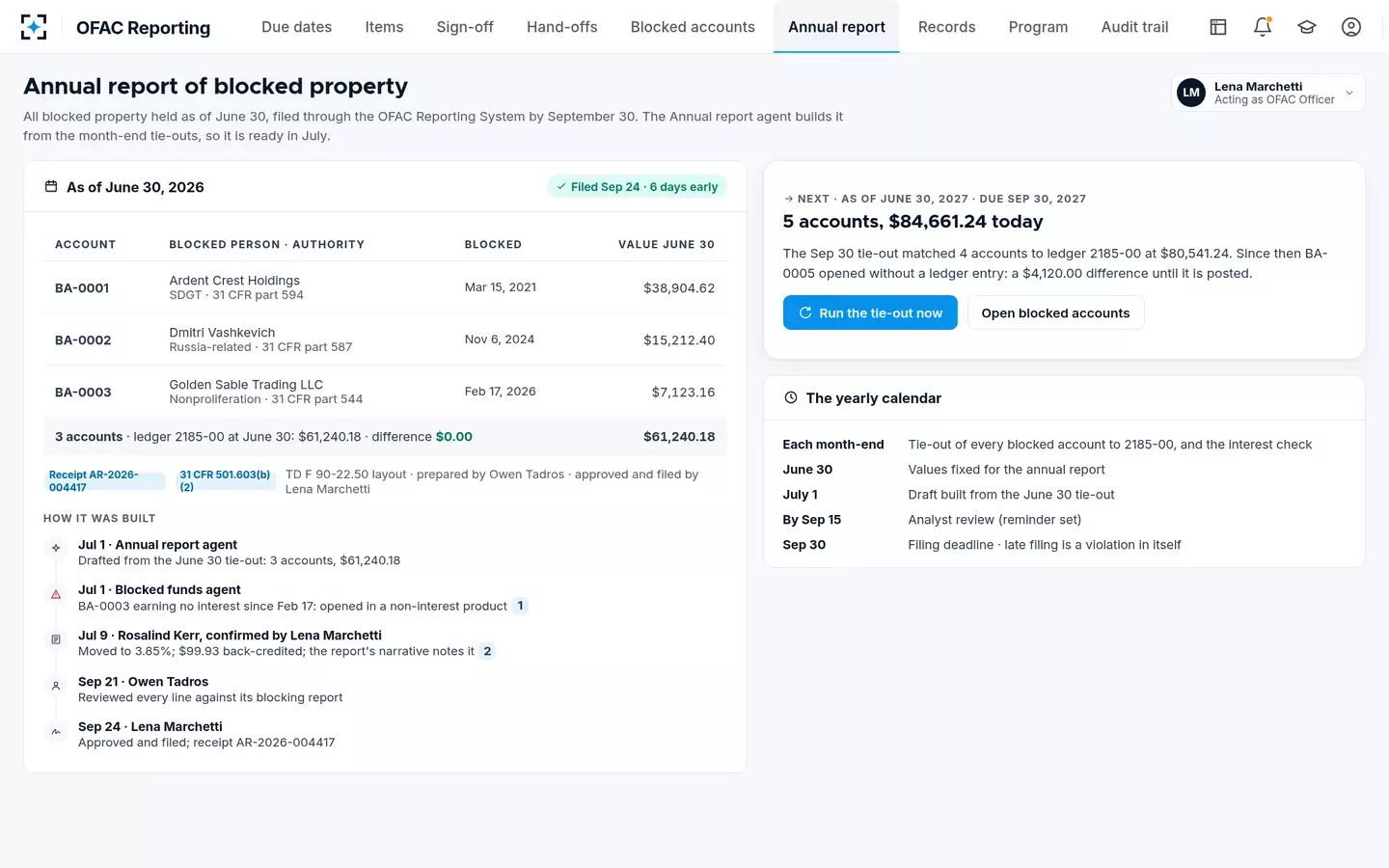
The sample bank's 2026 annual report, tied to the general ledger to the cent
| Account | Blocked person · program | Blocked | Value June 30, 2026 |
|---|---|---|---|
| BA-0001 | Ardent Crest Holdings · global terrorism (31 CFR part 594) | Mar 15, 2021 | $38,904.62 |
| BA-0002 | Dmitri Vashkevich · Russia-related (31 CFR part 587) | Nov 6, 2024 | $15,212.40 |
| BA-0003 | Golden Sable Trading LLC · nonproliferation (31 CFR part 544) | Feb 17, 2026 | $7,123.16 |
| Report total | 3 accounts | $61,240.18 | |
| General ledger 2185-00 at June 30 | Blocked funds account | $61,240.18 · difference $0.00 |
When is the annual report of blocked property due?
By September 30, for property held on June 30. The rule is one sentence: "A report on all blocked property held as of June 30 of the current year shall be filed annually by September 30" (31 CFR 501.603(b)(2)(i)). OFAC's 2026 guidance adds that "The reporting period begins July 1", and that "Failure to submit a completed ARBP by September 30 constitutes a violation of C.F.R. § 501.603 of the RPPR" (OFAC ARBP guidance, 2026). The word that matters is "completed": a report OFAC returns for correction is not complete until the corrected file is resubmitted.
Ninety-two days from June 30 to the deadline, and where the sample bank spent them
| Date | What happened | Who |
|---|---|---|
| Each month-end | Every blocked account tied to general ledger 2185-00; each account’s rate checked | Blocked funds agent; exceptions to deposit operations |
| June 30 | Values fixed for the report: three accounts, $61,240.18 | The June tie-out |
| July 1 | Draft built in OFAC’s layout; one account found earning no interest since February 17 | Annual report agent and blocked funds agent |
| July 9 | Account moved to the blocked savings product at 3.85%; $99.93 back-credited and noted in the narrative | Deposit operations, confirmed by the officer |
| September 21 | Every line reviewed against its blocking report (the bank’s target was September 15) | BSA/OFAC Analyst |
| September 24 | Approved and filed through ORS, six days before the deadline | OFAC Officer |
Who must file it, and are banks required to?
Any U.S. person holding blocked property on June 30 must file it, and that is far wider than banks. The rule reaches every U.S. person "who have in their possession or control any property blocked pursuant to this chapter, including financial institutions that receive and block payments or transfers" (31 CFR 501.603(a)(1)), and OFAC's guidance gives "a financial institution or a manufacturing company" as examples of the holder. Insurers, broker-dealers, property managers and logistics companies file it too, and one of OFAC's most recent reporting cases involved a property manager.
The duty follows the property. Part 501 ties the annual report to property held as of June 30 and does not describe a nil report, which is one difference from the UK: OFSI's annual frozen assets review requires a nil return from a firm that reported last year and no longer holds those assets, a legal requirement "from 2025 onwards" (OFSI general guidance). In the U.S., the bank that held blocked property last year should still be able to show where each item went: released under a license, unblocked on a delisting, or transferred under an order, each with its own report.
What counts as blocked property?
Anything in which a blocked person has an interest, and OFAC's definition of property is deliberately broad. It "includes financial property (e.g., money, checks, savings accounts, stocks, bonds, debt, or any other financial instruments), real, tangible, and intangible assets (e.g., goods, merchandise, ships, land contracts, and real estate), and any other property or interests therein present, future, or contingent" (OFAC FAQ 9). A bank's annual report is mostly deposits and blocked payments, but loans, safe deposit contents, collateral, letters of credit and securities held in custody all qualify.
Several kinds of property are reported at a value of zero, which is where they get lost. The rule says that "If the blocked property represents an outstanding loan, a credit card receivable, or other property with a negative balance, the amount blocked should be reported as $0.00 (zero) with the amount owed reflected in a narrative description", and blocked trade finance documents go in at $0.00 with the shipment value in the narrative (31 CFR 501.603(b)(2)(ii)(F)). A report that leaves out a blocked customer's loan because "there's no money in it" is incomplete.
What goes on the annual report, and how it is valued
| Kind of property | Reported value | What else the row needs |
|---|---|---|
| Deposit or blocked payment | Balance on June 30, including interest credited | Account number and type; one row per blocked asset even inside an omnibus account |
| Loan, credit card receivable, other negative balance | $0.00 | The balance owed as of June 30, in the Additional Description of the Property |
| Trade finance documents | $0.00 | The value of the shipment, in the narrative |
| Securities or stocks | Closing price on June 30 | The number of shares, in the Additional Description |
| Real estate and other non-financial assets | Actual or estimated market value on June 30 | Location: one city and one country |
| Foreign-currency property | U.S. dollars | The foreign amount and the notional exchange rate, in the narrative |
Three things do not belong on the report, according to the 2026 guidance: property unblocked by license or associated with a delisted SDN before July 1; property unblocked because its program was terminated and not blocked under any active program; and assets merely "immobilized pursuant to Directive 4 of Executive Order 14024 or restricted 'Iranian accounts,'" unless they are otherwise blocked (OFAC ARBP guidance). Each exclusion needs its own evidence in the file, because the line that drops off this year's report was on last year's.
Gracetown: 45 months of blocked property nobody reported
The clearest recent case of blocked property going unreported is not a bank. Gracetown, Inc., a New York property manager for real estate bought by Oleg Deripaska, had been receiving monthly settlement payments on behalf of a Deripaska-owned company and booking them as a loan. When OFAC designated Deripaska on April 6, 2018, it sent Gracetown a notification that reminded it of "its legal obligation to block all property in its possession in which Deripaska had an interest and report such property to OFAC within 10 business days" (OFAC, Gracetown, Inc., 2025).
As of April 6, 2018, Gracetown had already received and spent—and therefore owed Baufinanz—a total of $72,500, a debt that became blocked property (and thus required reporting) upon Deripaska’s designation.
OFAC enforcement release, Gracetown, Inc., December 4, 2025
Gracetown kept receiving payments, 24 more totalling $31,250, until the settlement ended in May 2020. It reported the accumulated debt of $103,750 as blocked property on January 11, 2022, "over 45 months after Gracetown received actual notice from OFAC". OFAC found the case egregious and imposed a penalty of $7,139,305, of which the statutory maximum for the reporting violations alone was $71,094. The lesson for a bank's annual report is the shape of the asset: what Gracetown failed to report was not money it held but money it owed. A bank that owes a blocked person anything, from a cashier's check never presented to a refund in suspense, holds blocked property.
One unreported debt, priced by OFAC
45+months
between OFAC’s notice and Gracetown’s report of blocked property
$103,750
accumulated debt to a blocked company, reported in January 2022
$7.14M
penalty imposed, for an egregious case not voluntarily self-disclosed
Do OFAC blocked funds earn interest?
They must, in programs with blocking provisions. Blocked funds are held in "a blocked interest-bearing account" at a federally insured U.S. institution, earning interest "at rates that are commercially reasonable", which the Global Terrorism Sanctions Regulations define as "the rate currently offered to other depositors on deposits or instruments of comparable size and maturity" (31 CFR 594.203); other programs have parallel provisions. Banks may hold each block in its own account or pool them, and OFAC's FAQ 32, rewritten on October 26, 2026, accepts either "provided there is a clear audit trail, including so the institution can later unblock specific funds with the appropriate interest, if authorized to do so". It adds that a bank using pooled accounts must list each blocked asset inside them separately on the annual report, under 31 CFR 501.603(d)(1) (OFAC FAQ 32).
The sample bank found its interest problem while drafting the annual report. On July 1 the agent that ties out blocked accounts flagged that BA-0003, blocked on February 17, 2026, had been opened in a product that earned nothing. Deposit operations moved it to the blocked savings product at 3.85% on July 9, back-credited $99.93 of interest with the officer's confirmation, and the report's narrative says so. Without the annual review, the gap would have run until the property was released, and the release would have been short of what the owner was owed.
The annual report, built in OFAC Reporting from the month-end tie-outs
Reconciling the annual report of blocked property to the general ledger
The report should equal the blocked funds on the general ledger, line by line and in total, on June 30. If it does not, either the report or the books are wrong, and both are the bank's problem. The reconciliation is ordinary accounting; what makes it hard in practice is that the blocked accounts sit in the core system, the blocked funds account sits in the general ledger, and the blocking reports sit in compliance, so no single person sees all three until September.
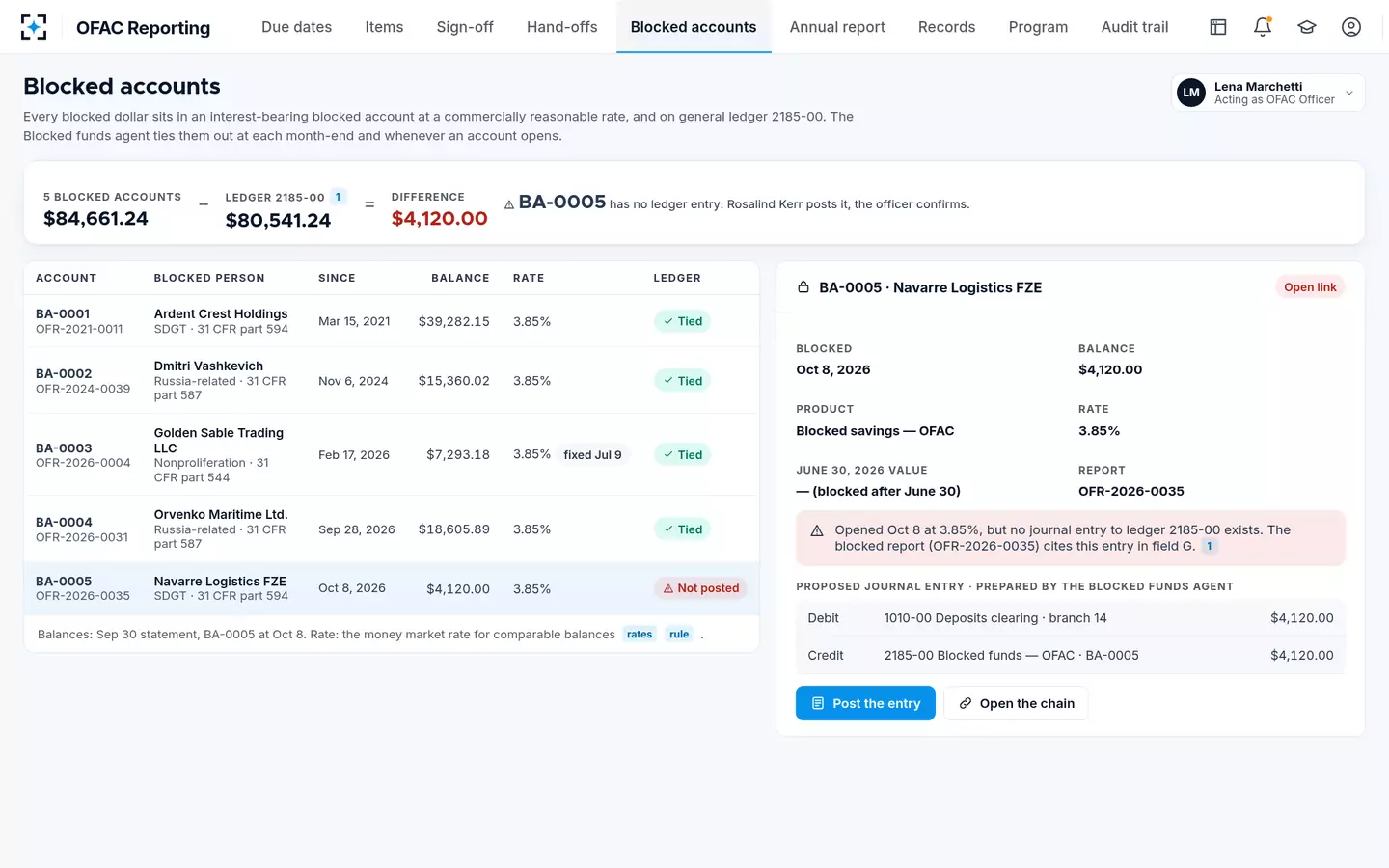
Doing it monthly turns the annual report into a by-product. In October the sample bank's tie-out showed five blocked accounts holding $84,661.24 against $80,541.24 in general ledger account 2185-00: a $4,120.00 check blocked on October 8 had its blocked account but no journal entry. The agent proposed the entry the same week, for deposit operations to post and the officer to confirm, inside the 10-day window for the blocking report, which cites the account in its "action taken" field. In a September-only process, that gap would have surfaced eleven months later.
Every blocked dollar on the general ledger, checked by OFAC Reporting at each month-end
Before the annual report is filed, reconcile these six things
- Report total to the general ledger
Every blocked funds account, at June 30, to the cent.
- Each line to its blocking report
Same target, same date blocked, same ORS report ID.
- Last year’s report to this year’s
Every line that left has its release, delisting or transfer report.
- Interest on every deposit line
A commercially reasonable rate since the day of blocking.
- The $0.00 lines
Loans, receivables, trade documents and debts owed to blocked persons, with narratives.
- Omnibus accounts broken out
One row per blocked asset inside any pooled account.
OFAC's own list of the errors that get submissions sent back, from the wrong report ID to merged cells, is worked through in the guide to the blocked property report template.
What examiners look for in blocked accounts
Examiners test the annual report from the other end: the bank's own records of who owns each blocked dollar and what it has earned. The FFIEC manual puts it plainly: "Banks are responsible for tracking the amount of blocked funds, the ownership of those funds, and interest paid on those funds. Total amounts blocked, including interest, must be reported to OFAC by September 30 of each year (information as of June 30)" (FFIEC manual). Ownership is the field that ages worst. A blocked account opened for a wire in 2021 may by now belong to an estate, a successor company or a party whose share of the blocked entity has changed, and the annual report is where the bank either tracks that or repeats last year's line.
The same section warns about mergers: "When a bank acquires or merges with another bank, both banks should take into consideration the need to review and maintain such records and information." An acquired bank's blocked accounts arrive with their own blocking reports, rates and report IDs, and the acquirer's first annual report after closing is the moment those have to be on its general ledger and in its files.
What does filing the annual report late cost?
A late report is a violation on its own, and OFAC's Enforcement Guidelines price it. As adjusted on January 15, 2025, late filing of a required report can bring a penalty of up to $3,642 within the first 30 days, up to $7,289 after that, and, for a report on blocked assets, up to $1,459 more for every 30 days it stays overdue (90 FR 3687). The overdue increments can run for years, which is how a reporting violation reached $71,094 in the Gracetown case. How OFAC calculates a penalty sets the late-report amounts beside the much larger penalties for the transactions themselves.
How do you get blocked funds released?
The owner applies to OFAC for a specific license, and the bank's blocking report is what makes that possible. OFAC itself never holds the money. Its FAQ 51 tells owners to confirm with their bank that the funds are blocked, and to have the bank identify the institution that filed the blocking report, because "OFAC generally does not process requests for the release of blocked funds where a corresponding blocking report has not been filed" (OFAC FAQ 51). A block that was never reported is therefore one that the rightful owner cannot easily get back.
Once a license is granted, or the person is delisted, the bank releases the property and, unless an exception applies, files a report of unblocked property within 10 business days. The line then drops off the next annual report, and the record of the property stays in the bank's file for 10 years after the release. OFAC's reporting requirements, field by field lists what the unblocking report must carry, including a copy of the original blocking report. The full cycle, from the block to the annual report and the sealed file, is on the OFAC Reporting page.
Questions people ask
Are banks required to file an annual report of blocked property?
Yes, if they hold blocked property on June 30. The duty in 31 CFR 501.603(a)–(b)(2) applies to every U.S. person holding property blocked under OFAC's regulations, including financial institutions that receive and block payments. The report is due by September 30.
Is the annual report filed through the OFAC Reporting System?
Yes. The initial blocked and rejected report forms are built into ORS, but the annual report is different: filers download the current TD F 90-22.50 spreadsheet, complete Parts A and B, and upload the file through ORS. OFAC no longer accepts earlier versions of the form.
Do I report property blocked after June 30?
Not on this year's report, which covers property held as of June 30. It is reported within 10 business days of the block, and goes on next year's annual report, where OFAC's 2026 form asks filers to mark it as a New Item, "Y", because it was not on the previous year's report.
What value do I report for blocked securities?
The closing price on June 30, under OFAC's 2026 guidance, with the number of shares written in the Additional Description of the Property. Real estate and other non-financial assets are reported at actual or estimated market value as of June 30.
What happens to blocked funds that would otherwise be escheated to the state?
OFAC's FAQ 39 answers in one line: "You need to discuss this with your state authorities and with OFAC." Blocked property cannot be transferred without OFAC's authorization, so an escheatment run that sweeps a blocked account without it would be an unauthorized dealing in blocked property.