The OFAC Reporting System (ORS) is OFAC's online portal for the reports its regulations require, and since August 8, 2024 it has been the mandatory route for initial reports on blocked property, reports on rejected transactions and the annual report of blocked property. Filers register by email, complete the blocked and rejected forms inside the system, upload the annual report as OFAC's spreadsheet, and receive a report ID for each filing. What ORS does not do is everything before the submit button: it does not tell the bank that a report is due, count the 10 business days, gather the payment message and the decision, check the values against the general ledger, or keep the bank's 10-year file. That work sits between the screening system and ORS, where most reporting failures happen. Botminds' OFAC Reporting is built for that gap: agents open a chain for each block or reject, count the days, draft every field with its source and, once the OFAC Officer signs, submit through ORS and file the receipt.
Where this page uses examples, they come from a fictional sample bank, Tessaly Community Bank, as it files through the solution; the people and companies named are fictional.
What ORS does, what it does not, and who does the rest
| Step | Done by ORS? | Who does it instead |
|---|---|---|
| Notice that a report is due | No | The bank: every block, reject and release starts a 10-business-day clock |
| Counting the business days | No | The bank, from the event date, skipping weekends and federal holidays |
| Gathering the transaction, parties, decision and documents | No | The bank, from its payments, case and core systems |
| Report forms for initial blocked and rejected reports | Yes: built into the system | — |
| The annual report form | Partly: it takes the upload of OFAC’s TD F 90-22.50 spreadsheet | The bank completes the spreadsheet offline |
| Tying blocked property to the general ledger | No | The bank’s deposit operations and compliance |
| A report identification number | Yes | — |
| Returning a defective annual report with a reason | Yes: OFAC returns non-compliant filings | The bank corrects and re-uploads over the original |
| Approval inside the bank | No | The bank’s preparer and signer |
| Keeping the bank’s copy and its 10-year file | No | The bank, under 31 CFR 501.601 and 501.603(d)(1) |
What is the OFAC Reporting System?
It is the electronic front door for OFAC's mandatory reports. OFAC describes it as "a public online platform for submitting mandatory reports on blocked property and rejected transactions, as required by the Reporting, Procedures, and Penalties Regulations (31 C.F.R. part 501)", and leaves no room for alternatives.
All persons subject to OFAC's reporting requirements must use ORS to file initial reports on blocked property, reports on rejected transactions, and the Annual Report of Blocked Property (ARBP).
OFAC, OFAC Reporting System page
The requirement became law through the rule OFAC published on May 10, 2024, effective August 8, 2024, which "required the use of the electronic OFAC Reporting System (ORS) for submission of reports related to blocked property and rejected transactions" and was finalized on October 8, 2024 (OFAC, 89 FR 81358). The volume flowing through it is large: in its 2024 paperwork estimate OFAC counted about 10,900 unique respondents across its reporting collections and roughly 2.5 million responses a year (OFAC, 89 FR 74375).
ORS in four dates
May 10, 2024
interim final rule requiring electronic filing published
Aug 8, 2024
ORS mandatory for blocked, rejected and annual reports
Oct 8, 2024
final rule adopted, with changes
Sep 30, 2026
due date of the 2026 annual report, uploaded through ORS
How do you register for ORS?
By email. OFAC's ORS page asks a new filer to write to OFACReport@treasury.gov with the name of the reporting institution, the name and email of the primary point of contact, and the names and emails of anyone else authorized to file (OFAC Reporting System). The 2026 annual report guidance repeats the instruction for first-time filers and adds a note on dormant access: inactive ORS accounts are reactivated by the institution's own "filer administrator", and "If all filer administrators are also inactive, email OFACReport@treasury.gov for assistance" (OFAC ARBP guidance).
That last sentence is a planning point. A small bank that files a handful of reports a year can find in September that its only administrator has left, and that the annual report's deadline is now waiting on an email exchange with OFAC. Two active administrators, reviewed when staff change, cost nothing.
Can you still file OFAC reports by email?
Only with OFAC's written permission, except for unblocking reports. For initial blocked reports, rejected reports and the annual report, a filer that can show "unique and extraordinary circumstances that would not allow the submitter to use ORS, such as lack of access to the internet" may ask for another route, and "Such requests will be subject to a presumption of denial and granted only in writing" (31 CFR 501.603(d)(1); the same words appear in 501.604(d)). Filers granted an exception still have OFAC's paper-era forms, TD-F 93.02, 93.08 and 93.07 (OFAC, 89 FR 74375).
Reports of unblocked or transferred property are the exception: they "must be submitted electronically to OFAC via email at OFACReport@treasury.gov, with the number of this section in the subject line, or through ORS" (31 CFR 501.603(d)(2)), and OFAC's ORS page lists the unblocking and transfer form, TD F 93.10, with the instruction to email it. OFAC's FAQ 49, rewritten on October 26, 2026, now says the same as the rule: blocked and rejected reports go through ORS within 10 business days, with the supporting documents attached (OFAC FAQ 49). Procedures written from its older text, which described email as the route, should be updated.
Filing before and after the 2024 rule
Before August 8, 2024: Optional OFAC forms, or the complete information by email
Since August 8, 2024: ORS only, unless OFAC grants an exception in writing
Before August 8, 2024: The same optional routes
Since August 8, 2024: ORS only, on the same terms
Before August 8, 2024: OFAC’s standardized spreadsheet, sent to OFAC Compliance
Since August 8, 2024: Current TD F 90-22.50 spreadsheet uploaded through ORS
Before August 8, 2024: No general reporting requirement
Since August 8, 2024: Report within 10 business days, by email or ORS
Before August 8, 2024: Accepted for several submissions
Since August 8, 2024: Removed for certain other submissions
What ORS does well
ORS standardizes the input and gives every filing an identity. The blocked and rejected report forms are inside the system, so a filer cannot omit a field the form requires, and each submission receives a Blocked/Rejected Report ID that later reports refer back to. The annual report form asks for that ID in its ORS Report ID column, and OFAC's 2026 guidance explains how to retrieve the IDs: log into ORS, open Dashboards, choose Blocked/Rejected Reports, search with Action Taken set to "Blocked", and download the results to Excel, where the IDs sit in column A (OFAC ARBP guidance).
For the annual report, ORS also carries OFAC's review back to the filer. When OFAC returns a submission, the filer reads the "Return Reason", corrects the spreadsheet and uploads the new file over the original rather than starting a new report, which OFAC asks for "To prevent duplicating records". A bank that keeps its ORS IDs and returns inside its own file, rather than only in the portal, can answer an examiner's question about any filing without logging in.
What does the OFAC Reporting System not do?
It does not know anything the bank has not typed into it. ORS cannot see the payments hub, the case management system, the core or the general ledger, so it cannot know that a block happened, that the clock started on a Friday before a holiday, or that a blocked check never reached the blocked funds account. It receives a report when someone submits one. The bank's obligations sit on either side of that moment: the regulation requires a copy of each report to be "retained for the submitter's records" (31 CFR 501.603(d)(1)), and the underlying records must be kept 10 years.
Nor does ORS make the judgement calls. Whether an item is blocked or rejected, which program is the legal authority, what the sanctions target's interest is, and how a foreign-currency amount converts are the bank's answers, entered into ORS. OFAC's FAQ 5 lists reporting as the sixth step of its screening process, after determining whether a hit is valid and whether to block or reject (OFAC FAQ 5): the portal is only where the sixth step ends.
Does screening software file OFAC reports?
Usually not. Screening and interdiction tools are built to find potential matches, and OFAC's own description of them stops there: some stop wire transfers that touch a listed name or a sanctioned country, others check new customers or rescreen account holders (OFAC FAQ 31; the two jobs are compared in name screening vs transaction screening). Between the cleared alert and the ORS receipt sit the decision, the movement of money, the report and the signature, which belong to other systems and other people.
The FFIEC manual treats reporting as its own part of the program: an OFAC compliance program "should also include policies, procedures, and processes for handling validly blocked or rejected items under the various sanctions programs", and "should also address the management of blocked accounts" (FFIEC manual). When a bank asks whether its software "does OFAC reporting", the useful follow-up is which of the steps in the table above it performs, and whether it submits anything to ORS or only prints a form for someone to retype.
The gap between the hit and the ORS receipt
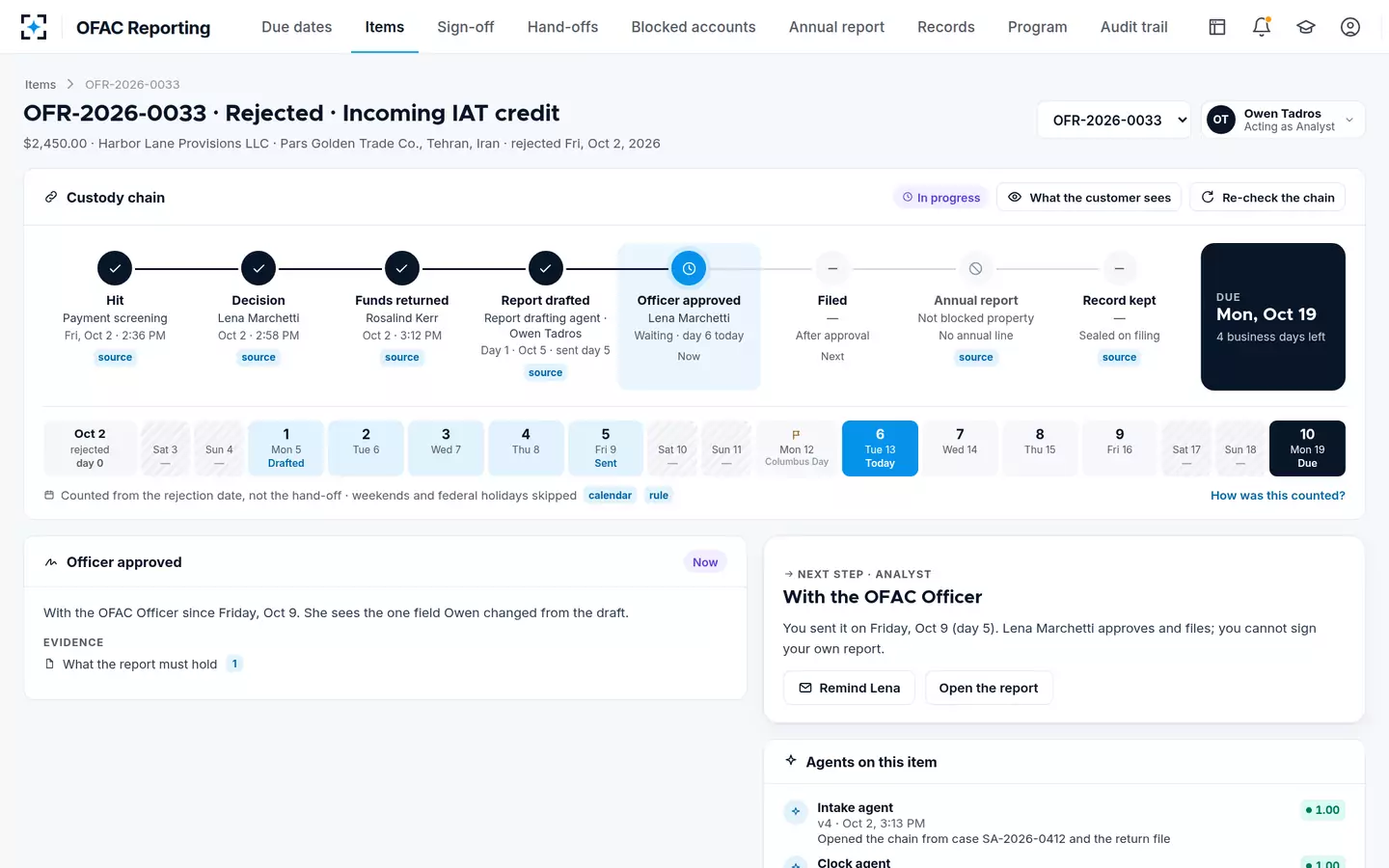
After the hit, one reported item passes through seven more links, held in different systems, and ORS is only one of them. The sample bank's solution treats the item as one chain and checks every link against the system that holds it, so a missing link shows up as an open step with a name on it, not as a surprise at examination.
After the screening hit: seven links to the ORS receipt, each in its own system
A person decides
DecisionBlock, reject or process, by the OFAC Officer, in case management.
A person decides
Money movedReturned, or posted to a blocked account, by deposit operations in the payments hub and core.
Agent
Clock and draftTen business days counted from the event; every field drafted with its source.
Never: starts the clock at a hand-off
A person decides
Prepared and signedThe analyst prepares and the officer approves, with every change shown.
Agent
Filed through ORSSubmitted after the signature; the report ID and receipt recorded.
Never: submits unsigned
Agent
Annual report lineBlocked property carried to the June 30 report from the month-end tie-outs.
Agent
File keptThe item’s documents sealed with a checksum and kept 10 years, or 10 years after release.
Never: deletes before its date
One item, one chain, ending at the ORS receipt
Report IDs, returns and amendments
The identifiers ORS issues are the thread between reports filed years apart, and they are easy to confuse. The annual report asks for the Blocked/Rejected Report ID of each block's initial report, "not the Submission ID", and OFAC's 2026 list of the commonest reasons for returning annual reports begins with filers who put "the ORS Submission ID, ARBP ID, an internal tracking number, or another incorrect identifier" in that column (OFAC ARBP guidance). The unblocking report needs the same IDs: it must attach "A copy of the original blocking report filed with OFAC" and "the OFAC Reporting System report identification numbers, when available" (31 CFR 501.603(b)(3)(ii)(G)).
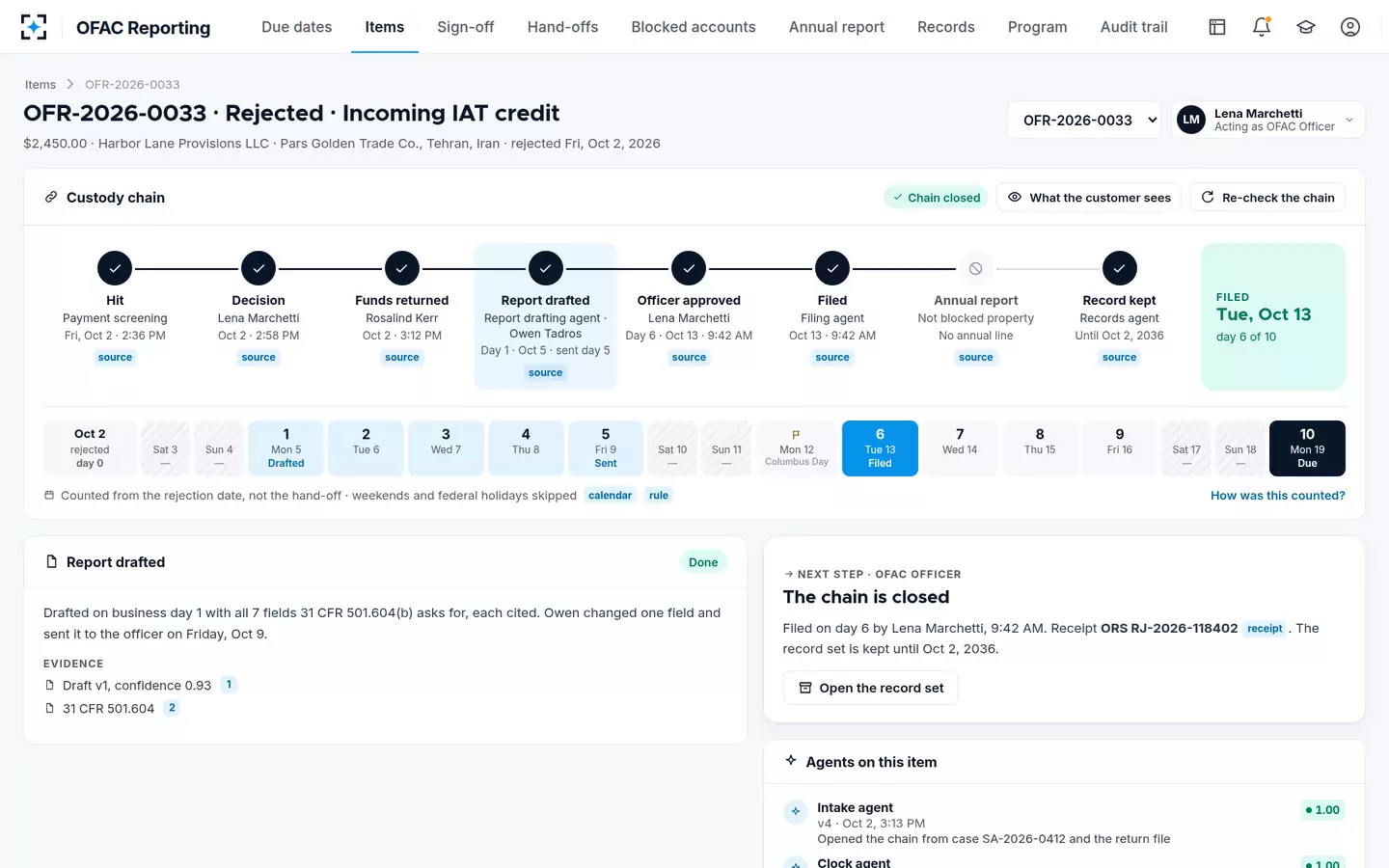
The practical rule is to capture the report ID at the moment of filing and keep it with the item, not to rely on retrieving it from the portal years later. In the sample bank, the filing agent records the receipt, ORS RJ-2026-118402 for its rejected Iranian credit, in the item's sealed file as soon as the submission completes.
Filed through ORS, receipt recorded, chain closed
Is the bank ready to file through ORS on a bad day?
- Two active filer administrators
Checked whenever staff leave or change roles.
- A registered filer who is not the signer
So the officer’s absence does not stop a submission.
- The current TD F 90-22.50 on file
OFAC will not accept earlier versions of the annual report form.
- Every ORS report ID stored with its item
For the annual report and for any later release.
- A copy of every submitted report kept
Required by 31 CFR 501.603(d)(1), and part of the 10-year file.
- An email route for releases
Unblocking reports may go to OFACReport@treasury.gov with the section number in the subject.
How OFAC Reporting hands a report to ORS, and what it never does
In the solution, ORS is reached only through the officer's signature. The Filing and records agent submits a blocked, rejected or unblocking report after the OFAC Officer has approved it, records the identifiers ORS returns, seals the item's documents with a checksum and sets the date until which they are kept. For the annual report, the Annual report agent builds the TD F 90-22.50 rows on July 1 from the month-end tie-outs; the analyst reviews them, the officer files them.
Its limits are written into the agents rather than the procedure manual: the filing agent never submits without the officer's signature and never deletes a record before its date or under a legal hold, and the drafting agent never writes "SDN" as a legal authority and never submits anything itself. Those are the controls an examiner will ask about once the typing is automated, because the risk moves from a wrong keystroke to an unreviewed submission.
What each report must contain before it reaches ORS is set out in OFAC's reporting requirements, field by field, and the deadline behind every submission in when the 10-business-day clock really starts. The chain from hit to receipt, with the agents and their limits, is on the OFAC Reporting page.
Questions people ask
Is there an OFAC Reporting System user guide?
OFAC's public material on ORS is its ORS page and its annual guidance for the annual report, which walks through registration, the TD F 90-22.50 form, report IDs and returns. Questions go to OFACReport@treasury.gov; OFAC asks filers of the annual report to put the ARBP ID in the subject line when they have one.
Does ORS confirm that a report was received?
Each submission receives identifiers in ORS, including the Blocked/Rejected Report ID that later reports cite. Banks should record the ID with the item at filing, because the annual report and any unblocking report both refer back to it.
Can a bank's vendor submit reports to ORS for the bank?
A report may be filed on the holder's behalf "by an attorney, agent, or other person", under 31 CFR 501.603(a)(2), but primary responsibility stays with the holder. The people who submit must be among those the institution has registered with OFAC.
Do I need ORS to report a release of blocked funds?
No. Reports of unblocked or transferred property may be emailed to OFACReport@treasury.gov with the section number, 501.603, in the subject line, or filed through ORS. They are due within 10 business days of the release and must include a copy of the original blocking report.
What happens if ORS is unavailable near a deadline?
The regulation's only alternative is a request to file another way, which OFAC grants only in writing and under a presumption of denial. A bank that sees an outage coming should contact OFAC at OFACReport@treasury.gov before the deadline, keep the evidence of the attempt, and file as soon as the system returns.