A bank would hold a wire transfer when its screening filter finds something in the payment that comes close to an entry on a U.S. sanctions list, such as a name, a bank, a city or a word in the reference text, and a person has to check it before the money moves. The law leaves the bank no choice: it may not process a payment for a blocked person or a sanctioned country, so it stops anything that looks similar until the analysis is done. Many held wires turn out to have nothing to do with sanctions and are released. Banks hold wires for other reasons too, fraud checks and missing information among them; this guide covers the sanctions hold, the one usually described as pending "OFAC review". It uses Botminds' Payment Sanctions Screening, a system banks use to clear these holds, to show what happens on the other side.
What happens to your wire after the bank’s filter stops it
You
You send the wireYour instruction becomes a payment message: your name and address, the beneficiary, both banks, the amount and your reference text.
Software
The bank’s filter stops itA name, bank, place or word in the message came close to an entry on a sanctions list. The payment is held, not refused.
Analyst
A person compares the detailsIdentifiers such as a registration number, a date of birth, a ship’s IMO number or a bank code are checked against the list entry.
You or the other bank
Sometimes, a questionIf the message lacks what is needed, the bank asks you, or the sending bank, for specific documents or data.
Bank
One of three outcomesReleased; rejected and returned to the sender; or blocked in a frozen account and reported to OFAC.
Why would a bank hold a wire transfer?
Because U.S. sanctions apply to every payment a U.S. bank touches, whatever its size. OFAC, the Treasury office that administers sanctions, answers the question of a dollar threshold in one line: "There is no minimum or maximum amount subject to the regulations" (OFAC FAQ 44). A $500 supplier payment and a $5 million acquisition payment are screened the same way, against the same lists.
The screening is done by software that compares the payment's words with OFAC's lists: nearly 19,500 entries on the main list alone, each with its aliases, plus sanctioned countries and regions. Because names are spelled many ways, the software looks for close matches, not just identical ones, and so it stops payments that only resemble a listed party. OFAC accepts that the check takes time. Asked whether a bank can wait for a report from its software vendor, it said the important thing is "not to conclude transactions before the analysis is completed" (OFAC FAQ 43).
A hold is therefore a question, not an accusation. The industry's own standards body puts it plainly:
The generation of an alert as a result of the process of screening is not, by itself, an indication of sanctions risk.
The Wolfsberg Group, Guidance on Sanctions Screening (2019)
What does "pending OFAC review" mean?
It means a person at your bank, not OFAC, is checking whether a party in your payment is the one on the list. OFAC will not settle a bank's doubt for it: it does not confirm or rule out matches against its lists, and leaves each bank to make its own risk-based call (OFAC FAQ 5). The phrase "OFAC review" is shorthand for the bank's own sanctions review; the six steps it follows are laid out in OFAC hit: what to do.
The same is true of money that is actually frozen. "OFAC itself does not seize or hold blocked funds", its FAQ 51 says; banks block and report them, and OFAC's authorisation is what it takes to release them (OFAC FAQ 51). So the people who can tell you where your payment stands are at your bank, usually its sanctions team at head office rather than the branch, which is where OFAC itself suggests you ask.
That review follows the steps OFAC recommends: confirm which list the hit is on, judge how good the match is by comparing every detail in the list entry with the payment and the customer file, decide whether a license or exemption applies, and then release, reject or block. OFAC itself notes that many potential matches are false positives, so the analyst is usually looking for the one detail that rules the match out.
Three numbers behind a sanctions hold on a wire
$0
the smallest payment OFAC’s rules apply to: there is no minimum or maximum amount
OFAC FAQ 44
10days
business days a bank has to report a block or a reject to OFAC
31 CFR 501.603 and 501.604
3:44min
how long a sample $412,880 freight wire was held before release
Sample data, fictional bank
Is my wire on hold because of something I wrote?
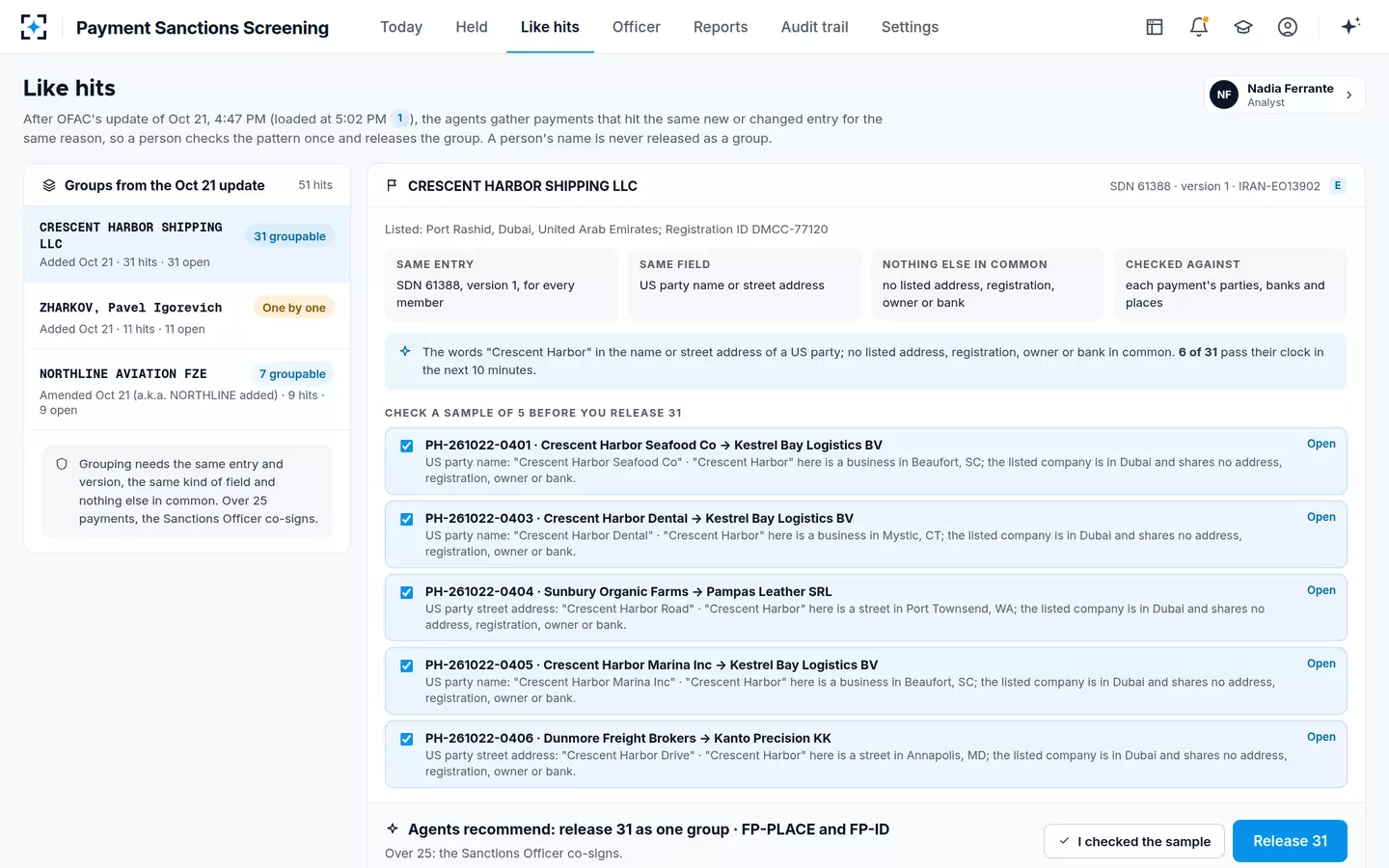
Often, yes. The filter reads the whole message, including the free-text reference you typed, and the hit is frequently there rather than in a party's name. A ship's name in an invoice reference, a street called after a place, a company name that shares a word with a listed one: each can stop a payment. On a sample bank's desk, a grain exporter's freight wire stopped because the reference named the ship MV KESTREL DAWN, one letter from a listed tanker; on the same morning, payments stopped on "Crescent Harbor" in a seafood company's name and in a street address, because a listed shipping company in Dubai shares the words.
A clear reference helps; a vague one does not. "Invoice HB-26-1187, ocean freight, MV KESTREL DAWN, IMO 0000836" gives the analyst the ship's permanent identifier, which settles the question in seconds. "Payment as agreed" gives nothing to clear a hit on the beneficiary's name. Vessel sanctions screening shows why the IMO number decides a ship hit.
What you must never do is reword a payment to get past the filter. OFAC's enforcement framework lists concealment, "stripping or manipulating payment messages, or making false representations to their non-U.S. or U.S. financial institution", among the conduct it targets (OFAC, A Framework for OFAC Compliance Commitments). A complete, accurate message is the fastest one.
One list update, many lookalike payments: 'Crescent Harbor' in names and street addresses
How long can a bank hold a wire transfer?
For a sanctions check, there is no fixed legal limit on the review itself; the hold lasts until the bank can decide. Most holds end within minutes or hours, on clocks banks set for themselves. The sample bank behind this guide gives wires 45 minutes, international ACH payments four hours and instant payments 15 minutes, and its median hold on a sample morning was 6 minutes 40 seconds. Those are one bank's settings, not rules.
Three things make a hold longer. The bank needs information it does not have, and has to ask you or the other bank. The hit is a close match that needs a senior officer's view. Or the payment turns out to involve a blocked party, in which case the money does not move at all until OFAC authorises it or the party is delisted. The 10-business-day deadline you may read about is the time the bank has to report a block or reject to OFAC, under 31 CFR 501.603 and 501.604, not the time it may take to decide.
Can a bank legally hold a wire?
Yes, and in the sanctions case it is required to. U.S. persons, banks included, may not deal in the property of blocked persons or process prohibited payments, and a bank that "knows or has reason to know that a target is party to a transaction" would be acting unlawfully if it processed it (OFAC FAQ 45). The hold is how a bank finds out whether it knows.
OFAC describes the duty with an image that also explains why a wire, once sent, is different from a question about one. If a customer merely asks whether they may send money to a listed bank, the bank can say no. If the customer instructs the payment, the funds must be blocked. OFAC compares the payment to a ball already in motion: once it is moving, any bank it reaches has to stop it (OFAC FAQ 42; the full decision between blocking and rejecting is set out in OFAC block vs reject).
Three outcomes: released, rejected or blocked
Every sanctions hold ends one of three ways, and they mean very different things for your money. Release is the usual result: on the sample bank's desk, 642 of the first 644 payments decided that morning were released. Reject applies when the payment is prohibited but no blocked person has an interest in it: OFAC's example is a commercial payment to a company in Tehran that is not itself blocked, held at a bank in a third country: processing it would export a service to Iran, so the bank returns it to the sender and never sends it on (OFAC FAQ 36). Block applies when a blocked person, government or entity has an interest, however indirect.
Released, rejected or blocked: what each means for your money
| Outcome | When it applies | What happens to the funds | What you can do |
|---|---|---|---|
| Released | The match is ruled out: a different identifier, owner, place or date of birth | The payment continues, after the delay of the review | Nothing; keep references clear for next time |
| Rejected | The payment is prohibited, but no blocked person has an interest in it | Not processed; returned to the sender, and reported to OFAC within 10 business days | Ask whether an OFAC license could authorise the payment |
| Blocked | A blocked person, government or entity has an interest in the funds | Frozen in a segregated, interest-bearing account; only OFAC-authorised debits; reported within 10 business days | Apply to OFAC for release of the funds |
If your funds are blocked, you will usually be told, and you have a route. OFAC says an organization "may notify its customer that it has blocked property in accordance with OFAC's regulations and may identify the sanctions program or regulations under which the organization blocked the property", and that "The customer may apply to OFAC for a license to unblock and release the funds" (OFAC FAQ 41). Until then the money sits in its own interest-bearing account at a federally insured U.S. institution, and nothing leaves it without OFAC's authorisation (OFAC FAQ 5). Where a block was a mistake of identity, the bank can unblock the funds and file an unblocking report (OFAC FAQ 1196).
What information will the bank ask me for?
The bank will ask for whatever separates you, or your counterparty, from the listed party. OFAC's guidance names the usual documents: verifying a match "may require gathering additional information from parties involved in the transaction or activity, such as a birth certificate, driver's license, or a business's corporate registration documentation" (OFAC FAQ 5). For trade payments that extends to invoices and shipping papers; for companies, to who owns them, because an unlisted company owned 50% or more by listed persons is blocked too.
For wires of $3,000 or more, banks must also pass on basic data about the person sending the money: the name, the account number, the address, the amount and the date, among other items (31 CFR 1010.410(f)). When that data is missing on an incoming wire, the receiving bank asks the sending bank, and your payment waits for the answer. Sending complete details in the first place is the simplest way to avoid that wait.
What to have ready when a wire is held for a sanctions check
- Full legal names and addresses
For you and the beneficiary, as on official registrations, not trading names or abbreviations.
- The invoice or contract
It explains the purpose and often names the goods, ports and vessel.
- Shipping documents
A bill of lading or charter party with the ship’s IMO number, flag and ports of loading and discharge.
- Company registration and ownership
Registration number and country; who owns 25% or more, and any owner on a sanctions list.
- Identity details for individuals
Date of birth and nationality, which rule out a name-only match faster than anything else.
- Any OFAC license you rely on
A general or specific license number, if the payment involves a sanctioned country.
What your relationship manager can and cannot tell you
Your relationship manager can tell you that the payment is in review and what documents would help. They usually cannot tell you which word or name caused the hit, how the review is going, or whether anything else is being looked at. Part of that is policy: banks keep sanctions decisions with the sanctions team. Part is law: if a bank files a suspicious activity report, "a SAR, and any information that would reveal the existence of a SAR, are confidential" (31 CFR 1020.320(e)), so many banks give the same neutral answer about every review.
The neutral answer protects you as much as the bank. Re-sending the payment through another bank, or splitting it into smaller amounts, does not avoid the check and can make an innocent payment look like evasion. The analyst who can release your wire is the person your documents need to reach; who waits on whom for a held wire describes that desk and the people around it.
How banks are shortening sanctions holds
Banks are shortening holds by preparing the analyst's evidence before a person opens the payment. In Payment Sanctions Screening, agents unfold the stopped message into plain fields, mark the words that hit, compare identifiers with the list entry and bring back earlier decisions on the same party, so the analyst starts with a cited recommendation instead of four windows of raw data. The decision stays with people: an analyst releases, and a second officer approves every reject and block.
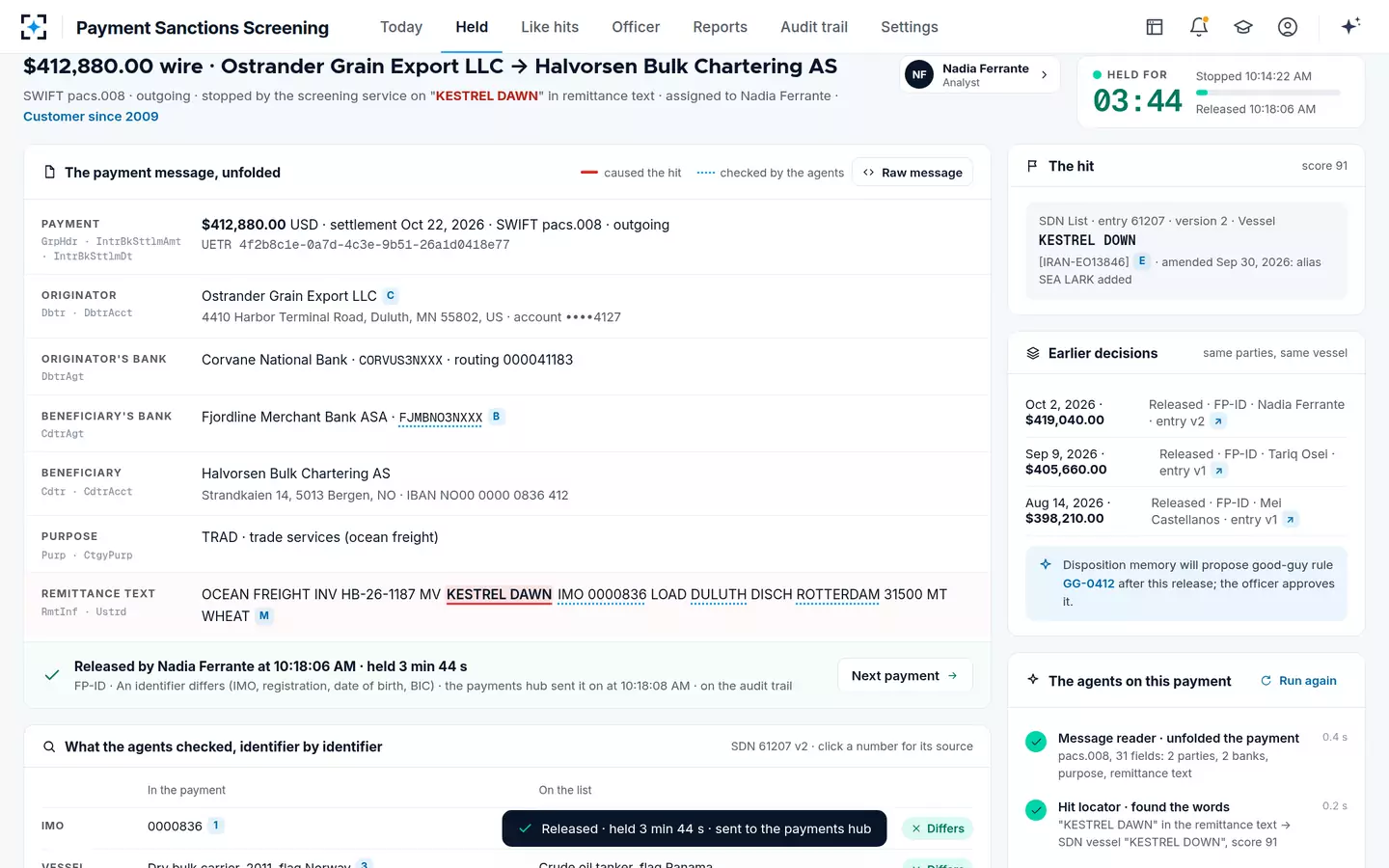
The sample freight wire shows the effect on one payment. It stopped at 10:14:22 AM; nine seconds later the analyst had the ship's IMO number compared with the listed tanker's, a different owner, flag and vessel type, and three earlier releases of payments to the same ship. She released it at 10:18:06 AM. The customer and the relationship manager saw "in review" for under four minutes, and nothing else.
A held wire released after 3 minutes 44 seconds, with the reason on file
Not every hold can be that short, and some should not be. A payment that may involve a blocked company needs its owners traced and a second signature, and an incoming wire missing its sender's address waits for the other bank. Name screening vs transaction screening explains why a payment can stop even when your bank checked you as a customer years ago, and the Payment Sanctions Screening page shows the full review from the bank's side.
Questions people ask
How long does an OFAC review take?
It is the bank's review, not OFAC's, and there is no set duration. Most sanctions holds are cleared within minutes to hours on clocks each bank sets; a hold that needs documents from you or the other bank lasts until they arrive. A blocked payment stays frozen until OFAC authorises its release or the party is delisted.
Why was my wire held when I have sent the same payment before?
Sanctions lists change constantly, and a new or amended entry can start matching payments that passed last week. In the sample bank's case, the listed tanker's entry was amended on September 30, 2026 to add an alias, and the bank re-checked the next wire to the same ship against the new version before releasing it.
Will my money be returned if the wire is rejected?
Yes. A rejected payment is not processed and is returned to the sender, and the bank reports the rejection to OFAC within 10 business days. Rejection applies when the payment is prohibited, for example because it involves a comprehensively sanctioned country, but no blocked person has an interest in the funds.
Can I call OFAC to get my wire released?
OFAC does not confirm matches or false positives for banks, so a call will not clear a hold; the bank decides. If your funds have been blocked, OFAC asks you first to confirm the block with your bank, then to apply for a specific license through its online application, naming the bank that filed the blocking report. If the block was a case of mistaken identity, the bank can unblock the funds itself and report it.
Does the bank tell me why my wire is on hold?
Usually it tells you only that the payment is in review and what documents would help. Banks keep the details of a sanctions review internal, and suspicious activity reports are confidential by law under 31 CFR 1020.320(e). If funds are blocked, OFAC allows the bank to tell you, and you may apply to OFAC for a license to release them.
Are small wires held as well as large ones?
Yes. OFAC says there is no minimum or maximum amount subject to its regulations, so a small payment with a name close to a listed one is held just like a large one. What triggers a hold is the content of the payment, not its size.