Real time payment screening checks instant payments, such as FedNow and RTP transfers, and other time-critical payments such as wires near their cut-off, against sanctions lists before the funds become available, and decides every hit fast enough to keep the payment's promise. Software can do most of the work in seconds: read the message, find the words that hit, compare identifiers and bring back earlier decisions. What it should not do is release a held payment by itself, and OFAC's enforcement history shows why: banks have paid for letting flagged payments go through automatically during backlogs, or because an old decision suppressed a new alert. Botminds' Payment Sanctions Screening is built on that line: seven agents prepare each held payment and recommend, a person releases, and the Sanctions Officer approves every reject and block.
The line in Payment Sanctions Screening: what each step does, and never does
Agent
Message readerUnfolds the held FedNow, RTP, wire or IAT message into plain fields with their paths.
Never: changes a payment
Agent
Hit locatorFinds the exact words that hit, the field they sit in and the list entry version.
Never: lowers a score or hides a hit
Agent
Identifier resolverCompares IMO numbers, BICs, registrations, dates of birth and places.
Never: decides, or treats a missing identifier as different
Agent
Disposition memoryBrings back earlier decisions on the same entry version; groups like hits after a list update.
Never: reuses a decision across list versions, or groups a person’s name
Agent
Recommendation and reportingWrites one line: release, reject, block or ask, with reason code and confidence.
Never: releases, rejects, blocks or files
A person decides
Payments sanctions analystReleases false positives, asks for information, proposes rejects and blocks.
A person decides
Sanctions officerApproves or returns every reject and block; co-signs large group releases. Never their own proposal.
How fast must real-time payments be screened?
As fast as the payment system's own clock allows, which differs by rail. FedNow runs every day of the year, and every value message is subject to a "payment timeout clock"; if it expires before the receiving bank responds, "the payment is rejected and Participants receive a rejection message" (FedNow Service Operating Procedures, June 2025). A receiving bank that screens and gets a hit does not have to decide inside that clock: it can answer with Accept Without Posting.
Accept Without Posting is the U.S. system's built-in room for a sanctions check. The payment settles between the banks, and "the Participant is relieved of its corresponding obligation to make funds immediately available to its customer, providing an opportunity for it to investigate." The room is bounded: the Federal Reserve Banks "require a Participant using the ACWP response to reject the transaction (and return funds) or make funds available to the intended recipient by midnight Eastern Time of the next standard business day", unless doing either "would be impermissible under applicable law", in which case it must report the payment as pending.
A bank may set itself a much shorter clock: a payment sold as instant that waits until tomorrow is not instant. The sample bank behind this guide gives instant payments 15 minutes, wires 45 and IAT entries four hours, all as its own settings. In the EU, euro instant payments between EU banks work differently again, with client screening instead of payment screening; instant payment regulation and sanctions screening compares the two regimes.
Can AI release a held payment automatically?
No rule names who or what may release a held payment, but OFAC's enforcement cases show what happens when nothing reviews the release. The guidance from the standards side is consistent: the FATF, reviewing new technologies for anti-money-laundering work, concluded that innovative tools "can help identify risks and focus compliance efforts on existing and emerging challenges, but manual review and human input remains very important" (FATF, Opportunities and Challenges of New Technologies for AML/CFT, 2021).
OFAC itself encourages better tools, including for instant payments, and expects controls to keep pace with speed: "OFAC recognizes that a key feature of instant payment systems is the near real-time nature of transaction settlement, but the speed necessitated by this commercial feature should not discourage financial institutions from implementing risk-based sanctions compliance controls" (OFAC, Sanctions Compliance Guidance for Instant Payment Systems, 2022). It also points to the design feature that makes a person's review possible: systems that allow "exception processing—i.e., allowing a transaction to be removed from the automated process to provide sufficient time for a financial institution to investigate potential sanctions concerns".
The useful distinction is between automating preparation and automating the release. Preparation, the reading, comparing and recalling, is where minutes go and where software is reliable and checkable. The release is where a wrong answer becomes an apparent violation, and where two OFAC cases show automation going wrong.
Two releases nobody reviewed: Payoneer and the suppression rule
In 2021, Payoneer agreed to pay $1,385,901.40 for 2,220 apparent violations. Among the control failures OFAC listed was, "during backlog periods, allowing flagged and pended payments to be automatically released without review", alongside "weak algorithms that allowed close matches to SDN List entries not to be flagged" and a failure to screen for BICs. OFAC's lesson for the industry included "holding flagged payments until they have been reviewed" (OFAC, Payoneer Inc., July 2021).
In October 2026, Bank of America agreed to pay $11,662,930 for 475 apparent violations. Part of the story was a routing directory that still contained blocked Russian banks. Some of those payments alerted and were released anyway: a screening rule silenced any new alert built on the same criteria as one an analyst had already closed as a false positive, so the old decision released the new payment with nobody looking (the rule is taken apart in OFAC false positive procedures). In all, the bank "processed 403 transactions totaling $14,340,100 between February 2022 and March 2025 via 35 blocked banks" (OFAC, Bank of America, N.A., October 2026).
What automated release cost two firms
2,220
apparent violations at Payoneer, including flagged payments released without review in backlogs
$1,385,901.40, July 2021
403
Bank of America payments through 35 blocked banks, some released by an alert suppression rule
$14,340,100 in value
$11.66M
Bank of America’s settlement for 475 apparent violations in all
October 2026
The two cases fail in different ways. Payoneer's backlog release was a capacity problem solved by switching the control off. Bank of America's suppression rule was a memory problem: a past decision reused automatically on a new alert, without anyone asking whether it still applied. Any real time payment screening design has to answer both: what happens when the queue backs up, and when an old decision may be relied on.
Who must approve a reject or block?
OFAC's rules require a report within 10 business days of a block or reject (31 CFR 501.603 and 501.604) but do not say who inside the bank signs. The answer in Payment Sanctions Screening is two people: an analyst proposes, a Sanctions Officer approves, and nobody approves their own proposal. A block freezes the customer's money in a blocked account until OFAC authorises its release; a reject returns it and starts the same reporting clock. Both deserve a second look.
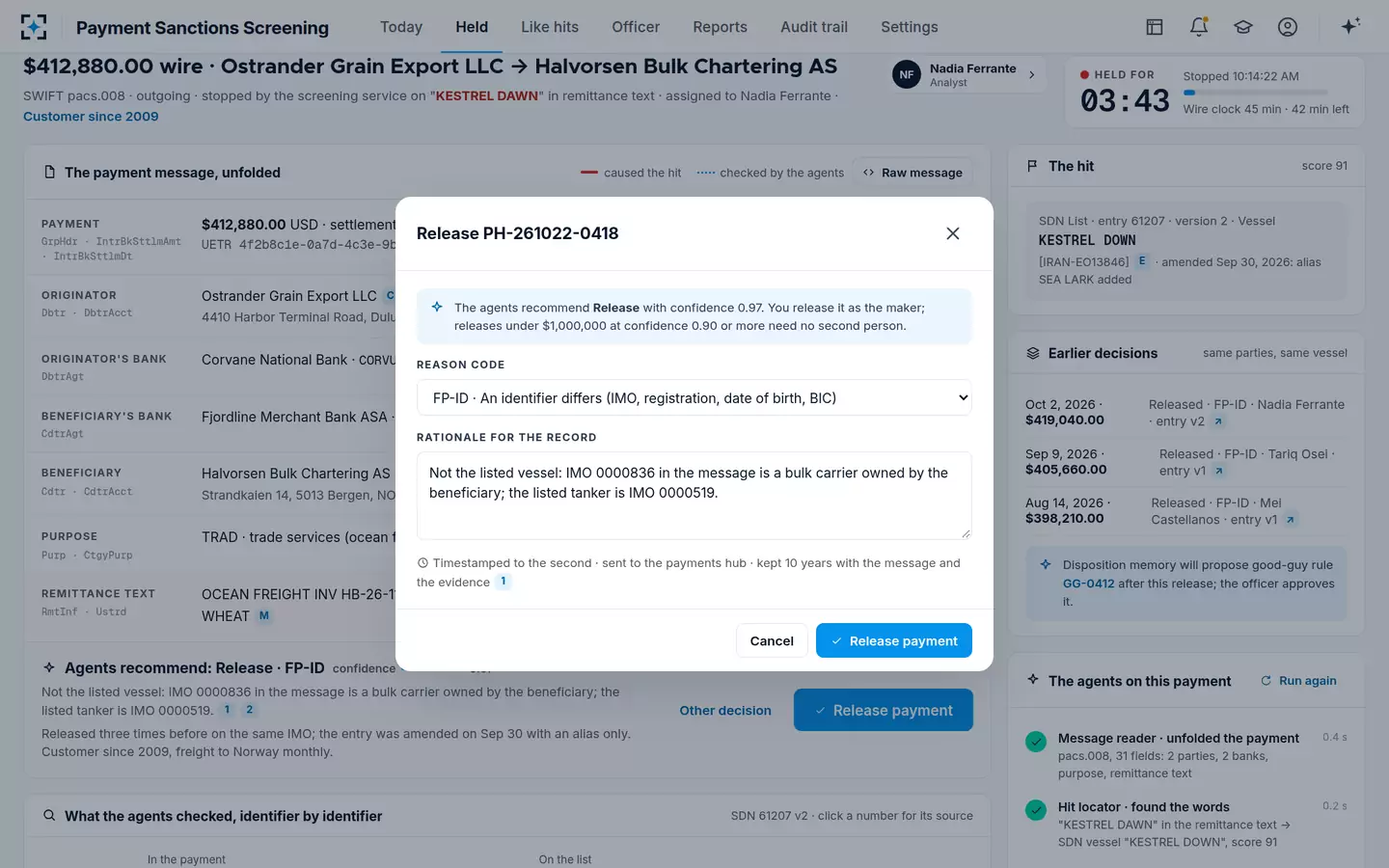
The same logic covers releases that carry more risk than usual. On the sample bank's desk a release over $1,000,000 or below a confidence of 0.90 needs a second analyst, a group release of more than 25 lookalike hits after a list update needs the officer's co-signature, and a person's name is never released as a group. Every one of those thresholds is a setting the Head of Sanctions approves, not a constant.
The release: a reason code, a rationale and the rule stated before the button
What can be automated in payment screening?
Everything up to the decision can be automated, and much of what follows it can be drafted. The table sets out the split on the sample bank's desk, with the enforcement case or guidance behind each "never".
What agents do in real time payment screening, and what stays with people
| Task | Agents | People | Why the line is there |
|---|---|---|---|
| Read the message and find the words that hit | Do it, in under a second | Check it when they open the payment | Mechanical; checkable against the raw message |
| Compare identifiers with the list entry | Do it, and cite each source | Open any citation | A missing identifier is marked missing, never different |
| Recall earlier decisions | Bring back those on the same entry version | Judge whether they still apply | Bank of America’s suppression rule reused old decisions automatically |
| Group lookalike hits after a list update | Gather and explain the pattern | Check a sample, then release the group | A person’s name is never grouped |
| Release a held payment | Recommend, with confidence | Release | Payoneer released flagged payments without review |
| Reject or block | Recommend; draft the OFAC report | Propose, then approve: two people | Money is frozen or returned, and reported |
| Change thresholds or standing rules | Propose, with evidence | Approve as a new version | OFAC asks that alert rules be supervised and tested |
How do agents handle FedNow's time limits?
By finishing their part well inside them, so the person has the time. The Federal Reserve's own economists tested large language models on sanctions name matching and found them far more accurate than fuzzy matching but "on average, over four orders of magnitude slower". Their conclusion for payments: "the economic cost of running LLMs, inference latency, and other frictions, including API limits, will likely necessitate using these types of tiered approaches for sanctions screening in high-velocity and high-throughput financial activities, such as payments" (Allen and Hatfield, FEDS 2025-092, Federal Reserve Board, a working paper).
That is the architecture of a held-payment queue. The bank's fast filter screens every payment and stops the ones that come close to a list entry; agents then spend seconds, not milliseconds, on each stopped payment; a person spends minutes on the decision. On FedNow, a receiving bank that holds a payment with Accept Without Posting has until midnight Eastern Time of the next standard business day under the network's rules, and the sample bank's own 15-minute clock sits well inside that.
Speed from preparation: where the seconds go
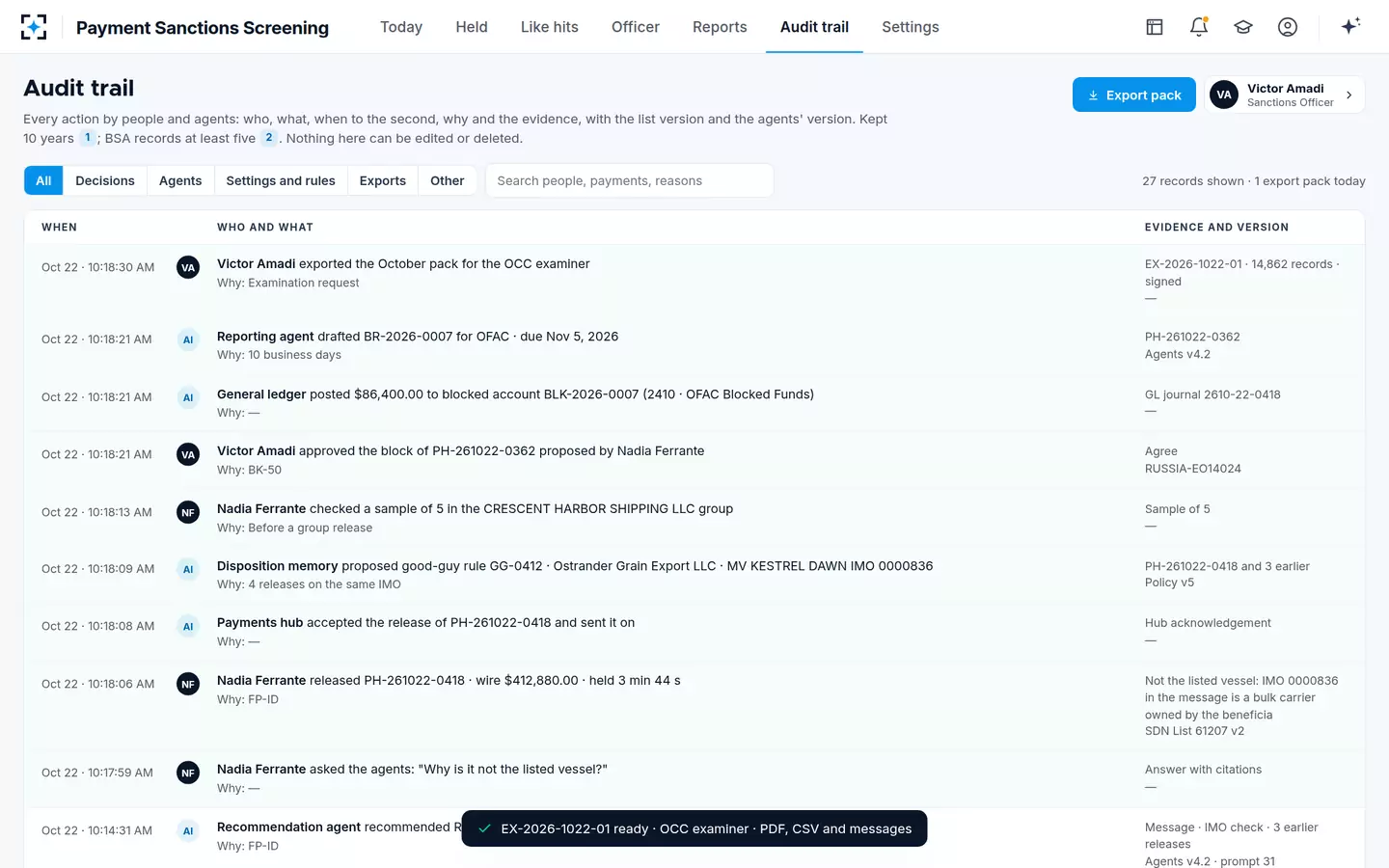
On the sample wire, the agents' work took under four seconds of processing and the recommendation was ready nine seconds after the stop. The rest of the 3 minutes 44 seconds belonged to the analyst: opening the list entry, asking why the ship was not the listed one, reading the answer and releasing. That is the right shape for a real time queue, with the person's minutes spent on judgement rather than on finding data.
Where 3 minutes 44 seconds went on one held wire
- Agents prepare9 s
- Analyst reads the evidence, opens the list entry, asks, releases3 min 35 s
The design also has to survive the morning after a list update, when lookalike hits arrive in bulk and the temptation to automate the release is strongest. On the sample bank's desk, 31 hits on one newly listed company were gathered, explained and released as a group after the analyst checked a sample of five and the officer co-signed; the 11 hits on a listed person's name were decided one by one. That is the honest alternative to a suppression rule: group the work, keep the decision.
Every agent step and every human decision, on one audit trail
What to ask any real time payment screening vendor
Ask to see the line, not the speed. Any product can show a fast release; the questions below show whether it can show who released, why, and on what evidence, and what happens on a bad day.
Questions for a real time payment screening vendor
- Can anything release a flagged payment without a person?
If yes, under what rule, approved by whom, and how is it switched off?
- What happens when the queue backs up?
Escalation and reassignment, or an automatic release? Payoneer’s backlog release is the case to cite.
- How are earlier decisions reused?
Only on the same list entry version, shown to the analyst, never applied silently.
- Who can change thresholds and standing rules?
Proposed with evidence, approved as a new version by someone else, logged.
- How is FedNow Accept Without Posting used?
Who decides inside the window, and what status is sent if the review is still open.
- Is every recommendation cited?
Each identifier and earlier decision should open its source in one click.
- Are agent versions on the audit trail?
An examiner will ask which model and prompt produced a recommendation on a given day.
- Can we replay a closed quarter first?
Your own held payments, rejects and blocks, with results by outcome.
The last question is the most useful one, and replaying last quarter's held payments sets out how to run it. The people around the decision, and which of their waits agents can and cannot remove, are in who waits on whom for a held wire. The full product is on the Payment Sanctions Screening page.
Questions people ask
What did OFAC fine for automatic release?
Payoneer's 2021 settlement of $1,385,901.40 cited, among other failures, "allowing flagged and pended payments to be automatically released without review" during backlogs. Bank of America's 2026 settlement of $11,662,930 included payments released by an alert suppression rule that reused past false-positive decisions.
Is real time payment screening the same as real time transaction monitoring?
No. Real time payment screening checks a payment's parties and words against sanctions lists before the funds are released. Real time transaction monitoring looks for fraud or money-laundering patterns in activity. They often share infrastructure, but sanctions hits need the release, reject and block decisions and OFAC reporting that monitoring alerts do not.
Do US banks have to screen every FedNow payment in real time?
No. The Federal Reserve Banks state that they do not require real-time transaction screening in their FedNow terms, and OFAC's guidance is risk-based. A bank that does screen in real time can use Accept Without Posting to hold a payment while it investigates.
Can a confidence score be used to release automatically?
It can be used to decide who reviews, not whether anyone does. On the sample bank's desk, a recommendation at 0.95 or more is marked "ready" for an analyst and a release below 0.90 needs a second analyst; the release itself is always a person's action.
How quickly should a held instant payment be decided?
FedNow allows a receiving bank using Accept Without Posting until midnight Eastern Time of the next standard business day, unless the law prevents release or return. A bank can aim far shorter; the sample bank sets 15 minutes, with escalation to the wire operations manager at 80% of the clock.
What can agents do that a filter cannot?
A filter decides whether a string is close to a list entry. Agents read the rest of the payment and the bank's own data to explain the hit: the identifier that differs, the earlier decision on the same entry, the owner traced through a registry. That turns a score into evidence a person can decide on.