A sanctions payment screening analyst decides what happens to payments the bank's filter has stopped because a name, bank, place or word came close to a sanctions list: release it, ask for information, or propose a reject or a block for a second person to approve. The judgement itself is usually quick. The hold is long because the analyst waits: on the other bank for a missing address, on the customer for an invoice, on the Sanctions Officer for a signature, on a registry for a ship's identity. Payment sanctions screening is the work of clearing those holds against a cut-off, and Botminds' Payment Sanctions Screening is built for that desk: agents read the stopped message, look up the identifiers and recall earlier decisions, so the analyst starts from a cited recommendation.
This guide follows one morning at a sample bank's payment screening desk to show who waits on whom. The bank, its customers, the vessels and the list entries are fictional; the rules and enforcement cases are real.
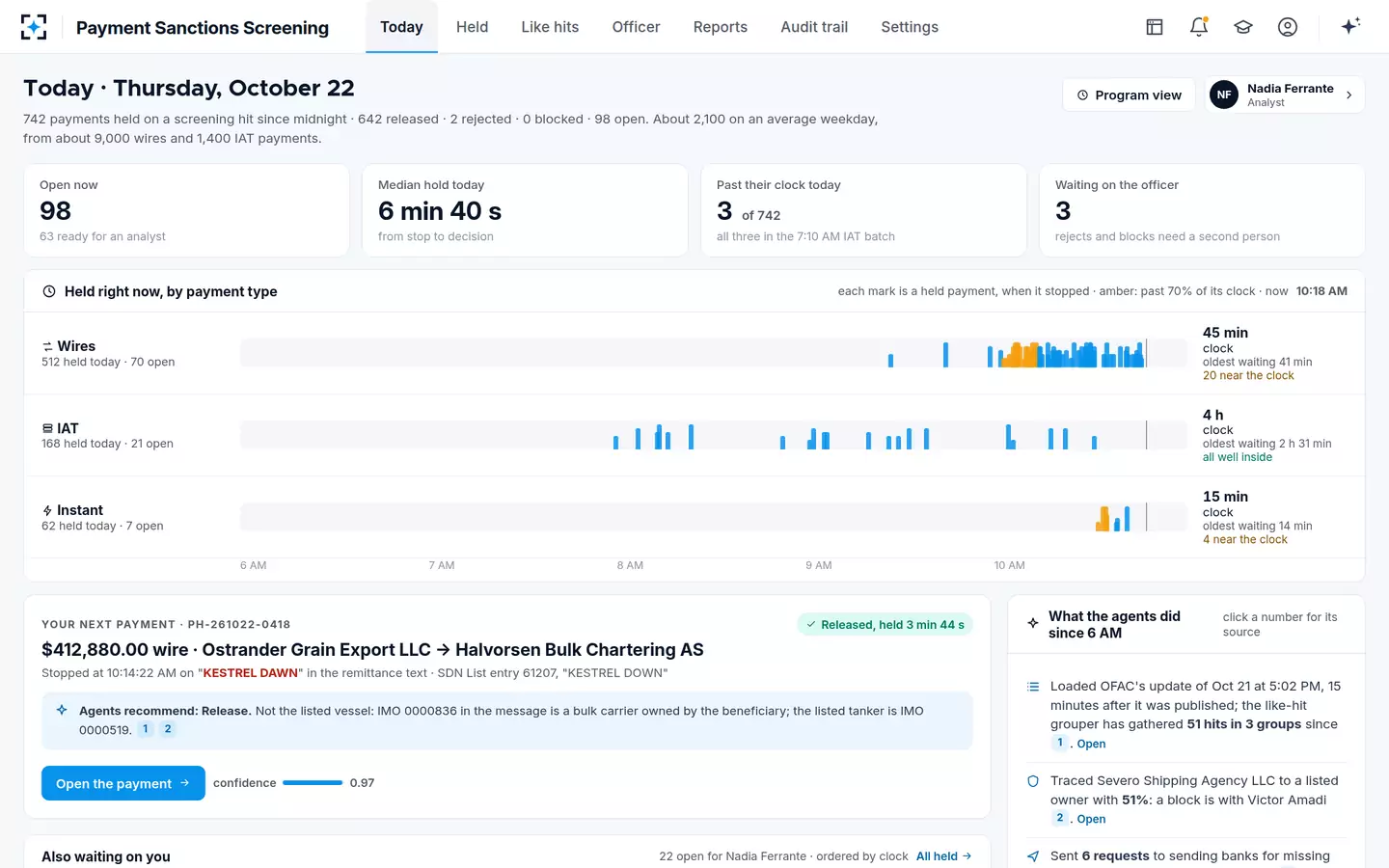
One morning at a payment screening desk, by 10:18 AM
742
payments held on a screening hit since midnight
Wires, IAT and instant payments
98
still open, 63 of them ready for an analyst
6:40
minutes and seconds: the median hold, from the stop to the decision
3
held past their clock, all in one early IAT batch
What does a sanctions payment screening analyst do?
The analyst works the queue of payments the screening filter has held, and for each one answers a single question: is this the listed party or not? OFAC sets out the method in its guidance on assessing name matches: compare every detail in the list entry with what the payment and the customer file say, and if that review shows the match does not hold, the payment may go ahead (OFAC FAQ 5; the six steps are set out in OFAC hit: what to do). Where several details match, the analyst escalates instead, and the payment may have to be blocked or rejected.
Software only finds the candidates. OFAC's rewritten guidance on blocking says there "may be instances of 'false positives,' where the individual's or entity's name is similar to a sanctioned person's name, but the rest of the information provided by the applicant or customer does not match", and that an institution "may need to conduct further due diligence" to tell which (OFAC FAQ 42). That research is the analyst's day: opening the raw message, finding the words that hit, often in the free-text remittance field, looking up a BIC or a ship's IMO number, finding last month's decision on the same party, checking the customer's expected activity and writing a rationale an examiner can follow.
The government does not count the job separately. Sanctions analysts fall inside the Bureau of Labor Statistics' compliance officer occupation: 19,850 people in credit intermediation in May 2025, at a mean annual wage of $94,090 (BLS, Occupational Employment and Wage Statistics). Job titles vary: payments sanctions analyst, transaction screening analyst, payments and level 1 sanctions analyst. The work does not.
Six people can stand between a held wire and its release
A held wire can wait on up to six parties, and only one of them is the analyst. The others are the Sanctions Officer who approves rejects and blocks, the wire operations manager who watches the cut-off, the relationship manager who owns the client, the customer who holds the invoice, and the other bank, which holds the missing originator data or the registry extract. Most minutes on a hold are spent in the gaps between them.
Who waits on whom for one held wire
Today
Waits on registries, BIC directories and old case notes found by hand, then on whoever holds the missing data.
With agents
Starts from the message unfolded, the identifiers already compared and earlier decisions on the same list entry, each cited.
Still theirs: Deciding the hit, and writing the reason in their own words.
Today
Waited on by every reject and block; often rebuilds the ownership chain from an email with a name and a score.
With agents
Sees the proposal with its evidence, the owners and what approval will do: blocked account, report draft, case.
Still theirs: The second signature on every reject and block.
Today
Hears about a held client wire when the client calls, close to the cut-off.
With agents
Sees every held payment against its clock by payment type, and is told when one passes 80% of it.
Still theirs: Reassigning work and escalating; never deciding a hit.
Today
Fields the client’s calls with nothing to say, and is tempted to promise a release time.
With agents
Gets a neutral status and a list of documents to request, with nothing about the hit itself.
Still theirs: The conversation with the client.
Today
Waits without knowing why, and is asked for documents late.
With agents
Is asked once for the specific documents that would settle the hit.
Still theirs: Producing the invoice, the registration or the identity document.
Today
Answers a free-text query about missing originator data when it can.
With agents
Receives a precise request for the missing fields, without the reason for the stop.
Still theirs: Its own data and its own timing.
The pattern matters because it decides where speed can come from. An analyst who needs ten minutes to find a ship in a registry is waiting on a lookup; an analyst who needs two hours for a sending bank's reply is waiting on a counterparty. The first wait can be engineered away. The second can only be shortened by asking earlier and asking precisely.
The analyst's view of the morning: every held payment against its clock
Who releases a held wire, and who approves a reject or block?
The analyst releases a false positive alone; a reject or a block needs a second, more senior person. That split is a common design rather than a rule OFAC prescribes, and it follows from what each decision does. A release lets money move that the filter stopped, and is reversible only by recall. A block freezes funds in an interest-bearing account from which only OFAC-authorised debits may be made, and starts a 10-business-day reporting clock under 31 CFR 501.603. A reject returns the funds and starts the same clock under 501.604.
OFAC's own enforcement history shows why a second look on high-confidence matches is worth its delay. In the American Express case, an operations analyst closed a "high confidence" alert despite a match on name, date of birth and national ID number. The bank's remediation added "second level-review for high-confidence matches" and centralised account suspensions, "minimizing the possibility for human error in both match adjudication and the application of suspension controls" (OFAC, American Express, July 2022).
The examiners' manual asks for a named owner at the top: one or more qualified people who run the OFAC program day to day, including reporting blocks and rejects to OFAC and watching over the frozen funds (FFIEC BSA/AML Examination Manual, OFAC; what that officer signs is in OFAC compliance officer). On many payment desks that person is the Sanctions Officer, and every block lands on their desk.
Who acts, in order, on a held wire in Payment Sanctions Screening
Agent
Message reader and hit locatorUnfold the stopped message into plain fields and mark the words that hit, with the list entry and its version.
Never: changes the payment or hides a hit
Agent
Identifier resolver and disposition memoryCompare IMO numbers, BICs, dates of birth and places; bring back earlier decisions on the same entry version.
Never: decides, or reuses a decision across list versions
A person decides
Payments sanctions analystReleases a false positive, asks for information, or proposes a reject or block with a reason code.
A person decides
Sanctions officerApproves or returns every reject and block. Nobody approves their own proposal.
Agent
Report draftingDrafts the OFAC report on an approved block or reject, for the officer to sign and file.
Never: releases, rejects, blocks or files
What happens when the analyst is waiting on the customer or the other bank?
The payment stays held, and the clock keeps running. OFAC's guidance expects a bank to gather what it needs from the parties to the payment when the message alone cannot settle a match (OFAC FAQ 5). In practice that means a request to the sending bank for an incoming wire, or to the customer, through the relationship manager, for an outgoing one.
The request is where most long holds start. OFAC said as much in its 2022 guidance on instant payments, where the clock is tightest: "Without such a messaging system, financial institutions may be unable to effectively adjudicate alerts of potential sanctions concerns, causing them to process payments without sufficient information or to block or reject large volumes of transactions that may not necessarily involve a sanctions nexus" (OFAC, Sanctions Compliance Guidance for Instant Payment Systems). Both failure modes are on the table for a wire too: release on too little, or stop too much.
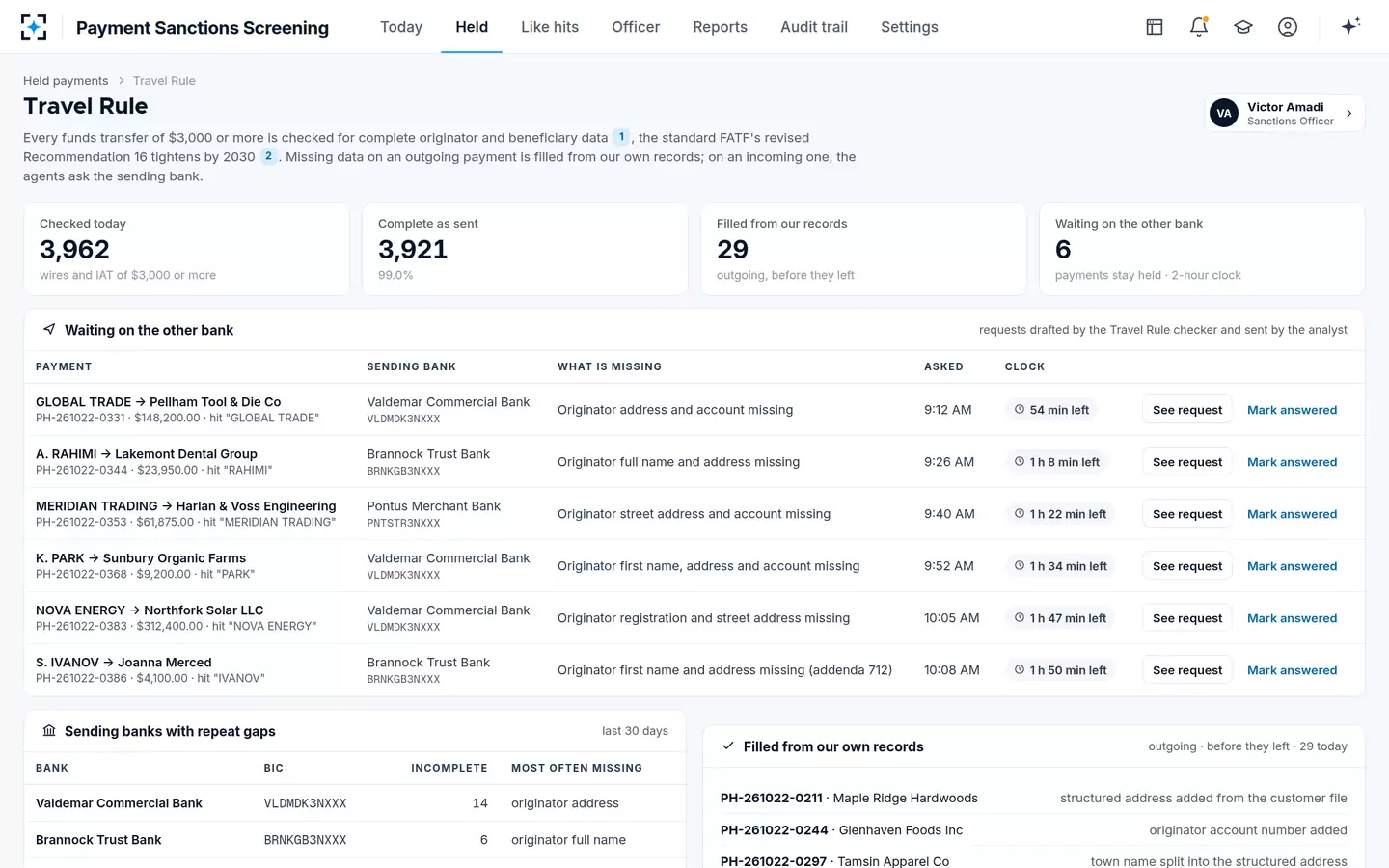
A precise request shortens the wait. "Originator address and account missing" gets answered; "please provide more information" gets a phone call. On the sample bank's desk the Travel Rule checker drafts that request for the analyst to send, naming the fields the rule at 31 CFR 1010.410 requires and never the reason the payment stopped.
Waiting on the other bank: six incoming payments, each with a two-hour clock
Why held payments miss the cut-off
Held payments miss the cut-off when the queue backs up faster than people can clear it, and backlogs are where controls break. In the UK, OFSI's penalty notice against Citibank's London branch describes the third, most senior review level swamped by potential matches that each needed a person, with some alerts left undecided for weeks (OFSI, Citibank N.A. London Branch, August 2026; the queue arithmetic behind it is in sanctions screening analyst job description). The penalty was £4,732,830.58.
The pressure also pushes people toward shortcuts. In Bank of America's 2026 settlement, OFAC found payments to blocked banks had been treated as false positives "due to human error" by analysts "in the sanctions screening or payments teams" (OFAC, Bank of America, October 2026). A queue that is always behind turns every analyst into a release machine. The fix is not more pressure; it is removing the minutes that are not judgement.
On the sample bank's desk the clock is visible to everyone who can act on it: a payment that has used 60% of its clock turns amber, and at 80% it goes to the wire operations manager, who can reassign it before the cut-off. That is a design choice, not a regulatory one, and what a held minute costs explains why the clock is set where it is.
Who talks to the customer about a held wire?
The relationship manager talks to the customer, and says very little. For a block, OFAC allows the bank to tell the customer and notes the customer may apply for release; for a payment that may also be under suspicious activity review, the Bank Secrecy Act forbids disclosing that a report exists. A common answer is a neutral script: the payment is "in review", and here is what would help. On the sample bank's desk that is all the customer and the relationship manager ever see.
The relationship manager is also the person most able to undo a control. In the Swedbank Latvia case, a U.S. correspondent rejected payments citing a possible Crimea connection; the customer "falsely assured" the bank, and "a relationship manager at Swedbank Latvia re-routed the rejected payments to a different U.S. correspondent bank, which ultimately processed the transactions" (OFAC, Swedbank Latvia, June 2023). The settlement was $3,430,900. Whatever the customer says goes back to the analyst; it never goes around them.
Why would a bank hold a wire transfer? is written for that customer conversation: what a hold means, the three outcomes and the documents that speed a release.
A hold is mostly waiting. Lookups, old decisions and the message itself can be prepared in seconds; a customer's invoice and an officer's signature cannot.
The waits agents remove, and the ones they cannot
Agents remove the waits that are lookups. On the sample wire, a $412,880.00 freight payment from Ostrander Grain Export to Halvorsen Bulk Chartering stopped at 10:14:22 AM because its remittance text named MV KESTREL DAWN, one letter from a listed tanker. Nine seconds later the analyst, Nadia Ferrante, had the message unfolded, the vessel's IMO number compared with the list entry's, three earlier releases on the same ship, the customer's history and a recommendation: release, confidence 0.97. She opened the list entry, asked the agents why it was not the listed vessel, and released at 10:18:06, after 3 minutes 44 seconds.
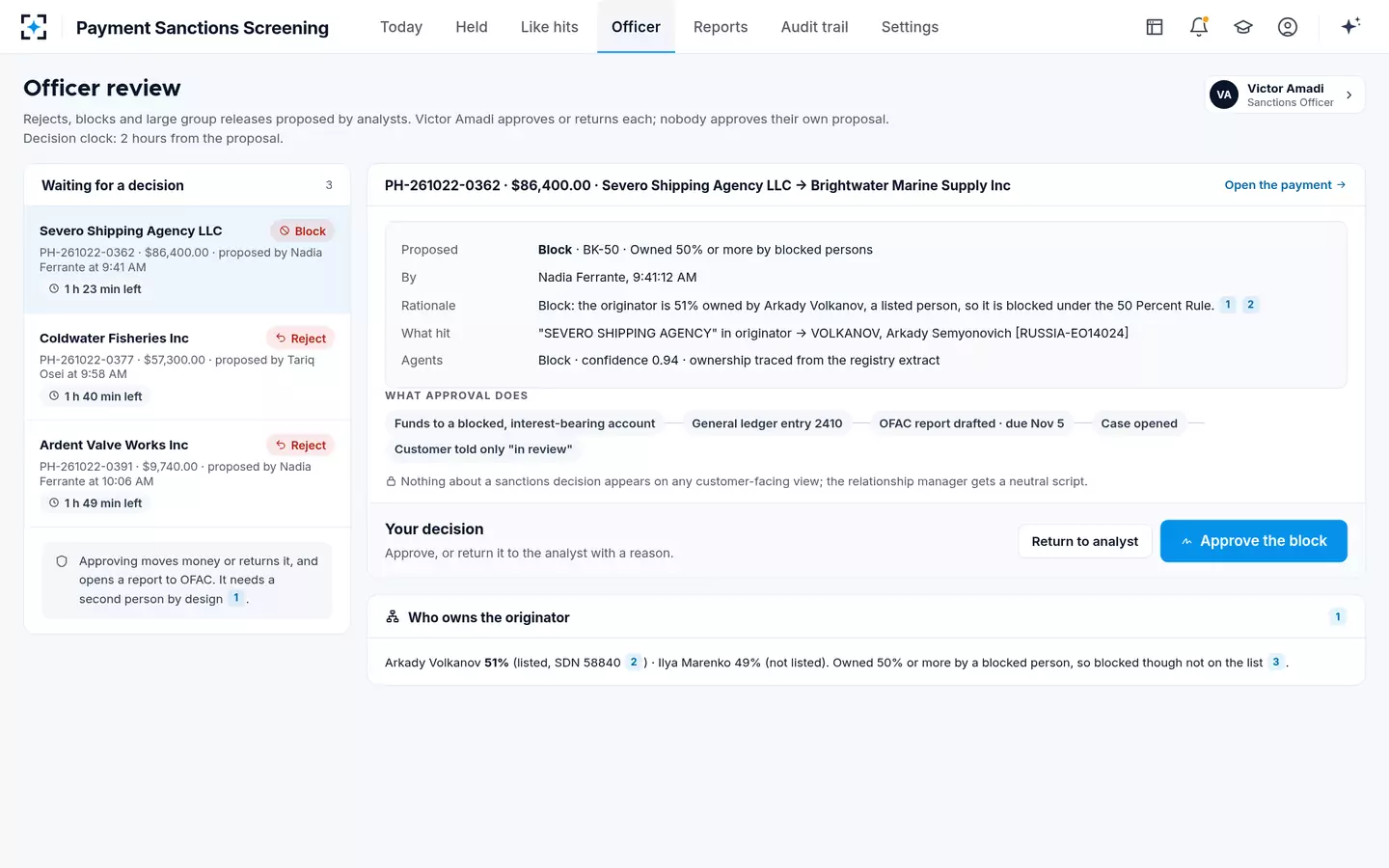
Agents cannot remove the waits that belong to other people. On the same morning, an $86,400.00 incoming wire from Severo Shipping Agency stopped at 9:36 AM. The ownership agent asked the sending bank for a registry extract and had it two minutes later: a listed person owned 51%, so the company was blocked under OFAC's 50 Percent Rule though it was not listed itself. Nadia proposed the block at 9:41 AM, and the payment then waited on Victor Amadi, the Sanctions Officer, who had three proposals in front of him. Nothing about that wait should be automated away.
The wait that stays: a block waiting on the Sanctions Officer
Drawing that line matters more on instant payments, where a bank may be tempted to let software clear its own hits. Real time payment screening sets out what can be automated and what OFAC has penalised banks for automating.
What the job asks for: skills, judgement and the interview questions
The job asks for three things software does not supply: knowledge of the programs, patience with messy data and the nerve to stop a client's money. A good payments sanctions analyst knows the difference between a blocked person and a sanctioned jurisdiction, reads a SWIFT or ISO 20022 message without a manual, and can explain in two sentences why a hit is not a match. A good interview tests exactly that, with a held payment on the table.
What a sanctions payment screening analyst should be able to show
- Walk a hit through OFAC’s six steps
Which list, which program, how good the match is, whether a license applies, block or reject, report and keep the evidence.
- Tell block from reject
A blocked person’s interest means block; a prohibited jurisdiction or activity with no blocked person means reject.
- Read the message, not just the alert
Know where names, banks, places and free text sit in an MT103 or a pacs.008, and which fields carry identifiers.
- Clear on identifiers, not on names
A different IMO number, BIC, date of birth or registration clears a hit; a different spelling does not.
- Apply the 50 Percent Rule
Add up listed owners’ stakes; an unlisted company can still be blocked.
- Ask for information without tipping off
Name the missing fields or documents; never the reason for the stop.
- Write a rationale an examiner can test
Which identifier differed, where it came from, and which list version it was checked against.
- Escalate on the clock, not after it
Know the cut-offs and say early when a payment will not make it.
The tools change what the analyst spends time on, not what they are accountable for. With the message and the identifiers prepared, the work shifts from finding to judging and from typing to reading evidence. Payment Sanctions Screening shows the full desk: the agents, the officer's view and the audit trail.
Questions people ask
What does a payments sanctions analyst do day to day?
They work the queue of payments the filter has held, decide whether each hit is the listed party, release false positives with a written reason, ask for missing information and propose rejects and blocks. OFAC calls this the point where "human intervention becomes critical", because software flags transactions that are not sanctions targets.
Can the analyst block a payment on their own?
OFAC's rules do not say who inside a bank signs, but many banks require a second person for rejects and blocks, and OFAC's enforcement cases favour it. American Express added "second level-review for high-confidence matches" after an analyst closed an alert that matched on name, date of birth and national ID.
How long should an analyst take on one held wire?
OFAC sets no time limit for the review itself, only a 10-business-day deadline to report a block or reject. Banks set their own clocks by payment type; the sample bank uses 45 minutes for wires, 4 hours for IAT and 15 minutes for instant payments, and its median hold on the sample morning was 6 minutes 40 seconds.
Is a sanctions analyst the same as a transaction monitoring analyst?
No. A sanctions payment screening analyst decides individual payments before they move, against OFAC's and other lists. A transaction monitoring analyst reviews patterns of activity after the fact for possible suspicious activity reports. The two jobs use different data, different queues and different deadlines.
What happens if the analyst gets it wrong?
A wrong release can be an apparent violation. Bank of America's 2026 settlement of $11,662,930 included payments to blocked banks that analysts approved as false positives "due to human error". A wrong block freezes a customer's money until the bank unblocks it and files an unblocking report, the route OFAC sets out in FAQ 1196 for mistaken identity, which is why OFAC's FAQ 42 asks the bank to verify that the party is the listed person before it acts.
What are good sanctions analyst interview questions?
Questions that use a real held payment work best: is this a valid match, and why; block or reject; what would you ask the other bank; how does the 50 Percent Rule apply to this owner. Candidates who answer with identifiers and evidence rather than name similarity are the ones who will hold up in an exam.