The OFAC hold process runs from the moment a bank's sanctions filter stops a payment to the moment a person releases, rejects or blocks it. For the customer it is a delay, explained from their side in why would a bank hold a wire transfer; for the bank each step of the process has a price, made of four parts: the analyst's hands-on minutes, the cost of the money not moving, the cost of missing the Fedwire cut-off, and the cost to the client relationship. On any realistic figures the interest is the smallest part and the cut-off the largest, which is why the minutes that matter are the ones that push a wire past 6:45 p.m. Eastern Time. Botminds' Payment Sanctions Screening is built to remove the lookup minutes of a hold, so that a held wire reaches a person's decision with its evidence ready, well inside its clock.
Where the hands-on minutes of one held wire go, by hand and with agents
By hand: about 32 minutes
- Open the hit, find the words (6 min) · 19%
- Look up list entry, registry, BICs (10 min) · 31%
- Find earlier decisions (6 min) · 19%
- Check the customer file (5 min) · 16%
- Write the reason, release (5 min) · 15%
With agents: about 3.5 minutes
- Open the unfolded message (0.5 min) · 14%
- Open the cited lookups (1 min) · 29%
- Read earlier decisions (0.5 min) · 14%
- Read the customer context (0.5 min) · 14%
- Confirm the reason, release (1 min) · 29%
What does an OFAC hold on a wire transfer cost the bank?
It costs the sum of four things, and only two of them grow with every minute. Analyst time grows with the minutes of hands-on work. The cost of money not moving grows with the minutes of the hold, but slowly. A missed cut-off is a step: nothing until 6:45 p.m., then a whole business day. And the client cost is a step too: a held payroll or closing wire can be forgiven once, not every month.
The cost of an OFAC hold on a wire transfer, term by term
Analyst time
hands-on minutes × loaded cost per minute
At the BLS mean wage for compliance officers in credit intermediation, about $0.75 a minute before benefits.
Operations finance
Money not moving
amount × rate × days held ÷ 360
Small: one day on a $412,880 wire at 3.88% is about $44.50.
Treasury
Missed cut-off
wires past the cut-off × cost of a missed settlement
A business day of delay for the client; fees, claims or a lost deal for the bank.
Wire operations
Client cost
complaints, escalations and lost relationships tied to holds
Measured, not guessed: tag held wires to client outcomes.
Relationship management
Put the two continuous terms side by side on the sample wire and the point is plain. By hand, about 32 hands-on minutes at $0.75 a minute is roughly $24 of analyst time; with the agents, about 3.5 minutes is under $3. The interest on $412,880.00 for the 3 minutes 44 seconds it was actually held is about 11 cents. Neither number is the reason to care about holds. The reason is the clock.
The Fedwire day and its cut-offs
The Fedwire Funds Service runs on a fixed business day: it opens at 9:00 p.m. Eastern Time on the preceding calendar day and closes at 7:00 p.m. Customer transfers, sent as pacs.008 messages, have a cut-off of 6:45 p.m.; bank transfers, as pacs.009, run to 7:00 p.m. (Federal Reserve Financial Services, Fedwire Funds Service operating hours). A bank sets its own customer cut-off ahead of that, to leave time to process what customers send late in the day.
The scale is what makes the cut-off expensive. In 2025, Fedwire carried 217,296,700 transfers worth $1.148 quadrillion: an average of 869,187 transfers a day, at an average of $5.28 million each, about $4.59 trillion a day (Federal Reserve Financial Services, Fedwire annual statistics). Wires are how businesses close property purchases, fund payrolls, meet margin calls and settle trades, and many of those obligations are dated.
The Fedwire Funds Service in 2025
869,187
transfers on an average business day
$5.28M
average value of a transfer
$4.59T
average value moved each business day
6:45p.m.
Eastern Time cut-off for customer transfers
What happens when a held wire misses the Fedwire cut-off?
It goes the next funds-transfer business day at the earliest. After the close, participants can only queue messages "for release to the Fedwire Funds Service when it begins processing online messages at the start of the next funds-transfer business day" (Fedwire operating hours). A wire held past the cut-off on a Friday waits through the weekend.
For the client, a day's delay can mean a closing that does not close, a supplier who stops shipping or a margin call that is not met. For the bank, it can mean fees waived, claims for the client's costs, a complaint, and a relationship manager spending a morning explaining a hold they were not allowed to discuss. None of those costs is published in aggregate; each bank has to count its own. What is certain is that they arrive all at once, at the cut-off, which is why the hold clock matters more than the average hold.
That shapes how the clock should be set. On a sample bank's desk in Payment Sanctions Screening, wires have a 45-minute clock from the stop to the decision, a payment turns amber at 60% of its clock and is escalated to the wire operations manager at 80%, so that someone can reassign it before the bank's cut-off. The bank, customers and payments in that example are fictional sample data.
Interest is the small number
The cost of money not moving is real but small, because a hold is usually measured in minutes and interest in days. Even a full day's delay on a large wire costs less, in interest, than a client's annoyance.
Interest cost of a one-day delay, by wire size
Blocked funds are different, because they do not move for months and the bank must pay interest on them. OFAC's rules require blocked funds to be placed in an interest-bearing account paying what the bank would pay any other depositor on a deposit of similar size and term (OFAC FAQ 33; how those balances are carried into the annual report is in annual report of blocked property), and the block must be reported within 10 business days (31 CFR 501.603). That is a cost of a correct block, not of a hold, and it is the customer's money that earns it.
How long do OFAC holds last?
No regulator publishes an average, and OFAC sets no time limit on the review itself, so each bank has to measure its own. That is a weakness in many programs. When the UK's Financial Conduct Authority fined Starling Bank in 2024, the wider review it described found problems including "testing and calibration of screening systems, and a lack of MI regarding alert volumes and trends" (FCA, Final Notice, Starling Bank, October 2024). A bank that cannot say how long its holds last cannot say what they cost.
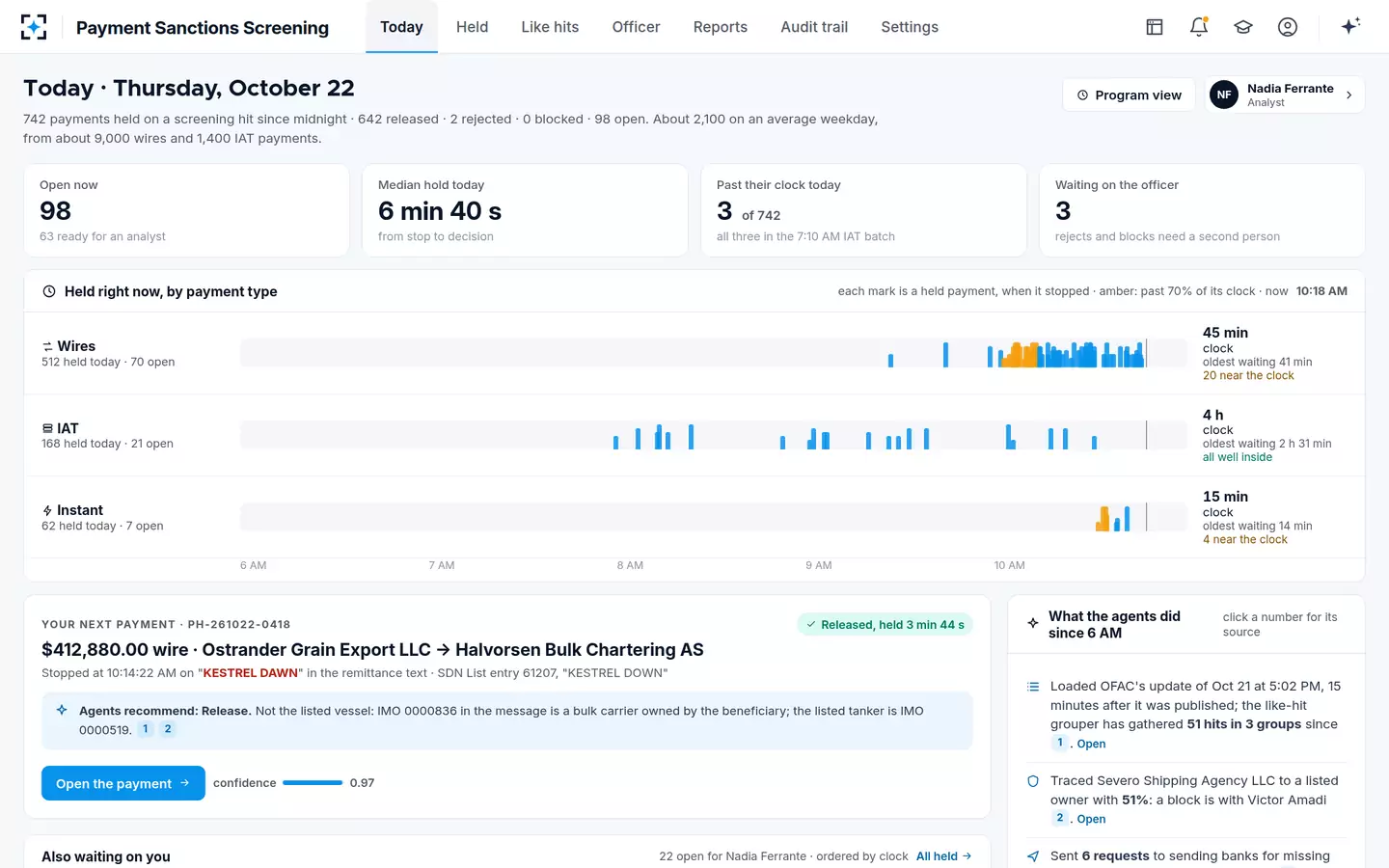
The sample bank's desk shows what measured looks like. By 10:18 AM on Thursday, October 22, 2026, it had held 742 payments on a screening hit since midnight, with a median hold of 6 minutes 40 seconds from the stop to the decision. Three payments were past their clock, all in one early IAT batch. In the wire lane, 512 had been held and 70 were open, the oldest waiting 41 minutes against a 45-minute clock and 20 near their limit; the sample freight wire took 3 minutes 44 seconds.
Hold time measured by payment type, against each clock
What does an IAT hold cost?
An international ACH hold behaves differently from a wire hold, because IAT entries arrive in batches and carry their parties in addenda records that need reading. The FFIEC sets out who is responsible: "In the case of inbound IATs, and regardless of whether the OFAC flag in the IAT is set, an RDFI is responsible for compliance with OFAC sanctions programs. For outbound IATs, however, the ODFI cannot rely on OFAC screening by an RDFI outside of the United States" (FFIEC BSA/AML Examination Manual, OFAC).
The batch is where IAT holds go wrong. When a gateway operator screening inbound IAT debits finds a potential violation, OFAC's guidance, as the FFIEC summarises it, is that "the suspect transaction is to be removed from the batch for further investigation", so one hit does not hold the rest. The cost of an IAT hold is therefore mostly the review of addenda data and, for incomplete entries, the wait for the other side. On the sample bank's desk, IAT entries have a four-hour clock, and the only three payments past their clock all morning were in one 7:10 AM IAT batch.
How do I measure hold time?
Measure it per payment, from the timestamp of the stop to the timestamp of the decision, and break it into stages. The median alone hides the cost: the payments that matter are the ones near the cut-off, and the stages tell you whether they were waiting on a lookup, an analyst, the customer, the other bank or the officer.
What to measure to price your OFAC holds
- Stop and decision timestamps, to the second
Per payment, by type: wire, IAT, instant. The hold is the difference.
- Time in each stage
Queued, with an analyst, waiting on information, waiting on the officer.
- The tail, not just the median
Payments past 60% and 80% of their clock, and past the cut-off.
- Cut-off misses and their cause
Each wire that missed the Fedwire cut-off because of a hold, and which stage held it.
- Hands-on minutes per decision
Sampled, by hit type: name, bank, vessel, place, free text.
- Client outcomes
Complaints, escalations and closed relationships that followed a hold.
- Alert volumes and trends
By field and list update; the management information the FCA found missing at Starling.
Where the minutes go, and which ones can be bought back
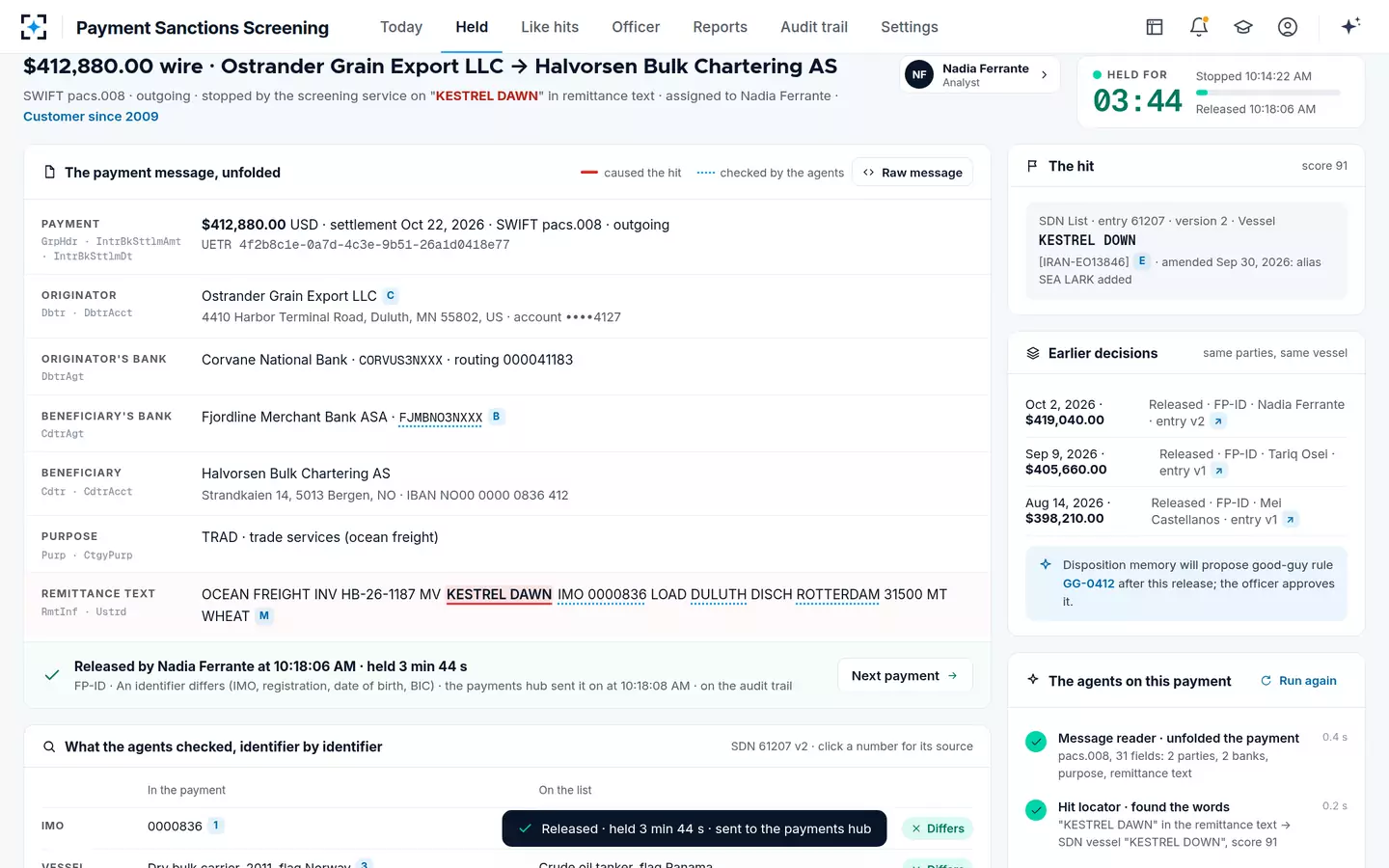
The minutes that can be bought back are the lookups. In the estimate at the top of this page, finding the words, looking up the list entry, the vessel registry and the BIC directory, and finding earlier decisions take 22 of the 32 hands-on minutes on one held wire. None of them is judgement. Agents can do them in seconds and cite what they found, which is how the sample freight wire reached a recommendation nine seconds after it stopped.
The minutes that cannot, and should not, be bought back are the decisions and the waits on other people: the analyst reading the evidence, the customer's documents, the sending bank's reply, the Sanctions Officer's signature on a block. Those are where judgement and accountability sit, and who waits on whom for a held wire maps them. Paying to shorten them by automating the release is the false economy OFAC has penalised, as real time payment screening shows.
One wire's hold, from stop to release, timed to the second
The economics follow. A desk that clears lookup minutes holds the same number of payments for less time, keeps more of them away from the cut-off, and spends its people on the hard hits. Where Payment Sanctions Screening sits in the payments stack, without replacing the filter, is covered in payment screening solutions that sit beside your filter, and the full product on the Payment Sanctions Screening page.
Questions people ask
Do held wires lose customers?
No public study measures it, so the honest answer is to measure your own: link complaints, escalations and closed relationships to the holds that preceded them. The risk is concentrated in holds that cross a cut-off on dated payments such as closings and payroll, rather than in short holds that clear the same hour.
Does the bank earn or pay interest while a wire is on hold?
A short hold is not an interest event of any size: a day's delay on a $412,880 wire is worth about $44.50 at the current federal funds rate. Blocked funds are different: OFAC requires them to sit in an interest-bearing account earning a commercially reasonable rate, which accrues to the owner of the funds.
What is the Fedwire cut-off time for customer transfers?
6:45 p.m. Eastern Time for core customer transfers sent as pacs.008, under the Federal Reserve Banks' current schedule; the Fedwire Funds Service closes at 7:00 p.m. Banks set their own customer cut-offs earlier.
Is there a legal limit on how long an OFAC hold can last?
No. OFAC sets a 10-business-day deadline to report a block or a reject, not a limit on the review. A bank that needs more information can hold until it has it; a payment that must be blocked stays blocked until OFAC authorises release.
What is a good target for hold time?
One that keeps every payment well inside its cut-off, set by payment type. The sample bank's settings are 45 minutes for wires, 4 hours for IAT and 15 minutes for instant payments, with escalation at 80% of the clock; its stated aim is a median under 10 minutes, a target rather than a measured result.