Vessel sanctions screening checks the ships named in a payment, usually in a freight or trade reference, against the vessels on sanctions lists. OFAC's SDN List names 1,568 vessels, and a ship's name in remittance text is screened by spelling, so a different ship with a similar name stops the payment. What settles the hit is the IMO number, the seven-digit identifier a ship keeps for life whatever its name, owner or flag, followed by the vessel type, flag and owner. The difficulty is that a payment rarely carries all of them, and that sanctioned ships change names and flags to hide. Botminds' Payment Sanctions Screening compares every identifier the payment and the registry offer against the list entry and cites each one, so the analyst decides on evidence rather than on spelling.
One letter apart, four identifiers apart
The ship in the payment: MV KESTREL DAWN: 0000836, written in the remittance text
The listed ship: KESTREL DOWN, SDN entry 61207: 0000519, unchanged since the entry was first published
The ship in the payment: MV KESTREL DAWN: Dry bulk carrier, built 2011
The listed ship: KESTREL DOWN, SDN entry 61207: Crude oil tanker
The ship in the payment: MV KESTREL DAWN: Norway
The listed ship: KESTREL DOWN, SDN entry 61207: Panama
The ship in the payment: MV KESTREL DAWN: Halvorsen Bulk Chartering AS, the beneficiary of the payment
The listed ship: KESTREL DOWN, SDN entry 61207: Tidemark Petroleum Shipping Ltd
The ship in the payment: MV KESTREL DAWN: KESTREL DAWN
The listed ship: KESTREL DOWN, SDN entry 61207: KESTREL DOWN, also known as SEA LARK
How do you screen vessel names in payments?
You screen the payment's free text and party fields against the vessel entries on the lists, then compare identifiers whenever a name comes close. Vessel names appear mostly in remittance information on freight, charter, bunkering and commodity payments, and in trade finance documents. The Wolfsberg Group's guidance lists vessels and their IMO numbers among the attributes banks commonly screen, mostly in trade finance.
Screening the name is necessary but cannot be sufficient. OFAC's guidance on assessing matches uses vessels as its example of how false positives arise: "Many potential matches identified through screening are false positives. For example, you may receive an alert when an individual or entity has a similar name or alias to a vessel identified on one of OFAC's lists" (OFAC FAQ 5). The same guidance tells the analyst what to do next: compare every detail in the listing with the information in the transaction.
The order of comparison matters. The IMO number first, because it is permanent; then vessel type, flag and owner, which can change but rarely all at once; then the voyage, which says whether the ship touched a sanctioned port or region. A name close to a listed ship with a different IMO number, a different type and a different owner is not that ship.
How many vessels are on the SDN List?
On October 26, 2026, OFAC's SDN List named 1,568 vessels among its 19,471 entries, and 1,551 of those vessel entries carried an IMO number. Crude oil tankers are the largest group, 443 of them. A further 591 entries for companies, mostly ship owners and managers, carried an IMO company identification number.
Ships on OFAC's SDN List, October 26, 2026
1,568
vessels on the SDN List
Out of 19,471 entries
1,551
of them carry an IMO number in the entry
443
are crude oil tankers, the largest single type
591
company entries carry an IMO company number
Owners and managers
Most listed vessels are tankers and cargo ships
The mix explains where vessel hits come from. A bank that finances grain, metals or general cargo will see its customers' bulk carriers and cargo ships stop on names that resemble listed tankers and cargo vessels, and the type alone often separates them. A bank with oil and gas customers sees hits where the type is the same and the IMO number has to do all the work.
What is an IMO number, and why does it decide the hit?
An IMO number is a ship's permanent identifier, assigned under the International Maritime Organization's scheme. A joint Treasury, State Department and Coast Guard advisory describes it as "a unique, seven-digit vessel identification code" that ships above certain sizes must display on the hull or superstructure, and says: "A vessel's IMO number is intended to be permanent regardless of a change in a vessel's ownership or name" (North Korea Sanctions Advisory, March 21, 2019).
That permanence is why the IMO number decides most vessel hits. A name can be one letter from a listed ship by accident; an IMO number cannot be. If the payment carries an IMO number and it differs from the listed vessel's, the ship is not the listed ship, provided the number is genuine. If it matches, the name no longer matters: the payment involves the listed vessel, whatever it is now called.
The weak point is the payment, not the identifier. Most remittance references name the ship and not its IMO number, so the analyst has to get the number from somewhere else: the invoice, the bill of lading, the charter party, the customer or a vessel registry. In the sample bank's own estimate, looking up the list entry, the registry and the BIC directory is the longest single step of a manual review: about 10 of 32 hands-on minutes on one held wire.
A name can be one letter from a listed ship by accident. An IMO number cannot.
The Kestrel Dawn wire: four identifiers and one close name
The sample wire shows the whole comparison on one payment. A grain exporter in Duluth sent $412,880.00 to a ship-chartering company in Bergen for ocean freight. The remittance text read "OCEAN FREIGHT INV HB-26-1187 MV KESTREL DAWN IMO 0000836 LOAD DULUTH DISCH ROTTERDAM 31500 MT WHEAT". The screening service matched KESTREL DAWN at a score of 91 to SDN entry 61207, a crude oil tanker listed as KESTREL DOWN, and held the payment at 10:14:22 AM.
The agents compared what could be compared. The IMO number in the payment, 0000836, against 0000519 on the list: different. A vessel registry lookup for 0000836: a dry bulk carrier built in 2011, Norwegian flag, owned by the beneficiary itself, against a Panamanian-flagged crude oil tanker owned by Tidemark Petroleum Shipping. Ports of loading and discharge: no sanctioned region. Both banks: not listed. Earlier decisions: three releases of payments for the same ship, the latest on October 2 against the current version of the list entry. The recommendation, nine seconds after the stop, was release, with a confidence of 0.97.
What the agents checked on the vessel hit, identifier by identifier
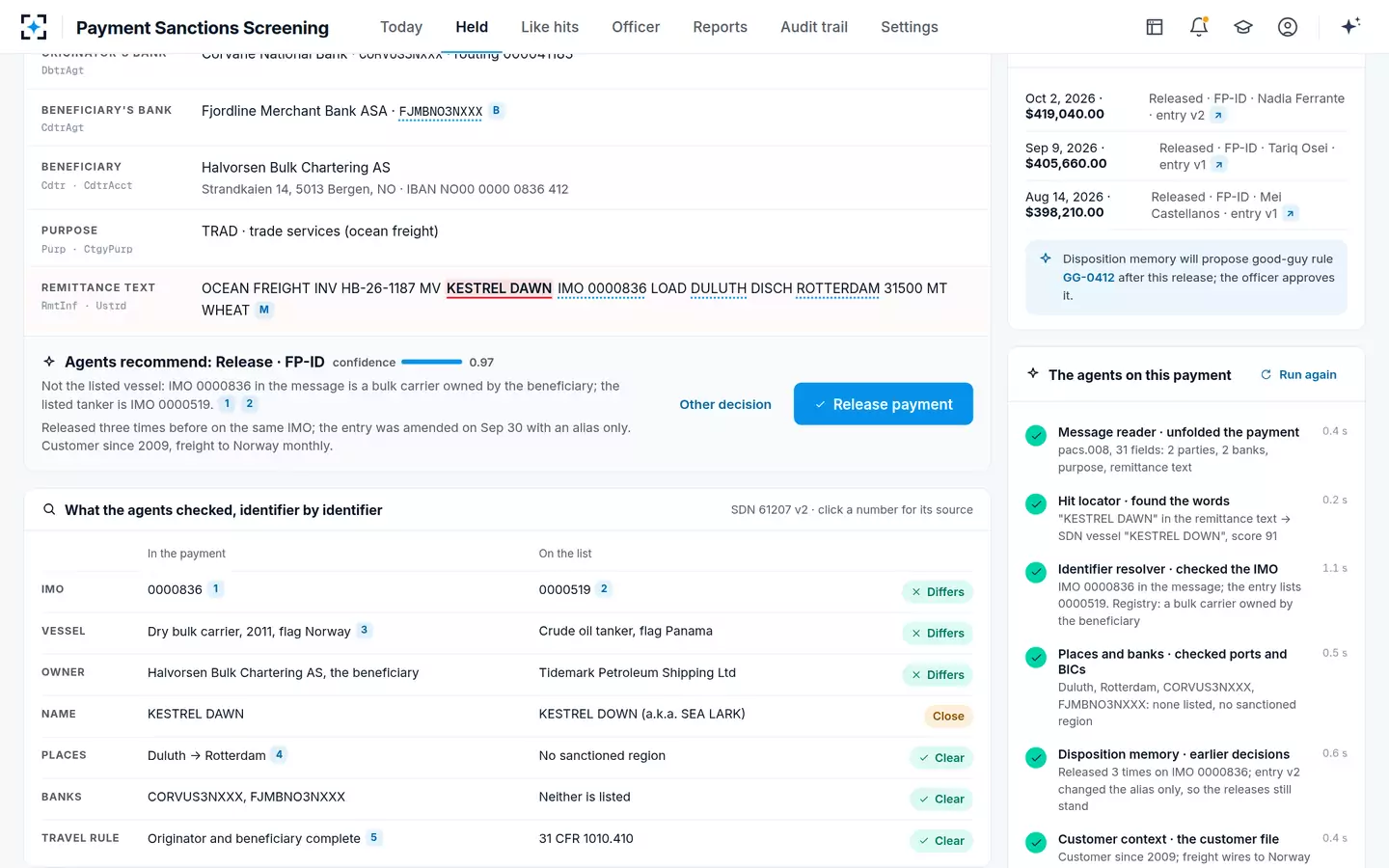
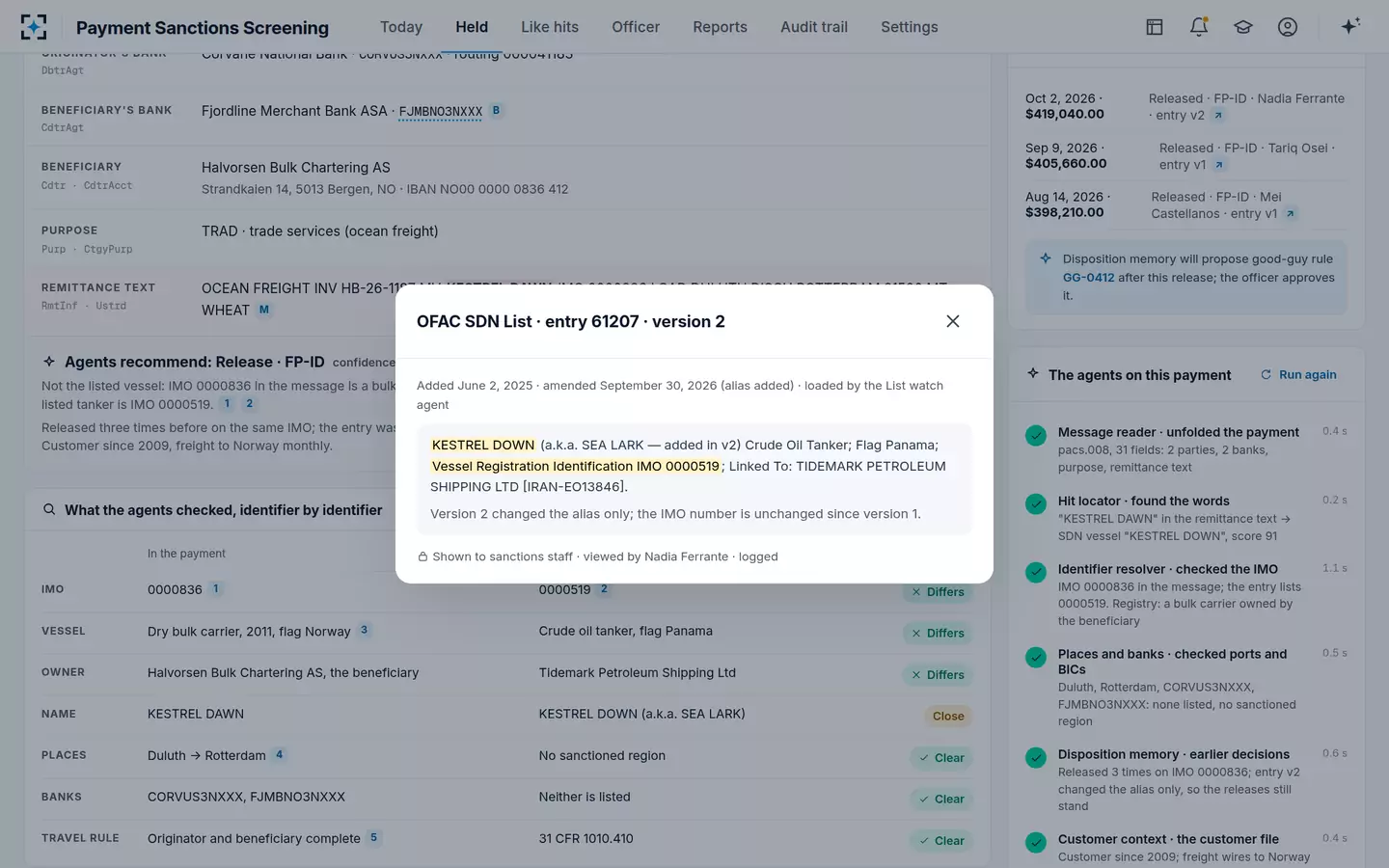
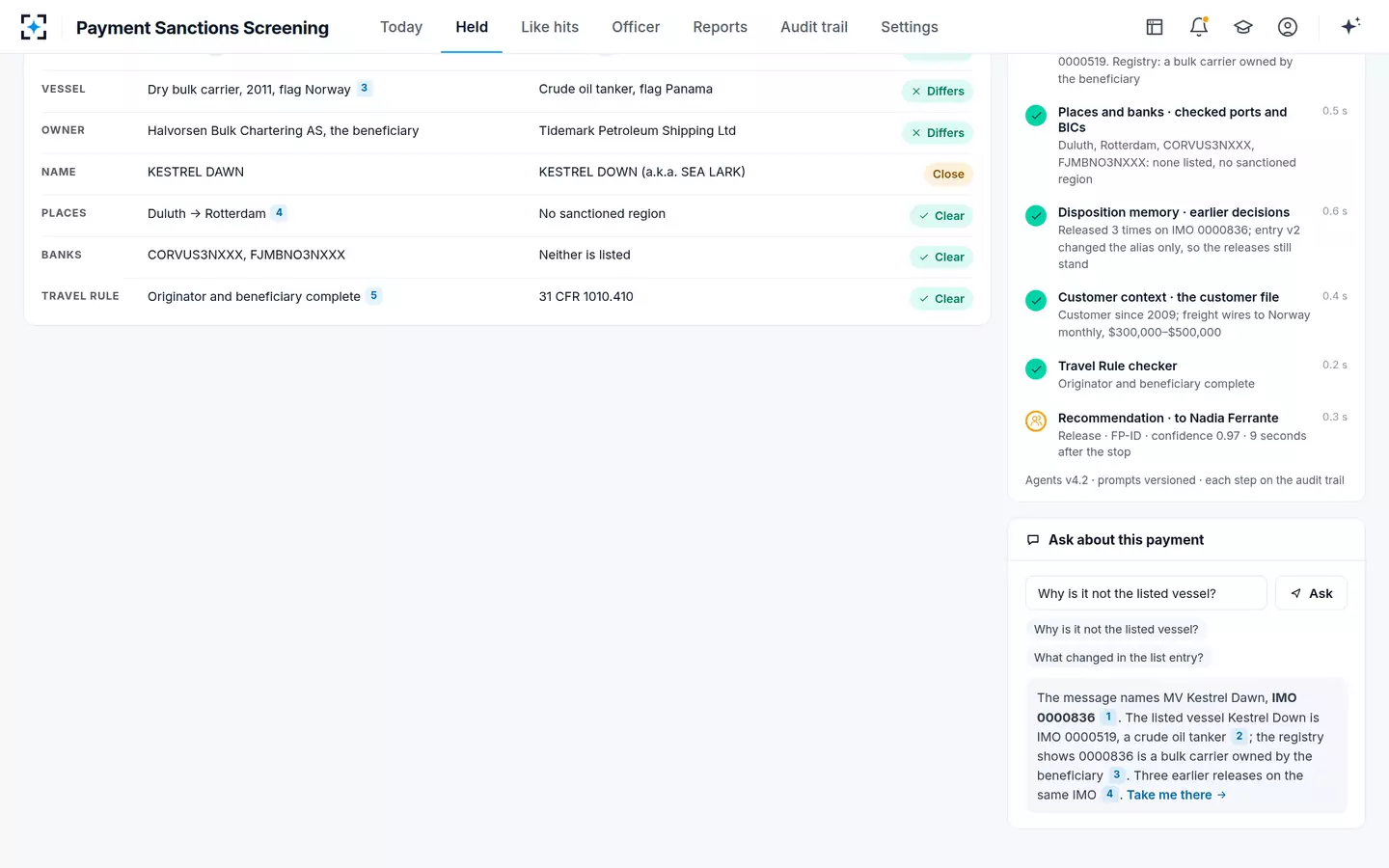
The analyst, Nadia Ferrante, did two things before releasing. She opened the list entry behind the citation, to see that the entry had been amended on September 30, 2026 to add an alias and that the IMO number had not changed since the first version; the earlier releases therefore still applied. And she asked the agents why it was not the listed vessel, which returned the four comparisons with their sources. She released the payment at 10:18:06 AM, held for 3 minutes 44 seconds, with the reason code "an identifier differs".
The source behind the comparison: the list entry and its version
What if a ship has been renamed or reflagged?
Then the name screen may miss it, and the IMO number and the vessel's history become the only reliable checks. OFAC's April 2025 shipping advisory describes the practices directly: vessels have reported "the International Maritime Organization (IMO) number of a vessel that has been scrapped and is no longer in operation", and stakeholders should "research all involved vessels not only by name but also using multiple identification and location data points" (OFAC, Guidance for Shipping and Maritime Stakeholders, April 16, 2025). The same advisory names financial institutions among the maritime industry participants exposed to this risk.
Flag changes are a warning sign in their own right. The advisory suggests asking for more documentation when a vessel has "flown multiple flags in an uncommonly short period of time (e.g., three flag registration changes within a year's time)", and points to the IMO's Global Integrated Shipping Information System (GISIS) to check whether a ship is flying a "FALSE" or "UNKNOWN" flag. The Price Cap Coalition's advisory for the oil trade warns that owners of sanctioned vessels "may attempt to engage in deceptive practices to obfuscate their status, such as renaming, reflagging, obscuring their IMO number, or falsifying documents" (Updated Price Cap Coalition Advisory, October 21, 2024).
OFAC's own entries show how often this has already happened: on the October 2026 list, 67 vessel entries note a former flag and 20 a former name. A list entry can carry both names, so a renamed ship can still match on its old name; but a ship renamed after it was listed, and not yet updated on the list, matches only on its IMO number.
Can a vessel name match a person or a company?
Yes, and OFAC uses exactly that as its example of a false positive. Ships are named after people, places, stars and virtues, and so are companies. Among the vessels on the SDN List, 22 names contain the word STAR, 20 contain GLOBAL, 15 SEA and 9 OCEAN, by our count on October 26, 2026. A trading company called Global Star, a restaurant called Sea Star or a person who shares a name with a fishing vessel will stop a payment if the filter screens party names against vessel entries.
Those hits clear on the nature of the party rather than on an IMO number. A company with a registration number and an address, or a person with a date of birth, is not a ship, and OFAC's list says what kind of entry each one is. The risk runs the other way too: a company named after a listed ship may be its owner or manager, so a hit on a company name that matches a vessel should be checked against the vessel entry's linked owner before it is closed.
What evidence clears a vessel hit?
A different IMO number from a reliable source clears most vessel hits; the other identifiers confirm it. The checklist below sets out what an analyst should be able to cite before releasing a payment on a vessel hit.
Evidence that clears a vessel hit, in order of weight
- A different IMO number, from a document or registry
Not just the number typed in the reference: the bill of lading, charter party or a vessel registry lookup.
- A different vessel type
A dry bulk carrier is not a crude oil tanker; the type is in the list entry and the registry.
- A different flag and flag history
Check for repeated flag changes; three in a year is a warning sign in OFAC’s 2025 advisory.
- A different owner and manager
And neither owner nor manager listed, nor owned 50% or more by listed persons.
- A voyage with no sanctioned port or region
Ports of loading and discharge from the documents, not just the payment text.
- Earlier decisions on the same IMO number
Valid only if the list entry has not changed in a way that matters since.
- The list entry version you checked against
So that a later amendment to the entry triggers a fresh check.
Asking why it is not the listed vessel, with the answer's sources
When a vessel hit should not be cleared
Some vessel hits should go to the Sanctions Officer rather than be released. The IMO number matches the listed ship. The IMO number in the payment belongs to a ship the registry shows as scrapped or as a different type. The documents disagree with each other about the ship's name, flag or ports. The owner or manager is listed, or the ship has changed flags several times in a year. The voyage includes a port in a sanctioned region, or a ship-to-ship transfer with no clear commercial purpose. In each case the name may be harmless and the payment still prohibited.
A good review distinguishes "different" from "unknown". An identifier that is missing is not evidence that the ship is different, and in Payment Sanctions Screening the identifier resolver marks a missing identifier as missing, never as different. If the payment names a ship with no IMO number and the customer cannot produce one, the honest outcome is to ask, not to release. Why a payment with an unresolved vessel hit waits, and what the customer can send, is explained in why would a bank hold a wire transfer; where the IMO number sits in the message is in ISO 20022 sanctions screening, field by field.
Once a ship has been cleared three times on the same evidence, the sample bank's agents propose a standing rule for it, which only the Sanctions Officer can approve and which is suspended the moment the list entry changes. That keeps repeat freight payments moving without letting an old decision outlive the entry it was made against. The full desk is on the Payment Sanctions Screening page.
Questions people ask
Where can I check whether a vessel is sanctioned?
OFAC's SDN List includes vessel entries with their IMO numbers, and OFAC offers a free online search of its lists. Other governments' lists can name ships too, so a bank screens against every list its sanctions programs require, and compares the IMO number rather than relying on the name.
Is the IMO number the same as the MMSI number?
No. The IMO number identifies the ship for its whole life; the MMSI is the number its radio and AIS transponder broadcast. OFAC's 2025 advisory notes ships reporting the MMSI of a different, non-sanctioned vessel, which is why an MMSI alone should not clear a hit.
Are vessels owned by sanctioned companies blocked?
A vessel is property, and property in which a blocked person has an interest is blocked. A company owned 50% or more by blocked persons is itself blocked under OFAC's rules, so its ships are too, listed or not. That is why the owner and manager are part of clearing a vessel hit, not only the ship's own entry.
How often does OFAC add vessels to the list?
Vessels are added with many OFAC actions, particularly under Iran- and Russia-related programs, and entries are amended when aliases or flags change. A bank should load every update the day it is published and re-check open and standing decisions that relied on an amended entry.
Do banks have to screen ships in every payment?
Banks screen by risk, and payments tied to shipping, commodities and trade carry the most vessel risk. OFAC's April 2025 advisory names financial institutions among the maritime participants exposed to Iranian oil sanctions evasion, so banks that pay freight, charter hire or bunkers should expect to screen ship names and identifiers.