Yes, there is a free sanctions check online: OFAC's own Sanctions List Search, part of its Sanctions List Service, searches the SDN List and OFAC's other lists by name at no cost, and the Commerce Department runs a free Consolidated Screening List across U.S. government lists. A free check answers "is this name, or something like it, listed?". It does not answer whether a country's program prohibits the payment, whether a general license covers it and every condition is met, or whether a listed person owns the company in front of you, and those are the questions that take a compliance officer an hour or more. The total cost of an answer is the officer's time plus the risk of being wrong, not the price of the search. Botminds' OFAC Sanctions Search is priced against that total: it cuts the research time on program and license questions, cites every source with its date, and leaves the decision with a named officer.
The cost figures below are our estimates, built from a federal wage statistic and the solution's own estimate of working minutes per question; how each is built is stated where it appears. Penalty figures are OFAC's.
What a free check costs, and what an answer costs
$0
to search OFAC’s lists with Sanctions List Search
$45/hour
mean wage of a compliance officer in credit intermediation
BLS, May 2025
≈$83
of officer time on one license question answered by email
our estimate
$10,000
base penalty for one non-egregious, undisclosed $3,200 violation
OFAC guidelines
Is there a free sanctions check online?
Yes, two from the U.S. government. OFAC's Sanctions List Search "is a free tool provided by OFAC to assist the public in complying with sanctions programs", searching the SDN List and the consolidated non-SDN lists (OFAC FAQ 287). OFAC itself points small institutions to it: asked whether a bank must buy expensive software, OFAC answers that it is "primarily a question for your regulator" and that "OFAC also offers a free, online search engine" (OFAC FAQ 27). The International Trade Administration's Consolidated Screening List adds a free search across lists from Commerce, State and Treasury (trade.gov).
Free comes with conditions OFAC states plainly. The tool is meant for "individual users", not automated systems; after a 2021 upgrade, OFAC told users "they are using a free service at their own risk" and should run baseline checks when it changes; and it "does not contain historical information", so a name removed last month is simply absent (OFAC FAQs 287, 892, 467).
What does a free sanctions check actually check?
A name, scored for similarity, against today's lists. OFAC's FAQs describe the method: the tool first keeps names that start with the same letter and are at least half alike by edit distance, then scores them with Jaro-Winkler and Soundex. Nothing but the name affects the score, and only the name is matched loosely; an ID number search uses "exact character matching" (the scoring is unpacked in sanctions screening threshold). The default score is 100, an exact match, and OFAC "cannot make" a recommendation on the threshold (FAQs 249–253).
That makes it a good first look at a name and a poor answer to anything else. It does not know the payment, the goods, the place, the owner or the date. And it never says "clear": OFAC "does not issue non-inclusion certificates", "nor does OFAC publish a 'safe list'" (OFAC FAQ 469). A blank result means no similar name above the threshold today, not that the transaction is permitted.
What a free check cannot tell you
Four things, and each has cost a firm money. It cannot tell you whether the place is under a comprehensive program, because countries are not on the SDN List. It cannot tell you whether a general license applies, or which version. It cannot tell you who owns the counterparty. And it keeps no record in the bank's files of what was searched, when, and what was decided.
Ownership is the expensive one. In 2024 OFAC settled with American Life Insurance Company, which had screened a UAE entity; its screening raised alerts, and ALICO closed them as false positives because the entity's own name was not on the SDN List. The entity's trade license, written in Arabic, named the Iranian embassy as its owner (the research that would have found it is in sanctions ownership research). ALICO processed 2,331 premiums and claims totaling $446,077 for Iranian government-owned entities and paid $178,421 (OFAC, ALICO). A name search did exactly what it is built to do; the question it could not answer was who stood behind the name.
Five ways to answer a sanctions question, and what each leaves open
| Option | Answers "is the name listed?" | Answers program and license questions | Leaves a dated record | Main cost |
|---|---|---|---|---|
| OFAC Sanctions List Search, by hand | Yes, for one name at a time | No | Only if someone saves it | Officer and staff time |
| Screening software on OFAC’s files | Yes, for every customer and payment | No; it flags names, not programs | Yes, for alerts | License fee and alert review |
| The compliance officer, from OFAC’s pages | Via the tools above | Yes, by research each time | If written up | About 110 minutes per license question (estimated) |
| An outside adviser | Usually via the tools above | Yes | A memo | Adviser’s hours at their rate; days, not minutes |
| Cited answers with officer confirmation (OFAC Sanctions Search) | Calls the bank’s screening service | Yes, cited and dated, conditions matched | Yes, with the payment, 10 years | Subscription plus about 9.5 officer minutes per question (estimated) |
Is OFAC's Sanctions List Search enough for a small bank?
For screening names at low volume and low risk, it can be. The FFIEC manual lets institutions with low OFAC risk and few transactions screen by hand, and OFAC's FAQ 27 names the free search engine as one way to do it. A credit union that opens a dozen accounts a week and sends a few international wires a month can document a by-hand search of each party. The OFAC requirements for a credit union with one compliance officer sets out what the examiners expect around it.
It is not enough for the questions that are not names. A customer who wants to send money to Cuba, pay a Dubai supplier for medical goods bound for Iran, or settle a contract with a company owned by a Russian group is asking a program, license or ownership question. The free search returns the same blank for all three, and the officer still has to do the research.
What does one answered question cost?
On a license question with a payment attached, about $83 of officer time by email, against about $7 with cited answers, before the subscription. Both are our estimates. The time comes from the solution's own split of working minutes on one license question answered by email today: 15 minutes to find the program, 25 to find the license with its conditions, FAQs and dates, 20 to match conditions to the payment, 20 to get a missing fact from the branch, 15 to confirm and 15 to write up, 110 in all, with inbox waiting excluded; with the solution, the same steps take an estimated 9.5 minutes, most of it the officer reading and confirming. The rate is the federal mean wage for a compliance officer in credit intermediation, $94,090 a year in May 2025, or $45.24 an hour over 2,080 hours, wage only.
Officer cost per license question, estimated: research by email against cited answers
Volume decides whether the difference matters. At ten license questions a week, our assumption for a small institution, the email route costs about 953 officer hours a year, roughly $43,100 of wage at the rate above, against about 82 hours and $3,700 with cited answers. At one question a month the email route takes about 22 officer hours a year, and no tool is worth buying for that alone. The sample bank in the solution's own demonstration is at the other end: one BSA/OFAC Officer answering about 90 questions a week from 41 branches.
What does a wrong answer cost?
Anywhere from a few thousand dollars to the statutory maximum, decided by how the violation came to light and how bad it was. OFAC's Enforcement Guidelines set the starting point. For a non-egregious case disclosed voluntarily, the base penalty is "one-half of the transaction value", capped at $188,850. For a non-egregious case OFAC finds by other means, it is the "applicable schedule amount": "$10,000 with respect to a transaction valued at $1,000 or more but less than $10,000". For an egregious case, it is one-half of the statutory maximum if disclosed, and the full maximum if not (31 CFR part 501, App. A). The maximum under IEEPA is $377,700 or twice the transaction, whichever is greater (31 CFR part 505; the method is worked in OFAC penalty calculation).
Base penalty for one $3,200 wire processed in error, by type of case
Most wrong answers never reach a penalty, and that is the trap. Each one is a transaction on file with the wrong reason beside it, kept for 10 years, and OFAC now has 10 years from the latest violation to bring a civil case under IEEPA or TWEA (89 FR 74832). The cost that is certain is the examiner's question about how the bank knew, and an answer with no dated source has no reply.
When is a paid sanctions tool worth it?
When the officer time it saves, plus the risk it removes, exceeds what it costs, and when it answers questions the free tools cannot. The terms below make that a calculation instead of a pitch; put your own numbers in each.
The return on a cited-answer service, term by term
Officer time saved
questions a year × (minutes by email − minutes with the tool) ÷ 60 × loaded hourly cost
Count only program, license and ownership questions; name checks stay with screening.
BSA/OFAC Officer
Branch and payments time saved
questions × minutes waiting or chasing a missing fact × their hourly cost
The ask-back is where the email route loses a day.
Branch and operations managers
Risk reduced
wrong answers avoided × expected cost of each
Use the base penalty table and your own likelihood; include the examiner finding, not only the fine.
Chief risk officer
Subscription and setup
annual fee + integration and testing effort
Ask for the price against your own volume; include the test set before go-live.
CFO
What to look for in a paid sanctions search, honestly
Look for the things the free tools cannot do, and check them on your own questions. A paid tool that only searches names faster has replaced a free tool with a paid one. The checklist below is what we would ask of any product, including ours.
Six tests to run before paying for sanctions search
- Ask it a program question, not a name
A remittance to Cuba, medical goods to Iran, a payment to Crimea. Does it name the program and passage, or only search names?
- Ask about a general license that changed this year
Russia GL 131 is at 131K. Does the answer name the letter and the date?
- Leave out a fact the license needs
Does it ask, or assume?
- Give it an entity owned by a listed person
Does it say "not listed, but owned", hand off to ownership review, or clear it?
- Open the record a year later
Is the source, its date and the confirmer kept with the payment?
- Check what it never does
It should not release, reject or block a payment, or clear a possible match, on its own.
Where OFAC Sanctions Search fits: banks and credit unions where program, license and ownership questions reach one desk every week, and where an answer must be cited, confirmed and kept with the payment. Where it does not: an institution with a handful of such questions a year, which will do better with OFAC's free search, its FAQs and a careful officer, and any institution looking for a screening engine, which this is not. The free check stays useful either way; in the sample bank, every question still runs through the bank's screening service before an answer is drafted.
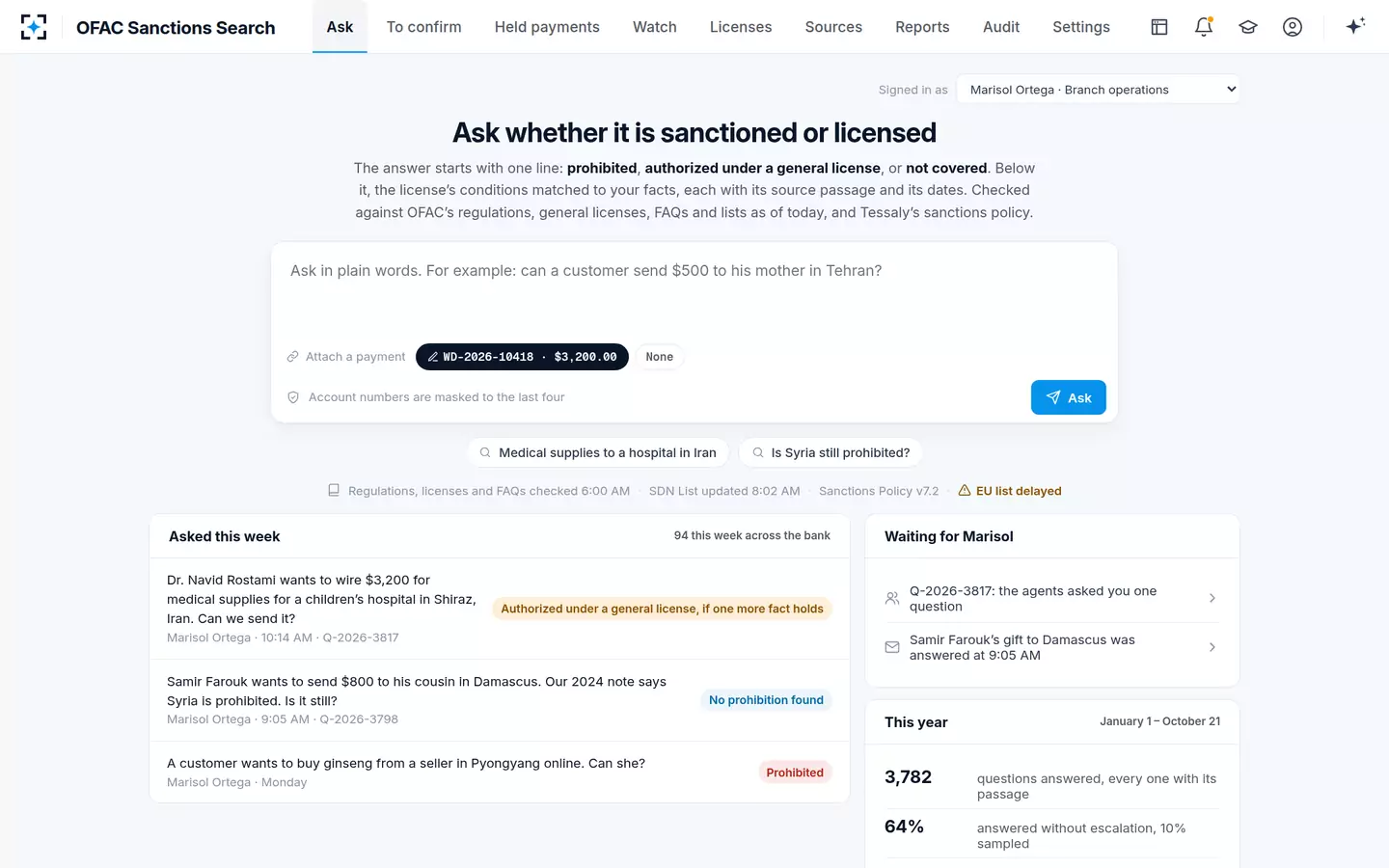
Every question asked this week, with its verdict and its source freshness
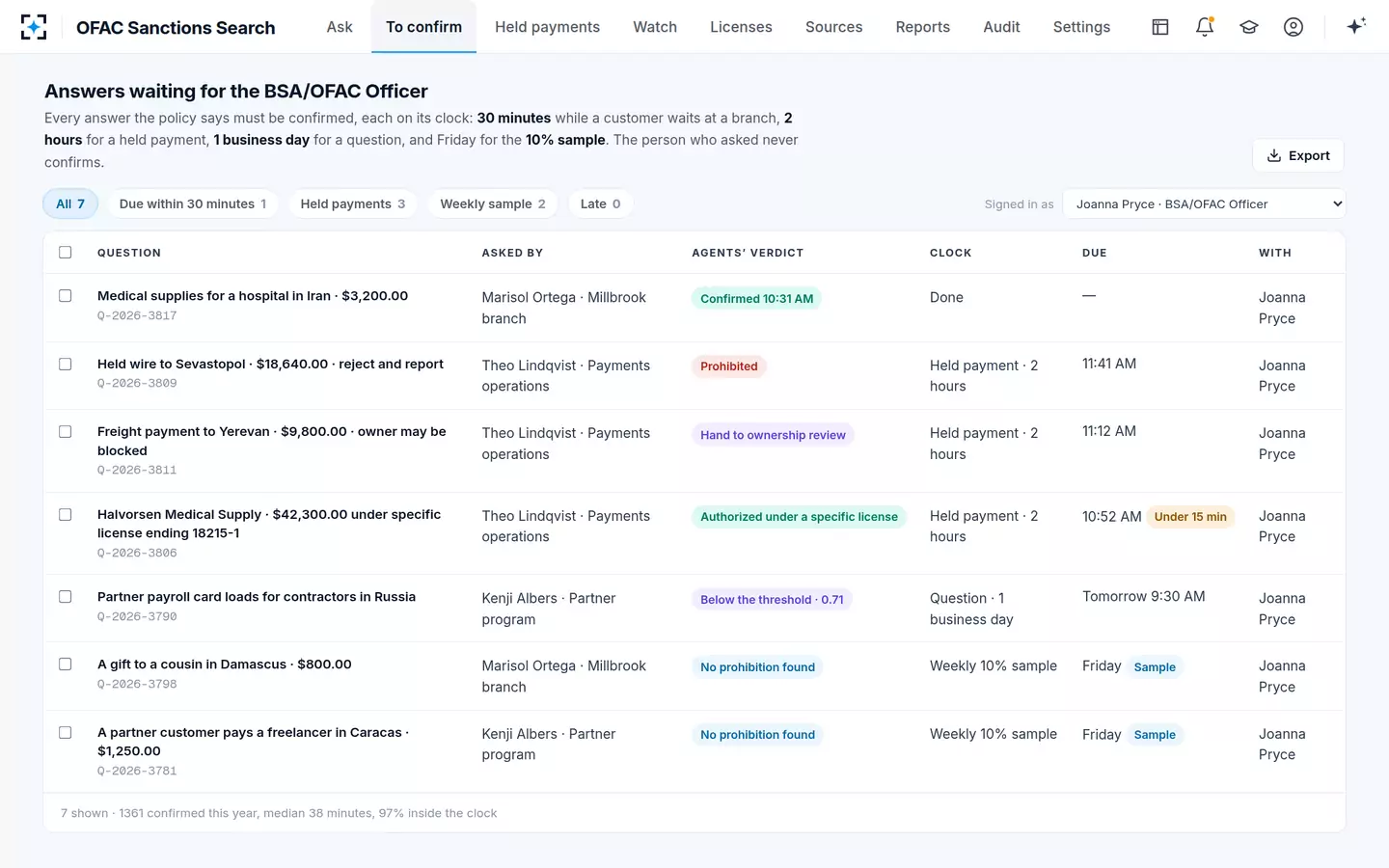
The officer's time goes to confirming, on clocks set by policy
Questions people ask
How much do sanctions research tools cost?
Prices are rarely published, and they vary with volume, lists and integration. Compare them per answered question: the officer minutes each option takes, at your loaded hourly cost, plus the fee, against the free search and the officer's own research.
Is OFAC's Sanctions List Search free to use?
Yes. It is free, searches the SDN List and the consolidated non-SDN lists, and is meant for individual users rather than automated systems. OFAC's downloadable list files are free as well, for loading into screening software.
Does a clear result on a free check mean we can process the payment?
No. It means no similar name scored above your threshold today. The payment can still be prohibited by a country program, need a general license whose conditions are not met, or involve an entity owned 50 percent or more by blocked persons, whose property OFAC treats as blocked even though the entity appears on no list (OFAC, 2014; the rule is worked through in OFAC 50 rule explained).
Can a small bank rely only on free tools?
It can for name screening if its risk and volume are low, which the FFIEC manual allows. It still needs a way to answer program and license questions, a record of each decision kept 10 years, and an officer who can show how each answer was reached.
How long does OFAC have to bring a case?
Ten years. OFAC may commence a civil enforcement action within 10 years of the latest date of a violation that occurred after April 24, 2019, which is why records are now kept for 10 years too.