Audit management software is software that plans audits, routes checklists and workpapers, records findings and tracks them to closure. For branch reviews at a bank or credit union it is one of three ways to run the same work. A paper or spreadsheet checklist captures ticks. Audit management software captures workflow: who did which step, when, and what they attached. Agents capture the evidence itself, by pulling it from the core, the teller platform, the security system and document imaging and by reading every photograph a manager takes on the walk. The right choice depends on what you need a branch review to prove. If the answer is that a control worked, in a form internal audit and an examiner can re-perform, only the third approach produces that by default. Botminds' Branch Self-Assessment is built that way, and it sits beside an institution's audit management system rather than replacing it.
The comparison below uses one fictional sample credit union in the solution, Norrell Federal Credit Union with 38 branches reviewed every quarter, and our estimates of a branch manager's time. None of it is a customer's measured result.
Three ways to run the same branch review, compared item by item
Where the evidence comes from
Paper or spreadsheetWhat the manager writes or ticks; attachments if someone scans them.
Audit management softwareWhat the manager uploads to the workflow; samples still pulled by hand.
AgentsAgents pull it from the core, teller platform, security system and imaging, and read every photo taken on the walk.
Can someone else re-perform an item?
Paper or spreadsheetRarely: a tick records a claim, not the record.
Audit management softwareIf the right attachment was uploaded and labelled.
AgentsYes: the photo without marks, the system extract, the verdict and who agreed are stored per step.
File samples (CIP, CTR, Reg CC, retention)
Paper or spreadsheetPulled and compared screen by screen.
Audit management softwareTracked as a task; the comparison is still manual.
AgentsPulled and compared field by field before the branch opens; corrections prepared for two people.
Surprise counts
Paper or spreadsheetScheduled by the branch or the region, and can be known in advance.
Audit management softwareScheduled in the tool; who knew in advance is not recorded.
AgentsDrawer picked at random when the walk starts; never shown before.
Exceptions to closure
Paper or spreadsheetIn email and next quarter’s checklist.
Audit management softwareOwners, due dates and reminders; closure is usually the owner’s.
AgentsOwners, due dates, reminders and repeat flags; a second person verifies evidence before closing.
Separation of duties
Paper or spreadsheetBy convention.
Audit management softwareConfigurable roles.
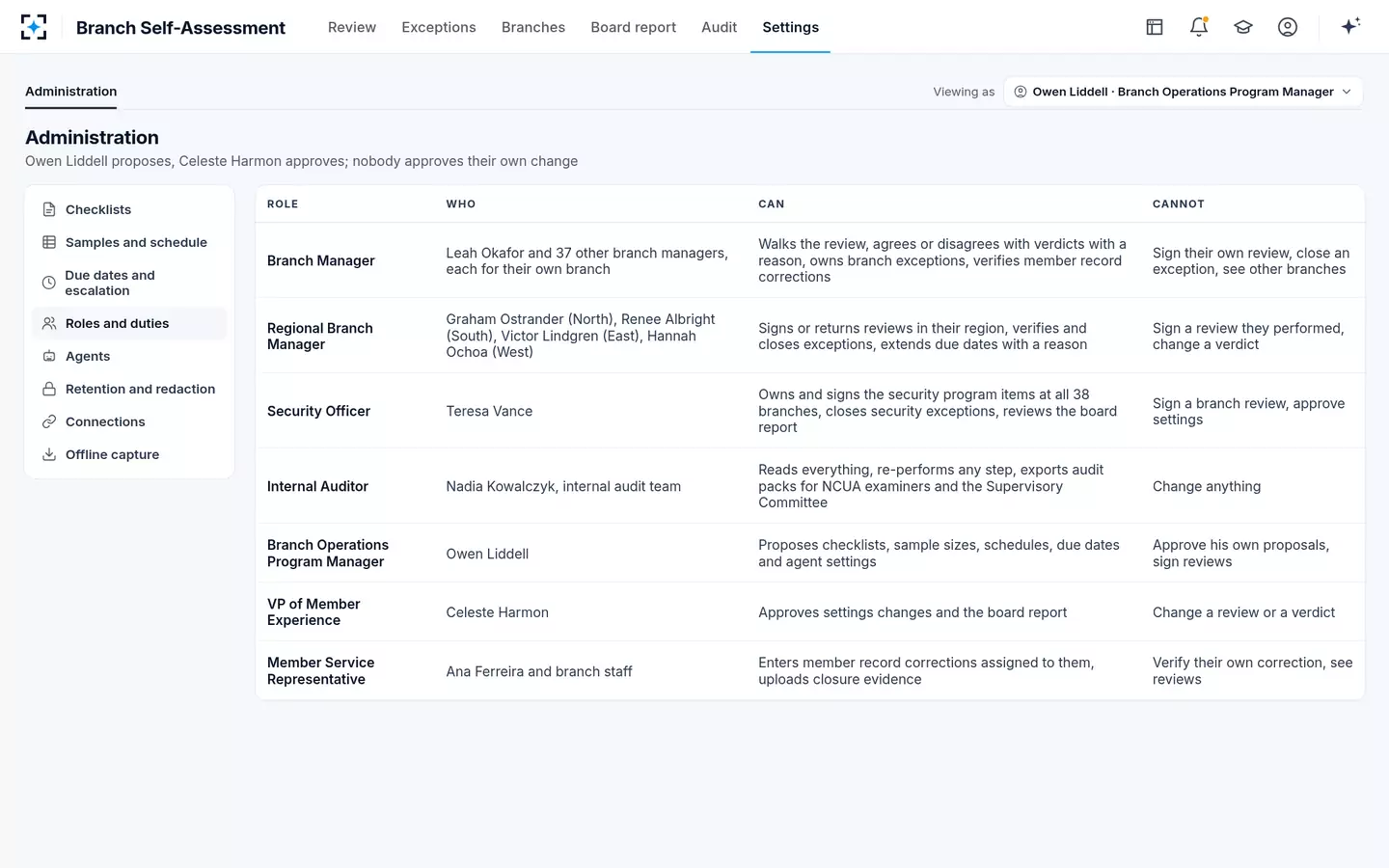
AgentsBuilt in: the performer cannot sign; nobody approves their own settings change.
Board and examiner output
Paper or spreadsheetAssembled by hand once a year.
Audit management softwareReports from what was entered.
AgentsSecurity program report and certification drafted with every number linked to evidence; exports for examiners.
What it does not do
Paper or spreadsheetAnything automatically.
Audit management softwareRead evidence or test it.
AgentsPlan the internal audit program or manage audits outside branches.
What is audit management software?
Audit management software is a system of record for audit work: it holds the audit plan and risk assessment, the programs and checklists, the workpapers and evidence attached to them, the findings and the management responses, and the follow-up to closure. Internal audit departments use it to run the annual audit program and to report to the audit committee. Branch operations teams sometimes borrow it to run branch self-assessments, because it already has checklists, assignments and due dates.
What audit management software does not usually do is gather evidence. Its checklists are completed by people, its evidence is what people upload, and its findings are what people write. That is fine for an audit of lending policy or IT change management, where the auditor's judgement is the work. It is a weak fit for a branch review, where most of the work is retrieving records and comparing them, and where the people doing it are branch managers fitting the review between appointments.
What is the difference between GRC software and audit management software?
GRC software (governance, risk and compliance) is broader: it manages risk registers, control libraries, policies, compliance obligations and issues across the institution, and often includes an audit module. Audit management software is focused on internal audit's own work, from planning to reporting. Both are systems of record. Neither, in its usual form, reaches into a teller platform or reads a photographed vault log.
For branch reviews the distinction matters less than a third category: software that performs the tests. A branch review needs a tool that can compare a currency transaction report's filing date with the transaction date, an imaged ID with the core record, and a vault log's initials with the security system's badge events. Whether the findings then flow into a GRC platform or an audit management system is an integration question, and a good branch tool should feed either.
The yardstick: what an audit program is expected to do
The fairest way to compare the three approaches is against what examiners expect audit procedures to do. The Federal Reserve's examination manual lists the procedures most audit programs include, and almost every one is about evidence rather than workflow.
Most audit programs include procedures such as— surprise examinations, where appropriate; maintenance of control over records selected for audit; review and evaluation of the bank’s policies and procedures and the system of internal control; reconciliation of detail to related control records; and verification of selected transactions and balances through procedures such as examination of supporting documentation, direct confirmation and appropriate follow-up of exceptions, and physical inspection.
Federal Reserve, Commercial Bank Examination Manual, section 4500.1
Read the list against a branch review. Surprise examinations: a surprise count the branch knew about is no surprise, so who picks the drawer and when matters. Control over records selected: a sample pulled by the branch manager from files the branch manager controls is not under anyone else's control. Reconciliation of detail to control records: drawer and vault counts against the teller platform, consigned items against the general ledger. Verification through supporting documentation and follow-up of exceptions: the file samples, and the exceptions followed to closure. Paper supports these only as well as the people doing them. Workflow software records that they were done. Agents perform the reconciliation and the verification and keep what they compared.
Can audit software run branch reviews?
Audit management software can run the workflow of branch reviews, and for some institutions that is enough. It can schedule a review per branch per quarter, assign it to the branch manager, route it to a regional manager for sign-off and track exceptions. What it cannot do on its own is the part that takes the branch manager's hours: pulling the samples, comparing them with the core, reconciling cash and consigned items, reading the security system and turning photographs into findings.
That gap decides the comparison. In the sample credit union's checklist, 42 of the 64 checks are retrieval and comparison that agents complete before the branch opens, and the other 22 are walked by the manager with one photo each, which the Reading agent transcribes and judges. A workflow tool would leave all 64 to the manager. How agents decide, and where they must stop and hand over to a person, is the subject of AI audit software for branch reviews.
How much time does audit software save?
Workflow software saves the time spent chasing paper and assembling reports; agents also save the time spent finding and comparing evidence, which is most of a branch review. Our estimate for the sample credit union is about six hours of a branch manager's time on one quarterly review on paper, with about two more hours of regional and internal audit follow-up, against about two hours with agents.
Hours on one quarterly branch review, by approach (estimate)
Across 38 branches and four quarters, six hours against two is about 600 branch-manager hours a year, by our arithmetic. Time is the smaller part of the case, though. The larger part is that the two hours that remain leave evidence that internal audit can re-perform from its desk, so audit's own branch visits can go where the evidence is weakest.
Is audit management software worth it for a small bank or credit union?
For internal audit's own program, a small institution can manage with documents and spreadsheets, and the case for an audit management system rests on volume, staff turnover and the audit committee's appetite for reporting. For branch reviews the question is different. A credit union with eight branches still runs 32 reviews a year if it reviews quarterly, and each one samples files, counts cash and checks the security program. What makes software worth it there is not routing; it is whether the software produces evidence the institution would otherwise not have.
Small institutions also have less capacity to oversee vendors. The federal banking agencies' third-party guidance reminds banks that contracts should settle who owns what the vendor produces: "Provisions that indicate whether any data generated by the third party become the banking organization's property help avert misunderstandings" (88 FR 37920). For credit unions the point is sharper, because the GAO found in 2025 that the NCUA lacks authority to examine technology service providers (GAO-25-107197). Whatever a credit union buys, its review evidence should be exportable and kept where its own examiners and Supervisory Committee can see it.
Who can do what in Branch Self-Assessment: roles and separation of duties as settings
What are the alternatives to paper audit checklists?
There are three, in rising order of what they prove. A shared spreadsheet or form tool puts the paper checklist online: easier to collect, no better as evidence. Audit management or GRC software adds assignments, due dates, sign-off and reporting: better control of the process, the same evidence. Agents that gather and test evidence change what the checklist leaves behind: system extracts and photographs with verdicts, exceptions with checked closure evidence, and a review someone else can re-perform.
The choice can be mixed. An institution can keep its audit management system for internal audit's program and its findings register, and run branch reviews with agents, sending the signed review and its exceptions into the audit system. What it should not do is move a paper checklist into software unchanged and call the result evidence. The checklist itself is worth rebuilding from the examiners' procedures first, as set out in Bank branch audit checklist: why a tick is not evidence.
How long does it take to implement audit software for branch reviews?
The work is in the connections and the checklist, not the screens. Implementing any tool for branch reviews means turning the checklist into versioned steps, agreeing sample sizes and due dates, setting roles so the performer cannot sign, and deciding retention. For agents, it also means connecting the systems the evidence lives in: document imaging, the core, the teller platform, the security system, the BSA reporting system, and the general ledger and HR roster. Those connections are where a pilot should start, on a handful of branches and the institution's own last-quarter reviews, comparing the agents' verdicts with the reviews already signed.
Questions to put to any vendor of software for branch reviews
- Show us one of our own checklist items end to end
From where the evidence comes from to who signs. A demo on the vendor’s sample proves the screens, not the fit.
- Which of our checks would your product complete from our systems?
The answer separates workflow from evidence gathering.
- Can internal audit re-perform a step without visiting the branch?
And see the evidence without the first reader’s marks.
- Who closes an exception, and what evidence must they see?
Closure by the owner alone is how findings repeat.
- Can the person who performed a review sign it?
If the product allows it, the control is a convention.
- How is a surprise count kept a surprise?
Who picks the drawer or date, and whether anyone at the branch can see it in advance.
- Who owns the evidence, and how do we export it?
For examiners, the audit or Supervisory Committee, and the day the contract ends.
- What does the annual report to the board look like?
Drafted from the reviews with every number linked, or assembled by hand.
Where Branch Self-Assessment sits beside an audit management system
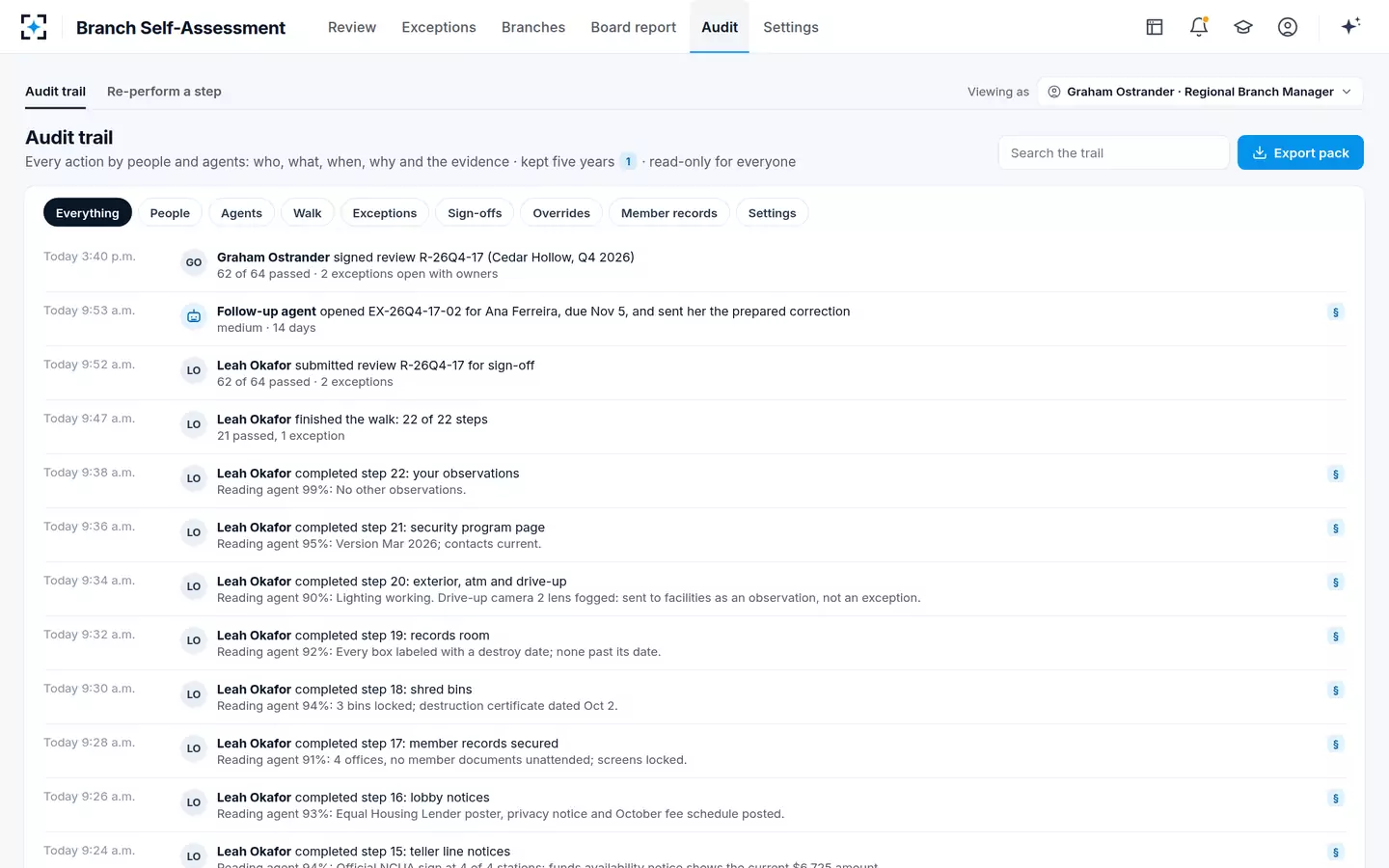
Branch Self-Assessment is the third approach in the comparison, built for one job: the periodic review a branch manager runs of their own branch, from preparation by agents through a guided photo walk, exceptions with owners, regional sign-off and re-performance by internal audit, to the annual security program report and, for a credit union, the certification draft. Every action, by people and agents, is kept on a read-only trail with who, what, when, why and the evidence, and can be exported for examiners, the Supervisory Committee and internal audit.
It is not an audit management system. It does not plan the internal audit program, hold workpapers for audits outside the branches, or track findings from external auditors and examiners across the institution. Where an institution has an audit management or GRC platform, Branch Self-Assessment should feed it rather than compete with it. The solution is at Branch Self-Assessment.
The trail behind every review: who did what, when, why and with which evidence
Questions people ask
What should a credit union look for in audit management software?
For internal audit's program: planning, workpapers, findings and Supervisory Committee reporting. For branch reviews: evidence gathered from its own systems, re-performance without a visit, second-person closure of exceptions, exportable evidence, and support for the annual Part 748 certification. Given the NCUA's limited authority over technology providers, ownership and export of the evidence deserve particular attention.
Can one system do internal audit and branch self-assessments?
It can route both, but the two jobs differ. Internal audit needs a system of record for independent audit work; branch self-assessment needs evidence gathered and tested at scale. A branch tool that feeds signed reviews and exceptions into the audit system lets each do the job it is built for.
Does audit management software satisfy examiners?
Examiners judge the controls and the evidence, not the software. A tool helps if it makes tests, findings and corrective actions documented and verifiable; a checklist moved online unchanged does not.
What is the biggest mistake when digitizing branch reviews?
Moving the paper checklist into software as it is. The ticks become clicks, the evidence problem stays, and the institution pays for software that records the same claims faster.
How do you pilot branch review software?
Pick a few branches with different risk profiles, load last quarter's checklist and completed reviews, and compare the tool's results with what the branches signed, step by step. Measure where it found something the paper review missed, where it asked rather than decided, and how long the managers spent.