Call center QA software records, transcribes and scores contact center calls and chats so a quality or compliance team can review them, and for a bank the question that matters is not the licence price but what each reviewed call and each confirmed finding costs. Most programs still pay a person to listen. That makes every reviewed call expensive and leaves most calls unheard, including the ones where a customer disputed a charge and started a Regulation E clock. Software that reviews every call changes the unit: the cost moves from minutes of listening to minutes of deciding. This page works the arithmetic on a fictional sample bank and shows where Botminds' Call Compliance Monitoring, which reviews every call and chat with agents and leaves each decision to a QA analyst, fits and where it does not.
The sample bank is Corvane National Bank: 4,800 bankers, 2,104,380 calls and 381,920 chats in September 2026, and a former QA rule of eight calls per banker a month. Its figures are sample data; the wage figures are the Bureau of Labor Statistics'; every cost below is our estimate, with the assumptions stated so a bank can replace them with its own.
The unit cost of a call reviewed by hand, before any software
18min
per reviewed call: about 7.5 minutes of audio and 10 to score and write it up
38,400
calls reviewed a month at eight per banker, about 1.5% of contacts
$6.46
people cost per reviewed call at the median customer service wage
$11.64
the same call at the median compliance officer wage
How much does call center QA software cost? Divide by the right unit
Call center QA software is priced in one of three ways, per licensed seat, per minute of audio processed, or per interaction reviewed, and list prices are rarely published, so the useful comparison is the one a bank makes itself: total monthly cost, people plus licence, divided by reviewed calls and by confirmed findings. A low price per seat can still buy an expensive program if each reviewed call needs eighteen minutes of a person's time, and a high price per interaction can be cheap if it replaces those minutes.
The second divisor is the one most business cases leave out. A QA program exists to find things: a notice of error that was not opened, a complaint that was not logged, a statement that misled. The cost of finding one is what the program spends divided by how many it finds, and on that measure a hand sample is far more expensive than its per-call cost suggests, because most of the calls it reviews contain nothing to find.
People cost per confirmed finding: a hand sample against every call reviewed
What is the cost of manual call monitoring?
The cost of manual call monitoring is the reviewer hours it takes multiplied by what those hours cost, and at a bank of any size it is large before it is useful. At Corvane, eight calls per banker a month across 4,800 bankers is 38,400 reviews. At 18 minutes each that is 11,520 hours a month, about 73 full-time reviewers working 7.5-hour days for 21 days. At the customer service median wage that is roughly $248,000 a month in wages before benefits; at the compliance officer median, about $447,000.
For that money the sample hears about 1.5% of what customers said. In the sample month people confirmed 6,412 findings across 2,486,300 calls and chats, about 2.6 per thousand. A random 38,400 of those contacts would hold about 99 findings, so the hand program pays somewhere between $2,500 and $4,500 for each one it finds, assuming its reviewers miss none. It also leaves the rest where they are. Of the 486 notices of error confirmed in the month, a 1.5% sample would expect to hear seven or eight.
Reviewing everything by hand is not the alternative, and the arithmetic shows why. Every call and chat at 18 minutes is nearly 746,000 hours a month, close to one full-time reviewer for every banker. That is why hand programs sample, and why the sample rate is set by the budget rather than by the risk. The QA sample size calculator shows what a given rate can and cannot be expected to hear.
The cost a sample never books: the notices nobody heard
The largest cost of a hand sample does not appear in the QA budget: it is the obligations created on calls nobody reviewed. A customer who disputes a debit card charge on a call has given notice, and Regulation E gives the bank 10 business days "of receiving a notice of error" to determine whether an error occurred (12 CFR 1005.11(c)(1)). An unheard notice is not a deferred task. It is a missed deadline that nobody has counted yet.
Examiners count it. In 2025 the FDIC cited 136 violations of the Electronic Fund Transfer Act and Regulation E, the second most cited consumer law in its examinations, and the two error resolution sections "represented 74 percent of the total EFTA violations cited in 2025" (FDIC Consumer Compliance Supervisory Highlights, March 2026). The same report records about $1.2 billion in restitution ordered by the FDIC in 2025 through its consumer compliance enforcement orders. Restitution follows the customers who were owed something, and finding them later means going back through calls.
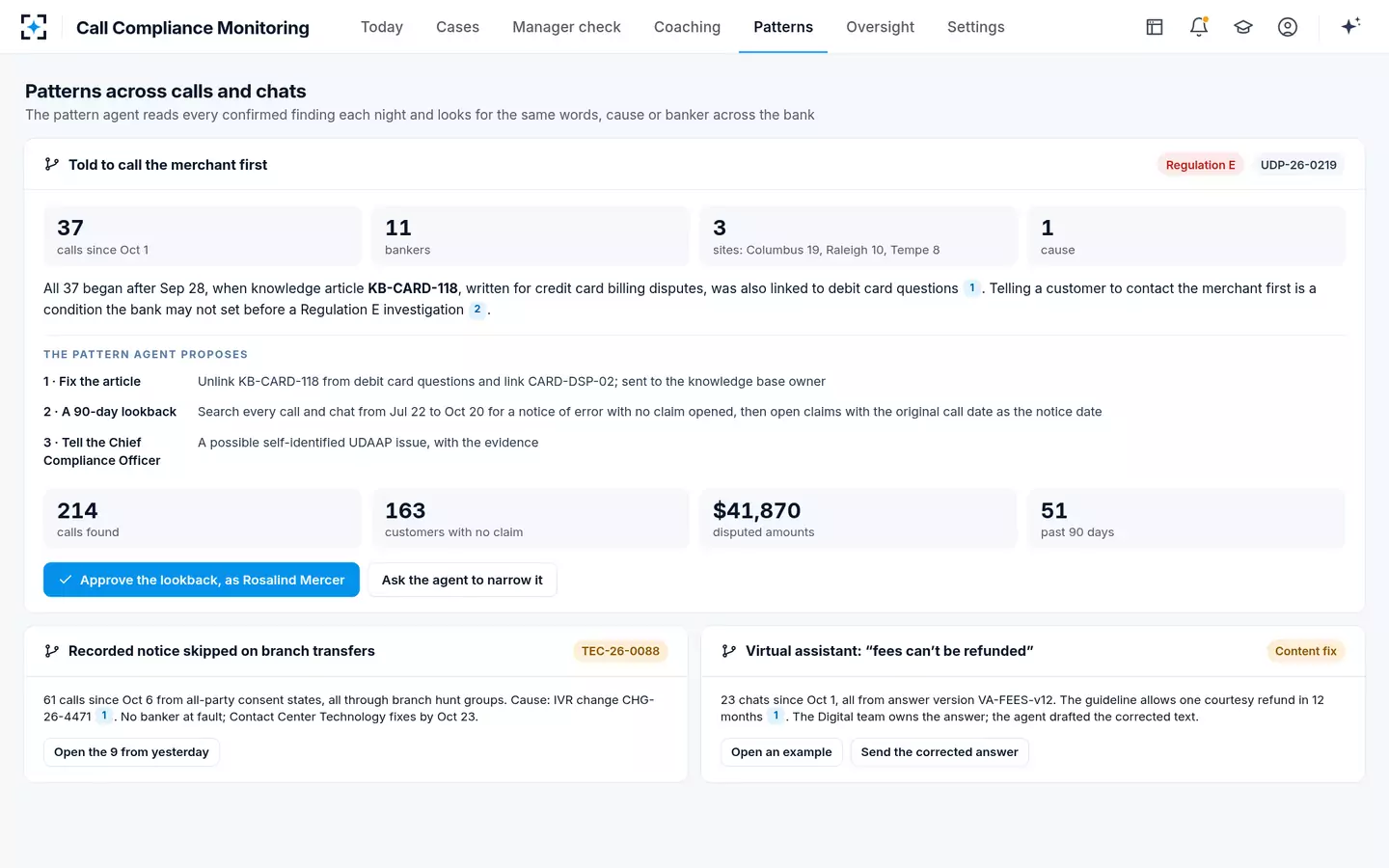
Corvane's sample data shows what that looks like. A knowledge article written for credit card disputes was linked to debit card questions, and bankers began telling customers to call the merchant first. Once the pattern was found, the lookback preview searched 90 days of calls and chats for notices of error with no claim opened and found 214 calls, 163 customers and $41,870 in disputed amounts, each of which would need a claim opened with the original call date.
One finding traced to its cause, and the lookback it implies
Per seat, per minute or per interaction: which pricing suits a bank?
Per-interaction pricing suits a bank that wants every call and chat reviewed, because it scales with what is reviewed; per-seat pricing suits a program that samples, because it scales with the number of bankers rather than the number of calls. Per-minute pricing sits between, and is the one most likely to surprise, because it prices chats and long collections calls differently from what they cost to review. The table is our reading of the three models, not any vendor's terms.
Three ways QA software is priced, and what each one rewards
| Pricing model | Scales with | Fits a bank that | Watch for |
|---|---|---|---|
| Per seat | Bankers or reviewers licensed | Samples calls and wants a predictable budget | Full coverage priced as an add-on; chats or digital agents licensed separately |
| Per minute of audio | Recorded minutes processed | Has short calls and few chats | Long collections and hardship calls cost the most; chats need a separate unit |
| Per interaction | Calls and chats reviewed | Wants every contact reviewed in every channel | What counts as one interaction when a call is transferred or a chat resumes |
How many QA analysts do you need per agent?
By hand, the answer is set by the sample rate: at eight calls per banker a month and 18 minutes a call, a bank needs about one QA reviewer for every 66 bankers. Reviewing every call by hand would need close to one reviewer per banker, which no bank staffs. When agents review every call, the answer is set by the number of findings to decide, not by the number of calls.
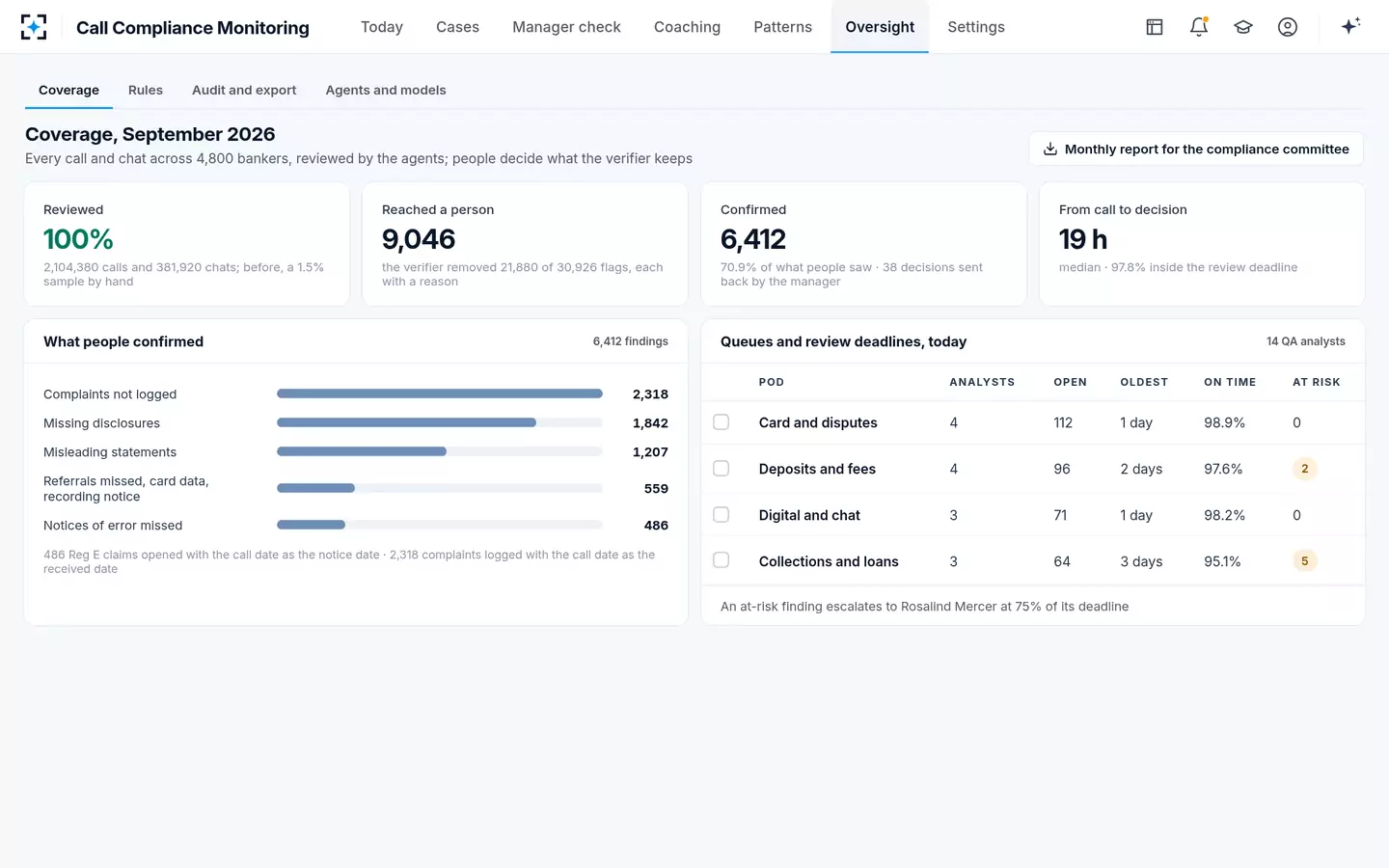
Corvane's QA team is 14 analysts in four pods, about one for every 340 bankers, and in the sample month they decided the 9,046 findings the verifier kept with a median of 19 hours from call to decision. Each analyst decides about 30 calls and chats with findings a day. The design point is that the analyst count follows the finding rate: a month with a bad knowledge article produces more findings and needs more decisions, while a quiet month does not need the same team listening to the same number of empty calls.
Coverage and queues: 14 analysts deciding what the agents found in a month
Can QA software replace QA analysts?
No, and in a bank it should not try: software can listen to every call, but a person has to decide what the bank does about each finding. The CFPB found it unfair in 2022 when a bank denied notices of error on the strength of an automated filter alone, and AI call monitoring with a verifier agent sets out the design that keeps the decision with a person.
What the evidence supports is that tools make people more productive, unevenly. In a study of 5,179 customer support agents given a generative AI assistant, issues resolved per hour rose 14% on average and 34% for the newest and least skilled agents, while the most experienced barely changed (Brynjolfsson, Li and Raymond, NBER Working Paper 31161). The firm studied was a software company's support desk, not a bank, so read it as evidence about contact center work in general. For a QA team the parallel is direct: agents do the listening that took most of the hours, and the analyst's time goes to the decisions that need judgement.
What does it cost to review 100 percent of calls?
Reviewing 100 percent of calls costs a licence that scales with volume, the work to connect the software to the bank's systems, the time to validate it, and the people who decide what it finds; it pays back in reviewer hours and in obligations met on time. The terms below are the ones to price, each in your own numbers.
The return on reviewing every call, term by term
Listening hours released
(sampled calls × minutes per review) − decision hours
At the sample bank, 11,520 hours a month by hand against about 2,200 hours of decisions.
QA and contact center finance
Obligations met on time
notices and complaints opened on the call date
Claims and complaints that would otherwise surface late, in a complaint, an audit or a lookback.
Compliance
Patterns found early
calls affected × days sooner
A wrong knowledge article caught in weeks, not after a quarterly report.
Compliance monitoring manager
Licence and connection
price per interaction × volume + integration
Recording platform, core banking, card processor, complaint system and case management.
IT and procurement
Validation and oversight
test set + model risk review + manager checks
A fixed test set for every new version, and a sample of decisions and removals every day.
Model risk and Compliance
People deciding
findings a month × minutes per decision
At the sample bank, 14 analysts for about 9,000 findings a month.
Compliance monitoring
Four things move the licence price of any product in this market: the number of interactions, the number of channels and languages, the number of call types and rules to check, and the systems it has to read. Budget separately for the two costs outside the licence that business cases tend to forget: the integration work to give the software read-only access to recordings and records, and the time model risk and Compliance will spend validating a tool that proposes findings on regulated obligations. A pilot on last month's calls is the cheapest way to get real figures for every term above.
What is the best call center QA software for banks? A scorecard
The best call center QA software for a bank is the one that finds the findings with a legal clock, on every call, and leaves a record an examiner can follow; tone scoring and dashboards come after. The scorecard below turns that into things a vendor can show.
Nine questions that separate bank-grade QA software from a call scorer
- Does it review every call and chat, or a sample?
And at what price per interaction at your volume, not the vendor's reference volume.
- Does it check rules against your records?
Fee schedule, hold notices, account and case records, not only the transcript.
- Does it recognise a notice of error in ordinary words?
Test with disputes that never use the word "dispute".
- What removes false positives, and can you audit it?
Removals visible, with reasons, and a share sampled for review.
- Which date goes on the case?
The date the customer spoke, so a Regulation E clock is never restarted by the review.
- Who decides, and who checks the decider?
A named analyst confirms; a manager samples confirmations and dismissals.
- Does it score bankers?
If you need performance scoring, ask separately; if you need compliance findings, scoring can push bankers to game the words.
- How is each version validated and approved?
A fixed test set, a validator, an approver, and a record of every override.
- What does the examiner export contain?
Decisions, excerpts, claims with notice dates, rule and agent versions, redacted, released by a second person.
On that scorecard, here is where Call Compliance Monitoring fits and where it does not. It is built for the compliance half of QA in a bank: every call and chat, rules checked against the bank's own records, a verifier on every flag, a person on every decision, and cases dated from the call. It does not give bankers real-time prompts during a call; it reviews overnight, with a target of a decided finding within a day. It does not rate, rank or discipline bankers; supervisors see confirmed findings for their own teams and decide the coaching. And it is not workforce management or a contact center platform: it reads from yours. The full design is on the Call Compliance Monitoring page.
Questions people ask
What is the ROI of call center QA software?
It is the reviewer hours released plus the obligations met on time, less the licence, integration, validation and the people who decide. On the sample bank's figures, hand review took about 11,520 hours a month to find an expected 99 findings, while deciding every finding the agents kept took about 2,200 on our estimate; the licence is the term to price against that.
Is per seat or per minute pricing better for QA software?
Per seat suits a program that samples, because it scales with bankers; per interaction suits one that reviews every contact, because it scales with what is reviewed. Per minute penalises long calls and needs a separate unit for chats. Price one month of your own traffic under each model before choosing.
Is call center QA software worth it for a small bank or credit union?
The arithmetic is the same at any size: hours per reviewed call times calls, against the cost of reviewing everything. A small institution has fewer calls but usually a smaller QA team, so a missed notice of error is just as likely to go unheard; ask for per-interaction pricing that does not assume a large volume.
What hidden costs come with call center QA software?
Integration with the recording platform and the systems the rules check against, validation by model risk before go-live and after each version change, and the people who decide findings. Software that reviews every call also surfaces past problems, and a lookback has a cost of its own, which is the cost of an obligation that already existed.
Does QA software cut the number of QA analysts a bank needs?
It changes what sets the number. By hand, the sample rate sets it: about one reviewer per 66 bankers at eight calls per banker a month. With agents reviewing every call, the finding rate sets it; the sample bank decided a month's findings with 14 analysts for 4,800 bankers.