Insurance policy processing automation software takes the servicing requests that arrive after a policy is sold, chiefly mid-term changes, and does the reading, matching, checking, rating and drafting that a policy service representative would otherwise do by hand. Good software leaves two things to people: accepting each change within a licensed person's authority, and deciding the changes that need an underwriter. The best way to evaluate any product in this category is to watch one realistic request go through it and ask, at every step, what it read, what it concluded, what it cited and what it refused to do. This page does that for Botminds' Policy Endorsement Processing, using one broker email that holds three policy changes and a certificate request.
"One email is four jobs, and the policy system wants them one field at a time."
Lena Marquardt, the sample desk's commercial policy service representative
The request, the people and the policy on this page are fictional sample data: Orchard Lane Landscaping, a commercial package policy CPP 7730418 with an invented carrier, Bracken Hill Mutual, written through the broker Penwick & Shaw. The email arrived on a Monday at 08:47. The run that follows is the solution's own, with its timings as the run log recorded them.
What does insurance policy processing automation software actually do?
It turns a request written for a person into changes a policy system can take, and checks them on the way. Concretely, that is five jobs: read the request and its attachments, split them into separate changes, find the policy and the page each change alters, check each change against the underwriting rules and the authority of the person who will accept it, and price and draft it. A sixth job comes after a person issues the change: read the issued endorsement back and compare it with the request.
The jobs matter because each fails differently. A reader that merges two requests loses one. A matcher that finds the wrong vehicle produces a correct-looking endorsement on the wrong unit. A checker that does not know the representative's authority lets a change through that should have gone to an underwriter. A rater that cannot see the filed rates invents a premium. The trace below shows each step with its evidence, so a buyer can ask the same of any product.
The email itself is short. Rob Delacroix, who owns Orchard Lane, wrote on Sunday evening: a 2026 Ford F-350 dump, financed through Buckeye Commercial, to go on from Thursday the 15th with "full coverage like the other trucks"; a new hire, Tyler Brandt, aged 20, to drive it; Crestline Property Group to be an additional insured before a contract starts on 1 November; and a certificate. Two attachments came with it: a two-page bill of sale and the 14-page Crestline agreement.
The 52-second trace, step by step
The run takes 52 seconds from the email's arrival to a drafted endorsement, a keying sheet and a drafted letter. Most of that time goes to reading: the email and 16 pages of attachments, and the 38-page policy the changes land on.
Policy Endorsement Processing on one broker email: 52 seconds, by agent
- Read the documents9 s
- Split4 s
- Find the pages6 s
- Check rules and authority11 s
- Rate7 s
- Draft and route15 s
Seconds 0 to 13: reading the email and splitting it
The request reader reads the email, the bill of sale and the agreement, then splits them into four requests: add a vehicle, add a driver, add an additional insured, and a certificate. Each request quotes the sentence it came from, so a person can see why the software thinks the request exists. The certificate is recognised as something other than a policy change and marked for the certificates queue. "Thursday the 15th" is resolved against the date the email was written, 11 October, to an effective date of 15 October 2026, and the reader will not supply an effective date the request does not contain.
Those two limits are the first things to test in any product. A reader that merges "a truck and a driver to drive it" into one change produces one endorsement where the carrier's rules need two decisions. A reader that fills in a plausible date when none is written creates coverage nobody asked for, or none where someone did.
Seconds 13 to 30: finding the page and checking the rules
The policy locator matches the email to CPP 7730418 by policy number, insured and broker, and finds where each change lands: unit 12 on the schedule of covered autos on page 6, driver 10 on the driver schedule on page 9, entry 4 on the additional insured schedule on page 14. It is read-only. It never edits the policy.
The eligibility checker then tests each change. The truck is allowed and within the representative's authority: it is garaged and used like units 1 to 11 and priced like units 4 and 5, the other F-350 dumps. The driver is not: rule CA-UW 4.2 sends drivers under 23 on a vehicle over 10,000 pounds gross vehicle weight to an underwriter, and the bill of sale puts this truck at 14,000. The checker also lists what is missing before an underwriter could decide, the driver's date of birth and licence number, because the motor vehicle record cannot be ordered without them. The additional insured is allowed, and here the checker reads past the email: section 4 of the agreement's insurance exhibit asks for primary and noncontributory wording that Rob never mentioned.
The email beside the policy it changes, each request numbered and pinned
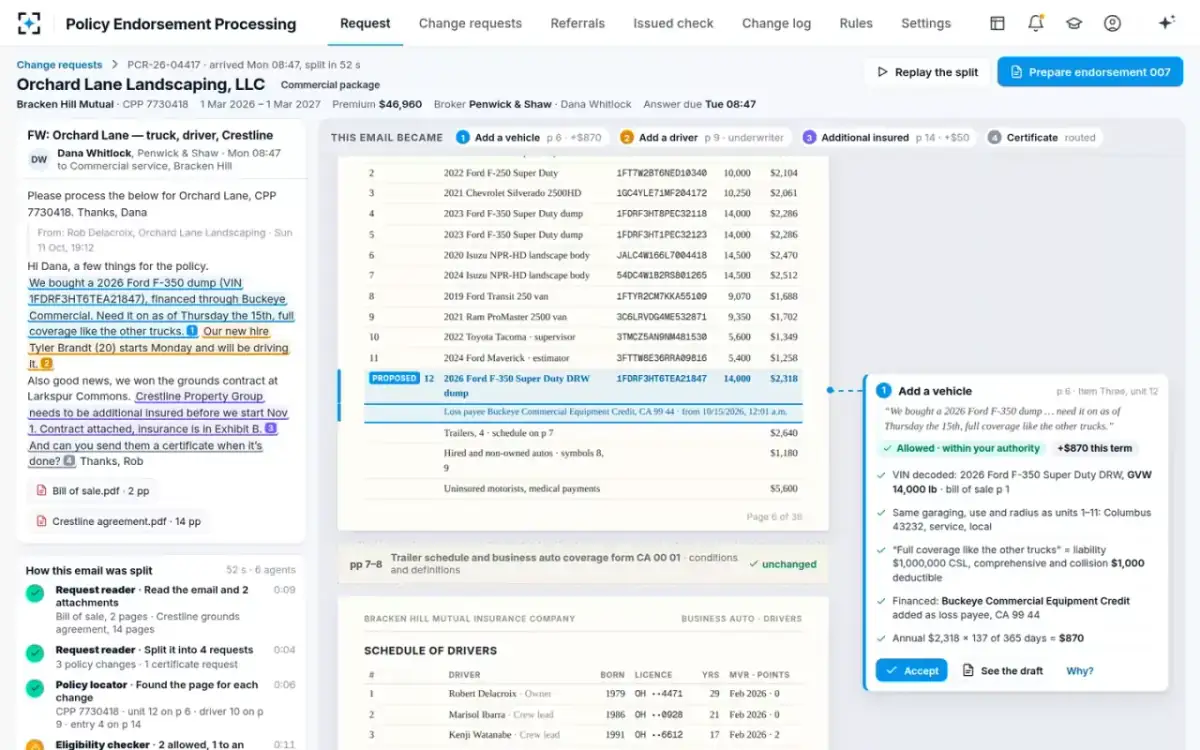
Seconds 30 to 52: pricing the changes and drafting the endorsement
The premium rater prices the truck through the rating engine the way units 4 and 5 are priced: liability $1,402, comprehensive $318 and collision $598, or $2,318 a year. From 15 October 2026 to the policy's expiry on 1 March 2027 is 137 of 365 days, so the truck adds $2,318 × 137 ÷ 365 = $870 this term. The additional insured is a flat $50, as filed, and the primary and noncontributory endorsement carries no premium on this policy. The rater never overrides a rate and never waives a minimum. The full method is worked through in how to calculate additional premium for endorsements.
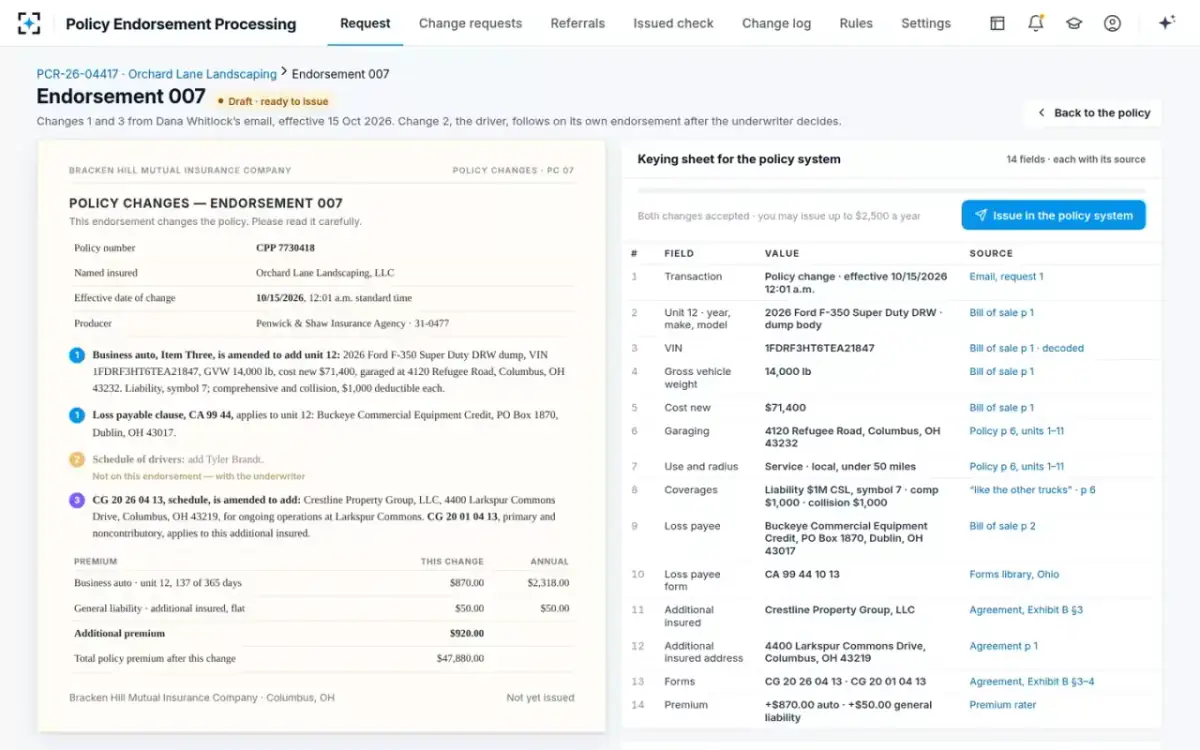
The endorsement drafter then combines the two accepted changes, which share an effective date, into endorsement 007: unit 12 added with the loss payee, Crestline on the additional insured schedule with the primary and noncontributory form, $920 of additional premium, and a total policy premium after the change of $47,880. Beside it, it writes a keying sheet for the policy system with 14 fields, each pointing to its source: the email for the transaction, the bill of sale for the VIN, weight and cost new, the policy pages for garaging and use, the agreement for the additional insured's name and address, the forms library for the form editions. It drafts the letter asking the broker for the two missing driver items and routes the certificate, held until the additional insured is issued.
Endorsement 007 as the insured will read it, and the keying sheet with a source for every field
Where does a licensed person still have to decide?
At acceptance, at every referral and at issue. The software's output at 52 seconds is a set of drafts, and nothing leaves the building until a person acts. That is a design choice with legal weight: binding coverage is licensed activity. Florida, for example, bars an agency employee from binding cover unless licensed and appointed as an agent or customer representative (Fla. Stat. §626.0428(2); see who has authority to make changes to an insurance policy), and software is not appointed by anyone.
Lena's part took 24 minutes. She accepted the truck. She accepted the additional insured and added the primary and noncontributory form the agreement required, at no premium. She read the drafted letter to the broker and sent it at 09:06. She issued endorsement 007 in the policy system at 09:12. The driver went to Darius Pell, the commercial auto underwriter, who decided once the broker supplied the missing items and the motor vehicle record came back clean.
Who does what in Policy Endorsement Processing, and what each step may never do
Agent
Request readerReads the email and attachments and splits them into separate requests, quoting the source sentence for each.
Never: merging two requests; guessing an effective date.
Agent
Policy locatorFinds the policy and the schedule entry each change adds, removes or alters.
Never: editing the policy; it is read-only.
Agent
Eligibility checkerTests each change against the rules in force and the representative’s authority: allowed, refer with the rule, or ask for what is missing.
Never: approving a referral.
Agent
Premium raterRates each change through the rating engine and prorates it by days to expiry, with the working shown.
Never: overriding a rate or waiving a minimum.
Agent
Endorsement drafterDrafts the endorsement, the keying sheet with a source per field, the letter for missing items and the routing.
Never: issuing or sending anything.
A person decides
Policy service representativeAccepts changes within authority, sends the letter, issues in the policy system.
A person decides
UnderwriterDecides referrals: approve, approve with a condition, or decline.
Agent
Issued-endorsement checkerReads the issued endorsement back within 10 minutes and compares every field with the keying sheet and request.
Never: closing a mismatch on its own; the documents are held until it is corrected.
After issue: reading the endorsement back
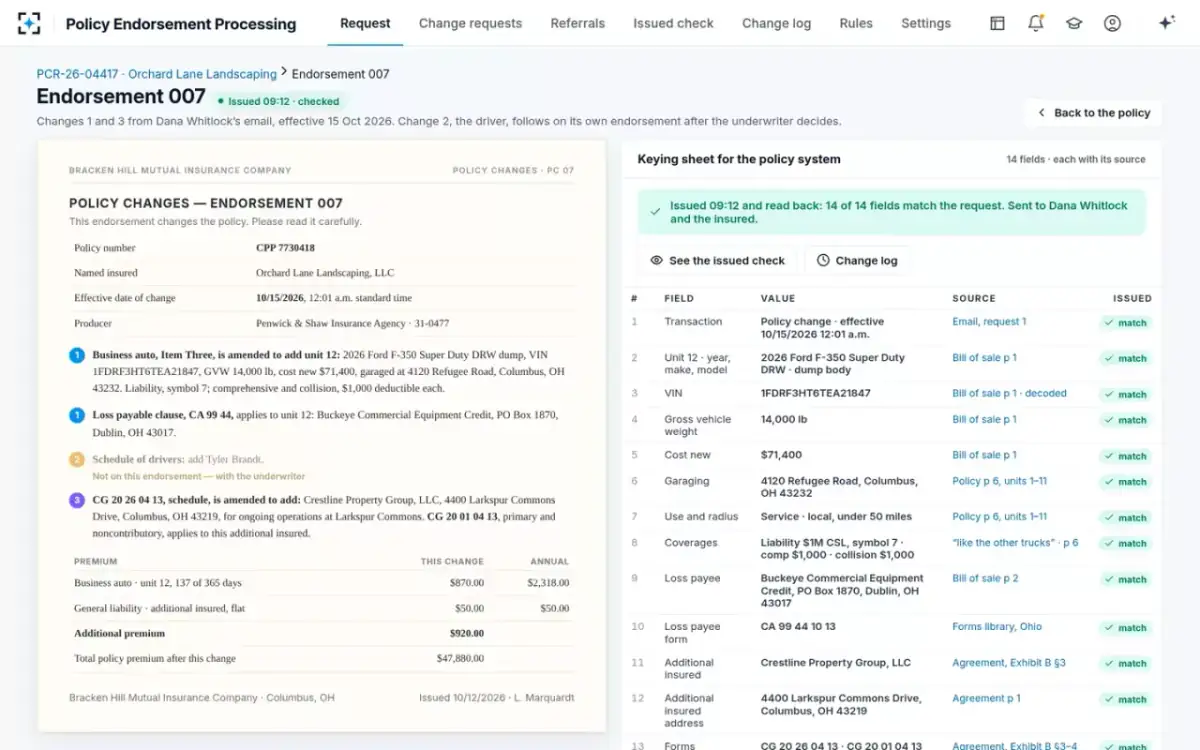
The last step is the one most automation leaves out, and it is the one that catches keying errors. Within 10 minutes of issue, the issued-endorsement checker reads the endorsement back from the policy system and compares each field with the keying sheet and the original request: transaction, VIN, gross vehicle weight, garaging, coverages, loss payee, additional insured, forms and premium. On endorsement 007 all 14 fields matched, and the documents went to the broker and the insured.
Regulators test the same thing from the outside. One of the NAIC's policyholder service standards asks for policy transactions processed accurately and completely (NAIC examination standards, 2024; how to measure against it is in policy servicing KPIs and metrics), and market conduct examiners test it on issued documents, not on procedures. A read-back is how a desk learns about a keying error before an examiner or a claimant does; the errors it catches, and how to measure a checker, are set out in insurance endorsement errors and a test that counts them.
Issued at 09:12 and read back: 14 of 14 fields match the request
How should you evaluate insurance policy processing automation software?
By running your own requests through it and checking the trace, not by reading its feature list. Bring twenty real change requests, including the messy ones: a forwarded chain, a scanned letter, a request with a contract attached, one with a date missing, one that is really a cancellation. The questions below are the ones the 52-second trace answers; ask any vendor, including us, to answer them on your requests.
Ten questions to put to any policy processing automation software
- Does it split one message into separate changes, and show the sentence each came from?
Count the changes it finds against what a senior CSR finds in the same twenty requests.
- What does it do when a value is missing?
It should ask, in a drafted message, not fill in a likely VIN, date or address.
- Does it read attachments that decide the change?
Bills of sale, contracts with insurance exhibits, scanned forms. The Crestline contract changed what the endorsement had to say.
- Are your underwriting rules and authority matrix settings you own?
Versioned, with the rule cited on every referral, and editable by your team lead without a release.
- Does the premium come from your rating engine and filed rates?
A tool that computes its own rates is a second rating plan nobody filed.
- Does it use the form editions you have filed in each state?
Not the latest editions by default. Examiners check that forms in use were filed.
- Who issues, and who sends?
A licensed person, every time. Ask to see the step where the software would issue and confirm there is none.
- Does it read back what was issued?
Field by field against the request, including work keyed by an outsourced team.
- Can every decision be reconstructed later?
Who asked, what was checked, which rule applied, who approved, what was issued, and the premium.
- What happens when it is wrong?
Ask for its mismatch and referral rates on your own requests, and how a person overrides it.
Policy processing automation compared with keying bots and claims AI
Three different things are sold under similar names, and they solve different problems. Screen-keying automation, often called robotic process automation, copies values from a structured source into a policy system's screens; it is fast and reliable when the input is already a clean form. Claims automation reads first notices of loss and claim documents, a different set of documents with different rules. Policy processing automation of the kind traced here is built for the unstructured end of servicing: the email, the scan, the contract.
Two ways to automate a mid-term change, on the same Orchard Lane email
Screen-keying automation: A structured form or portal entry with each field in its place.
Reading agents, a person issuing: The email, its two attachments and the policy, as they arrived.
Screen-keying automation: A person has to split them first and fill a form for each.
Reading agents, a person issuing: Split into three changes and a certificate, each quoting its sentence.
Screen-keying automation: The field is blank; the bot stops or keys nothing.
Reading agents, a person issuing: Listed as missing, with a drafted letter asking the broker for it.
Screen-keying automation: Not seen: it is in a 14-page attachment, not a field.
Reading agents, a person issuing: Found in section 4 of the insurance exhibit and offered as CG 20 01.
Screen-keying automation: Whatever the bot’s login is allowed to key.
Reading agents, a person issuing: The representative’s authority matrix, with referrals cited by rule.
Screen-keying automation: Usually nothing; the bot’s job ended at keying.
Reading agents, a person issuing: Every issued field read back and compared with the request.
Where this kind of software does not fit
It does not replace a policy administration system, and it should not try: the policy system stays the authority on what is issued and the source of filed rates and forms. If most of a desk's changes already arrive as clean portal transactions, the reading half of the product adds little, and the read-back is the part worth having. If a carrier's referral rules and authority limits exist only in the heads of senior underwriters, they have to be written down before any software can apply them; that is often the longest part of a go-live. And it is not a claims product. How the tool connects to the systems a carrier keeps is set out in an endorsement automation tool that fits the policy system you keep.
The honest promise is narrower than "automation": the reading, splitting, checking, rating and drafting are done in under a minute with the evidence shown, a person makes every decision, and every issued endorsement is compared with what was asked. The design target is 25 minutes from email to an issued, checked endorsement; Orchard Lane's two changes inside the representative's authority were issued and read back at 09:12, 25 minutes after the email arrived.
Questions people ask
What is insurance back office automation?
It is software that takes over repetitive post-sale work such as policy changes, certificates, billing exceptions and document handling, so that staff spend their time on decisions. For policy changes, the work automated is reading, matching, checking, rating and drafting; issuing stays with a licensed person.
Is a policy servicing automation tool the same as a policy administration system?
No. The policy administration system holds the policy, the rates and the forms and issues the documents. A servicing automation tool works around it: it reads requests, prepares the change and the keying sheet, and reads the issued endorsement back. Policy Endorsement Processing reads from the policy system and leaves issuing to a person.
Can AI process insurance claims the same way?
Claims are a different workflow with different documents, rules and regulators, from first notice of loss through coverage decisions and payment. Software built for policy changes does not handle claims, and Policy Endorsement Processing does not. The shared lesson is the evidence trail: every conclusion should point to the document it came from.
Does policy processing automation software issue endorsements itself?
It should not. Binding and issuing coverage is licensed activity in states such as Florida, and an authority matrix belongs to named people. In the trace on this page the agents drafted endorsement 007; the representative issued it at 09:12.
How long does an endorsement take with automation?
On the sample request, 52 seconds of reading, checking and drafting, then 24 minutes in which the representative reviewed, accepted, sent a letter and issued; the design target is 25 minutes from email to an issued, checked endorsement. Changes that need an underwriter or missing information take as long as the answer does: Orchard Lane's driver waited for the broker's reply at 10:52.
What does AI for policy servicing software need from us to start?
Your underwriting and eligibility rules, the authority matrix by role, your forms library with filed editions by state, access to the rating engine and read access to the policy system, and a sample of past change requests to test on. The rules are usually the longest item, because they are often unwritten.