Insurance cancellation notice requirements are set state by state, and within each state by line, notice type and how long the policy has been in force; there is no national rule. In four of the largest markets the clocks differ sharply. Florida requires 45 days for a commercial nonrenewal and 120 days for a residential cancellation or nonrenewal; Texas 60 days for a nonrenewal and ten for most cancellations; California 75 days for a residential nonrenewal, plus the days its Code of Civil Procedure adds for mailing; New York 45 to 60 days for a personal-lines nonrenewal and 60 to 120 for a commercial one, the only window here with a far end. Each state also decides what a late notice does, and none lets it simply take effect. Botminds' Cancellation & Nonrenewal Compliance checks every notice in a day's mail run against the rule for its own state, line, notice type and policy age before it prints; this guide sets the four states' rules side by side.
Every rule below is from the state's statute, linked where it appears, and summarised; read the statute before relying on it, and add your own states. Product examples are from a fictional sample carrier, Kestrel Point Insurance Group.
Four states, four different answers to one question: how much notice?
120days
Florida: residential cancellation or nonrenewal, other than nonpayment and the first 60 days
80days
California: a homeowners nonrenewal mailed within the state, 75 plus five for mailing
61stday
Texas: when cover ends after a late commercial nonrenewal notice
60–120days
New York: the commercial nonrenewal window, with a maximum as well as a minimum
Is there one national rule for insurance cancellation notices?
No. Insurance is regulated by the states, and each writes its own cancellation and nonrenewal rules into its insurance code, usually in separate sections for personal and commercial lines and sometimes a third for auto. The same notice type can carry a different number of days, a different list of permitted reasons, different required wording and a different consequence in each. What the four states share is structure: a short clock for nonpayment, a stricter regime once a policy has been in force about 60 days, a longer clock for nonrenewal, and a penalty for lateness that keeps the policy alive.
That shared structure is why a rule library can be built at all. Every rule has the same keys (state, line, notice type and policy age) and the same values (minimum days, any maximum, any mailing days, permitted grounds, required content, copies, and what happens if the notice is late). The matrix below fills those keys for four states.
Insurance cancellation and nonrenewal laws by state: the four-state matrix
Notice clocks and late-notice consequences in Florida, Texas, California and New York
| Notice | Florida | Texas | California (residential) | New York |
|---|---|---|---|---|
| Cancellation for nonpayment | At least 10 days, with the reason | Personal lines: effective no earlier than the 10th day after mailing. Commercial: notice by the 10th day before | Nonpayment is a permitted ground after day 60; the notice names the ground | Commercial: 15 days. Personal: the notice states the amount due; payment within 15 days of mailing is timely |
| Cancellation in the first 60 days | 20 days, with the reason (property and casualty, including residential) | Personal auto and homeowners may be cancelled in the first 60 days, homeowners only on stated conditions | The ground limits begin at day 60 | Commercial: 20 days. Personal: the notice states the specific reason |
| Cancellation after 60 days | Commercial 45 days; residential 120; private passenger auto 45; only on the grounds listed | Only on the grounds listed; effective no earlier than the 10th day after mailing (personal) or on 10 days' notice (commercial) | Only on the grounds in §676; the notice states the ground and the supporting information | Commercial: 15 days on the grounds listed. Personal: the grounds listed |
| Nonrenewal, personal or residential | Residential 120 days; private passenger auto 45, to the insured and the agent | 60 days before expiry | At least 75 days before expiry, plus 5 calendar days for mailing within California (10 if either end is outside it) | 45 to 60 days before the end of the policy period |
| Nonrenewal, commercial | 45 days, with the reasons | 60 days before expiry, to the first-named insured | Not in §678: it covers residential and personal-liability policies | 60 to 120 days (30 to 120 for excess liability or a jumbo risk), to the insured and the broker |
| If the notice is late | Commercial: cover to 45 days after notice, same premium. Residential: to the full period after notice | Personal: the insurer must renew if the insured asks. Commercial: cover to the 61st day after notice | The existing policy, unchanged, for 75 days from the notice | Personal: the insured may renew by paying. Commercial: cover for 60 days after the notice, or another policy period |
Read down any column and the state's priorities show. Florida's numbers are the largest and its consequence the most precisely priced: the same premium for a defined extension. Texas's clock is short but its personal-lines consequence is open-ended, because the insured can insist on renewal. California's residential nonrenewal rule is the most text-heavy, with required statements and a mailing extension. New York's is the only one where a notice can be too early.
Insurance non renewal notice requirements by state, side by side
Nonrenewal is where the clocks diverge most, because states treat ending cover at expiry as the insurer's right but want the insured to have time to replace it. Measured as the minimum days of notice, the four states span from 45 to 120, and the same homeowners policy needs nearly three times as much notice in Florida as in New York.
Minimum days of notice for a nonrenewal, by state and line
Florida: 45, 120 and an extension at the old premium
Florida splits its rule by line. For commercial property and casualty, it requires 45 days' notice of nonrenewal or of the renewal premium and 45 days for a cancellation, ten for nonpayment and 20 in the first 60 days. For residential property, including homeowners, condominium and apartment policies, the cancellation and nonrenewal notice rises to 120 days. Private passenger auto has its own statute, §627.728, with 45 days for cancellation and nonrenewal and notices to the agent as well as the insured.
Its consequence is the most precisely priced of the four. A short commercial notice keeps cover in effect until 45 days after the notice is given, or until replacement cover starts, and the insurer may not raise the premium for those extra days (Fla. Stat. §627.4133(1)(c)). A short residential notice extends cover for the full required period after notice. The cost of that, per policy, is worked through in the 45-day nonrenewal notice under Florida's statute.
Texas insurance non renewal notice requirements: 60 days, and a renewal the insured can demand
Texas requires a nonrenewal notice no later than the 60th day before expiry, for personal and commercial lines alike, but the consequences differ. For personal auto, homeowners and dwelling policies, unless the insurer mailed the nonrenewal notice in time it has to renew the policy at expiry if the insured asks (Tex. Ins. Code §551.105), though the obligation ends when the insured's replacement policy takes effect. For liability and commercial property policies, a late notice keeps cover in force until the 61st day after it is delivered or mailed, with the premium for the extra days earned pro rata on the previous year's rate.
Texas's cancellation clock is short and its grounds narrow. A personal-lines cancellation on a permitted ground does not take effect until the 10th day after the insurer mails the notice; a commercial cancellation needs written notice by the 10th day before it takes effect, to the first-named insured at the address on the policy. Every declination, cancellation and nonrenewal must come with a written statement of the reason that names the precise incident or risk factor and the source of the information, and a cancellation made in violation of the personal-lines rules has no effect.
Insurance non renewal notice requirements in California: 75 days, plus the mail
California's rules in Insurance Code §§675 to 678 apply to residential property of up to four dwelling units, the contents of residents, and personal liability; §675 leaves out auto and workers' compensation insurance. For a policy expiring on or after 1 July 2020, the insurer must deliver or mail the nonrenewal notice at least 75 days before expiry, and since July 2022 the mailing rules of Code of Civil Procedure §1013(a) apply to a mailed notice. That section extends a notice period served by mail by five calendar days when both the mailing and the address are in California, and by “10 calendar days if either the place of mailing or the place of address is outside the State of California but within the United States”. A carrier mailing from an out-of-state print centre therefore needs 85 days, not 75.
The notice must state the specific reasons, display the insurer's telephone number for consumer inquiries, tell the policyholder that if they have contacted the insurer and remain unsatisfied the Department of Insurance may review the matter, and carry the Department's notice about the California Home Insurance Finder and the FAIR Plan. A renewal offer that cuts limits or drops coverage must go out at least 45 days ahead and identify each reduction. A late nonrenewal keeps the existing policy, unchanged, in effect for 75 days from the date the notice is delivered or mailed. After a declared wildfire, California also bars cancelling or refusing to renew residential policies in ZIP codes within or next to the fire perimeter for a year when the only basis is that a wildfire occurred in the area, with exceptions; the Commissioner names the ZIP codes in a bulletin, which a moratorium ZIP-code map tracks from bulletin to notice.
New York: the only one of the four with a maximum
New York's notices must arrive inside a window. Personal lines (private passenger auto, homeowners on up to four units, personal liability) need nonrenewal or conditional renewal notice at least 45 but not more than 60 days before the end of the policy period; commercial lines at least 60 and not more than 120, or 30 to 120 for excess liability and jumbo risks. A notice mailed early fails as surely as one mailed late. New York also caps private passenger auto nonrenewals at two percent of covered policies per rating territory each year, requires a three-year required policy period for homeowners during which a nonrenewal needs a cancellation ground, and makes proof of mailing sufficient proof of notice. The full rules, and a way to test last quarter's notices against them, are in New York's non renewal notice requirements, replayed.
Cancellation & Nonrenewal Compliance stops a New York notice for arriving too early
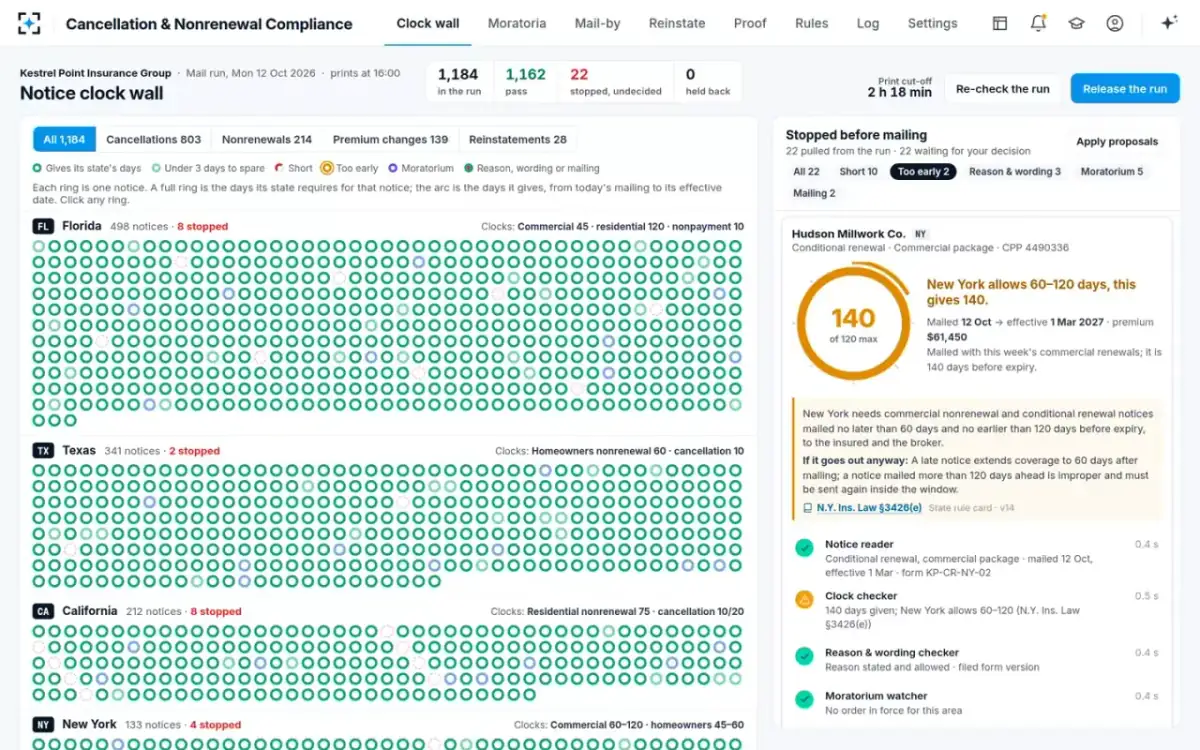
How many days notice to cancel a commercial insurance policy?
In the four states, between ten and 45 days, depending on the state, the ground and the policy's age. Florida requires 45 days' notice for a commercial property or casualty cancellation, ten for nonpayment and 20 in the first 60 days. Texas requires written notice by the 10th day before a liability or commercial property cancellation takes effect, and allows it after the first 60 days only for fraud, nonpayment, an increase in hazard within the insured's control that would raise the rate, or loss of reinsurance, or when the insurer itself is in supervision or receivership; a renewal policy cannot otherwise be cancelled at all. New York requires 20 days in the first 60 and 15 days afterwards, on a listed ground, to the first-named insured and the broker. California's §§676 to 678 do not reach commercial policies.
Conditional renewal notification requirements by state
Each state also regulates renewals on worse terms, under a different name. New York calls it a conditional renewal and gives it the nonrenewal window: for commercial lines it covers reduced limits or coverage, a higher deductible, an added exclusion, or a premium increase of more than ten percent beyond exposure and rating changes. For the personal lines its Subchapter C covers, Texas calls it a material change at renewal and requires a conspicuous, plain-language notice of each change at least 30 days before the renewal date, with separate notice to agents. California requires a renewal offer at least 45 days ahead that identifies each limit reduced or coverage eliminated. Florida requires 45 days' notice of the renewal premium. How those triggers line up, and what a notice should say, is in the conditional renewal notice sample.
Why one company-wide notice rule is wrong somewhere
A carrier that simplifies with a house rule, mailing every nonrenewal a fixed number of days ahead, will find that any single number fails at least one of these four states. Set it at 60 days and Florida residential and California notices are short; set it at 120 and New York personal lines and commercial notices are too early. The comparison shows a 75-day house rule against the statutes.
A 75-day house rule for nonrenewals, against the four statutes
Mail every nonrenewal 75 days ahead: 45 days short
What the statute requires: 120 days; cover runs to 120 days after the late notice
Mail every nonrenewal 75 days ahead: 5 days short
What the statute requires: 75 days plus 5 for mailing; the policy runs 75 days from the late notice
Mail every nonrenewal 75 days ahead: 15 days too early
What the statute requires: No more than 60 days, and no fewer than 45
Mail every nonrenewal 75 days ahead: Passes with 15 days to spare
What the statute requires: 60 days
Mail every nonrenewal 75 days ahead: Passes
What the statute requires: 60 to 120 days
Mail every nonrenewal 75 days ahead: Passes
What the statute requires: 45 days
Building a state notice rule library, as Cancellation & Nonrenewal Compliance keys it
- Key every rule four ways
State, line, notice type and policy age; Florida auto, Florida residential and Florida commercial are three rules.
- Store the minimum and any maximum
New York's windows need both ends; most others need only the floor.
- Store the mailing days
California adds five calendar days in state and ten across state lines; add your own print and post allowance on top.
- Store the consequence
Extension, forced renewal or an unchanged policy for a set period, and at what premium.
- Store the content and copies
Required statements, reason standard, the agent's and mortgagee's copies, and the filed form edition.
- Keep the source text with the rule
The statute's words beside the plain reading, versioned and approved by compliance.
The sample carrier's rule library is at version 14, approved by its compliance analyst on 2 October 2026, and each rule keeps the statute's text beside its plain reading. Cancellation & Nonrenewal Compliance applies it to every notice in the day's run; a carrier writing in other states adds those states' rules, written and approved by its own compliance team. To see the four clocks applied to your own notices, start from Cancellation & Nonrenewal Compliance.
Questions people ask
Which state requires the longest notice for a homeowners nonrenewal?
Of the four large states on this page, Florida: 120 days for a residential nonrenewal under §627.4133(2)(b). California requires 75 days plus five calendar days for a notice mailed within the state, Texas 60, and New York 45 to 60.
Is a notice counted from the day it is mailed or the day it is received?
The statutes here count from mailing or delivery: Texas measures a cancellation from the date the insurer mails the notice, and New York makes proof of mailing sufficient proof of notice. California adds days for mail under Code of Civil Procedure §1013(a), five within the state and ten across state lines.
What happens if an insurer sends a nonrenewal notice late?
The policy does not end on the date in the notice. Florida extends commercial cover to 45 days after the notice at the same premium; Texas requires a personal-lines insurer to renew if the insured asks; California keeps the policy unchanged for 75 days from the notice; New York lets a personal-lines insured renew by paying the premium.
Do cancellation notice rules differ for commercial and personal insurance?
Yes, in every state on this page. Florida, Texas and New York write separate rules for commercial lines, with different days and consequences, and California's residential rules in §§675 to 678 do not apply to commercial policies or to auto insurance.
Can an insurer send a nonrenewal notice too early?
In New York, yes: personal-lines notices may go no more than 60 days before the end of the policy period and commercial notices no more than 120, or the notice falls outside the window the statute sets. Florida, Texas and California set only minimums for the nonrenewals on this page.