The 60 day underwriting period is the first 60 days of a new auto insurance policy, during which the insurer can cancel the policy more freely than it can afterwards, because the state's list of permitted cancellation reasons does not yet apply. It is the insurer's chance to check what the application said, order the reports, and decide whether to keep the risk at the price written. On day 61 that room narrows: the policy can then be cancelled only for the reasons the state's law lists, with the notice it requires. The phrase is industry shorthand rather than a term the statutes on this page use, and the length and the rules differ by state. Auto Premium Leakage Detection is Botminds' software for using that window well: it checks every new auto policy's drivers, garaging, use, mileage, prior insurance and vehicle in its first days, so the underwriter has the evidence long before day 60.
This guide sets out where the 60 days come from, how Texas, Florida and New York handle them, and what an underwriter can and cannot do on either side of the line. It is written for underwriters, agents and policyholders. It describes the statutes; it is not legal advice. Figures describing the solution come from its fictional Georgia sample book.
This section shall not apply to a policy of automobile insurance that has been in effect less than sixty (60) days at the time notice of cancellation is mailed or delivered by the insurer unless the policy has been renewed.
NAIC Model Act #725, §4B
What the 60 day underwriting period means
It means that for a new auto policy's first 60 days, the statutory limits on why an insurer may cancel do not yet bite, so a policy written on wrong facts can still be unwound. The clock starts on the policy's effective date. It counts to the day the cancellation notice is mailed or delivered, not to the day the cancellation takes effect. And it applies only to the first term: once a policy has been renewed, the protection is in place from its first day.
The underwriting period in auto insurance is therefore not the time it takes to approve an application. Personal auto policies are commonly bound at the point of sale, through the agent. The underwriting that matters, checking the household's facts against outside records, happens after the policy is already in force. The 60 days are the time the law gives that work to finish before the carrier's options shrink.
Where the 60 days come from: the NAIC model act
The 60 days come from the NAIC's Automobile Insurance Declination, Termination, and Disclosure Model Act, a template the NAIC offers states for their auto cancellation laws. Its section 4 lists the only reasons on which a notice cancelling an auto policy can be effective, and then exempts policies in effect less than 60 days, as quoted above (Model Act #725).
The model's list after day 60 is short: non-payment of premium; "fraud or material misrepresentation made by or with the knowledge of an insured in obtaining the policy, continuing the policy, or in presenting a claim under the policy"; failure to provide a household driver's record when asked; a suspended or revoked licence or a relevant conviction of a household operator; certain uses or conditions of the vehicle; a move to a state where the insurer is not licensed; unpaid dues where membership is required; and a regulator's determination. A notice must be mailed at least 20 days before the cancellation takes effect, 10 for non-payment, and "shall be accompanied by a written explanation of the specific reasons for the cancellation."
States adopt models in their own words. The comparison below sets the model beside the three states whose current text we read.
The 60-day line in the model act, Texas, Florida and New York
| First 60 days of a new policy | After day 60: is a misstated application a ground? | Notice for a listed ground | |
|---|---|---|---|
| NAIC model act | The list of permitted reasons does not apply | Yes: fraud or material misrepresentation in obtaining the policy | At least 20 days (10 for non-payment), with the specific reasons |
| Texas | The insurer may cancel for any reason | No: the grounds are non-payment, a fraudulent claim, a regulator’s determination, a suspended or revoked licence or registration, or the 12-month anniversary | Effective the 10th day after mailing; 60 days before a 12-month anniversary cancellation |
| Florida | The list of grounds does not apply unless the policy is a renewal | Yes: material misrepresentation or fraud | At least 45 days to the first-named insured and the agent (10 for non-payment), with the reasons |
| New York | A notice must still state the specific reason | Yes: fraud or material misrepresentation in obtaining the policy | In the first 60 days, the specific reason; after them, a listed ground, and a non-payment notice must state the amount due |
Can car insurance cancel after 60 days in Texas?
Yes, but only for the reasons Texas lists, and a misstated application is not one of them. Texas states the window most plainly of the three: "An insurer may cancel a personal automobile insurance policy if the policy has been in effect less than 60 days" (Tex. Ins. Code §551.104(g)), with no list of reasons attached.
After that, an insurer may cancel any policy if the named insured does not pay, if "the insured submits a fraudulent claim", or if the department determines that continuing the policy would break the law. For personal auto it may also cancel if the licence or registration of the named insured or a household operator is suspended or revoked, though not if the named insured agrees to an endorsement removing that person; and it may cancel on any 12-month anniversary of the original effective date with at least 60 days' written notice. Cancellation on any of these grounds, other than the anniversary, takes effect on the 10th day after the notice is mailed.
The practical point for Texas underwriters is stark. A household that hid a teenager, gave a cheaper address or understated its mileage cannot be cancelled for that alone after day 60. The carrier can ask for the premium, can decline to renew on proper notice, and can cancel at the 12-month anniversary, but the leverage it had in the window is gone.
Can car insurance cancel after 60 days in Florida?
Yes, for non-payment, "Material misrepresentation or fraud", or a suspended or revoked licence or registration of the named insured or a household operator. Florida's list of grounds "shall not apply to any policy which has been in effect less than 60 days at the time notice of cancellation is mailed or delivered by the insurer unless it is a renewal policy" (Fla. Stat. §627.728(2)).
Florida's notice is the longest of the three. A cancellation notice must reach the first-named insured and the insured's agent at least 45 days before the effective date, 10 for non-payment, and "no notice of cancellation of a policy to which this section applies shall be effective unless the reason or reasons for cancellation accompany the notice of cancellation" (§627.728(3)(a)). Most cancellation notices must also tell the insured, in prominent words, that they are "permitted by law to appeal this cancellation" (§627.728(7)). A misrepresentation cancellation in Florida after day 60 is therefore possible but slow, and open to appeal.
New York: sixty days, but never without a reason
New York uses the same 60-day line with one difference that matters: even inside the window, a cancellation notice must state the specific reason. Under §3425, during a covered policy's first 60 days no notice of cancellation is effective unless it states or is accompanied by the specific reason or reasons. After 60 days, the permitted grounds include the discovery of fraud or material misrepresentation in obtaining the policy (N.Y. Ins. Law §3425).
New York also counts one kind of misrepresentation separately. Its auto insurers report each year how many policyholders misstated where their cars were garaged, and the premium lost; the form is explained in the misrepresentation New York counts.
Can auto insurance be cancelled at any time?
Not by the insurer, once the first 60 days have passed: from then on, a cancellation must rest on a reason the state lists and come with the notice it requires. The policyholder is different. A household can generally cancel its own policy whenever it chooses, subject to the policy's refund terms. And an insurer that does not want to keep a policy past its term can decline to renew it, which is governed by separate notice rules: 30 days in the model act, 45 days in Florida, and 60 days before expiry in Texas.
The timing rules for notices, by state, are their own discipline, and a carrier sending thousands a year needs them checked notice by notice; that is the job of Botminds' Cancellation and Nonrenewal Compliance. This page is about the window before any notice is needed.
Day 59 against day 61: what an underwriter can still do
On day 59 an underwriter who finds a wrong rating fact can ask, correct, or, if the household refuses, decline to keep the risk. On day 61 the first two are still available; the third depends on the state's list. That is the whole difference, and it shifts every conversation that follows.
The same finding, one day either side of the line
Day 59: Yes, with the evidence and a reply date.
Day 61: Yes, the same way.
Day 59: Yes, by endorsement, if the household agrees.
Day 61: Yes, by endorsement, if the household agrees.
Day 59: The carrier can cancel, with the state’s notice for new policies.
Day 61: Only on a listed ground: misrepresentation in Florida, New York and the model act; not in Texas.
Day 59: Days.
Day 61: Weeks: a longer notice, and in Florida an appeal right.
Day 59: Still an underwriting question if the finding is already on file.
Day 61: Increasingly a coverage question, argued with a claimant.
Correction is available on both sides because a premium change is not a cancellation. What changes is the carrier's position if the household disagrees. Inside the window, a carrier can say, in effect, that it would not have written the policy at this price and will not keep it. Outside it, the carrier may have to keep a risk it misprices until a proper termination point, or prove misrepresentation to a regulator's standard.
Cancelling is not correcting: premium changes on either side of day 60
The 60-day rules limit cancellation, not correction. A premium change by endorsement, agreed with the household, is governed by the policy's terms and the carrier's filed rules on either side of day 60. Whether a correction may reach back to the effective date or only run forward from the day it is made is a question for those terms and for the carrier's compliance team, not for the cancellation statute.
Two obligations follow a correction wherever it falls. If the increase rests in whole or in part on a consumer report, such as a household driver report, the insured is owed a notice naming the reporting company, stating that it did not make the decision, and setting out the right to a free copy within 60 days and to dispute the report (FCRA §615(a)). And the correction should be signed by someone with the authority to sign it. Who signs what, from the agency to compliance, is covered in the auto underwriter's job, signature by signature.
Before day 60 on every new auto policy
- Order the reports in the first days, not the first weeks
Household driver report, driving records, prior-carrier report, registration and odometer data.
- Compare every declared fact, not a sample
The policy you do not check keeps its wrong facts past day 60.
- Ask the agency with a reply clock
Ten days leaves room for a reminder and a letter to the insured before the window closes.
- Price the difference under the filed plan
So the conversation is about a number, not a suspicion.
- Decide, and sign, inside the window
A finding still open on day 61 has lost the carrier’s strongest option.
- Never cancel on a finding alone
A cancellation or rescission should need the underwriting manager and compliance, with the reasons the state requires.
Using the window: how Auto Premium Leakage Detection counts the days
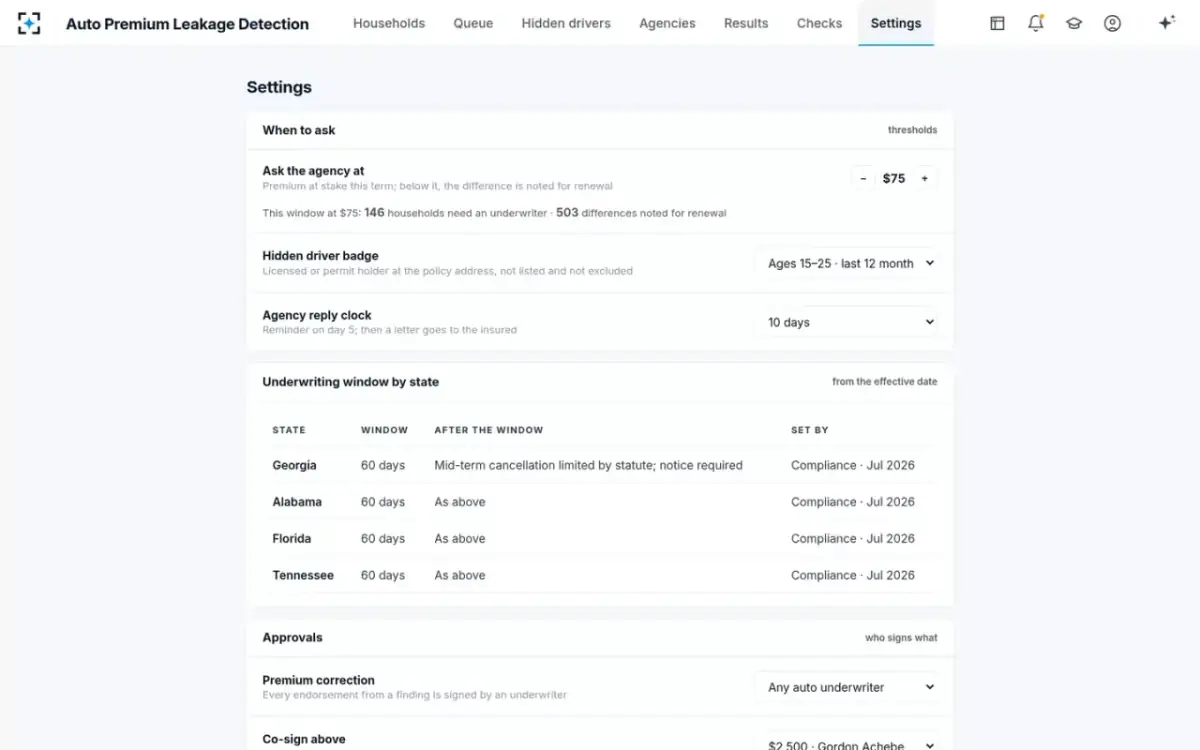
The solution treats the window as a setting and every policy's day count as part of the screen. Compliance sets the window for each state; on the sample book it is 60 days for Georgia, Alabama, Florida and Tennessee, entered by compliance in July 2026. Every household screen shows the policy's day of its window, and the queue sorts by premium at stake, so the largest differences with the least time left come first.
The underwriting window by state, set by compliance
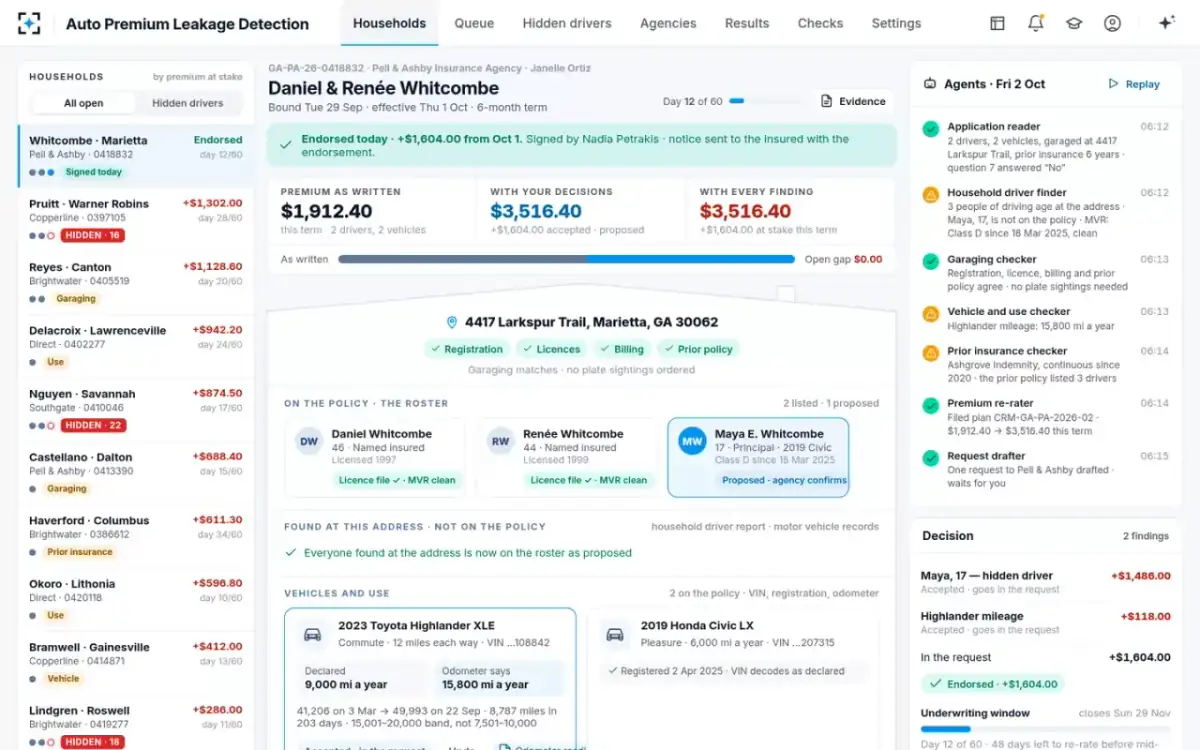
On the sample book, the agents found 90% of all differences by day 5. One sample household shows what that buys. The policy took effect on 1 October; the agents found a hidden 17-year-old driver and understated mileage on day 2; the underwriter sent the request on day 12, the agency confirmed the same afternoon, and the endorsement was signed with 48 days of the window still to run.
One sample policy: signed on day 12, with 48 days of the window left
- Checked, asked, signedDays 1–12
- Window still open after signing48 days
Endorsed on day 12 of 60
For what each day of that window is worth in premium, see what premium leakage is; for the solution itself, Auto Premium Leakage Detection.
Questions people ask
My car insurance was cancelled within 60 days of purchase. Is that allowed?
Often, yes: under the NAIC model act and in Texas and Florida, the list of permitted reasons does not apply in a new policy's first 60 days. Notice rules still apply, and in New York the notice must state the specific reason even in that period.
Can car insurance be cancelled within 60 days in Texas for any reason?
Texas law says an insurer "may cancel a personal automobile insurance policy if the policy has been in effect less than 60 days", without listing reasons. After that, only the grounds in §551.104 apply.
Does the 60-day underwriting period start again at renewal?
No. The model act exempts only policies in effect less than 60 days "unless the policy has been renewed", and Florida's carve-out likewise excludes renewal policies, so a renewed policy carries the full protection from its first day.
Is the underwriting period 60 days in every state?
No single rule covers every state, and we have not checked all of them. The model act and the three states on this page use 60 days; a carrier's compliance team should confirm each state's own statute and set the window accordingly.
Does my insurer have to tell me why it cancelled my policy?
For a cancellation on a listed ground, generally yes: the model act requires a written explanation of the specific reasons, and Florida makes a notice ineffective without them. New York requires the specific reason even during the first 60 days.
What happens if a misstatement is found after day 60?
The insurer can still ask the household to correct the premium. If the household refuses, cancellation depends on the state: Florida, New York and the model act list material misrepresentation as a ground, while Texas's list does not.