Premium leakage in insurance is the gap between the premium a policy should carry under the insurer's own filed rates and the premium it actually carries, because a fact used to rate it was wrong or missing when it was written. In personal auto the facts are few and familiar: who drives, where the cars are garaged overnight, what they are used for, how far they go, whether the household had continuous prior insurance, and which vehicle it is. When an application leaves out a licensed teenager or gives a cheaper garaging address, the policy is rated on it and the premium is short for as long as nobody checks. Auto Premium Leakage Detection is Botminds' software for that check: specialist agents compare every new policy's declared facts with outside reports in its first days, re-rate any difference under the filed plan, and leave the decision and the signature with the underwriter.
The definition is simple; the economics are not. Leakage is not a fixed amount that sits on the book waiting to be collected. Its value falls with every day it goes unfound, because a new auto policy gives the insurer its widest room to act in its first 60 days. The figures on this page that describe the solution come from its fictional Georgia sample book, 6,412 new policies written by an invented carrier and its agencies; none is a customer's result.
Premium leakage on a sample book of new auto policies
12.7%
of new households had a rating fact that differed from the outside reports
814 of 6,412, fictional sample book
6
rating facts where it hides: drivers, garaging, use, mileage, prior insurance, vehicle
60days
the NAIC model act’s window before listed-reason rules apply
90%
of the differences found by day 5 when every policy is checked
sample book
What counts as premium leakage, and what does not
Premium leakage is a rating error the insurer did not choose. It is measured against the insurer's own rating plan, not against what a competitor charges or what an actuary thinks the rate should be. If a filed plan prices a 17-year-old principal operator at a factor of 2.31 and the household has one that the application left off, the shortfall is leakage. If the plan itself is inadequate, that is a rate adequacy question for the actuaries, and it belongs in the next rate filing, not in an underwriting correction.
Three things look like leakage and are not. A discount the plan allows and the household qualifies for is not leakage, even if it costs premium. A fact that changed after bind, such as a teenager who earns a licence in month four, is a mid-term change the policy's own terms handle. And a difference between the premium and the expected loss for one household is ordinary insurance: pricing works on groups, not on one driver's luck. Leakage is narrower: the facts the plan asks for were stated wrongly at the start.
That narrowness matters for how leakage is found and how it is corrected. Because the measure is the filed plan, a correction is a re-rate under the plan in force on the policy's effective date, not a judgement call. Examiners hold carriers to the same standard. The NAIC's examination standards ask whether "the rates charged for the policy coverage are in accordance with filed rates (if applicable) or the regulated entity’s rating plan". A premium that rests on a wrong declaration fails that test in substance, even when the file looks complete.
Six rating facts where auto premium leaks
Auto premium leaks through the rating facts that the applicant supplies and the insurer does not observe. Driving records and claims history come from reports the insurer orders, so they leak less. The facts below are stated by the household and believed until something contradicts them.
Where personal auto premium leaks, fact by fact
| Rating fact | What the application says | How it goes wrong | What usually contradicts it |
|---|---|---|---|
| Drivers | Every licensed person or permit holder in the household | A newly licensed teenager or a returning adult child is left off | Household driver report, motor vehicle record, the prior policy’s driver list |
| Garaging | The address where the cars sleep | A cheaper address: a relative’s home, a former address, another state | Registration, licence address, billing address, the prior policy |
| Use | Pleasure, commute or business | Business or delivery driving called commuting | Registered owner and class, commercial signs on the registration |
| Mileage | Estimated miles a year | An estimate well below what the car is driven | Two dated odometer readings: service, inspection, title transfer |
| Prior insurance | Years of continuous cover and prior limits | A lapse not mentioned, or lower prior limits | Prior-carrier report and claims history |
| Vehicle | Year, make, model, trim | A higher-rated trim or engine recorded as the base model | VIN decode |
Actuaries have long recognised that some of these facts are hard to verify. The Casualty Actuarial Society's ratemaking text makes the point about mileage directly: "asking a personal auto policyholder to declare estimated annual miles provides more opportunity for dishonesty than the use of car-years. This circumstance is referred to as moral hazard" (Basic Ratemaking). The same logic applies to every self-declared fact. The household knows the truth; the insurer has the declaration.
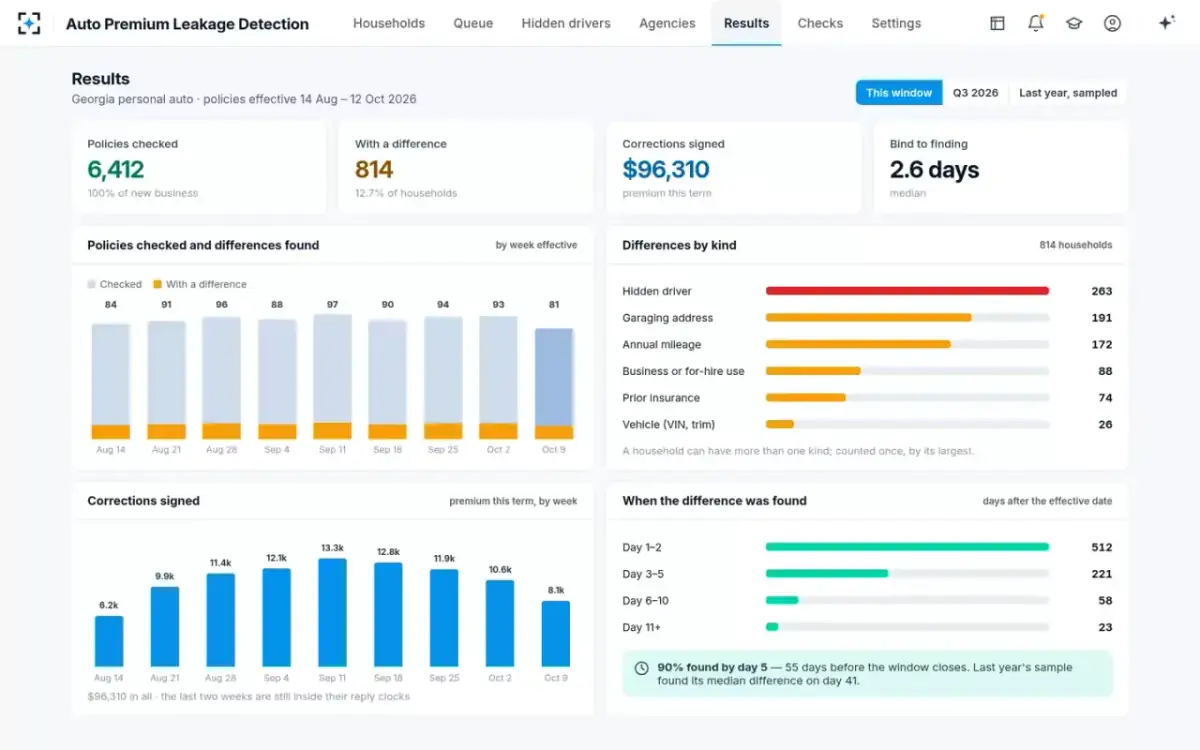
On the sample book the six facts did not leak equally. Hidden drivers were the largest kind, then garaging and mileage; prior insurance and vehicle identity were smaller.
On the sample book, drivers, garaging and mileage made up most differences
Why personal auto leaks where audited lines do not
Personal auto has no end-of-term true-up, so a wrong declaration stays wrong until someone checks it. Lines rated on payroll or sales are estimated at the start and audited at the end; the CAS text notes that "premium for lines of business subject to premium audits will continue to develop after the end of the policy year period" (Basic Ratemaking). The workers compensation premium on a misstated payroll is corrected by the audit. The auto premium on a misstated household is not corrected by anything except an underwriting review.
That review has traditionally been sampled. Household driver reports, motor vehicle records, prior-carrier reports and odometer data cost money and underwriter time, so a team orders them on a share of new business and trusts the rest. A sample is a good way to estimate how much leakage a book carries. It is a poor way to correct it, because the policies outside the sample keep their wrong facts.
Examiners expect timing as well as accuracy. Among the NAIC's property and casualty underwriting standards is that "underwriting, rating and classification are based on adequate information developed at or near inception of the coverage rather than near expiration, or following a claim" (examination standards). Leakage found at a claim is exactly what that standard warns against: a fact developed after a loss, used to change the terms.
Is there an insurance premium leakage rate anyone publishes?
No regulator or research body we found publishes an auto premium leakage rate. The prevalence figures quoted in the trade come from data vendors, and we found no independent measurement behind them. A carrier that wants its own rate has to measure it on its own book.
The closest thing to a public measure covers one kind of leakage in one state. New York's Department of Financial Services collects data every year on policyholders who misstate where their vehicles are garaged. Insurers report the number of such policyholders by county and the premium lost, on a ten-item form whose lines include "the total amount of premium lost due to misrepresentations pertaining to the principal place where motor vehicles were garaged and/or driven" (New York DFS). The form shows what a carrier must be able to count. Its items are explained in the misrepresentation New York counts.
For an internal leakage rate, two definitions are useful and they answer different questions. The share of new households with any difference (12.7% on the sample book) tells you how often the application is wrong. The premium corrected per policy checked tells you what it is worth: on the sample book, $96,310 of corrections signed this term across 6,412 policies is about $15 a policy, our arithmetic, with the last two weeks' requests still inside their reply clocks. A leakage rate quoted without saying which of the two it is cannot be compared with anything.
The third number matters most for the economics: how much of the leakage was found while it could still be acted on. That is the subject of the rest of this page. How to measure the first two honestly, with known errors planted in closed files, is the subject of the premium leakage test.
Where the days go between bind and a finding
When review is sampled, most of the delay is waiting to be picked. The solution's own modelled split for one household with a finding, built on its sample book, puts the median finding on day 41 when new business is sampled by hand. Thirty-two of those 41 days pass before anyone looks at the policy; ordering and reading the reports take six; matching people, vehicles and mileage to the application takes three.
Most of the 41 days was waiting to be picked, not checking
Sampled by hand · 41 days to a finding
- Waiting to be picked · 78%
- Reports · 15%
- Matching · 7%
Every policy checked · 2.6 days to a finding
- Reports · 38%
- Matching · 62%
The waiting is not anyone's fault. It is what a sample does: the policy that is not picked this week waits for next week or never. Checking every policy removes the 32 days outright, and the work that remains is quicker because reading and matching are done before an underwriter opens the file. On the sample book the median from bind to finding fell to 2.6 days, and 733 of the 814 differences, 90%, were found by day 5.
When each difference was found, on the sample book
What does a day of delay cost on one policy?
A day of delay costs the policy's daily shortfall wherever a correction runs only from the day it is signed, and it costs options everywhere. Whether a mid-term correction can reach back to inception depends on the policy wording, the filed rules and the state; that choice belongs to the carrier's compliance team, and the solution treats it as a setting. The arithmetic below prices the days for the case where the correction runs forward.
Take one sample household. Daniel and Renée Whitcombe of Marietta, Georgia, bound a six-month policy effective 1 October. Their application said no other licensed drivers lived at the address; a 17-year-old daughter, licensed 19 months, did, and one of their cars was driven about 15,800 miles a year against 9,000 declared. Re-rated under the carrier's filed plan, the term premium moves from $1,912.40 to $3,516.40: $1,604.00 over a 182-day term, or $8.81 a day.
Fifty days against seven: one policy's window, each day priced
- Waiting to be picked32 d · $282
- Reports and matching9 d · $79
- Re-rate, reply, sign9 d · $79
- All steps7.1 d
On this one household, the sampled process costs about $441 of premium that a forward-only correction can never collect, against about $63 when every policy is checked. Across a book the sum depends on how many households carry a difference and how large each is, which is why the share found early matters more than any single figure. In the sample itself the correction ran from inception, so the money was not the issue on day 12. The issue was the clock that governs what the carrier can do if the household disagrees.
Why day 61 changes the arithmetic
After a new auto policy's first 60 days, an insurer can cancel only for reasons the statute lists, so a dispute about a wrong declaration becomes harder to resolve. The NAIC's model act lists the permitted reasons for cancelling an auto policy and exempts from that list a new policy in its first 60 days, counted to the day the notice is mailed or delivered, unless the policy has been renewed (Model Act #725, §4B).
States that use the 60-day line do not all list the same reasons afterwards. Florida keeps material misrepresentation and fraud among its grounds (§627.728). Texas lets an insurer cancel a personal auto policy freely during its first 60 days, but its later grounds are non-payment, a fraudulent claim, a regulator's determination and a suspended or revoked licence or registration, with a cancellation on the 12-month anniversary on 60 days' notice (§551.104). A misstated application is not on the Texas list. The day-by-day comparison of those rules is in what changes on day 61.
None of this stops a correction after day 60. A household that agrees to add a driver can be endorsed on day 90. What changes is the carrier's position when the household does not agree. Inside the window, the carrier can decline to keep a risk it would not have written; outside it, the remaining routes are narrower, slower and state-specific. That is why the useful leakage rate is not the share of policies with a difference but the share found inside the window.
Underwriting leakage versus claims leakage
Underwriting leakage is premium not charged; claims leakage is money paid that should not have been. The two are measured differently. Claims leakage is usually estimated by re-reviewing closed claim files against the carrier's own claim standards. Premium leakage is estimated by re-rating policies on verified facts. The word "leakage" covers both in industry use, and a search for what leakage in insurance means will turn up both.
They meet at the claim. A hidden driver who crashes turns an underwriting question into a coverage question, asked at the worst moment and under the most scrutiny. The NAIC's examination standards say rescissions are limited to material misrepresentation, and a carrier that discovers the teenager only from the police report is arguing about materiality with a claimant, not about premium with an agent. Finding the fact on day 2 keeps it an underwriting question.
Measuring leakage inside the window with Auto Premium Leakage Detection
The solution exists to move leakage from the claim file to the first days of the policy. Seven specialist agents divide the work: an application reader lists every rating fact as declared, with the question each came from; a household driver finder, a garaging checker, a vehicle and use checker and a prior insurance checker compare those facts with the reports the carrier already buys; a premium re-rater prices every difference under the filed plan in force on the effective date; and a request drafter writes one request to the agency and the adverse action notice. None of them changes a policy or contacts a household. An underwriter decides and signs.
The new business queue: every policy effective in the last 60 days, by premium at stake
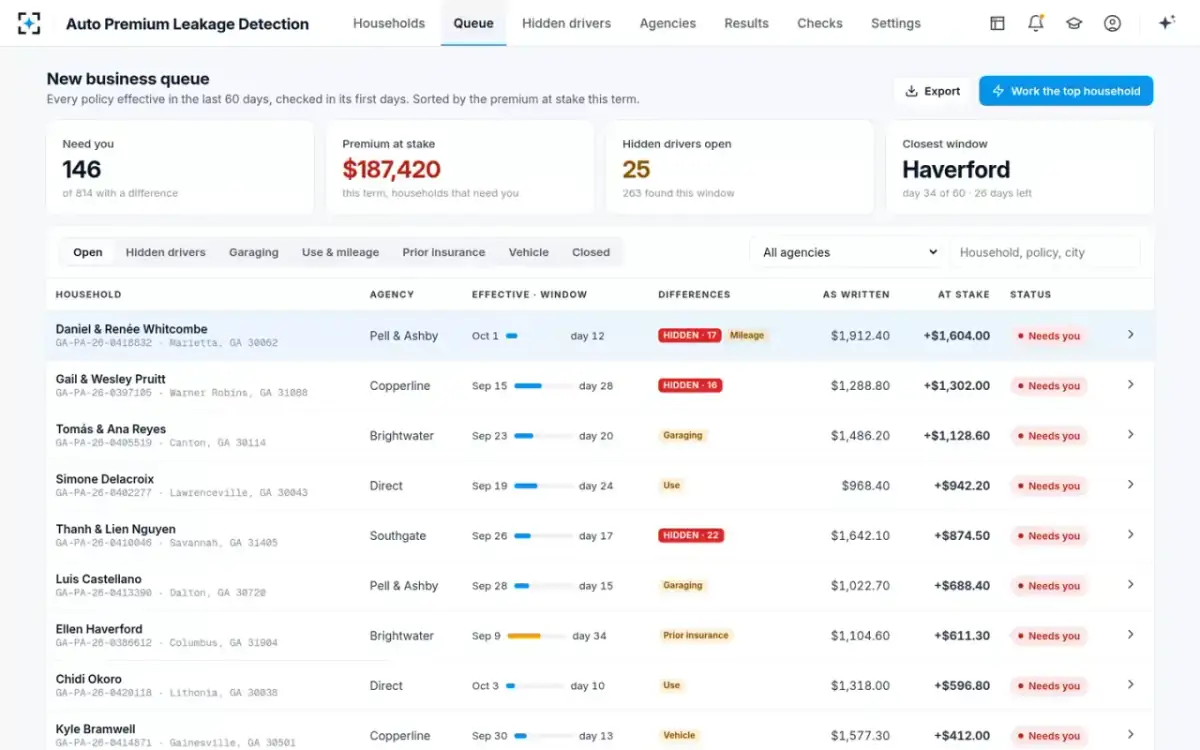
Three settings decide how leakage turns into premium. The ask threshold ($75 a term on the sample book) decides which differences are worth an agency's time; smaller ones are noted for renewal. The reply clock (10 days) decides how long the agency has. The underwriting window by state is set by compliance, not by the software. The design target is that every new policy is checked in its first days, not a sample, and it is a target, not a measured result. How the agents handle a household report without turning it into an accusation is explained in how insurers know who lives with you; the whole solution is at Auto Premium Leakage Detection.
Questions people ask
What is premium leakage in insurance, in one sentence?
It is premium the insurer's own filed rates say a policy should carry but does not, because a rating fact such as a driver, a garaging address or mileage was wrong or missing at the start. It is measured against the carrier's rating plan, not against the market.
What is premium leakage in auto insurance specifically?
In personal auto it is usually a household driver left off, a cheaper garaging address, business use called commuting, understated mileage, an unmentioned lapse in prior cover or a misdescribed vehicle. On the solution's fictional sample book, 12.7% of new households had at least one such difference.
Is premium leakage the same as fraud?
Not necessarily. Many omissions are honest, such as parents who do not think of a newly licensed teenager as a driver yet. A state may treat some misstatements as crimes, such as California's rule against claiming residence in the state to obtain motor vehicle insurance when you live elsewhere, but leakage is the rating effect, whatever the intent.
How do you calculate an auto premium leakage rate?
Re-rate a set of new policies on verified facts under the plan in force on each effective date, then report two numbers: the share of policies with any difference, and the premium difference per policy checked. Add a third, the share found inside the first 60 days, because that is the share the carrier can still act on fully.
What is underwriting leakage in insurance?
It is another name for premium leakage: the premium lost to rating facts the underwriting process did not catch. It is distinct from claims leakage, which is overpayment on claims, though the two meet when an undisclosed driver has an accident.
Why does premium leakage matter to regulators?
Examiners test that the rates charged follow the filed rating plan and that underwriting rests on information developed at or near inception rather than after a claim. A book where wrong declarations are found only at claim time strains both standards.