An undisclosed driver discovery tool compares the people associated with a policy's garaging address, from household reports and driving records, with the drivers listed or excluded on the auto policy, and flags anyone licensed who is neither. The way to choose one is not a demonstration on someone else's data. It is a 30-day pilot on your own new business: about two weeks replaying last quarter's closed policies, where the answers are known, then two weeks running beside your underwriters on live policies, then a decision against pass marks you fixed before day 1. Auto Premium Leakage Detection is Botminds' software for this work: its household driver finder orders the household driver report and motor vehicle records for the garaging address, matches each person of driving age to the roster, and passes any gap to a re-rater and a request drafter, with an underwriter deciding every outcome.
This buyer's guide is for personal auto underwriting leaders, IT and compliance teams who have a shortlist. It covers what to measure, how to run the weeks, and the compliance questions any tool must answer. Figures about the solution are from its fictional Georgia sample book, not from a customer.
Five pass marks to fix before the pilot starts
| Pass mark | What it measures | How the pilot measures it | Who sets the bar |
|---|---|---|---|
| Recall | Share of real hidden drivers the tool finds | Replay closed policies whose answer is known, and plant some, by age band | Underwriting |
| False alarms | Share of flagged people who are not household drivers | Count closures as “not a household driver” in the live weeks | Underwriting and agency management |
| Speed | Days from the effective date to a finding | Median, replayed and live, against the 60-day window | Underwriting |
| Agency load | Requests per agency and median reply time | Every request sent in the live weeks, by producing agency | Agency management |
| Notices | Share of report-based increases with an adverse action notice | Every endorsement in the live weeks | Compliance; anything below every one fails |
What a driver discovery tool does, and what it cannot know
A driver discovery tool finds people the records associate with an address and checks whether the policy accounts for them. It cannot know whether a person lives there now, drives the insured cars, or was honestly forgotten. Household reports carry adult children who moved out, students living elsewhere and former residents. A licence proves someone can drive, not where. So the tool's output is a list of questions, and its quality is how good those questions are: how many of them are right, how few are wrong, and how much evidence each carries.
That is why the pass marks above include false alarms and notices alongside recall. A tool that flags every person in every household report will score perfectly on recall and generate an agency complaint per policy. A tool that re-rates on a flag will produce premium and, sooner or later, a regulator's question. How a careful process turns a flag into a question is set out in how insurers know who lives with you.
What is driver discovery in insurance?
Driver discovery is the process of finding licensed household members who are missing from an auto policy, usually after bind, so the policy can be corrected or the person excluded. The phrase appears in some data products' names, but the work is generic: order reports tied to the address, match people to the roster, and resolve the differences with the agency and the household.
It sits inside a broader trend in personal auto. In an NAIC survey of private passenger auto insurers, "approximately 88% of the companies responding to the PPA Survey reported they currently use, plan to use, or plan to explore using AI/machine learning (ML)" (NAIC). The figure comes from a 2023 NAIC memo that set its homeowners survey beside the earlier auto survey, so it shows direction rather than today's level. Driver discovery is one of the places that use shows up first, because it is narrow, measurable and close to premium.
Driver discovery service or tool: buying data versus buying decisions
A driver discovery service sells you records: who the reporting company associates with an address. A driver discovery tool, in the sense this guide uses, sells you a finished question, with the records read, the people matched, the difference priced and the request drafted. Most carriers need both. The data comes from consumer reporting companies; the tool decides what to do with it.
A data service and a discovery tool, side by side
A driver discovery data service: A list of people linked to the address.
A discovery tool that ends in a decision: A proposed roster change, priced, with its evidence and a draft request.
A driver discovery data service: Left to the underwriter.
A discovery tool that ends in a decision: Each person matched to listed and excluded drivers, licence and prior policy.
A driver discovery data service: None.
A discovery tool that ends in a decision: Re-rated under your filed plan in force on the effective date.
A driver discovery data service: Not addressed.
A discovery tool that ends in a decision: A request to the agency with a reply clock, and the adverse action notice drafted.
A driver discovery data service: Everything after the list.
A discovery tool that ends in a decision: The decision and the signature.
Days 1 to 15: set up, then replay last quarter's new business
The first half of the pilot answers one question: on files where you already know the answer, does the tool find what your team found, and more, without inventing what is not there? Set-up takes the first days: read-only access to the policy system, the filed rating plans by state, the report sources you already buy, and the carrier's settings for the ask threshold, reply clock and approvers.
A 30-day pilot on your own new business
- Set upDays 1–5
- Replay last quarterDays 6–15
- Run live, then decideDays 16–30
Then replay. Take last quarter's closed new business, including the files your team corrected and a sample it never looked at. The corrected files give known positives; adding planted cases, such as a licensed teenager removed from an application, fills gaps by age band. Use the reports already obtained for those policies where you can: the FCRA permits obtaining a consumer report to underwrite insurance for the consumer (FCRA §604), and a pilot replay is a different purpose. Take advice before ordering fresh reports for it. The full method for planted errors, including how many to plant, is in the premium leakage test.
Days 16 to 30: run beside the underwriters, then decide
The live half answers the questions a replay cannot: how agencies respond, how fast, and how often a plausible flag turns out to be wrong. Run the tool on every new policy as it comes in, let underwriters work its findings through the normal process, and count everything: requests sent, replies, closures as not a household driver, exclusions signed, endorsements, notices.
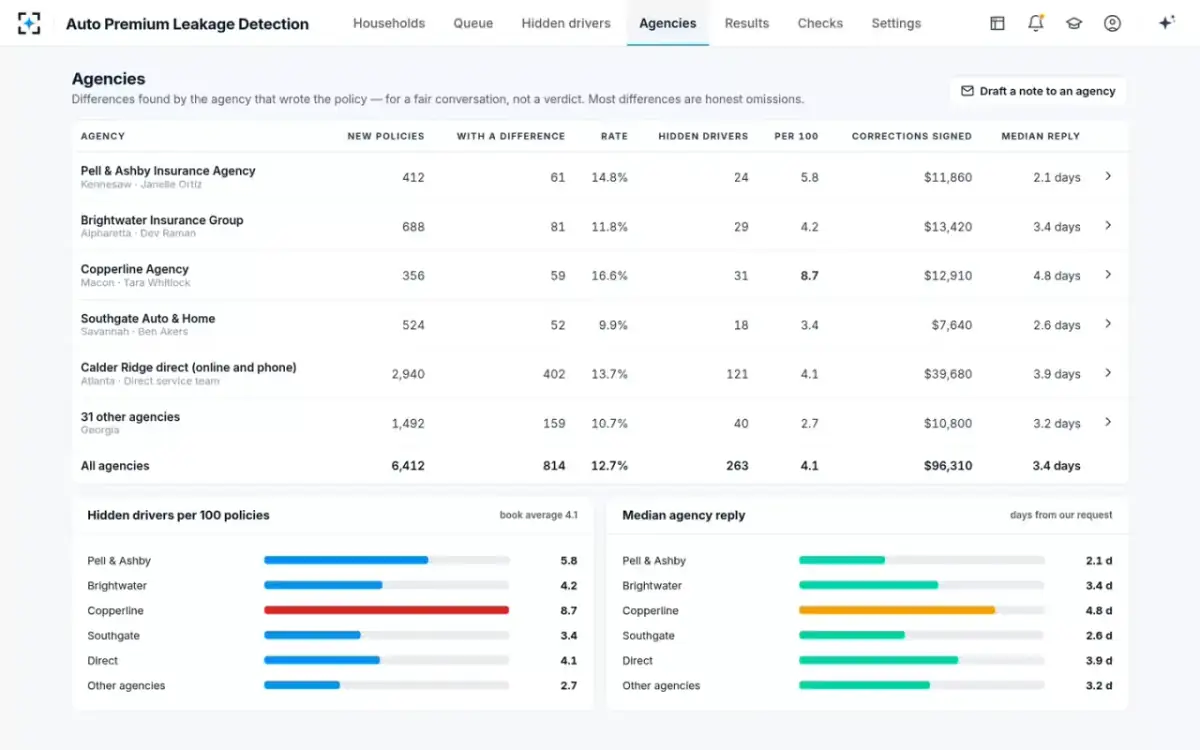
Agency patterns appear quickly and are among the most useful outputs. On the solution's sample book, hidden drivers ran from 2.7 per 100 new policies at the smaller agencies to 8.7 at one agency, against a book average of 4.1, and median replies ranged from 2.1 to 4.8 days.
Hidden drivers per 100 new policies, by producing agency, on the sample book
Differences by producing agency: a conversation, not a verdict
The undisclosed driver discovery process, from report to signed endorsement
Whatever tool you choose, the process it supports should run in the same order: report, match, price, ask, reply, decide, sign, notify. A pilot should test that the tool supports every step and skips none. In the solution, agents do the first three and draft the fourth; people do the rest.
One sample household shows the timings. The policy took effect on 1 October. At 06:12 on day 2 the household driver finder placed a 17-year-old with a licence at the address; her driving record, the prior policy's driver list and the registration of a second car two weeks after her licence backed it. The re-rater priced her as principal operator at +$1,486.00 for the six-month term. On day 12 the underwriter sent one request to the agency, which replied that afternoon with a change form signed by both parents. She signed the endorsement, and the adverse action notice went with it.
The last step is easy to under-specify. When an increase rests in whole or in part on a consumer report, the notice must name the reporting company, say that the company did not make the decision and cannot give its reasons, and set out the consumer's rights to a free copy and to dispute (FCRA §615(a); the full notice is set out in how car insurance companies know who lives with you). A pilot that counts endorsements without counting notices has not tested the process.
Compliance questions any driver discovery tool must answer
Every tool on a shortlist should answer the same compliance questions, in writing, before the pilot. Two regulators' texts frame them. New York's 2024 circular letter on external consumer data and AI expects insurers to oversee their vendors and leaves the insurer answerable for what a vendor's data or model produces (NY DFS Circular Letter 7). Colorado's amended Regulation 10-1-1, which governs insurers' use of external consumer data and algorithms, has applied to private passenger auto insurers since 15 October 2025 (Colorado Division of Insurance).
Questions for every driver discovery tool on the shortlist
- What is the permissible purpose for each report it orders?
Underwriting the consumer’s own policy, and nothing else. Who orders, under whose account?
- Does every finding show its sources and dates?
An underwriter, an agency, the household and an examiner should all see why the person was flagged.
- Does it ever re-rate, send or cancel on its own?
It should not. A flag is a question; a person decides.
- Does it handle exclusions as your states require?
Texas, for one, allows a named driver exclusion only if it names each driver and the named insured accepts it in writing.
- Does it draft the adverse action notice from the reports actually used?
And does it leave out any finding the underwriter dismissed?
- Can you switch each source off and replay a week?
Governance means being able to change the tool and see the effect before it reaches a household.
- What does it keep, for how long, and who can see it?
Reports ordered for underwriting should stay with the policy, used for underwriting only.
Where Auto Premium Leakage Detection fits in a driver discovery program, and where it does not
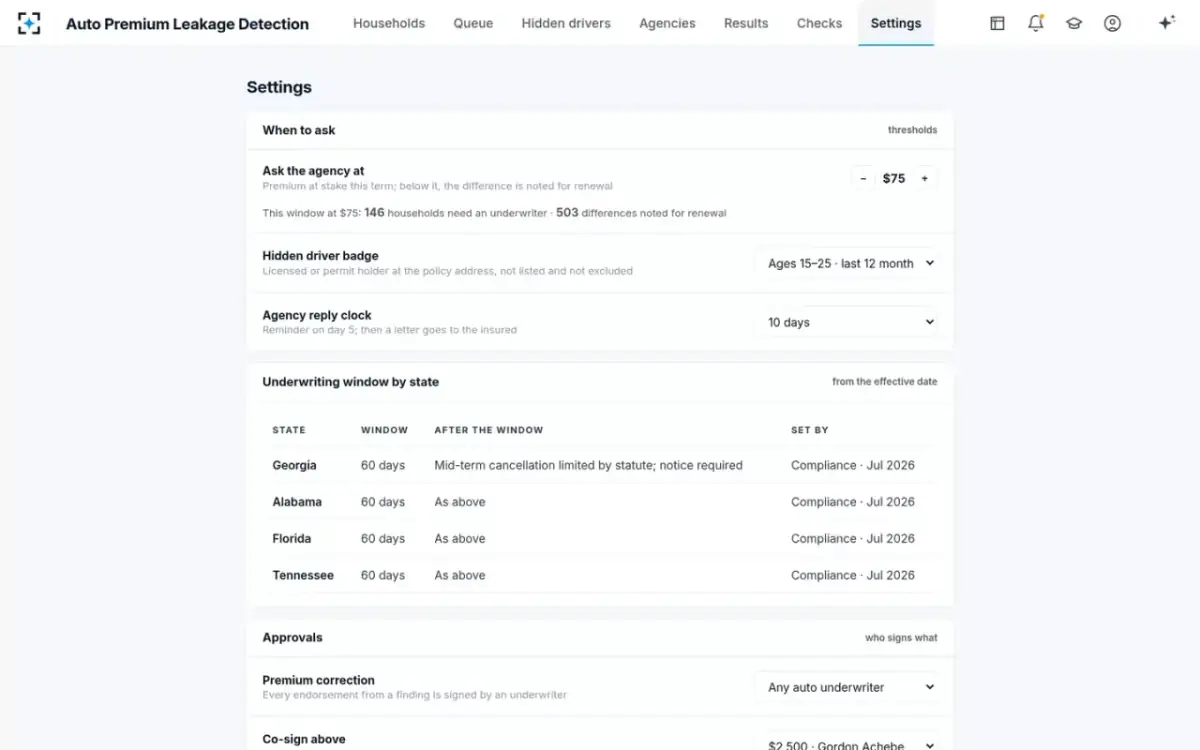
The solution fits after bind, on every new policy, between the reports a carrier buys and the underwriter who decides. It reads the application and the policy system without writing to either, orders the household driver report and motor vehicle records for underwriting only, matches people to the roster, prices the gap under the filed plan, and drafts one request and the notice. Its hidden driver badge is set by default to licensed people or permit holders aged 15 to 25 at the address in the last 12 months, and a carrier can change both.
The carrier's rules for when to ask, how long to wait and who signs
It does not fit everywhere. It is not a data provider and does not replace the consumer reporting companies a carrier contracts with. It is not a telematics programme and does not track where cars go; plate sightings are ordered only when addresses disagree, and reported as shares by ZIP code. It does not decide fraud. And connecting it to a carrier's own policy system and report sources is part of set-up, which is why those days are on the timeline.
The sample book gives a sense of scale, not a promise: 263 hidden drivers among 6,412 new policies in one 60-day window, 171 of them added, 38 excluded by signed form, 29 closed as not household drivers and 25 still open, with $61,840 a term added from those added. A pilot exists to replace those numbers with yours. To request a pilot, start at Auto Premium Leakage Detection.
Questions people ask
What is an undisclosed driver report?
A consumer report listing people a reporting company associates with an address, used by insurers to find licensed household members missing from a policy. Because it is a consumer report, a premium increase based on it carries an FCRA adverse action notice.
How long should a driver discovery pilot run?
About 30 days is enough to replay a quarter of closed new business and then run two weeks on live policies. Shorter pilots usually drop the live weeks, which are the only way to measure agency replies and false alarms.
What data does a driver discovery tool need?
Read access to applications and policies, the household driver reports and motor vehicle records the carrier already buys, prior-carrier reports, registrations, and the filed rating plan by state. Without the rating plan it can flag a person but cannot price the difference.
Does a driver discovery tool contact policyholders?
A well-governed one should not. In the solution, agents never contact a household or send a request; the underwriter sends one request to the agency, and the insured hears from the carrier only if the agency does not reply within the reply clock.
Can the same tool check renewals?
The same matching works at renewal, but the stakes differ: a renewal is not inside a new policy's first 60 days. On the sample book, differences below the $75 ask threshold were noted for the renewal review rather than raised mid-term.
What should happen at the end of the pilot?
A decision against the pass marks written down before day 1: recall, false alarms, speed, agency load and notices. If one is missed, the useful question is whether a setting, a source or the process caused it, which the replayed weeks can test.