Rate evasion, in insurance, is misstating where a vehicle is garaged or mainly driven in order to pay a lower auto premium: a relative's address in a cheaper county, a former home, or a state where cover costs less. It is a misrepresentation of a single rating fact, the place the car sleeps, and New York is the state that counts it. Its Department of Financial Services requires auto insurers to report every year how many policyholders misstated their garaging location, where they really kept the car, which place they claimed, and how much premium the insurer lost. Auto Premium Leakage Detection is Botminds' software for checking that fact and five others on every new auto policy in its first days, comparing the garaging address with registration, licence, billing and the prior policy, and putting any difference in front of an underwriter with the evidence.
This page explains why the address matters to the price, what New York's form asks for line by line, how a carrier tells an honest move from a misstatement, and what the law says about lying on the address. It is written for underwriting and compliance teams; it is not legal advice. Figures about the solution come from its fictional Georgia sample book.
The Department collects and reports data concerning New Yorkers who misrepresent where their vehicles are garaged and/or driven in order to obtain a lower insurance premiums.
New York Department of Financial Services, Rate Evasion Form instructions
What is rate evasion?
Rate evasion is a false statement about the principal place a vehicle is garaged or driven, made to get a lower rate. New York's form frames it exactly that way: it counts insureds "who misrepresented the principal place where their motor vehicles were garaged and/or driven", once for locations inside the state and once for locations outside it (New York DFS). The misstatement is about place, not about who drives or how far.
The term covers two patterns that look alike on an application. In-state evasion uses a cheaper county or ZIP code in the same state, often a parent's or friend's address. Out-of-state evasion registers or insures the car in another state while it lives in the insured's real home state. Both are rating errors; the second can also break a state's registration and residency rules.
Rate evasion is one kind of premium leakage. On the solution's sample book, garaging differences, which include honest moves as well as evasion, were the second largest kind: 191 of 814 households with a difference had a garaging address that disagreed with the other records. The largest kind, hidden drivers, is covered in how insurers know who lives with you.
Why the garaging address moves the premium
Auto rates vary by territory because claim frequency and severity vary by place, and the territory is set by where the vehicle is garaged. California's regulation states it plainly: the rating factors for relative claims frequency and relative claims severity "shall reflect where the insured vehicle is garaged", grouped into bands of ZIP codes or census tracts with similar claims experience (10 CCR §2632.5(d)(14)–(15)). Move the declared address one band and every liability and physical damage coverage on the car is re-priced.
The law treats location as something to price, not to punish. The NAIC's model act prohibits declining or terminating an auto policy "based upon the principal location of the insured motor vehicle unless the decision is for a business purpose that is not a mere pretext for unfair discrimination" (Model Act #725, §5). Florida bars refusing to renew based on "the principal place of garaging the insured vehicle in this state" (§627.728(4)(c)). The consequence for a carrier is clear: when the address is wrong, the remedy is to re-rate at the right one.
That makes rate evasion unusually measurable. Once the true garaging address is known, the premium lost is the difference between the policy rated at the claimed address and the same policy rated at the real one, under the filed plan. It is the number New York asks for.
What New York makes auto insurers report each February
Each year New York requires qualifying private passenger auto insurers to file a Rate Evasion Form inside their annual special investigations unit report, counting the previous calendar year's garaging misrepresentations and the premium lost. "The due date of the form is February 15 of each year," with edits allowed through 22 February, and "the form must be approved by the SIU Manager and by the Executive Officer responsible for the SIU" (form instructions). The instructions tie the duty to insurers "that meet the requirements of Section 409(a) of the New York Insurance Law", the fraud-prevention section; the Department's fraud-reporting page cites its information-gathering power under Insurance Law §308 (DFS fraud reporting).
Three features of the form matter to anyone designing the work behind it. It counts policyholders, not cars: "if one policy provides coverage to four different drivers or vehicles, the number of insureds is one." It requires every item to be filled, with "0" where an insurer has none. And it asks for premium lost, which only a carrier that can re-rate a policy at its true address can answer.
The rate evasion form, item by item
The form has ten items in three groups, and the totals must reconcile across them. Read as a specification, it describes the minimum a carrier must know about every confirmed garaging misstatement: where the car really was, where the insured said it was, and the premium difference.
New York's ten-item Rate Evasion Form, and what each item demands of a carrier
| Item | What it counts | What the carrier must know |
|---|---|---|
| 1a | New York insureds who misstated the county where their vehicles were garaged or driven, when both places were in New York | Which policies had a confirmed in-state garaging misstatement last calendar year |
| 1b | Those insureds by the county where they actually garaged or drove | The true county, confirmed, for each one |
| 1c | Those misrepresentations by the county they used instead | The county claimed on the application |
| 1d | Premium lost to the in-state misstatements | Each policy re-rated at its true territory |
| 2a | Insureds whose misstatement involved a location outside New York | Which confirmed cases used another state |
| 2b | Those insureds by the New York county where they actually garaged or drove | The true New York county |
| 2c | Those misrepresentations by the state they used | The state claimed |
| 2d | Premium lost to the out-of-state misstatements | The New York premium the policy should have carried |
| 3a | Total insureds who misrepresented; must equal 1a plus 2a | A single count with no double entries |
| 3b | Total premium lost; must equal 1d plus 2d | A reconciled premium figure |
Items 1d, 2d and 3b are the hard ones. A carrier that discovers rate evasion only at claim time, or that settles it by cancelling the policy, may know the count but not the premium. One that corrects the policy by re-rating it at the true address has the number as a by-product. Rate evasion is the only form of premium leakage we found a state measuring this way, which is why a carrier's own leakage rate should be defined the same way: count and premium, side by side.
Garaging address fraud or an honest move?
Most address differences are not fraud, and a carrier cannot tell which ones are from one record. People move mid-year and update the bank before the insurer. Students and service members keep a home address while living elsewhere. Couples keep two homes. The question is where the car principally sleeps, and the evidence has to point at that, not just at a mismatch.
An honest address difference and rate evasion, side by side
Usually an honest difference: The other records changed recently and all in the same direction, after a move.
Points towards rate evasion: The application address differs from every other record from the start.
Usually an honest difference: The prior insurer had the new address, or the old one for a clear reason.
Points towards rate evasion: The prior policy garaged the same car at the address the application avoids.
Usually an honest difference: Registration and licence agree with each other, and one agrees with the application.
Points towards rate evasion: Registration, licence and billing agree with each other and not with the application.
Usually an honest difference: The claimed address rates about the same as the real one.
Points towards rate evasion: The claimed address sits in a cheaper territory or a cheaper state.
Usually an honest difference: The household explains it at once: student, second home, recent move.
Points towards rate evasion: No explanation, or one that changes when evidence is shown.
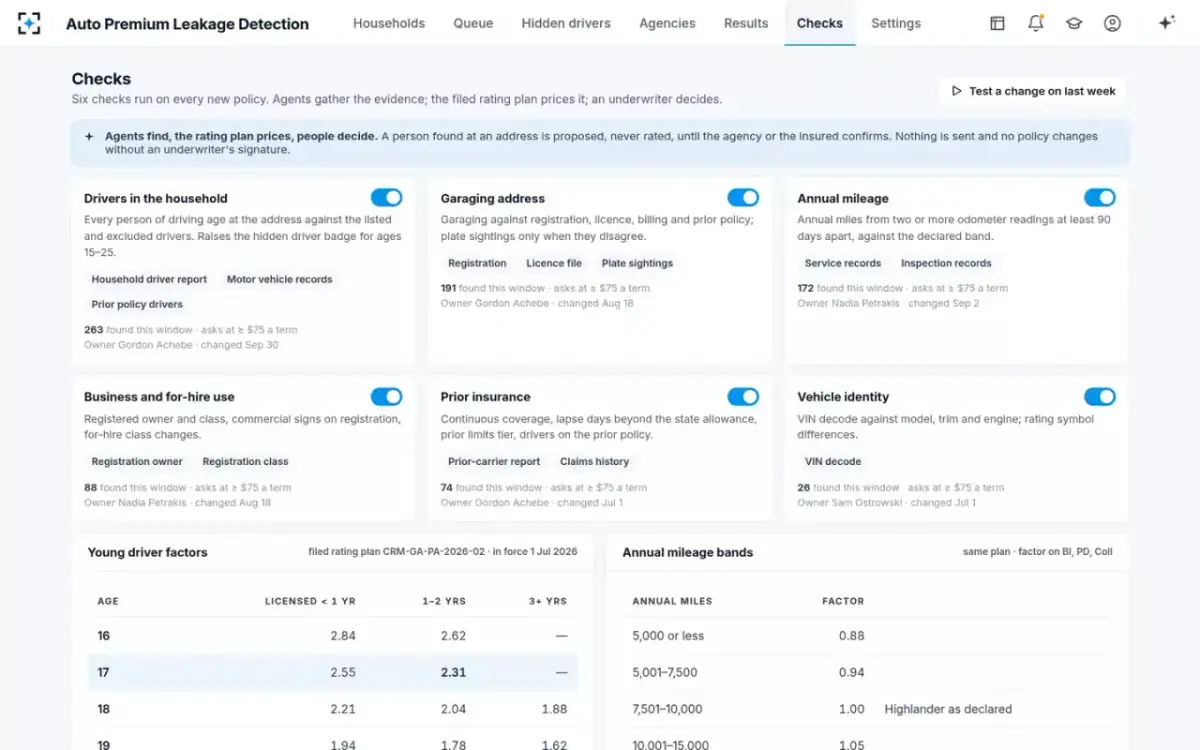
Only a disagreement justifies more intrusive evidence. In the solution, the garaging checker compares the application's address with the registration, licence, billing address and prior policy, and orders overnight plate sightings only when those disagree. It reports the share of sightings in each ZIP code, never a route. On the sample household on the solution's main page, all four records agreed, so no sightings were ordered at all.
The garaging check, with its sources, owner and threshold
What happens if you lie about your garaging address on insurance?
Usually the insurer corrects the premium to the true address, and the consequences grow with the stakes and the timing. Found in a new policy's first weeks, it is a premium question: the agency is asked, the policy is re-rated and, where a consumer report contributed, the insured receives an adverse action notice. Found after the first 60 days, the insurer's room to cancel narrows to the reasons the state lists; the NAIC model act and Florida include material misrepresentation, while Texas's list does not (compared in what changes on day 61). Found after a claim, it can become a coverage dispute, and in New York the case is also counted on the form.
Where a misstatement is deliberate, it can be a crime. New York requires auto insurers above a size threshold to run fraud prevention plans; the Department's page ties those plans to insurers writing private passenger auto "with 3,000 or More Policies" in the state (DFS). Investigating suspected fraud is the work of a carrier's special investigations unit, not of underwriting, and Botminds treats it as a separate job; see the SIU referral form, from Botminds' Claims Fraud Detection, for how referrals reach an SIU.
Is lying about your address insurance fraud in California?
California's Penal Code names one address lie specifically. It is unlawful to "prepare or make any written or oral statement, intended to be presented to any insurer or producer for the purpose of obtaining a motor vehicle insurance policy, that the person to be the insured resides or is domiciled in this state when, in fact, that person resides or is domiciled in a state other than this state" (Cal. Penal Code §550(b)(4)).
The penalty range is wide. A violation of that paragraph can be punished by imprisonment for two, three or five years, by a fine of up to $50,000 or twice the amount of the fraud if that is more, or by up to a year in county jail and a fine of up to $10,000 (§550(c)(3)). The statute's other paragraphs mainly address claims. Whether a misstated address inside California is a crime depends on the facts and the prosecutor; for the insurer, it is a rating fact to correct either way.
Counting garaging misstatements with Auto Premium Leakage Detection
The solution's job is to find the garaging difference early and keep the evidence that makes it countable. It does not file New York's form, and it does not decide that anyone committed fraud. It gives the people who do both the inputs the form requires.
From an address that disagrees to a number a carrier can report
Agent
Application readerRecords the garaging address as declared, with the question it answered.
Agent
Garaging checkerCompares it with registration, licence, billing and the prior policy; orders plate sightings only if they disagree.
Never: reports a route
Agent
Premium re-raterRates the policy at the claimed and the found address under the filed plan; the difference is the premium at stake.
Agent
Request drafterDrafts one request to the agency: confirm the address, or tell us why the records differ.
A person decides
UnderwriterDecides whether the address was wrong, signs the correction, and records the true and claimed places.
A person decides
Compliance and SIUDecide which confirmed cases are reportable misrepresentations, and approve the annual count.
What a carrier needs on file to count rate evasion
- The address as declared, and where it was declared
The application question and answer, dated and signed.
- The records it was compared with
Registration, licence, billing, the prior policy; each with its date and source.
- The true place, confirmed
County and state, not just ZIP code, because the form counts by county and state.
- The premium both ways
Rated at the claimed and the true address under the plan in force on the effective date.
- The household’s answer
What the agency or the insured said, so an honest move is not counted as evasion.
- Who decided
The underwriter who signed the correction, and compliance’s decision on whether it is reportable.
Garaging differences in the new business queue, by premium at stake
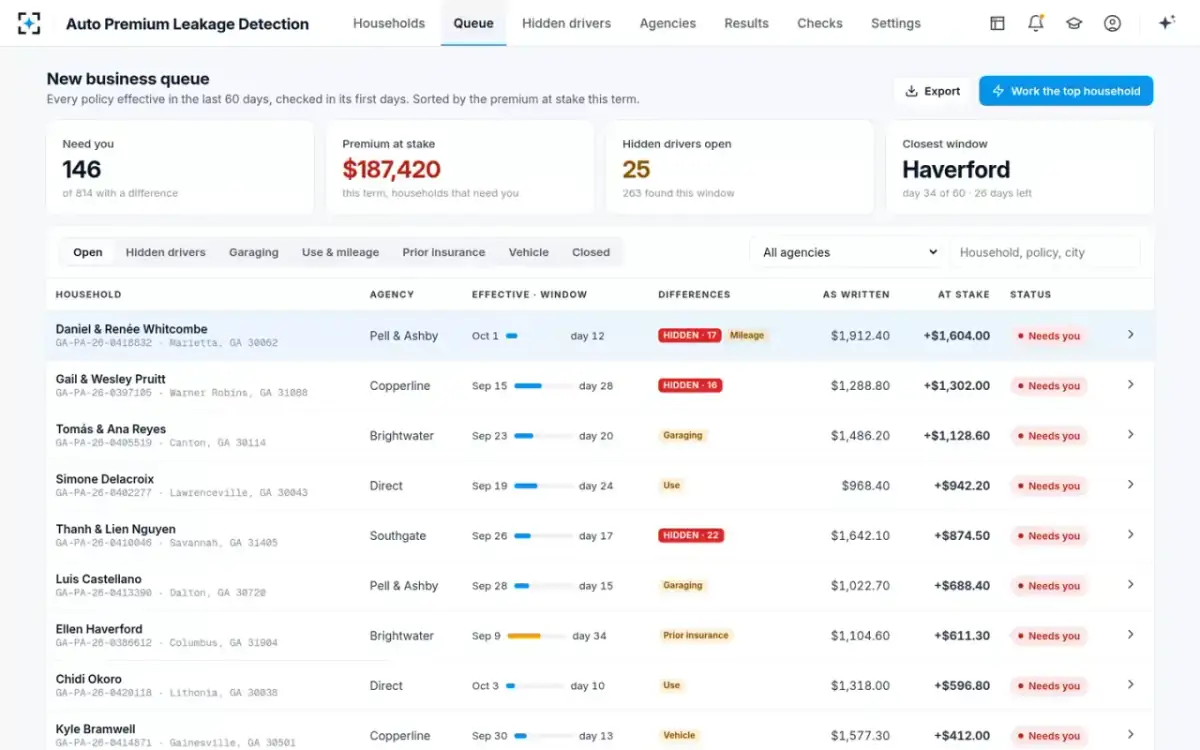
On the sample book, the largest garaging differences were worth more than $1,000 a term on a single policy. New York's carriers must report what such differences add up to. Carriers elsewhere have the same leakage and no form to make them count it. The rest of the solution is at Auto Premium Leakage Detection.
Questions people ask
What does rate evasion mean in car insurance?
It means misstating where a vehicle is principally garaged or driven to get a lower premium, either a cheaper place in the same state or another state. New York's Department of Financial Services uses the term for the misstatements it makes auto insurers count every year.
Who has to file New York's rate evasion report?
Private passenger auto insurers that meet the requirements of Section 409(a) of the New York Insurance Law, through the Rate Evasion Form in the annual SIU report. It is due 15 February each year and must be approved by the SIU manager and the executive officer responsible for the SIU.
What is proof of garaging address?
Documents that tie the car to the address where it sleeps: usually the registration, the driver's licence and a bill or lease at that address. An insurer asks for it when the application's address disagrees with its other records.
Can an insurer refuse to cover me because of where I live?
The NAIC's model act bars declining or terminating an auto policy based on the vehicle's principal location unless there is a genuine business purpose that is not a pretext for unfair discrimination, and Florida bars refusing to renew because of where the car is garaged in the state. Location is normally priced through territory rates instead.
Is rate evasion a crime?
It can be. California's Penal Code §550(b)(4) makes it unlawful to claim California residence to obtain a motor vehicle policy when you live in another state, punishable by up to five years in prison or fines of up to $50,000 or double the fraud. Other cases depend on each state's insurance fraud laws and the facts.
How does New York count an insured with several cars?
As one insured. The instructions define the insured as the policyholder, so a policy covering four drivers or vehicles counts once, however many of its cars were misgaraged.