The personal auto policy business use exclusion is narrower than its name: ordinary business driving, such as sales calls or trips between job sites, is usually covered and rated in the carrier's business class, while carrying passengers or property for a fee is the use personal policies commonly exclude, and state laws written for app-based drivers expressly allow it. For a carrier the hard part is not the wording. It is that use is self-declared, so a car bound as a commuter can be driven for business or for hire from day one, rated short every term, and found only when a claim tests the exclusion. Auto Premium Leakage Detection is Botminds' software for personal auto new business: its agents read each new policy's rating facts, including vehicle use, against outside records in the first days after bind, re-rate any difference under the filed plan, and leave the decision to an underwriter.
This guide is for underwriting managers, product owners and new business teams. It covers what the rules permit, what evidence of business and for-hire use a carrier can actually see, how to correct a misstated class inside the underwriting window, and the controls a regulator or an auditor will ask about. Product examples come from the solution's fictional Georgia sample book.
Why vehicle use deserves its own check
4%
of US adults did app-arranged short tasks, such as ride-sharing or delivery, in the prior month
9%
did any short-term task work, such as giving rides or delivering takeout
6
coverages Texas lets a personal policy exclude while an app driver is logged on
60days
in which the NAIC model’s list of permitted cancellation reasons does not yet apply
What the personal auto policy business use exclusion covers, and what it does not
Three different things travel under the name "business use exclusion", and a carrier's application questions, rating plan and claims handling need to keep them apart. The first is ordinary business use, which a personal policy usually covers and rates. The second is for-hire use, carrying people or goods for a fee, which a personal policy may exclude. The third is a vehicle that is not a personal auto risk at all.
The NAIC's model act on auto cancellations draws the outer line. Its definition of the policies it governs covers a private passenger vehicle "that is not used as a public or livery conveyance for passengers, nor rented to others", and a light vehicle "that is not rated by the insurer as a commercial motor vehicle whether or not used in the occupation, profession or business of the insured" (Model Act #725, §2A). Business use alone does not take a car out of personal auto; livery use and commercial rating do.
Three uses, three treatments on a personal auto policy
| Use | Typical treatment | What the carrier owes the file |
|---|---|---|
| Business use: clients, job sites, tools of a trade | Covered and rated in the carrier’s business class where it files one | The class declared, the reason, and the premium in that class |
| For-hire use: passengers or goods for a fee | May be excluded, or covered by a rideshare or delivery endorsement | Whether the endorsement was offered, taken or declined, in writing |
| A vehicle rated or used as commercial | Outside the personal auto definition; belongs on a commercial policy | The referral, and why the personal policy was declined or not renewed |
Inside personal auto, use is a rating factor before it is an exclusion. California, which spells out the factors an insurer may file, lists "Type of use of vehicle (pleasure only, commute, business, farm, commute mileage, etc.)" among the optional ones (10 CCR §2632.5(d)(3)). A car moved from commute to business is re-rated. A car found driving for hire raises a different question: whether the carrier wants the risk at all, and on what endorsement.
Do personal auto policies exclude business use?
Generally they do not exclude ordinary business use; they price it. What personal forms commonly exclude is use for hire, and state transportation network company laws confirm that a carrier may. Texas is a clear example. An insurer "may exclude from coverage under a personal automobile insurance policy" any loss "while a transportation network company driver using the personal vehicle" is logged on to the app or engaged in a prearranged ride, across every coverage from liability to collision (Tex. Ins. Code §1954.151).
The same chapter keeps older exclusions alive. It "may not be construed to invalidate or limit an exclusion contained in a policy form ... that excludes coverage for automobiles used to carry persons or property for compensation or available for hire by the public" (§1954.151(d)). Food and parcel delivery, which the rideshare chapter does not address, therefore falls back on the carrier's own form. And the law leaves room to sell the cover: the exclusion section "does not prevent an insurer from providing coverage that may be excluded ... if the insurer elects to provide the coverage in the policy or by endorsement" (§1954.152(b)).
Who covers an app driver in Texas, and when the personal policy may step aside
| Phase | Personal auto policy | Minimum the rideshare cover must carry |
|---|---|---|
| App off | Covers as written and rated | Not applicable |
| Logged on, waiting for a request | May exclude every coverage | $50,000 per person and $100,000 per incident bodily injury; $25,000 property damage |
| From accepting a ride until the last rider leaves | May exclude every coverage | $1 million aggregate per incident for death, bodily injury and property damage |
Why misstated use is a coverage problem as much as a premium one
Misstated business use costs premium; misstated for-hire use can cost coverage, and the two land on different desks. A commuter class on a car driven between job sites leaves the premium short, a classic underwriting leak that premium leakage covers in full. A commuter class on a car driven for an app leaves the premium short most of the time and the policy excluded at the moment the carrier most needs clarity.
Texas spells out the claims side. A carrier whose form carries the authorized exclusion "does not have a duty to defend or indemnify a claim arising from an event subject to the exclusion", and one that defends anyway has a right of contribution against the insurer that should have paid (§1954.153). To decide which phase a crash fell in, the network company must give each insurer involved "the precise times that a driver logged on and off ... in the 12-hour period immediately preceding and the 12-hour period immediately following the accident" (§1954.154).
That evidence arrives after the loss, which is the expensive moment to learn about it. A coverage position taken on an exclusion the policyholder did not know applied invites a complaint and, often, a dispute with the claimant's lawyer. The network company must already have told its drivers in writing that their personal policy "may not provide coverage, depending on the policy's terms" while they are logged on (§1954.101), but that disclosure runs from the network company to the driver, not to the driver's personal carrier, and a driver can join a platform months after bind. A carrier that finds the use at bind can offer an endorsement, re-rate, or decline to continue, with every party knowing where they stand.
How common is undisclosed business or for-hire use?
No regulator or study publishes the share of personal auto policies with misstated use, so a carrier has to measure its own. What public research does show is the size of the pool. In the Federal Reserve's household survey fielded in October 2024, "Four percent did platform tasks, or short-tasks that they arranged using an app or website, such as a ride-sharing or delivery app," and 9 percent did short-term tasks of any kind in the prior month (Federal Reserve, 2025).
Not every one of those adults drives, and many who drive for an app carry the right endorsement. But the figure sets the order of magnitude: on a book of 100,000 households, on our arithmetic several thousand may have someone doing app-arranged work in any month, and the application asked about use once, at bind. A carrier that wants its own rate can get one cheaply by running a use check over a quarter of closed new business and counting what it finds.
On one sample book, use differences were the fourth-largest source
What evidence of business or for-hire use can a carrier see after bind?
A carrier cannot see where a car goes each day, but it can see traces that make a declared class unlikely. The Casualty Actuarial Society's ratemaking text sets the test every rating variable should pass: "the levels of a rating variable should not be easily manipulated by the insured or distribution channel, and should be easy for the insurer to verify" (Werner & Modlin, Basic Ratemaking). Use is easy to declare and hard to verify, so the evidence comes from documents around the car, never from one source alone.
Signals of business or for-hire use, and what each can and cannot show
| Signal | Where it comes from | What it suggests | What it cannot prove |
|---|---|---|---|
| Registered owner is a business | State registration file | The car may be a business asset, or belong on a commercial policy | How the household uses it day to day |
| Commercial or for-hire registration class, or a change to one | Registration class and its history | Use for hire or a commercial vehicle | Whether the use continues, or which coverage phase a trip fell in |
| Mileage far beyond the declared commute | Two or more dated odometer readings | Driving the declared purpose cannot explain | Which purpose explains it: business, for hire or simply pleasure |
| Rideshare or delivery endorsement on the prior policy | Prior-carrier report | App work the household already disclosed elsewhere | That the work continues under the new policy |
| VIN decodes to a cargo or work body | VIN decode | Business use is likely | That it is the only use, or the class it should carry |
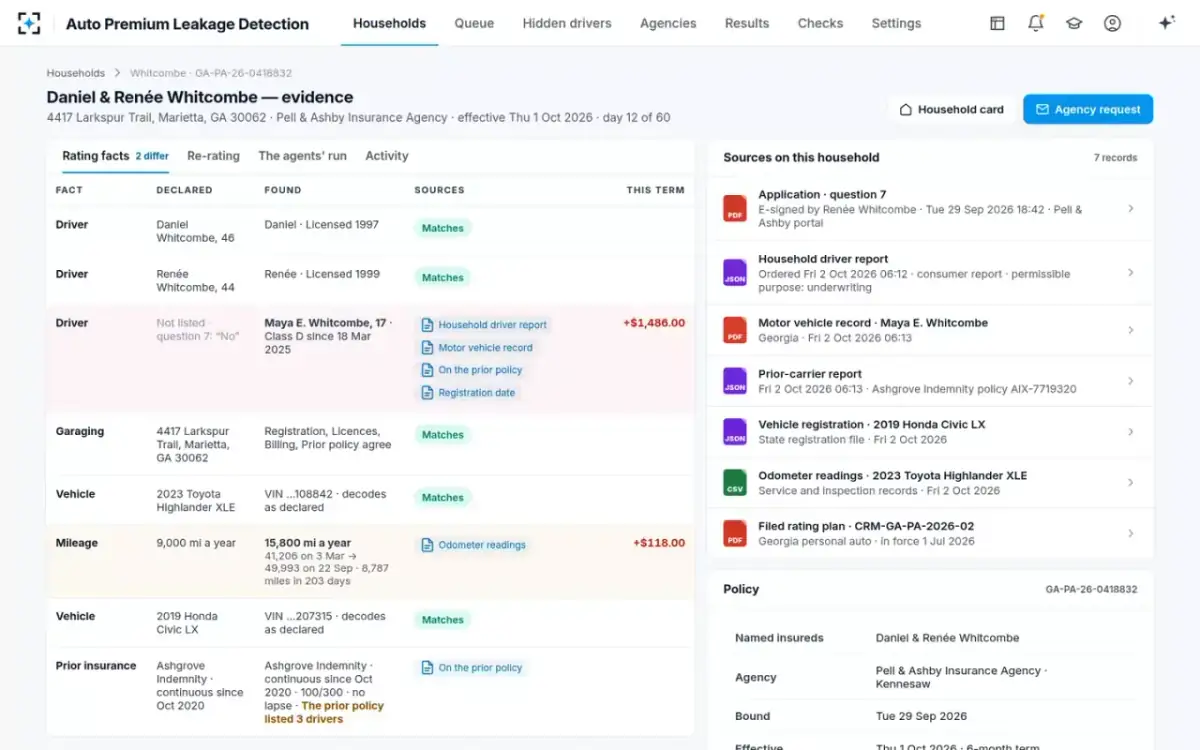
Mileage needs the most care, because it points at a use without naming one. Twelve miles each way, five days a week, over about 250 working days, is 6,000 miles a year before any other driving, our arithmetic. A car declared that way and read at 15,800 miles a year has driven nearly ten thousand miles the declared commute does not explain. That may be weekend travel, a second job or app work. The mileage band can be corrected on the readings alone, as the mileage verification guide shows; the use class needs a question.
Use and mileage, declared against found, each with its source
Is misstated vehicle use a material misrepresentation?
Sometimes, and the test is the carrier's own underwriting, not the size of the price difference. New York's statute is typical in shape: "No misrepresentation shall be deemed material unless knowledge by the insurer of the facts misrepresented would have led to a refusal by the insurer to make such contract," and "evidence of the practice of the insurer ... with respect to the acceptance or rejection of similar risks shall be admissible" (N.Y. Ins. Law §3105).
Read for vehicle use, that points two ways. A car declared as a commuter and used for sales calls would usually have been accepted in the business class at a higher price, so the misstatement supports a re-rate more readily than a rescission. A car declared as a commuter and driven full time for hire may be one the carrier's guidelines would have declined, and then the written guideline is the evidence. Either way, the carrier's position is only as strong as its documented practice, which is why the use questions, the classes and the decline rules belong in the underwriting guidelines in writing.
The cancellation statutes follow the same logic. The NAIC model lists "Fraud or material misrepresentation made by or with the knowledge of an insured in obtaining the policy" as a permitted reason to cancel an established policy, and separately a vehicle "Used in carrying passengers for hire or compensation" (Model Act #725, §4A(2) and §4A(5)(b)). States vary in how far they adopted it, and compliance sets the rule for each.
Inside the window or after it: what a carrier can still do
Timing decides the remedy. Under the NAIC model, the list of permitted cancellation reasons "shall not apply to a policy of automobile insurance that has been in effect less than sixty (60) days" (§4B), and many states set a similar new-business period, explained in what the 60 day underwriting period means. Inside it, a carrier that finds for-hire use can still decide whether to keep the risk; after it, the carrier is limited to the statute's reasons and a re-rate.
The same use difference, found on day 12 or after the window closes
Found inside the window: Re-rated in the business class from inception, with the agency’s confirmation.
Found after it, or at a claim: Re-rated where the filed rules allow; earlier terms usually stay short.
Found inside the window: Endorsement offered, risk re-rated, or the policy not continued, with notice.
Found after it, or at a claim: Cancellation only on a reason the state permits; otherwise a coverage position at the claim.
Found inside the window: Referred to commercial lines before the first renewal.
Found after it, or at a claim: Non-renewal at the end of the term, with the notice the state requires.
Found inside the window: Registration, readings and the agency’s answer, dated before any loss.
Found after it, or at a claim: Log-on times obtained after the crash, read by people with a stake in the answer.
The correction process, from signal to signed endorsement
A use correction is a short chain, and each link has an owner. The signal is gathered automatically; the price comes from the filed plan; the question goes to the agency; the decision and the signature stay with an underwriter. An increase based on a consumer report is an adverse action under federal law, which includes "an increase in any charge for ... any insurance, existing or applied for, in connection with the underwriting of insurance", so it carries a notice to the insured (15 U.S.C. §1681m).
One use difference in Auto Premium Leakage Detection, from registration to endorsement
Agent
Vehicle and use checkerDecodes the VIN, reads the registered owner and class, and works out annual mileage from two or more dated odometer readings.
Never: Never computes mileage from one reading
Agent
Premium re-raterPrices the business or for-hire class under the filed plan in force on the effective date, coverage by coverage.
Never: Never changes the policy
Agent
Request drafterWrites one plain question to the agency, with the evidence attached, and drafts the adverse action notice if a consumer report is used.
Never: Sent only by the underwriter
A person decides
UnderwriterReads the agency’s answer, chooses re-rate, endorsement offer or no change, and signs.
A person decides
Underwriting manager and complianceCo-sign corrections over the set amount, and any cancellation or rescission.
The wording of the question to the agency decides how fast and how truthfully it is answered. App work can start after bind, so a household that answered honestly in September may be driving for a platform by November. A request that names the evidence and asks what changed gets a faster, truer answer than one that implies the application was false, and it keeps the carrier's relationship with the producer intact.
How Auto Premium Leakage Detection checks business and for-hire use
Auto Premium Leakage Detection runs the use check on every new policy in its first days, beside five others: drivers in the household, garaging address, annual mileage, prior insurance and vehicle identity. Its vehicle and use checker reads the registered owner and class, flags commercial signs on the registration and for-hire class changes, and passes any difference to the premium re-rater. The agents gather and price; they do not change a policy, contact the household or send a request.
The business and for-hire use check, with its sources, threshold and owner
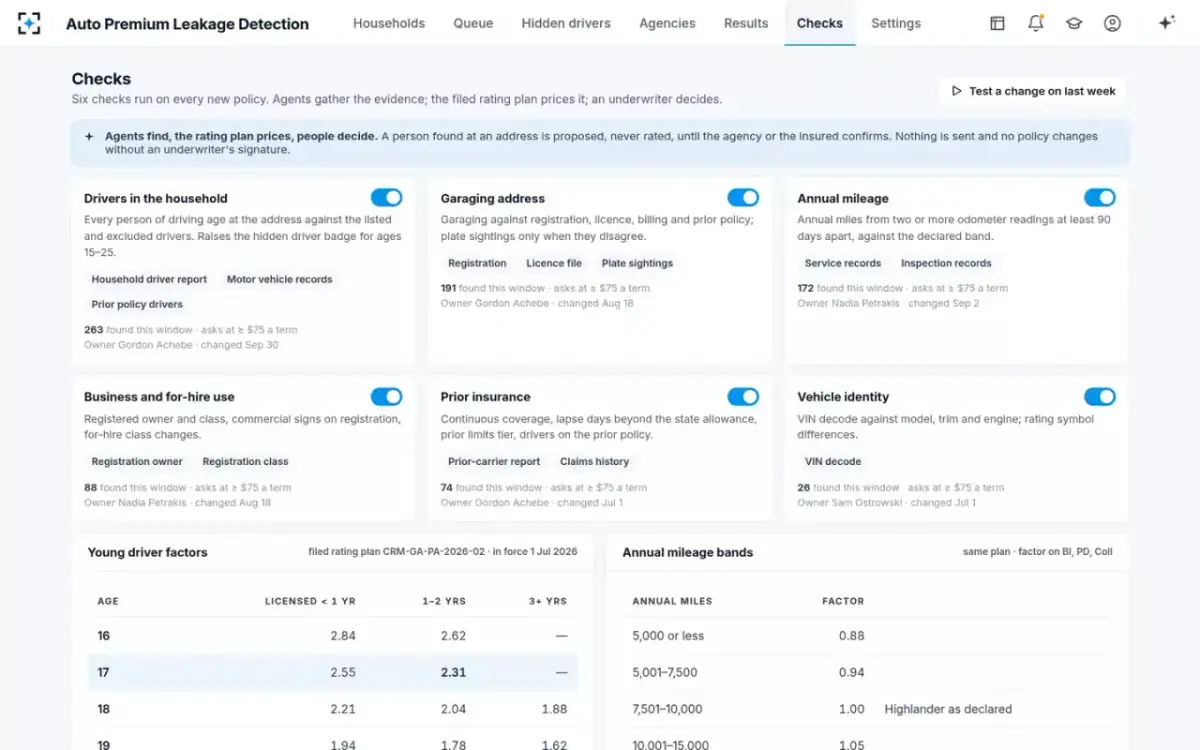
The check is bounded by design. It does not read telematics, social media or platform data, and it does not decide that a household drives for hire. It finds documented signals that the declared class is unlikely, prices them, and asks. Where a carrier already runs a telematics programme or a rideshare endorsement, the check complements it on the policies those programmes do not reach.
Controls a regulator or an auditor will ask about
A use check changes premiums on consumer evidence, so it must be explainable policy by policy. The checks below are the ones a market conduct examiner, an internal auditor or a complaint handler will test, and each should leave evidence on the policy file.
Seven controls for a vehicle use check
- Use classes and decline rules written in the underwriting guidelines
Materiality turns on the carrier’s documented practice with similar risks; an unwritten rule is weak evidence.
- Each signal cites its source and date
Registration file, odometer readings or prior-carrier report, opened from the decision screen.
- No class change from a signal alone
The agency or the insured confirms the use before the premium moves.
- Re-rating under the filed plan in force on the effective date
Deterministic pricing, coverage by coverage, so the same facts give the same premium.
- An endorsement offered before a cancellation is considered
Where the carrier writes one, for-hire use is a product conversation first.
- Adverse action notice with any increase based on a consumer report
Names the reporting agency and the insured’s right to a free copy and to dispute.
- Cancellation or rescission signed by a manager and compliance
Never from a finding alone, and only on a reason the state permits.
Questions people ask
Do personal auto policies exclude business use?
Ordinary business use, such as visiting clients or job sites, is usually covered and rated in a business class where the carrier files one. What personal forms commonly exclude is use for hire, and Texas, for example, lets an insurer exclude every coverage while an app driver is logged on or carrying a rider under Insurance Code §1954.151.
Is food delivery covered by the rideshare laws?
Not in Texas: its transportation network company chapter deals with passenger rides, and it expressly preserves policy exclusions for vehicles "used to carry persons or property for compensation". Delivery work therefore falls on the carrier's own policy form and any delivery endorsement it sells.
Can an insurer cancel a policy for undisclosed rideshare driving?
In a policy's first 60 days the NAIC model's list of permitted cancellation reasons does not apply, though its prohibited reasons and notice rules still do. After that, it permits cancellation for a vehicle "used in carrying passengers for hire or compensation" or for material misrepresentation, where a state adopted those reasons; compliance confirms the rule state by state.
What makes a vehicle use misstatement material?
Under New York's test, a misrepresentation is material only if knowing the truth "would have led to a refusal by the insurer to make such contract", proved by the insurer's practice with similar risks. A use that would only have changed the price usually supports a re-rate rather than a rescission.
Does a car pool count as use for hire?
No. The NAIC model says a car pool "shall not be considered use of an automobile for hire or compensation", and Texas excludes a shared-expense carpool or vanpool from the meaning of a prearranged ride.
How can a carrier verify vehicle use without telematics?
From documents around the car: the registered owner and registration class, dated odometer readings set against the declared commute, endorsements on the prior policy and the VIN decode. California expressly lets an insurer ask the commuting days and workplace and use state smog-check odometer readings under 10 CCR §2632.5.