A car insurance mileage verification form is the document an insurer uses to capture a vehicle's odometer reading on a known date, usually with the VIN, a photo of the odometer and the policyholder's signature, so it can check the annual mileage the policy was rated on. The form matters less than what is done with it. A single reading tells you how far the car has gone in its life; two dated readings far enough apart tell you how far it goes in a year, and that is the number the premium rests on. Often the second reading already exists, in a service invoice, an emissions inspection or a title transfer. Auto Premium Leakage Detection is Botminds' software for checking declared mileage and five other rating facts on every new auto policy in its first days; its vehicle and use checker works out annual mileage from two or more dated odometer readings at least 90 days apart, and an underwriter decides what follows.
This is a buyer's guide for personal auto underwriters and product managers deciding how to verify mileage, and an explainer for policyholders asked to fill in such a form. The mileage figures for the worked household come from the solution's fictional Georgia sample book.
What a mileage verification form should capture, and why each field matters
Vehicle
VIN, year, make, model
Ties the reading to one car; a photo should show the VIN or the plate with the dashboard.
Odometer reading
Whole miles, as displayed
Not the trip meter; kilometres converted only if the display is metric.
Date of the reading
The day it was taken, not the day it was sent
Annual mileage is miles between two dates; a wrong date is a wrong rate.
Who read it
Insured, agent, repair shop, inspection station or device
The source decides how much weight the reading carries.
Evidence
A photo, a service invoice, an inspection report
A number with nothing behind it is an estimate, not a reading.
Signature
The named insured, confirming the reading
The same attestation as the application, for the same rating fact.
What a car insurance mileage verification form asks for
A usable form asks for six things: the vehicle, the reading, the date, who took it, the evidence behind it and the insured's confirmation. The figure above sets out why each is there. Leave out the date and the reading cannot be turned into miles a year. Leave out the evidence and the form is just a second estimate.
The form usually arrives in one of three moments. At application, an insurer may ask for the current reading; California's regulation lists "the current odometer reading of the vehicle to be insured" among the information an insurer may require (10 CCR §2632.5(c)(2)(C)). In a verified-mileage or low-mileage programme, the insurer asks for readings on a schedule. And after bind, when the records disagree with the declaration, an underwriter may ask the agency for a current odometer photo to settle the question.
Does annual mileage affect car insurance?
Yes, wherever the rating plan uses it, because more miles mean more exposure to a crash. In California it is written into law: the number of miles the insured drives annually is the second of three mandatory rating factors, after the driving safety record and before years of driving experience (10 CCR §2632.5(c)). Elsewhere, carriers file mileage bands with their rates. The sample carrier's plan, for instance, runs from a factor of 0.88 at 5,000 miles or less to 1.05 at 10,001 to 15,000, applied to liability and collision.
Actuaries have long been candid about the weakness of the fact. The Casualty Actuarial Society's ratemaking text says that "many car owners cannot accurately estimate how many miles their car will be driven in the upcoming policy period, and even if they can, the insurance companies may not currently have a cost-effective way to verify the accuracy of the amount estimated by the insured", and that some companies have chosen not to use annual miles as a rating variable for that reason (Basic Ratemaking, ch. 9). The verification problem is the reason the form exists.
How do insurance companies check annual mileage?
They compare the declared estimate with odometer readings from other sources: the insured's own reading, service records, state inspection records, title transfers and, where the driver has enrolled, telematics. California's regulation is the most explicit list we found. For an insurer running a verified actual mileage programme, it allows readings taken by the insurer or its agent, readings "recorded by an automotive repair dealer … in the ordinary course of the business of servicing a vehicle", readings from smog check stations or the state's Department of Motor Vehicles, readings reported by the insured, and a technological device (10 CCR §2632.5(c)(2)(F)).
Six ways to verify mileage, as California's regulation lists them
| Method | Who produces the reading | What it is good for | What to watch |
|---|---|---|---|
| Insurer or agent reads it | An employee, agent or vendor of the insurer | Independent and dated | Costs a visit or an inspection |
| Repair shop records | An automotive repair dealer, servicing the car | Often already exists; dated | California lets insurers request service records but not require them |
| Smog check and DMV records | A licensed station or a government agency | Independent, dated, routinely collected | Only where inspections happen |
| Self-reported reading | The insured or their agent | Fast; pairs with a photo | Needs evidence to carry weight |
| Technological device | A device or app provided or approved by the insurer | Continuous and exact | California bars using it to collect or store the car’s location for this purpose |
| Other approved methods | As the Commissioner approves | Room for new sources | Needs approval first |
Two federal sources add dated readings outside California. When a car changes hands, the seller must disclose "the odometer reading at the time of transfer" and the date on the title (49 CFR §580.5), so a recently bought car arrives with a reading. Vehicles from model year 2011 on stay subject to that disclosure until they are 20 years old (§580.17). And where a driver has opted in, some consumer reporting companies "may also share your driving behavior data with auto insurers", including miles travelled, according to the CFPB (CFPB list, 2025).
Declared, read and inferred: one household's three mileages
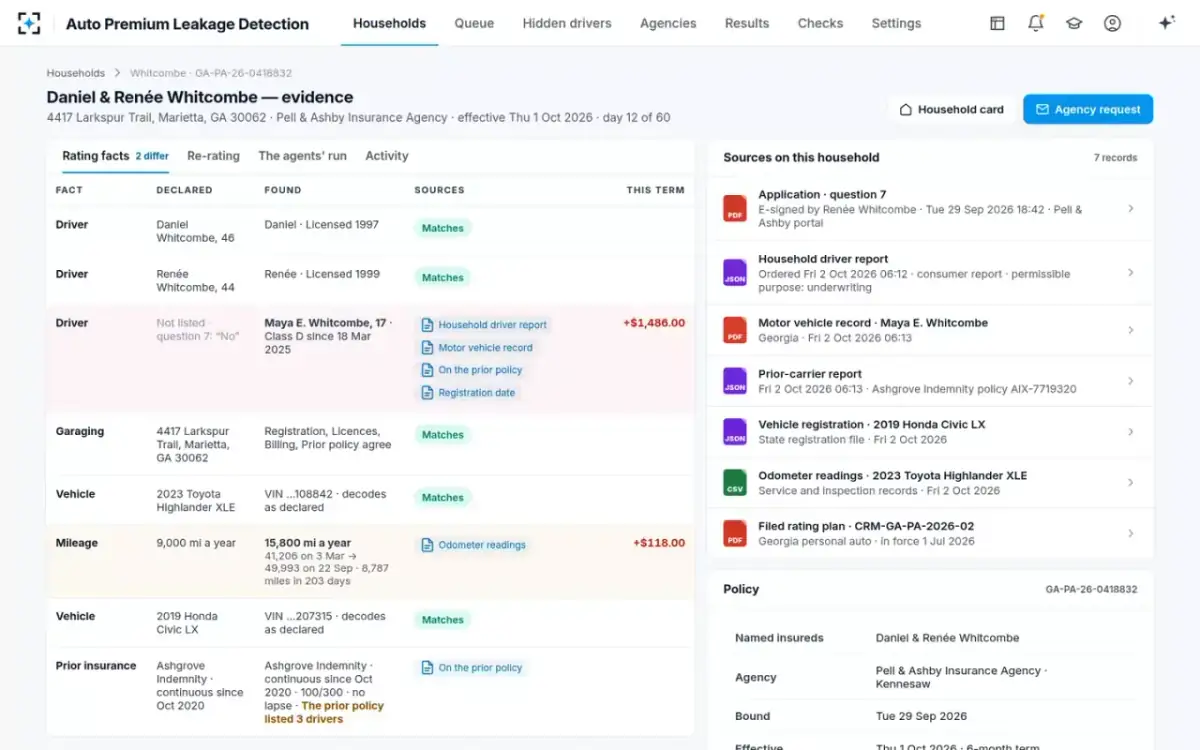
Every rated car has three mileages, and they rarely agree. The declared figure is what the application says. The read figure comes from odometer readings. The inferred figure is what the rest of the application implies, such as the declared commute and its use class, which can hide business or for-hire use. Take a sample household as it runs through the solution: the Whitcombes of Marietta, Georgia, declared their 2023 Toyota Highlander as a commute car at 9,000 miles a year, 12 miles each way.
The Highlander's mileage, three ways
Declared on the application: 9,000
Read from two odometer readings: 15,800 (8,787 miles in 203 days, annualised)
Declared on the application: 7,501–10,000
Read from two odometer readings: 15,001–20,000
Declared on the application: The insured’s estimate, e-signed at bind
Read from two odometer readings: 41,206 at a service on 3 March; 49,993 at an emissions inspection on 22 September
Declared on the application: 12 miles each way: about 6,000 miles a year on 250 working days
Read from two odometer readings: Consistent with a commute plus about 9,800 miles of other driving
Declared on the application: As written
Read from two odometer readings: +$118.00 under the filed plan
Of 15,800 miles a year, 6,800 were never declared
The Highlander, miles a year
- Declared: 9,000 miles · 57%
- Not declared: 6,800 miles · 43%
The sample shows why the readings, not the form, decide the case. Nobody asked the household for anything until the records disagreed. Two readings already on file, one from a service and one from an inspection, put the car in a different band, and the request to the agency carried both. The agency confirmed the same day. On the sample book as a whole, 172 households had an annual mileage difference as their largest, the third largest kind after hidden drivers and garaging.
The mileage line on the evidence view: declared against read, with the readings
Two readings, ninety days apart: why one reading is not enough
A single reading cannot measure annual mileage, and two readings close together measure it badly. Annualising multiplies whatever happened between the readings. A 600-mile weekend trip inside a 14-day gap adds about 15,600 miles to the annual figure; inside the Highlander's 203-day gap it adds about 1,080, our arithmetic. The longer the gap, the less one unusual week can move the band.
That is why the solution's vehicle and use checker never works out mileage from one reading, and needs at least two readings at least 90 days apart. The rule is a design choice, not a regulation, and a carrier can set it longer. It also means a car bought last month has no usable mileage history yet, and is left at its declared figure until one exists.
Car insurance odometer photo requirements: what makes a photo usable
No regulator we found sets a standard for an odometer photo; each carrier writes its own instructions. A photo is usable when a stranger could read it and tie it to the car without asking a question. In practice that means the full odometer display in focus, the ignition on so the display is lit, the trip meter not shown in its place, the VIN or plate visible in the same session, and a date the carrier can trust, ideally from the photo itself rather than from the email that carried it.
A photo is also only one reading. Its value comes from the other reading it is compared with. A carrier that asks for a photo should already have a dated reading to set it against, or it should ask for a second photo later; otherwise it has replaced one estimate with another.
California's mileage rules: estimate, verify, and give notice first
California's regulation is the most detailed set of mileage rules we found, and it constrains how a carrier there may use a verification form. For new business, the applicant provides "the miles the applicant expects each vehicle to be insured will be driven during the 12-month period following policy inception." If the applicant gives no estimate, or one the information does not support, the insurer may use "a reasonable objective mileage estimate" or a filed default figure, but must first "inform the applicant of the mileage figure which it will use to rate the policy" (10 CCR §2632.5(c)(2)(A)).
Three limits matter for a verification process. An insurer may request but "shall not require" service records or a device. It may not require "information from a prior insurer to confirm mileage estimated or driven." And it "may not retroactively or prospectively adjust premiums based on actual miles driven unless notice is provided to the policyholder prior to the effective date of the policy." A carrier in California that wants to correct a premium from verified mileage needs that notice in place before the policy starts. The search for a "mileage verification form california" usually ends at one of these programmes.
Choosing a mileage verification method or tool: what to ask
Judge any mileage verification method, a form, a vendor feed or software, on whether it produces a defensible annual figure from dated evidence, under your filed bands, inside your states' rules. A cheap process that annualises one photo, or that cannot show its readings, will move premiums the carrier cannot defend.
Questions for any mileage verification process or software
- Does it ever annualise from one reading?
It should refuse. Ask for the minimum gap between readings and whether you can set it.
- Which sources can it read?
Service records, inspection records, title transfers, photos, devices. More sources mean fewer requests to households.
- Does every result show its readings and dates?
An underwriter, an agent and an examiner should all be able to redo the arithmetic.
- Does it price under your filed mileage bands?
The band and factor should come from the plan in force on the effective date, not from the tool.
- Does it respect state rules?
In California: no required service records, no prior-insurer mileage, and notice before the effective date for any adjustment on actual miles.
- Who decides?
A reading should lead to a request and an underwriter’s decision, never to an automatic re-rate.
- Does it keep location out of it?
Mileage needs miles. California bars using a device to collect or store the car’s location in a verified-mileage programme.
Where Auto Premium Leakage Detection fits, and where a telematics programme does
The solution is a verification step on new business, not a usage-based insurance programme. It reads the service and inspection records a carrier already buys, works out annual mileage only from two or more readings at least 90 days apart, prices any band change under the filed plan, and drafts one request to the agency that offers to re-rate unless a current odometer photo shows otherwise. It does not install devices, track location or price per mile.
The mileage check and the filed plan's mileage bands
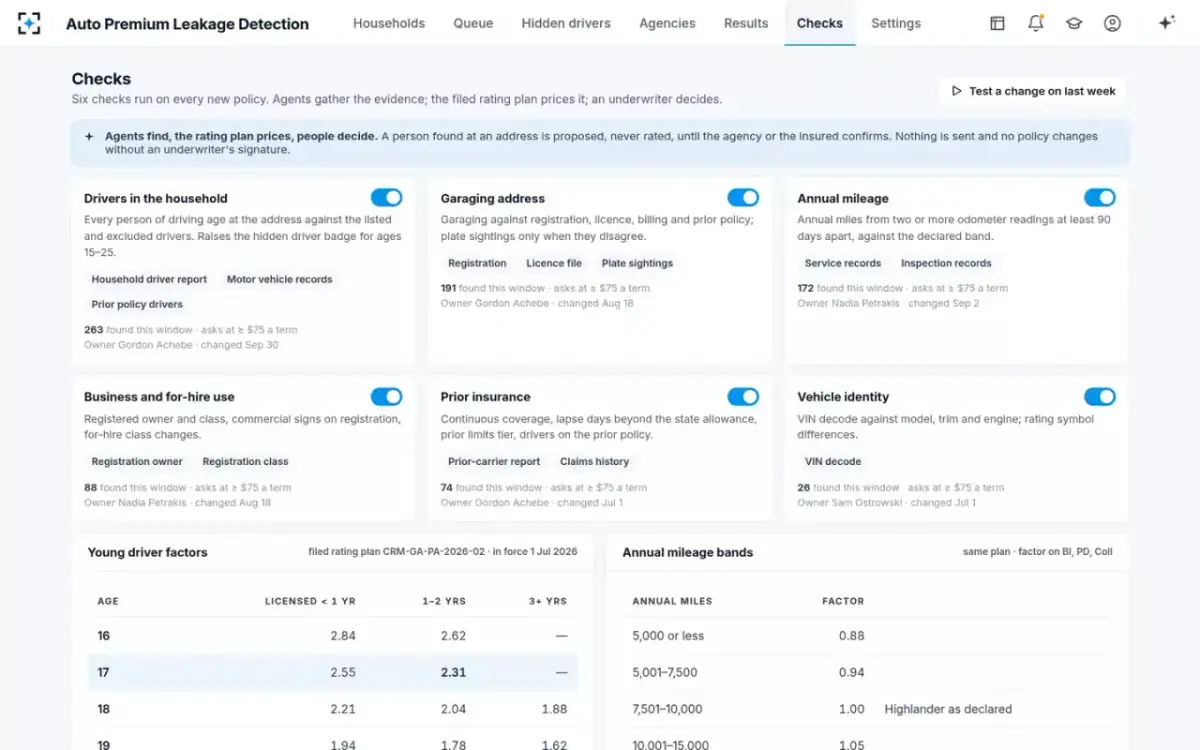
A telematics or pay-per-mile programme does a different job. It measures miles continuously for drivers who choose it, and California's regulation treats such programmes as voluntary where an insurer also offers estimated mileage. Verification on new business covers everyone else, and it is where most of the leakage sits: the households who estimated low and were never asked again. The other rating facts the solution checks, and what they are worth, are set out in what premium leakage is; how to test any mileage check before relying on it is in the premium leakage test. The solution itself is at Auto Premium Leakage Detection.
Questions people ask
Do insurance companies check mileage?
They can, by comparing the estimate on the application with odometer readings from service, inspection or title records, a photo, or a telematics device where the driver enrolled. California's regulation lets insurers use smog check readings from state records to estimate annual miles.
How do insurance companies know your annual mileage?
From two odometer readings on known dates, divided by the days between them and multiplied by 365. On the solution's sample household, 8,787 miles in 203 days annualised to 15,800 miles a year.
What should I put for estimated annual mileage on car insurance?
Your honest estimate for the next 12 months, built from your commute distance, days a week and other driving. California's regulation lets an insurer ask for exactly those inputs, plus the miles driven in a recent period and the reason for any difference.
What happens if I drive more miles than I estimated?
If the insurer finds a higher mileage, it will usually ask you or your agent to confirm it and re-rate in the right band, often at renewal. In California, an insurer may adjust premiums on actual miles only if it gave notice before the policy's effective date.
Who fills in an odometer verification form?
Usually the policyholder, sometimes with the agent, and sometimes a repair shop or inspection station supplies the reading instead. The form is stronger when the reading comes with evidence, such as a dated photo or a service invoice.
Does a title transfer record the mileage?
Yes. Federal rules require the seller to disclose the odometer reading and the date on the title at transfer, for cars from model year 2011 on until they are 20 years old.