A household drivers report is how a car insurer checks who lives at a policy's address after the application has said who does. The application asks for every licensed driver and permit holder in the household. After the policy is written, an insurer can order a household driver report, a consumer report listing people associated with the address, along with state motor vehicle records, the prior insurer's records and the registration of each car. When a person of driving age appears in those sources but not on the policy, the insurer has a question, not an answer. Auto Premium Leakage Detection is Botminds' software for finding those questions on every new auto policy in its first days, with agents that gather the evidence and draft the question to the agency, and an underwriter who decides.
This page explains the sources, what each can and cannot prove, and the order of steps that keeps a report from turning into an accusation. It is written for personal auto underwriters, and it answers the household's side of the question too. Figures describing the solution come from its fictional Georgia sample book; no carrier's data is shown.
I can pull reports on one policy in ten. The one I skip is the one with the sixteen-year-old.
Nadia Petrakis, the sample book's personal auto underwriter (a fictional character)
Five places an insurer learns who lives at the address
An insurer has five ordinary sources on a household's drivers, and only one of them comes from the household. Each answers a narrower question than people assume.
The application. It lists the drivers the household named and asks whether anyone else in the household is licensed or holds a permit. It is the baseline every other source is compared with, and the source the policy is rated on.
The household driver report. A reporting company assembles the people its records associate with the address: names, dates of birth and how long each has been linked there. The insurer orders it as a consumer report, which federal law allows a company to obtain when it means to use it to underwrite insurance for that consumer (FCRA §604).
Motor vehicle records. The state's driving record for a named person shows whether they hold a licence, of what class and since when, and their violations. California requires insurers to verify the driving record of every listed driver at application and "for each new driver added to the policy at the time the driver is added" (10 CCR §2632.5). A motor vehicle record answers whether someone can drive; it does not say where they sleep.
The prior insurer's records. A prior-carrier report shows the previous policy's dates, limits and, often, its listed drivers. A teenager who was on last year's policy and is missing from this year's application is the most direct contradiction an underwriter sees. Claims history comes from the same kind of source; the CFPB notes that property insurers "buy your claims and loss history data from consumer reporting companies" (CFPB list, 2025).
The cars themselves. Registration shows the owner and the address, and a registration date can tell a story. A second car registered two weeks after a household member's first licence is a fact an underwriter will notice.
Are household driver reports consumer reports?
Yes, when an insurer orders one to underwrite a policy, it is treated as a consumer report, and the Fair Credit Reporting Act's duties follow it. That has two consequences. The insurer needs a permissible purpose to order it, and underwriting is one. And if the insurer raises the premium because of what the report says, the FCRA counts that as an adverse action: the definition covers "an increase in any charge for … any insurance, existing or applied for, in connection with the underwriting of insurance" (FCRA §603(k)).
The household can see what the reporting companies hold. The CFPB's list of consumer reporting companies includes the insurance-history companies, and it reminds consumers that "the bigger nationwide companies must provide you a free report no less than once every twelve months upon your request" (CFPB). It also notes that some of these companies pass driving behaviour data to auto insurers, a separate source used only where the driver has enrolled (how insurers use it to check mileage is in the car insurance mileage verification form).
Data rules for auto insurers have tightened since 2025. Colorado's amended Regulation 10-1-1, which governs insurers' use of external consumer data and algorithms, now names private passenger auto insurers and took effect on 15 October 2025 (Colorado Division of Insurance). A household report is external consumer data. A carrier using one at scale should be able to show how each finding was reached and who decided what followed.
A match suggests a driver; it does not prove one
A household report shows that a person is associated with an address, not that they live there now, hold a licence or drive the insured car. People stay linked to a parent's address long after moving out. Students give a home address while living elsewhere for most of the year. A relative may use the address for post. A former tenant lingers in the data.
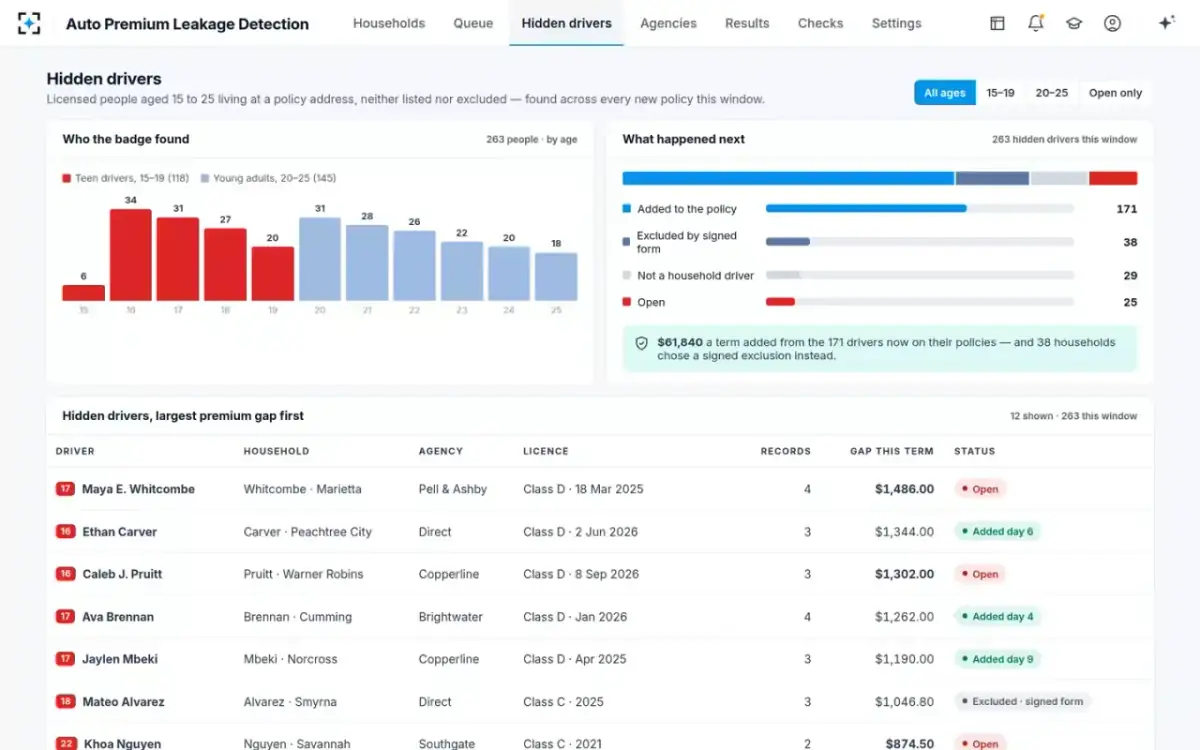
The sample book shows how often a plausible match is wrong. Of 263 hidden drivers its checks found in one 60-day window, 29, or 11%, were closed as not household drivers. Another 38 households chose to exclude the person by a signed form, 171 added them, and 25 were still open. A process that re-rated all 263 on the report alone would have charged 29 households for someone who does not drive their car.
What happened to 263 hidden drivers found on the sample book
Age matters too. Of the 263, 118 were teenagers aged 15 to 19 and 145 were young adults aged 20 to 25, the age band where a person is most likely to be at college, newly moved out or back home for a while. One sample household's 18-year-old was a student living 68 miles away; whether she counts as a household driver depends on the policy's definitions and the family's facts, which is exactly why someone has to ask.
Do all drivers in a household need to be on the policy? What the carrier's form and the state decide
Usually the application asks the household to list every licensed driver and permit holder living there, and leaving one off can change the premium and, in a dispute, the coverage. The precise rule depends on the policy and the state. Two pieces of law show how differently states approach the household.
Texas defines a household as "a unit composed of individuals living together in the same dwelling, without regard to whether they are related to each other", and since 2019 has barred insurers from issuing a "named driver policy", one that does not cover every permitted household resident, except as an operator's policy. A household member can be left out only by a named driver exclusion that "specifically names each excluded driver" and that the named insured "accepts … in writing" (Tex. Ins. Code §§1952.351–.353). So in Texas the question is less whether an unlisted teenager is covered and more whether the premium reflects them.
The NAIC's model act takes the household seriously from the other direction. Among the reasons an insurer may cancel an established auto policy, it repeatedly names "any operator who resides in the same household or customarily operates an automobile insured under the policy" (Model Act #725). The household, not just the named insured, is the unit being insured.
The missing-fact decision: match, ask, wait, re-rate
The fair order is to match, then ask, then wait, and only then re-rate, with a person deciding at the last step. Each stage has a question with two answers, and every answer leads somewhere definite, so no finding sits in limbo and none becomes a charge without the household having had its say.
Four questions between a report and a premium change
1Match
Does an outside report place a person of driving age at the address who is neither listed nor excluded?
YesGather every source on that person: licence, prior policy, the car’s registration date.
NoNothing to ask. The roster stands.
2Ask
Is the premium at stake above the carrier’s ask threshold?
YesOne request to the agency: add the person, return a signed exclusion, or tell us they do not live here.
NoNote it for the renewal review instead of troubling the household now.
3Wait
Has the agency replied inside the reply clock?
YesRead the reply. A signed change form or an exclusion settles it; a plausible “moved out” closes it.
NoA reminder, then a plain letter to the insured. Still no re-rate on the report alone.
4Re-rate
Did the household confirm the person, or does the evidence leave no reasonable doubt?
YesRe-rate under the filed plan; an underwriter signs; the adverse action notice goes with the endorsement.
NoClose the finding with the reason, so the next review does not ask again.
The threshold at the second step does real work. On the sample book, 503 of 814 differences were below $75 a term and were noted for the renewal review rather than raised with an agency mid-term. That keeps small gaps from becoming a stream of emails to producers, and it puts the agency's attention on the 146 households where the difference is worth a conversation.
Why the request goes to the agency before anyone re-rates
The agency knows the household and the household trusts the agency, so a question from the producer is answered faster and more honestly than a letter from an underwriter. Most omissions are not lies. Parents of a newly licensed teenager often do not think of them as a driver yet, and the application's question about other licensed drivers is easy to answer quickly.
The request should be one message, not three. It names the person, the evidence and the choice: add the driver, return a signed exclusion, or say they do not live there. It sets a date. It says plainly that the carrier will take out anything that is wrong. In the sample, the household's agency replied on the day the request was sent with a change form signed by both parents.
The household screen: the roster against the people found at the address
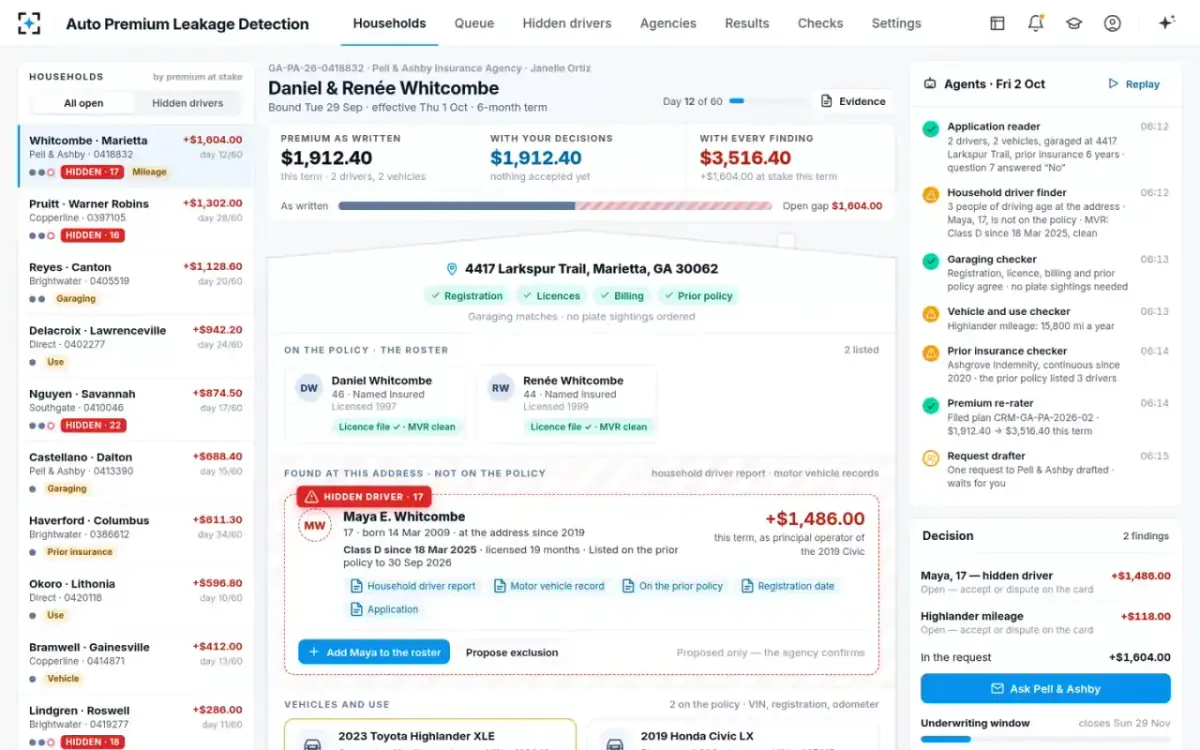
A good request also shows its working. The household screen above lists five sources behind the hidden-driver badge: the household report, her driving record, the prior policy, the registration date of the second car and the application's own answer. When the agency forwards the question, the insured can see why it is being asked.
What the household is owed when a report raises the premium
When a premium goes up "based in whole or in part on any information contained in a consumer report", the FCRA requires a notice to the consumer (FCRA §615(a)). The notice must give the reporting company's name, address and telephone number; a statement that the company "did not make the decision to take the adverse action and is unable to provide the consumer the specific reasons why the adverse action was taken"; and the consumer's rights to a free copy of the report within 60 days and to dispute its accuracy with the reporting company.
Every rating fact, declared against found, with its sources
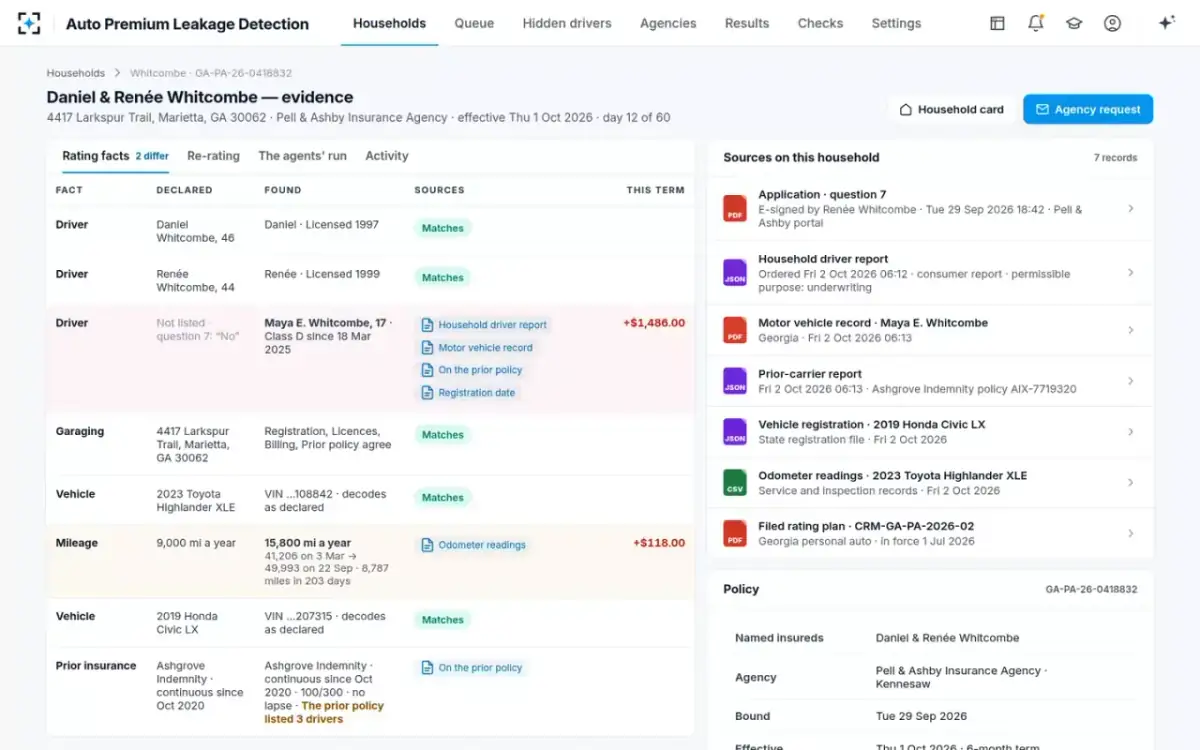
The notice is owed when the report contributed to the increase, even if the household then confirmed the facts. A process that sends the endorsement without it has a compliance gap on every corrected policy. Building the notice from the same evidence as the request, and sending it with the endorsement, closes that gap by design.
One household's hidden driver in Auto Premium Leakage Detection
In the solution, the work is split between agents that read and people who decide. The steps below are the sample household's, from the morning the agents ran to the afternoon the underwriter signed.
From a household report to a signed endorsement, step by step
Agent
Application readerLists the facts as declared: 2 drivers, 2 vehicles, question 7 answered “No”.
Never: infers an answer the applicant did not give
Agent
Household driver finderFinds 3 people of driving age at the address; Maya, 17, is on neither the roster nor an exclusion.
Never: contacts the household or rates a person found
Agent
Prior insurance checkerThe prior policy listed 3 drivers, Maya among them, to 30 September.
Agent
Premium re-raterPrices Maya as principal operator of the Civic under the filed plan: +$1,486.00 this term, as a proposal.
Never: changes the policy
Agent
Request drafterOne request to the agency and the adverse action notice, drafted for the underwriter.
Never: sends anything itself
A person decides
UnderwriterSends the request, reads the signed change form, signs the endorsement with the notice.
The finder ran at 06:12 on the second day of the policy. The underwriter, Nadia, opened the household on day 12, because the queue sorts by premium at stake and hers was the largest. She sent the request; the agency replied that afternoon with the change form signed by both parents; she signed the endorsement, and the notice went with it. Across the sample book, the agents found each policy's differences with a median of 2.6 days from bind. How a carrier should judge that kind of tool before buying it is set out in a 30-day pilot on your own book; the whole solution is at Auto Premium Leakage Detection.
Every hidden driver found in the window, and what happened next
Questions people ask
How do insurance companies find out about other drivers?
From the application, a household driver report tied to the address, state motor vehicle records, the prior insurer's policy and claims records, and vehicle registrations. A claim involving a driver nobody listed is the late and expensive way they find out.
What does an insurer do when a household member is not on the policy?
It usually asks the policyholder to add the person, exclude them by a signed form where the state allows, or explain why they do not drive the car. If the premium rises because of a consumer report, the insurer owes a notice naming the reporting company and the policyholder's right to a free copy and to dispute it.
What does undisclosed driver mean in car insurance?
A person who lives in the household and drives, or can drive, the insured cars but is not on the application or the policy. On the solution's fictional sample book they were the largest single kind of difference: 263 of 814 households with one.
Can a household driver report be wrong?
Yes. It shows people associated with an address, which can include adult children who moved out, students living elsewhere or former residents. On the sample book, 29 of 263 people flagged were closed as not household drivers.
How do car insurers verify the garaging address?
They compare the garaging address on the application with the car's registration, the driver's licence address, the billing address and the prior policy. When those disagree, some carriers order further checks. The garaging question, and the state that counts misstatements of it, is covered in rate evasion insurance.
What is an MVR in insurance?
A motor vehicle record is the state's driving record for one person: licence status, class, issue date and violations. It tells an insurer whether someone is licensed and how they drive; it does not show where they live.