The auto insurance underwriting process, in one line: analyse applications, judge the risk of insuring each driver and vehicle, decide whether to offer cover, and set the premium and terms under the carrier's filed rating plan. In personal auto most of that first decision is now automated at the point of sale, so the underwriter's distinctive work comes after bind: checking the household's declared facts against outside reports, asking the agency when they differ, and signing the correction that follows. The signature is where the job's authority and accountability sit. Auto Premium Leakage Detection is Botminds' software for that post-bind work: seven agents read the reports, match the facts and re-rate under the filed plan, and the underwriter decides and signs every correction.
This page is for underwriters, their managers and the compliance teams who need to know who answered for each change. The occupation figures come from the U.S. Bureau of Labor Statistics; the examples of the solution come from its fictional Georgia sample book.
Insurance underwriters in the United States
125,600
insurance underwriter jobs in 2025
−4%
projected employment change, 2025–35
52%
employed by direct insurers other than life, health and medical carriers
The auto insurance underwriter's duties, as the BLS writes them
The BLS describes the underwriter's work as analysing the information on applications, determining the risk of insuring a client, screening applicants against set criteria, using and reviewing automated underwriting software, contacting field staff and others for more information, deciding whether to offer insurance, and setting premiums and coverage amounts (Occupational Outlook Handbook). It names the auto case explicitly: "For someone applying for car insurance (a form of property and casualty insurance), underwriters consider the person's driving record."
That description is accurate and incomplete for personal auto. The driving record is ordered and scored automatically at quote, as are most of the other rating inputs. What the software cannot do is know whether the application was true. A household that leaves out a newly licensed teenager is rated cleanly, on a clean record, for the wrong drivers. Finding that, and deciding what to do about it, is the part of the job a generic description leaves out.
The BLS also notes, in its outlook, that automated software lets underwriters process applications faster and so reduces the number needed, which is why it projects a decline. In personal auto, that automation has moved the underwriter's attention from the first decision to the later one: is the policy we wrote the policy we meant to write?
What is auto underwriting? The process, from quote to renewal
Auto underwriting is the process of deciding whether to insure a driver and vehicle and on what terms, and in personal auto it runs in two passes. The first is at the point of sale. The agent or website collects the application, the carrier's systems order the driving records and claims history, apply the rating plan and bind the policy. California, for example, requires insurers to check the driving record of every listed driver at application and again whenever a driver is added (10 CCR §2632.5; the other sources an insurer reads are in how car insurance companies know who lives with you).
The second pass happens after bind, in the policy's first weeks. The underwriter compares what the application declared with outside reports: household driver reports, prior-carrier records, registrations and odometer readings. Differences become requests to the agency, then corrections by endorsement, or, rarely, a decision not to keep the risk. Under the NAIC model act and in states such as Texas and Florida, the first 60 days are when that last option is widest; the rules either side of day 60 are compared in what changes on day 61.
The cycle closes at renewal, where small differences that were noted rather than raised are reviewed, and where a carrier can decline to renew on proper notice. A personal auto underwriter's week is therefore a mix of new business in its window, renewals coming up, and the occasional file that has turned into a claim.
What is an underwriting review for car insurance?
An underwriting review is the insurer's check, usually after the policy is in force, that the facts it was rated on are true. To a policyholder it arrives as a request from the agent: confirm who drives, send a copy of a licence, prove the garaging address, send an odometer photo. To the carrier it is a file the underwriter must be able to defend to an examiner. The NAIC's examination standards ask that the documents in the file support the decision, and that rating and classification rest on information gathered at or near inception rather than at expiry or after a claim (examination standards; why the timing matters is set out in what premium leakage is).
The second standard is the review's deadline in all but name. A review that turns up a hidden driver in week one meets it. One that turns up the same driver in the police report after a crash does not, and the carrier will be explaining why it changed the terms only after a loss.
The part most role descriptions leave out: signing a correction
The underwriter's signature on a correction says three things: the finding is right, the price is the filed price, and the household has had its say. Each needs evidence, and each can be checked later by a manager, an examiner or a court. That is why the signing, not the finding, is the core of the role once reports are cheap to order.
From a finding to a signed correction, and who does each step
Agent
FindAgents compare the declared facts with the reports and raise a difference with its sources.
Never: contact the household
Agent
PriceThe re-rater prices the difference under the filed plan in force on the effective date.
Never: change the policy
A person decides
AskThe underwriter reviews the draft and sends one request to the agency, with a reply date.
A person decides
ConfirmThe agency returns the insureds’ signed change form, an exclusion, or an explanation.
A person decides
SignThe underwriter signs the endorsement: change, premium, effective date; the notice goes with it.
A person decides
Co-signAbove the carrier’s limit, the underwriting manager co-signs. A cancellation needs the manager and compliance.
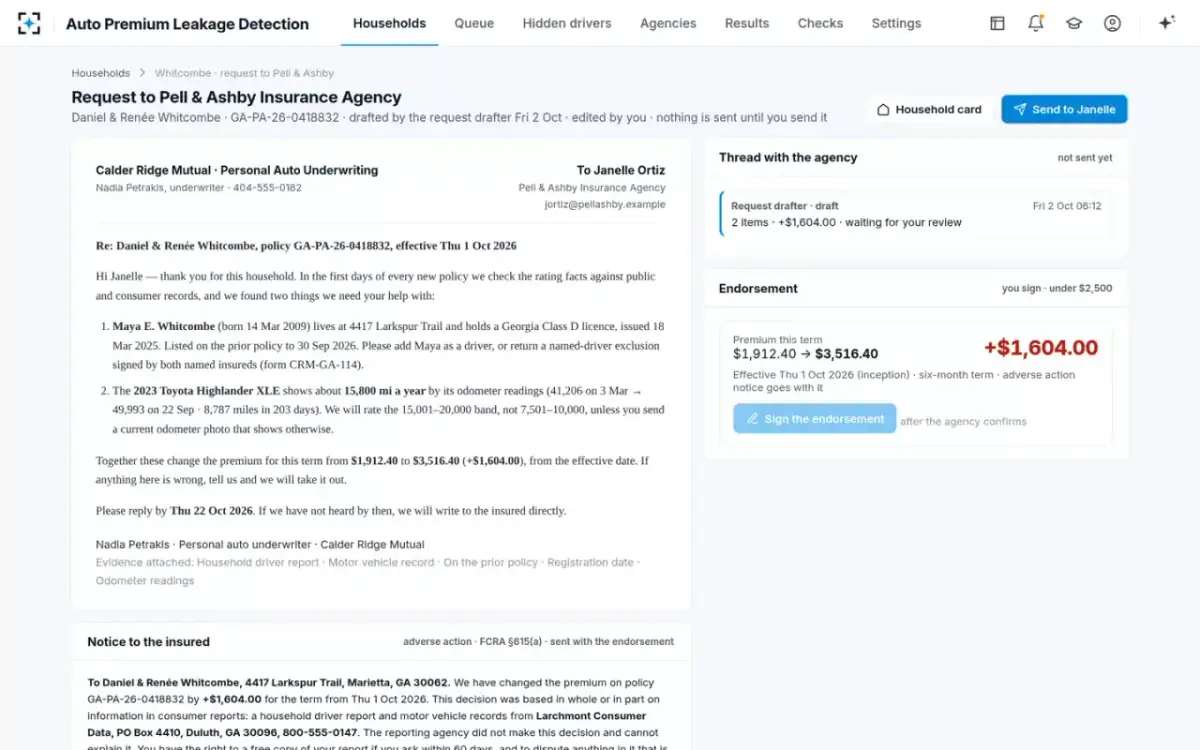
One request to the agency, drafted for the underwriter to send
Who signs what, from the agency to compliance
A premium correction passes through four sets of hands, and each signature means something different. The household confirms facts; the underwriter certifies a price; the manager adds a second view on large changes; compliance answers for any termination. Mixing them up is how a carrier ends up with a cancellation nobody can defend.
Six actions on a correction, and what each signature means
| Action | Prepared by | Signed by | What the signature means |
|---|---|---|---|
| Confirm the household’s facts | Prepared byThe request drafter writes the ask | Signed byThe named insureds, on a change form, through the agency | What it meansThe facts are true as the household knows them. |
| Exclude a household driver | Prepared byAgency, on the carrier’s exclusion form | Signed byBoth named insureds | What it meansThey accept no cover when that person drives. |
| Correct the premium | Prepared byPremium re-rater prices it under the filed plan | Signed byAny auto underwriter | What it meansThe finding is right, the price is the filed price, the effective date is proper. |
| Correct above $2,500 a term | Prepared byAs above | Signed byUnderwriter, co-signed by the underwriting manager | What it meansA second person agrees a large change is warranted. |
| Send the adverse action notice | Prepared byRequest drafter, from the reports actually used | Signed bySent by the underwriter with the endorsement | What it meansThe insured is told which report was used and their rights. |
| Cancel or rescind | Prepared byNever prepared from a finding alone | Signed byUnderwriting manager and compliance | What it meansA listed ground exists, the notice is right, the file supports it. |
Two of those signatures carry legal weight beyond the carrier's own rules. If the increase rests in whole or in part on a consumer report, the insured must be told which reporting company supplied it and that the company did not make the decision, along with the right to a free copy and to dispute it (FCRA §615(a)). And any cancellation needs a ground the state lists and the notice it requires; the NAIC model act requires the notice to explain the specific reasons in writing (Model Act #725; the state versions are compared in the 60 day underwriting period).
Why a cancellation never rests on one finding
A finding is a report's view of the household; a cancellation is the carrier's decision to end cover, often with a claimant or regulator watching. The two are different in kind, and treating the first as enough for the second is the most expensive mistake an underwriting team can make. Reports are wrong in ordinary ways: an adult child who moved out, a student away at college, a former address. On the sample book, 29 of 263 people flagged as hidden drivers were closed as not household drivers.
So the sample carrier's rule is that a cancellation or rescission is never made from a finding alone. The underwriting manager and compliance sign it, after the household has been asked and the state's ground and notice have been checked. The underwriter's job is to make sure that, by the time anyone considers it, the file shows what was asked, what was answered and what the reports said.
Fewer underwriters, more sign-off: what the BLS numbers say
The insurance underwriter occupation held about 125,600 jobs in 2025, according to the BLS, which projects employment to fall 4% from 2025 to 2035. About 52% of underwriters worked for direct insurers other than life, health and medical carriers, and 24% for insurance agencies and brokerages (BLS).
The BLS does not break out personal auto underwriters, so their numbers sit inside these totals. The direction is clear enough: fewer people handling routine applications, and more of the remaining work in judgement, review and sign-off.
How the job changes with Auto Premium Leakage Detection
With the solution, the underwriter stops ordering and reading reports and starts each household with the reading done, the difference priced and the request drafted. The four roles on a new business team change in different ways. In the sample, they look like this.
Four people who carry a new auto policy, before and after
Today
“I sample a tenth of new households; the other nine renew on what the application said.”
With agents
Opens each household with the reports already read, the difference priced under the filed plan and the request drafted.
Still theirs: the decision and the signature on every correction
Today
“If we cancel on day 61, it’s not a cancellation, it’s a lawsuit.”
With agents
Owns three of the six checks and sets the $75 ask threshold; co-signs corrections over $2,500 a term.
Still theirs: every cancellation or rescission, with compliance
Today
“Half my week is emailing agents for a driver’s licence number.”
With agents
Works from one request per household, with evidence attached and a reply clock: a reminder on day 5, a letter to the insured after 10.
Still theirs: the relationship with each agency’s staff
Today
“The agent wants one clear ask, not three emails.”
With agents
Sees differences and reply times by producing agency, with a respectful note to an agency drafted.
Still theirs: the conversation, which is never a verdict
The signature: change, premium and effective date, confirmed in one step
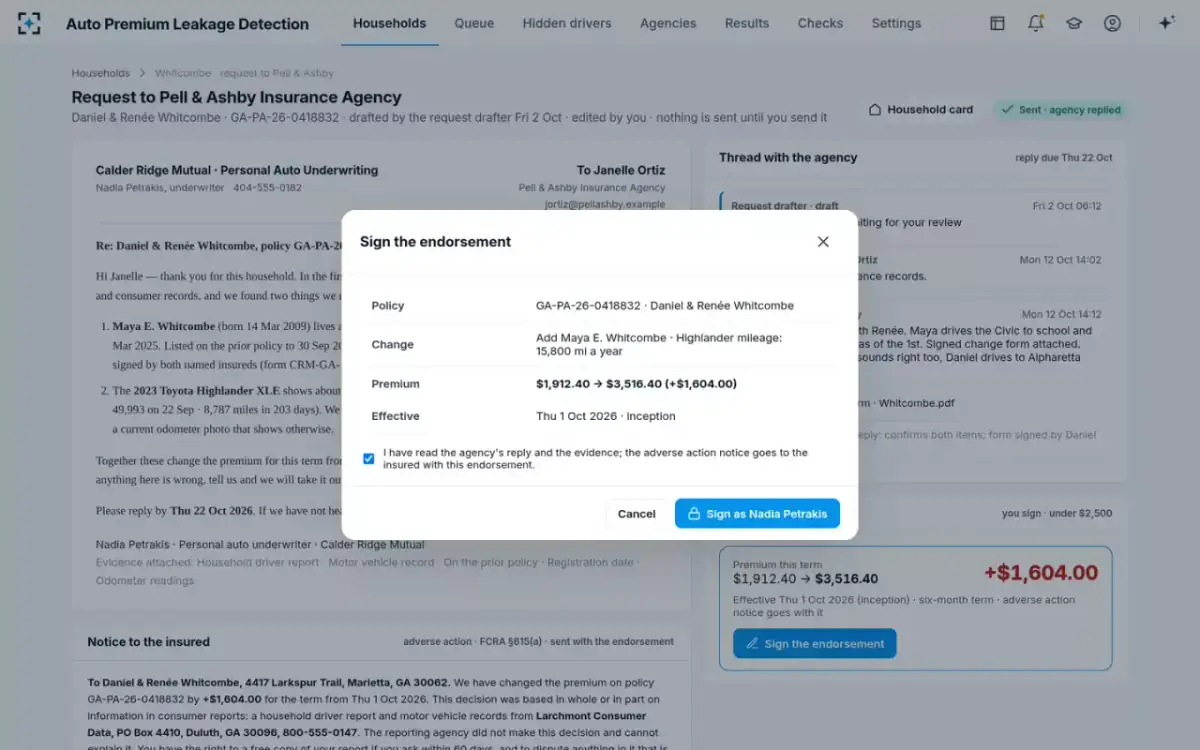
The work that remains is the work the role implies but rarely names: judging evidence, deciding, and answering for it. The agents never change a policy, contact a household or send a request. On the sample book, the median time from bind to a finding was 2.6 days. The team's time goes into the 146 households that need a person, out of 814 with a difference. How the agents find those differences without accusing anyone is in how insurers know who lives with you, and a guidelines question an underwriter cannot answer from memory belongs to Botminds' Underwriting Guidelines Assistant, described in an underwriting chatbot that cites the rule. The solution itself is at Auto Premium Leakage Detection.
Questions people ask
What does a personal auto underwriter do day to day?
Reviews new policies in their first weeks against outside reports, sends requests to agencies when the facts differ, signs premium corrections, and handles renewals and referrals. Most first-pass decisions are made by rating software at quote, which the BLS describes underwriters as reviewing.
Is auto insurance underwriting automated?
Mostly at quote. The BLS describes underwriters as using and reviewing automated underwriting software, and in personal auto rating software makes most first-pass decisions at the point of sale. The post-bind review, the request to the agency and the signature on a correction stay with a person.
What should a carrier write into an auto underwriter's authority?
A premium limit for corrections signed alone, the point at which a manager co-signs, and the actions no underwriter takes alone, such as cancellation or rescission. Knowledge of the state rules on notices, cancellation and adverse action belongs beside it, because those govern what an underwriter may sign.
Can an underwriter cancel a car insurance policy alone?
That depends on the carrier's authority rules and the state's law. Carriers set their own approval rules; on the solution's sample book, a cancellation or rescission needs the underwriting manager and compliance, and never rests on a report alone.
What authority does an auto underwriter have over premium?
Within the carrier's limits, an underwriter can sign a correction under the filed rating plan. On the sample book, any auto underwriter signs a correction up to $2,500 a term; above that the underwriting manager co-signs.