An SIU referral form is the internal document a claims adjuster, underwriter or other claims staff member uses to send a suspected fraudulent claim to the insurer's special investigations unit (SIU), with the red flags that prompted it and the evidence behind each. It is not the report to the state: in California that is a second form, the FD-1, which the insurer files with the Department of Insurance after its own investigation. The hard part is that three different people answer for three different things along the way, and a weak form wastes all three of their weeks. Botminds' Claims Fraud Detection reads every new claim at first notice and drafts the referral with each reason tied to its source line; an SIU intake analyst still decides whether it goes in.
The examples come from a fictional sample claim as it runs through the solution: a $48,620 homeowners burglary reported by Darren Meachum at 09:14 on Tuesday 20 October, handled by adjuster Felipe Arguello at a sample carrier, Kittredge Mutual. The rules come from California's SIU regulations, which spell out who refers what in unusual detail, and from the Department of Insurance's own forms and training.
Four people carry one referral, and each answers for something different
Today
Spots the signals between 140 other files, writes the referral by hand, and often refers late or not at all.
With agents
Is told when a claim crosses the referral line, answers any question the SIU sends back, and keeps the claim moving.
Still theirs: The duty to refer, and the claim on its fair-claims clock.
Today
Rebuilds what the adjuster saw from the declarations, application and claim history before deciding.
With agents
Opens a drafted form whose every reason links to the line that supports it, then accepts, returns or closes.
Still theirs: The decision, and a written reason for every referral closed without an investigation.
Today
Starts from a thin narrative and asks for the file again.
With agents
Starts from an evidence index and three suggested first steps.
Still theirs: Every investigative call, including whether to request an examination under oath.
Today
Signs state reports drafted from scratch near the deadline.
With agents
Owns the red-flag list and its points, and approves reports drafted from the case file.
Still theirs: The insurer's report to the state and the list the adjusters are trained on.
What is an SIU referral form, and how is it different from the FD-1?
The SIU referral form travels inside the insurer; the FD-1 travels to the state. The first is written by claims staff when a claim shows red flags, so the SIU can decide whether to investigate. The second is written by the SIU after it has a reasonable belief that fraud may have occurred, so the Fraud Division and, for workers' compensation, the district attorney can decide whether to open a criminal case.
California sets the content of the state form in detail, field by field, in 10 CCR § 2698.38, and the Department prints it as the FD-1. It sets no template for the internal form. What it does instead is require the SIU to write and distribute procedures that tell claims staff how "to detect, identify, document, and refer suspected insurance fraud to the SIU" (§ 2698.35(b)). The internal form is whatever those procedures say it is, which is why it varies so much between carriers.
Two forms, two thresholds: the internal referral and the state report
SIU referral form (internal): Claims handlers, underwriters, call-centre and legal staff: the people California calls integral anti-fraud personnel.
FD-1 (to the California Department of Insurance): The insurer, through its SIU or the person named in its antifraud procedures.
SIU referral form (internal): A red flag: facts that, singly or in combination, support an inference that fraud may have been committed.
FD-1 (to the California Department of Insurance): A reasonable belief: an objective justification based on articulable facts and rational inferences from them.
SIU referral form (internal): None in the regulation; carriers set their own.
FD-1 (to the California Department of Insurance): Within 60 days after determining that a claim appears to be fraudulent (Ins. Code § 1872.4, as printed on the form).
SIU referral form (internal): Set by the insurer's written procedures.
FD-1 (to the California Department of Insurance): Set by § 2698.38: parties and identifiers, loss amounts, and a summary answering who, what, how and whether the investigation is complete.
SIU referral form (internal): The SIU investigates, or closes it at preliminary review with its reasons written down.
FD-1 (to the California Department of Insurance): The Fraud Division reviews it and may open a case; workers' compensation reports also go to the district attorney.
Who can refer a claim to the SIU? Anyone the regulation calls integral anti-fraud personnel
In California, any employee whose work touches a claim or an application may, and is expected to, refer. The regulation defines integral anti-fraud personnel as staff outside the SIU whose work may involve processing, investigating or litigating whether a claim is paid, and lists "claims handlers, underwriters, policy handlers, call center staff within the claims or policy function, legal staff" (§ 2698.30(l)).
Referring is part of the job, not a favour to the SIU. "An insurer's integral anti-fraud personnel are responsible for identifying suspected insurance fraud during the handling of insurance transactions and referring it to the SIU as part of their regular duties," says § 2698.35(a). The same section makes the SIU responsible for the tools: written procedures, distributed and monitored, with a separate list of red flags for each line of insurance or product.
Two consequences follow for anyone designing the form. It must be short enough that a call-centre representative can send one, not only a senior adjuster. And it must be built around the red-flag list for that line, because the regulation expects every transaction to be compared against it: the procedures "shall provide for comparison of any insurance transaction against red flags and other criteria that may indicate possible fraud" (§ 2698.35(c)). A form that asks for a free-text narrative and nothing else leaves that comparison to memory.
When should an adjuster refer a claim to the SIU? On a red flag, not on proof
An adjuster should refer when the file shows a red flag, and should not wait for proof. The thresholds are deliberately different. A red flag only has to support an inference that fraud may have happened; reasonable belief, the bar for the report to the state, needs facts someone can state and the inferences they reasonably support (§ 2698.30(m)–(n), quoted and compared in the guide to red flags in insurance claims). The gap between them is the SIU's work.
The Department's own training slides draw the line on a sample auto claim. A new policy bought days before the loss, a neighbour's statement, a database hit for a prior accident and a claimant who withdraws once the SIU calls are listed as red flags. Doorbell camera footage, photo metadata, a prior carrier's photos of the same damage and a tow bill dated before the policy started are listed as what establishes reasonable belief (CDI SIU compliance training). The adjuster's job ends at the first list. Waiting for the second turns a referral into an investigation the adjuster has no time or authority to run.
What separates a good referral from a weak one is not the strength of the suspicion but whether each flag arrives with the line in the file that shows it, and with what was checked that might explain it innocently. The method for testing a red flag against its innocent explanation is worked through separately.
What the SIU needs in a referral form: seven parts that save the intake morning
The intake analyst needs enough to decide in minutes whether the referral is credible, and nothing that sends them back to the claim system. The list below is our recommendation, built backwards from what California makes the SIU do with a referral and what it later puts on the FD-1, so that nothing has to be typed twice.
Seven parts of an SIU referral form, and why each is there
- The claim, policy, line and loss type
Red flags are written per line, so the intake analyst needs to know which list the referral was compared against.
- Each red flag, quoted from the list, with the line in the file that shows it
A credible referral is one that includes a red flag (§ 2698.36(c)); a flag without its source is an opinion.
- What was checked that could explain each flag innocently, found or not
The SIU may close only where it is reasonably clear the flag is not fraud, and must say why; give it the checks already made.
- The money: potential loss, paid to date, and any suspected amount paid
The same three amounts the state form asks for in § 2698.38(d)(6)–(8), captured while the adjuster knows them.
- The parties, with the identifiers used to match them
Names, roles, phone, address, licence and vehicle numbers: the party fields of § 2698.38(g), and the basis for any prior-claim match.
- The claim's own clocks
Acknowledgement, the accept-or-deny deadline and status letters keep running; the SIU should see them on the form.
- Who referred it, and the one question they want answered
So a returned referral goes back to a named person with a specific question, not into a general inbox.
The money fields matter more than they look. In November 2024 the Department told its Fraud Assessment Commission that its intake now flags FD-1s that arrive short of information and follows them up with the carrier (FAC minutes; more in how often insurance fraud is prosecuted). Most of what makes a state report thin was missing from the internal referral first.
Can the SIU refuse a referral? Only with its reasons written down
The SIU can decline to open an investigation, but in California it must write down why. The rule starts from a duty, not a discretion:
The SIU shall investigate each credible referral of suspected insurance fraud that it receives from integral anti-fraud personnel, including automated or system-generated referrals.
10 CCR § 2698.36(c)
The exception is narrow. If, "upon a preliminary review the SIU determines that it is reasonably clear that the red flag or red flags contained in the referral is not or are not the result of suspected insurance fraud," it need not open an investigation, but it "shall document in the claim file or SIU investigation file the reasons supporting its conclusion." Examiners check exactly that. The Department's compliance training asks two questions of every sampled file: "Was investigation opened for all valid red flags?" and "If an investigation was not opened, was it documented why?"
In practice intake has a third answer: send the referral back with a question. The regulation does not mention it, and it should not become a way of declining without a reason. A returned referral is still a referral with red flags; it needs either an answer that clears the flag, which goes in the file as the reason, or an investigation.
Does an automated fraud score count as a referral?
Yes, in California, when it carries a red flag. The SIU's duty covers "automated or system-generated referrals" in the same sentence as referrals from people, and a credible referral "is one that includes a red flag or red flags." Two practical points follow.
First, the referral line on a scoring system is a compliance setting, not only an efficiency one. Every claim it sends across becomes SIU work that ends either in an investigation or in a written reason. Set it low and the SIU drowns in closures it must justify; set it high and adjusters stop referring because the system is supposed to. Second, a bare number is hard to defend as a red flag. A score of 812 says nothing an intake analyst can check. A score that is the sum of named red flags, each linked to its evidence, is a referral the regulation recognises. How such a fraud scoring model should be validated is its own question.
California also trains for this. New employees must receive an anti-fraud orientation "within ninety (90) days of commencing assigned duties," and claims staff an annual in-service that covers "identification and recognition of red flags or red flag events" (§ 2698.39). A tool that refers on their behalf does not remove the duty; it changes what the training has to teach, from spotting the flag to reading the reason the system gives.
From the SIU to the state: the second form and its 60-day clock
The FD-1 follows the investigation, not the adjuster's referral. The state report is owed once the facts create a reasonable belief that someone may have committed or is committing fraud, and it must say whether the investigation is finished or still running (§ 2698.37). The form gives the insurer 60 days from determining that a claim appears fraudulent, and sends workers' compensation reports to both the Department and the district attorney (FD-1); the FD-1 form, field by field, is a guide of its own.
Payment does not change the duty. At the same Commission meeting the Department's SIU audit manager explained that "the statute says 'regardless of payment status'," and that a claim settled before the investigation finished should still be reported. Other states set their own clocks, Texas and New York among them at 30 days; the state-by-state reporting rules and the FD-1 itself belong to the SIU's case file.
The internal form decides how hard that second form is to write. The state summary must say what facts caused the belief, what was misrepresented and by whom, why it matters, who the witnesses are and what documents exist (§ 2698.38(d)(9)). A referral that arrived with each flag sourced has already answered the first and last of those.
Who answers for each signature, and what no agent signs
The chain has four human decisions, and software can sit between them without taking any. In the sample carrier's set-up in Claims Fraud Detection, six agents read and draft; people refer, accept, investigate and report.
One referral, from first notice to the state: who does what in Claims Fraud Detection
Agent
Claim readerReads first notice, notes, documents and photos; writes each detail with its source line.
Never: Decides coverage or contacts the insured.
Agent
Indicator matcher and history checkerMatch the details to the approved red-flag list and to prior claims, needing two identifiers for a match.
Never: Uses a reason outside the approved list.
Agent
Innocent-explanation checkerLooks for what explains each reason and shows every check, found or not.
Never: Removes a reason.
A person decides
Claims adjusterIs told the claim crossed the line; answers any returned question within a business day.
Never: Stops handling the claim while the SIU decides.
A person decides
SIU intake analystAccepts, returns with a question, or closes with a written reason.
Agent
Packet writerDrafts the referral packet with an evidence index and suggested first steps.
Never: Recommends coverage or denial.
A person decides
SIU investigator and fraud managerInvestigate, decide on reasonable belief, and file the state report from the case file.
How Claims Fraud Detection drafts the SIU referral form from the claim file
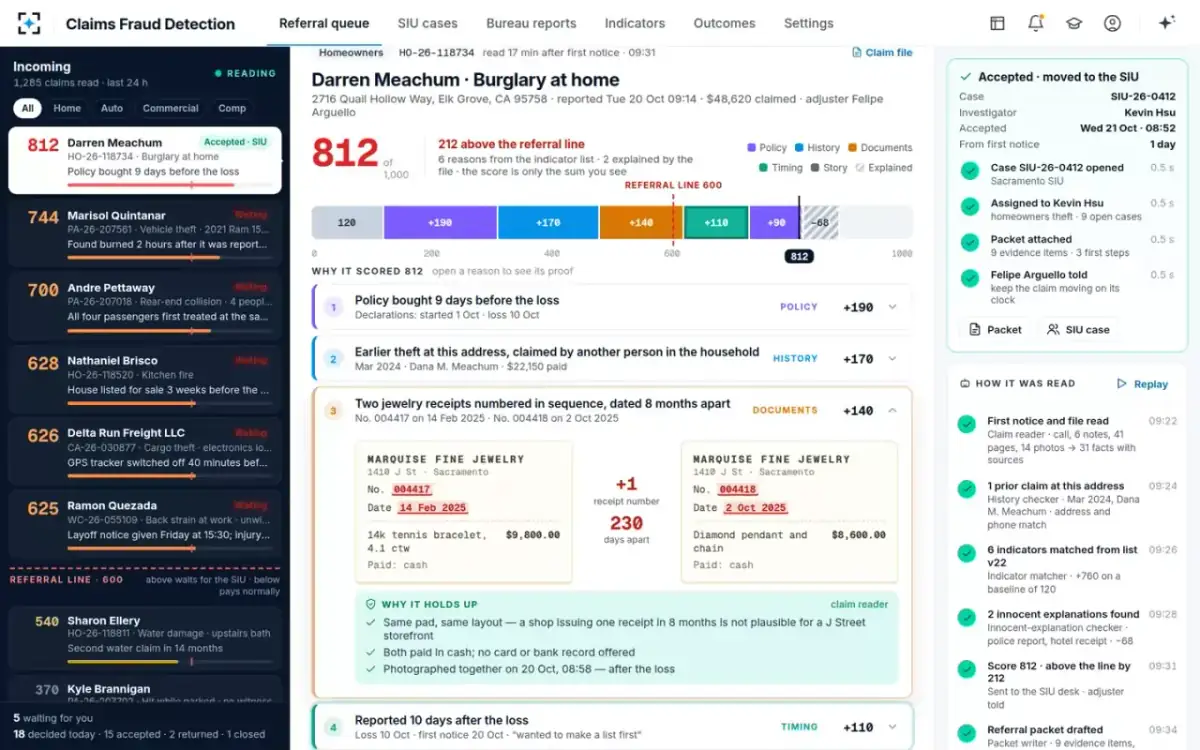
The sample claim shows the form being written by the time the intake analyst reaches it. The burglary was reported at 09:14; by 09:31 the agents had read the first notice call, six adjuster notes, 41 pages and 14 photos, found one prior claim at the address, matched six red flags from the carrier's list and found two innocent explanations. The claim scored 812 against a referral line of 600.
Imani Rourke, the sample SIU intake analyst, opened it the next morning. The top reason was a policy that started on 1 October, nine days before the loss, with the contents limit raised during the online quote from a suggested $42,000 to $70,000 and no prior insurer declared on a home owned since 2019. The second was a theft at the same address paid by another carrier in March 2024 to a household member, matched on address and phone. Against them, a police report on file took 40 points off and a hotel receipt for the trip the insured described took 28 off. She had three choices: accept, return it to the adjuster with a question, or close it with no referral. She accepted at 08:52.
The intake decision: accepted, assigned, and the adjuster told
The packet that went to the investigator is the referral form in finished state: a summary in which every sentence links to an evidence item, the six red flags with their points against an index of nine items, the two innocent explanations, the claim's California clocks and three suggested first steps. It ends with a sentence the carrier wrote into the packet's limits: "Examination under oath is the investigator's call under the policy conditions. Nothing here recommends a denial."
The referral packet: every sentence tied to its evidence, no recommendation on coverage
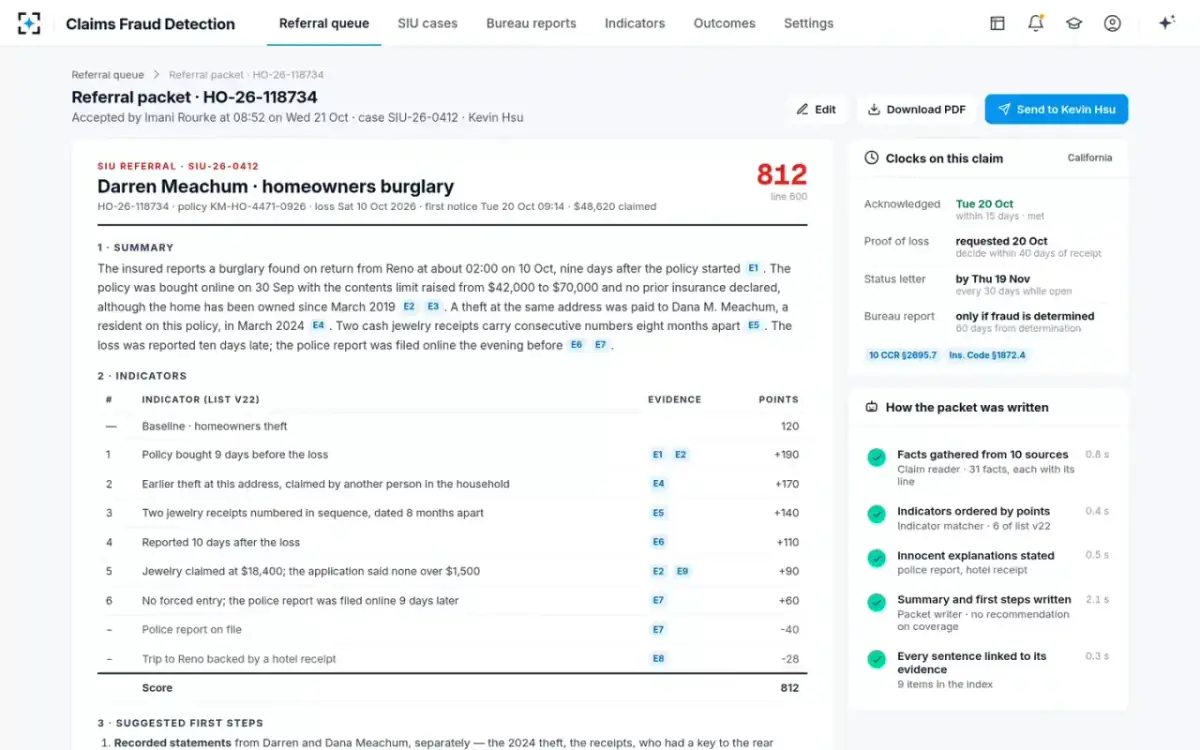
Three things on that page are the intake analyst's protection if an examiner later samples the file: the red flags come from the approved list for homeowners theft, each one opens to its evidence, and the closures she makes on other claims carry their reasons in the same place. The minute-by-minute trace of how the agents read this claim shows where each of those lines was produced.
Questions people ask
What is an SIU referral?
An SIU referral is a request from claims, underwriting or other staff for the special investigations unit to look at a claim or application that shows red flags of fraud. In California the SIU must investigate every credible referral, including system-generated ones, or write down why the flags are reasonably clearly not fraud. It is an internal step; the report to the state comes later and has its own form.
What happens after a claim is referred to the SIU?
Intake reviews it and either opens an investigation, closes it with a written reason, or in many carriers returns it with a question. An investigation includes a file analysis, witness interviews, industry database checks and a written summary (10 CCR § 2698.36(a)). If it produces a reasonable belief of fraud, the insurer reports to the Fraud Division within 60 days of that determination.
Who is responsible for reporting insurance fraud to the state?
The insurer. In California the SIU provides for referrals to the Fraud Division and, for workers' compensation, the district attorney (§ 2698.37(a)), and the form is filed within 60 days after the insurer determines a claim appears fraudulent. The NAIC's antifraud plan guideline asks each plan to name the person or group who reports suspected fraud for the insurer.
Does an SIU referral stop the claim?
No. The claim stays on its clocks while the SIU works. In California the 40-day accept-or-deny period can stretch to 80 days only where specific information the Department can review supports the suspicion (10 CCR § 2695.7(k)), and the insurer need not tell the claimant the claim is under fraud investigation.
Is there a standard SIU referral form?
Not for the internal referral; each insurer's procedures set it. State reports are standardised: California's FD-1 follows the fields in 10 CCR § 2698.38. The NAIC guideline asks antifraud plans to describe "the criteria used to report suspicious claims of insurance fraud for investigation to an insurer's SIU," which is in effect the referral form's rulebook.
Can an adjuster be penalised for not referring?
The regulation puts the duty on the insurer, which must train staff and show examiners that referrals happen. California can impose up to $5,000 for each act of non-compliance with the SIU rules and up to $10,000 for each wilful act (10 CCR § 2698.42). Individual discipline is a matter for the carrier's own procedures.