AI in insurance fraud detection is used mainly to read claims and decide which ones an investigator should look at, not to decide that a claim is fraudulent. In the NAIC's survey of private passenger auto insurers, 95 of 193 companies used AI or machine learning for fraud detection, and the use most of them reported was referring claims for further investigation (83 companies). The value is in reading everything at first notice: rule scores see structured fields, while the evidence of fraud usually sits in notes, documents and photos that nobody has time to cross-check. Botminds' Claims Fraud Detection is built that way: six agents read every new claim, score it with plain-word reasons, check each reason for an innocent explanation and draft the SIU referral, and an SIU intake analyst decides.
The trace below follows one fictional sample claim through the solution: a homeowners burglary reported by Darren Meachum at 09:14 on Tuesday 20 October, claiming $48,620. The industry figures come from the NAIC's own surveys of insurers, conducted under state market-conduct authority.
How insurers say they use AI against fraud
49%
of private passenger auto insurers surveyed used AI or machine learning for fraud detection
95 of 193 companies
83
of those companies used it to refer claims for further investigation, the most common fraud use
42%
of large homeowners insurers surveyed used AI or machine learning for fraud detection
26
homeowners insurers used it to detect organized crime rings
How is AI used in insurance fraud detection? Mostly to refer, rarely to decide
Insurers use AI chiefly to pick out claims for an investigator, and the surveys show it advising people rather than replacing them. In the auto survey, "companies reported currently using AI/ML models mostly as a referral of claims for further investigation (83 companies)," well ahead of detecting medical provider fraud (27), third-party liability (17) and fast-tracking claims that look clean (10), the use the claim scoring guide takes up. For referral models, the report found "an even split between augmentation and support," defined as a model that suggests an answer to the person deciding versus one that only provides information (NAIC auto survey).
The homeowners survey a year later found the same pattern, a little further along: "For the referral of claims for further investigation, most of the models augmented human decisions." It also found that "Fraud detection models are mostly from third-party sources," which matters for anyone buying, because the insurer stays answerable for a model it did not build (NAIC homeowners memo). And 26 homeowners insurers were using AI "to detect organized crime rings," a use that reads across many claims at once and is covered in fraud ring detection.
What the surveys describe, then, is a triage tool sitting in front of the special investigations unit. The useful question for a buyer is not whether a product uses AI but what it reads, what it writes, and what it leaves to a named person. One claim answers all three.
One claim in Claims Fraud Detection, minute by minute: 09:14 to 09:34
From first notice to a drafted referral took twenty minutes on the sample claim, and none of it needed a person. The agents started reading at 09:22 and finished the referral packet at 09:34.
Twenty minutes from first notice to a drafted SIU referral, on one sample claim
- Waiting for the file09:14–09:22
- File read, 31 details09:22–09:24
- Prior claim found09:24–09:26
- 6 red flags matched09:26–09:28
- 2 innocent explanations09:28–09:31
- Packet drafted09:31–09:34
At 09:22 the claim reader turned ten sources into 31 details, each with the line it came from: the first notice call, 6 adjuster notes, 41 pages and 14 photos. At 09:24 the history checker found one prior claim at the address, a theft paid by another carrier in March 2024 to Dana M. Meachum, a resident listed on the policy, matched on the address and the phone number. At 09:26 the indicator matcher compared the details with version 22 of the carrier's approved list for homeowners theft and matched six indicators. At 09:28 the innocent-explanation checker looked for anything in the file that explained each one. At 09:31 the score was set and the claim joined the SIU desk's queue; at 09:34 the packet writer had the referral drafted.
Each step is in the run log with its time, which is what an examiner, an auditor or the investigator later needs: not "the model said 812" but who read what, when, and what they wrote. The accountability chain from the adjuster to the state report shows who signs at each point after this.
Six agents in Claims Fraud Detection, and what each read and wrote on one claim
| Agent | Reads | Wrote on this claim | Never |
|---|---|---|---|
| Claim reader | First notice, notes, documents, photos and invoices | 31 details from 10 sources, each with its source line; what the 14 photos show and do not show | Decides coverage or contacts the insured |
| History checker | Prior claims for the policy, address, people, phones and bank accounts, internal and industry | One prior theft at the address, matched on address and phone | Counts a prior claim as proof; matches on one identifier |
| Indicator matcher | The approved indicator list and its points | Six reasons in plain words, adding 760 points to a baseline of 120 | Uses a protected trait, a ZIP code or neighbourhood on its own, or a credit-based score |
| Innocent-explanation checker | The file again, looking for what explains each reason | Police report on file, −40; hotel receipt for the trip, −28 | Removes a reason; hides a check that found nothing |
| Packet writer | Everything above | Summary, indicators, explanations, first steps and a nine-item evidence index | Recommends coverage or denial; writes to the insured; stops the claim clock |
| Outcome tracker | What the SIU finds on closed referrals | Nothing yet: this claim is still open | Changes the list itself; the fraud manager and a second approver decide |
What data does AI use to detect claims fraud? The whole file, not only the fields
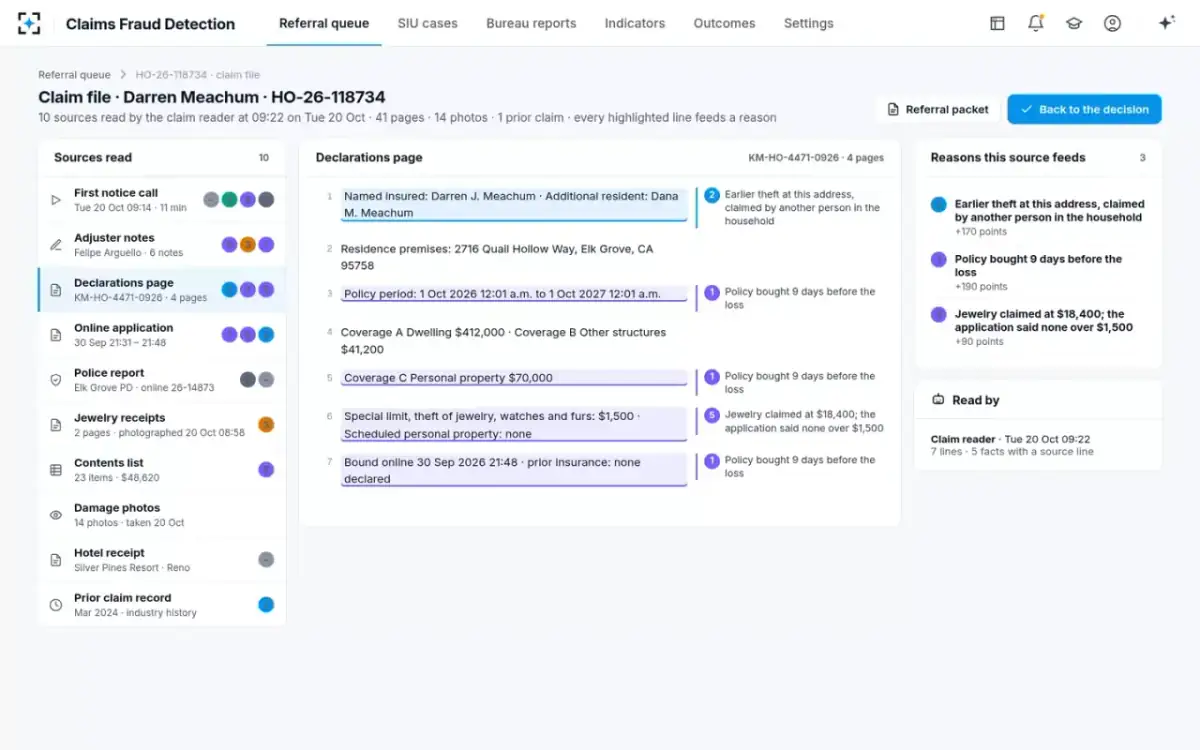
A fraud model is only as good as what it can see, and most of a claim is not in structured fields. On the sample claim, the strongest signals sat in places a rule score does not read: the policy's start date on the declarations page, an answer on the online application, a receipt number, the timestamps on photos taken by the insured.
Every highlighted line on the declarations page feeds a named reason
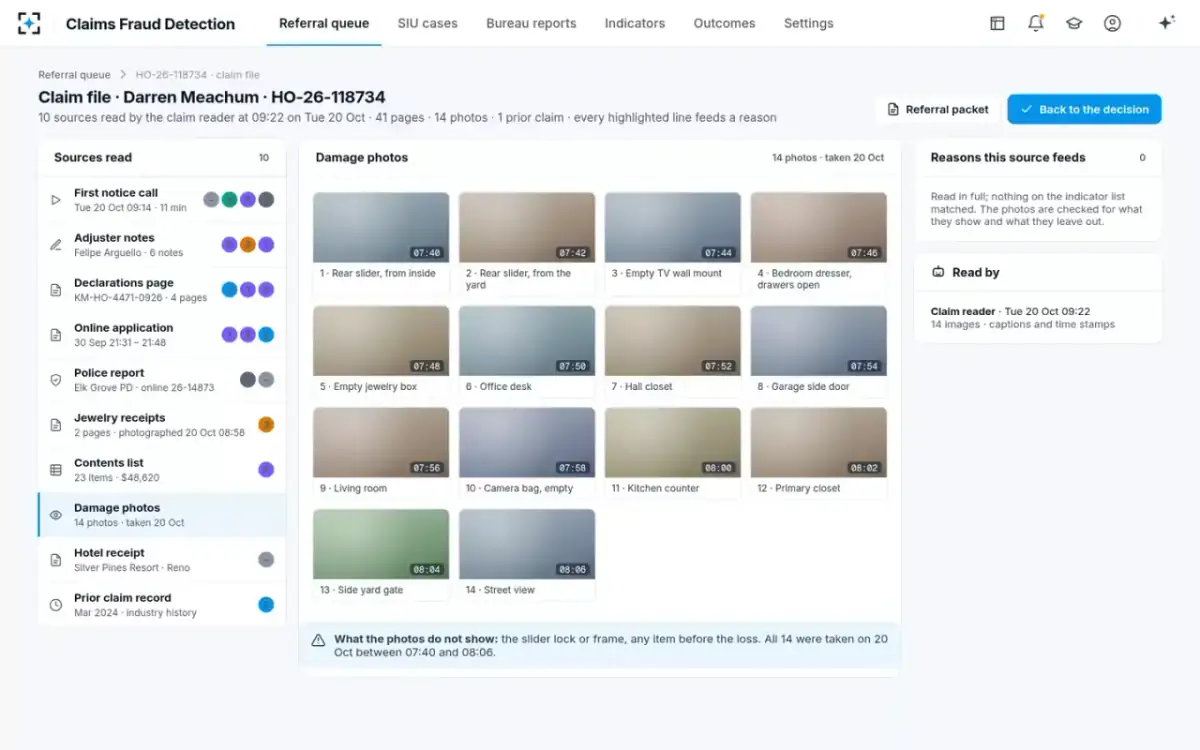
Photos are read for what they show and what they leave out. All 14 sample photos were taken on 20 October between 07:40 and 08:06, and the claim reader's note says what is missing: "the slider lock or frame, any item before the loss." That note is not a red flag on its own and the solution does not score it as one; it tells the investigator what to ask for. Public records come in the same way: the county record showing the home owned since March 2019 is what turned "no prior insurer declared" into something worth an investigator's time.
What the agents do not use matters as much. Race, colour, religion, national origin, sex, marital status, age, disability, a ZIP code or neighbourhood on its own, and credit-based insurance scores are locked off the carrier's list and cannot be added. California's claims regulation already bars insurers from discriminating in claims settlement on, among other things, where the insured property or person is located; a fraud reason built on a postcode would be hard to square with that.
How does AI explain a fraud score? As points that add up to the number
The clearest explanation of a fraud score is one where the score is nothing but the sum of reasons a person can read. On the sample claim the arithmetic is on the screen: a baseline of 120 for homeowners theft, six reasons adding 760, two innocent explanations taking 68 off. That is 812, which is 212 above the line.
The score is only the sum you see: 120 + 760 − 68 = 812
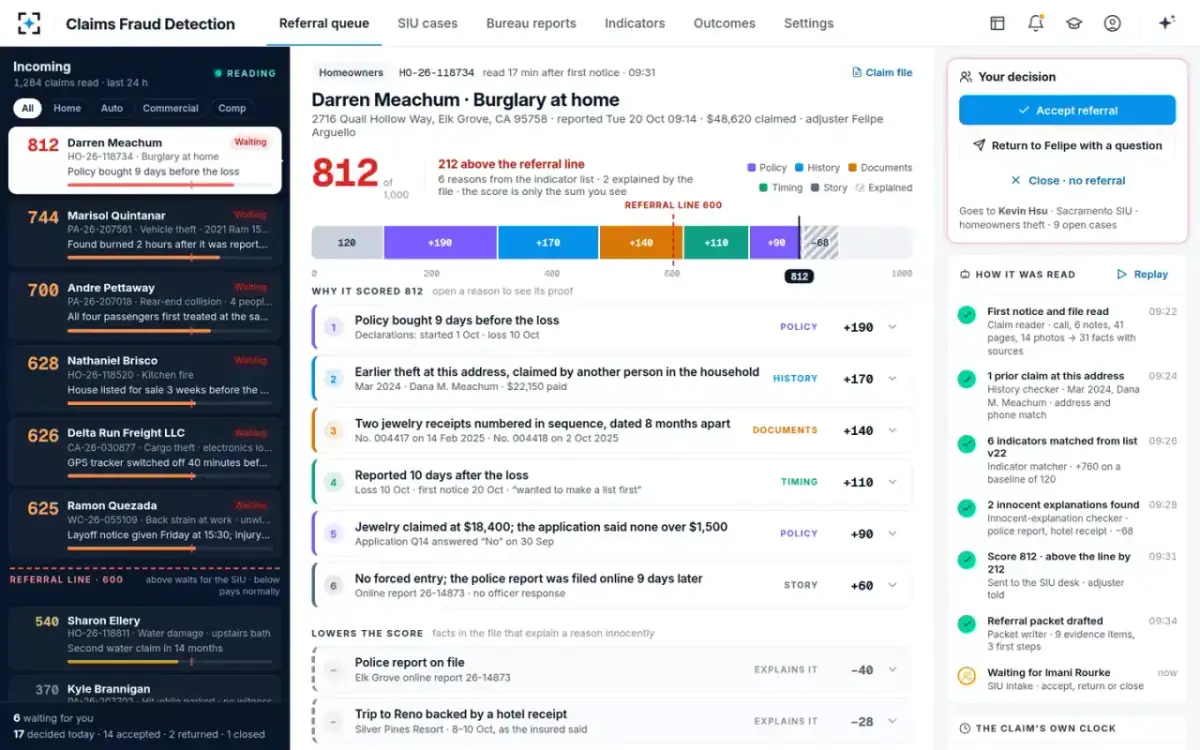
Additive points are a design choice, and they cost something: a model that only adds points cannot capture interactions a statistical model might find. What they buy is that every number can be challenged one line at a time. The intake analyst can say the late-report reason is weak because the insured explained it, the fraud manager can see that the indicator "policy started within 30 days before the loss" was confirmed in 41% of last quarter's referrals, and an examiner can follow the arithmetic without a data scientist in the room. The validation questions for a fraud scoring model look at what that design means for testing.
Can AI detect insurance fraud? It finds reasons; the SIU decides what they mean
AI can find the evidence that makes a claim worth investigating, faster and more completely than an adjuster with 140 open files. It cannot determine that a claim is fraudulent, and in California it is not supposed to. The SIU must investigate every credible referral, and the rule names automated and system-generated referrals alongside those from people (10 CCR § 2698.36(c); what that means for the form is worked through in the guide to the SIU referral form). The system's output is a referral; the conclusion belongs to an investigation.
The innocent-explanation step is what keeps that distinction honest. On the sample claim the trip the insured described was backed by a hotel receipt, and a police report was on file; both lowered the score and both appear in the packet. The top reason carries its own limit in plain words: "Not proof on its own — 41% of referrals with this indicator were confirmed last quarter." A system that only adds suspicion trains everyone downstream to discount it.
Where the person takes over, and where the day actually goes
The person takes over at the referral decision, and on the sample claim that came the next morning. Imani Rourke, the sample SIU intake analyst, accepted at 08:52 on Wednesday 21 October and the case opened with investigator Kevin Hsu. One day from first notice is the design target for the solution; the product team's estimate for the same work done by hand is 23 days, most of it spent before anyone notices the signals.
Where the days from first notice to referral go, by hand and read at first notice
By hand: about 23 days (estimate)
- Spotting the signals · 61%
- Writing the referral · 17%
- SIU inbox · 13%
- Rebuilding the file · 7%
- Intake decision · 2%
Read at first notice: 1 day (design target)
- Spotting · 10%
- Writing · 10%
- Waiting for intake · 50%
- Rebuilding · 10%
- Intake decision · 20%
The bottom row has an uncomfortable feature: once the reading is done in minutes, half the remaining time is a person's queue. That is the right place for it. The intake decision is the one step California's regulation and the carrier's own procedures put on a named human, and the evidence for it is already assembled. The claim, meanwhile, never stopped: the adjuster was told it crossed the line and kept it moving on its own clocks.
Is AI fraud detection allowed by regulators? Yes, inside the same claims laws
Regulators expect insurers to use AI for fraud detection and to govern it. The NAIC's model bulletin, adopted on 4 December 2023, names fraud detection among the uses of AI "across all stages of the insurance life cycle," and asks that an insurer's written program for AI systems cover "claim administration and payment, and fraud detection" (NAIC model bulletin). Twenty-nine jurisdictions had adopted it as of 8 October 2026, according to the NAIC's adoption map.
The bulletin adds no new permission or ban. Its point is that decisions made or supported by AI "must comply with all applicable insurance laws and regulations," including unfair claims settlement practices, and that the insurer can be asked for its inventory of models, its validation and its due diligence on any third-party system. In the European Union, the AI Act lists credit scoring as high-risk "with the exception of AI systems used for the purpose of detecting financial fraud," and in insurance lists only risk assessment and pricing for life and health insurance (Regulation (EU) 2024/1689). Neither text treats a fraud referral as a decision about the claim. The line regulators do draw, between flagging a claim and denying it, is worked through in the Property and Auto Claims guide on insurance companies using AI to deny claims.
What to ask an AI fraud detection vendor to show you on one of your claims
The fastest evaluation is to hand a vendor one of your own closed claims, one the SIU confirmed and one it cleared, and ask to see the trace. These are the things worth seeing; the fifteen questions for insurance fraud detection software go further into contracts, cost and the regulator.
Eight things to see on one claim before buying AI for fraud detection
- The run log, step by step, with times
Who read what and when; not a single model call.
- Every reason opened to its source line
A page, a note, a photo or a record from your own file, not a feature name.
- The arithmetic from reasons to score
If the score is not the sum of what you can read, ask what else is in it.
- The innocent explanations it looked for, including the ones it did not find
A check that found nothing is still evidence that someone looked.
- What it refused to use
Protected traits, territory on its own, credit-based scores: locked, not merely unused.
- The claim it would have cleared
Run your cleared claim: the reasons should be weak or explained, and the trace should say so.
- The step where your person decides
And what the system does if nobody decides: it should wait, not act.
- What it does to the claim's clock
Nothing, is the right answer: the adjuster keeps handling the claim on its deadlines.
What the photos show, and what they do not
Questions people ask
What percentage of insurers use AI for fraud detection?
In NAIC surveys, 49% of private passenger auto insurers (95 of 193 in the 2022 report) and 42% of large homeowners insurers (2023 memo) reported using AI or machine learning for fraud detection. Most used it to refer claims for further investigation. The homeowners survey counted only more advanced models; simpler ones, such as generalized linear models, were left out of its main results.
Does AI decide if a claim is fraud?
It should not, and the surveys suggest it rarely does: for referral models the NAIC found an even split between models that advise the decision-maker and models that only inform. In California the SIU must investigate credible referrals, system-generated ones included, so the system's output is a reason to look, not a finding.
What does an AI fraud score look like?
In Claims Fraud Detection it is a number out of 1,000 made of a baseline for the loss type plus points for each matched indicator, minus points for each innocent explanation found. The sample burglary scored 812: 120 + 760 − 68. Other designs return a probability; ask how it breaks down into reasons you can check.
Can generative AI be used in insurance fraud prevention?
Its natural uses are reading unstructured documents and drafting: turning notes, pages and photos into sourced details, and writing the referral packet. The NAIC bulletin defines generative AI separately and expects validation and testing to fit the kind of system, predictive model or generative AI (model risk management at an insurer). A drafted sentence still needs its evidence link, or it is a claim, not a finding.
Will AI replace SIU investigators?
The work the regulation assigns to investigators, interviews, examinations under oath and the reasonable-belief decision, stays with people. The Bureau of Labor Statistics projects employment for claims adjusters, appraisers, examiners and investigators to decline 6% from 2025 to 2035 and expects AI to "make workers more productive"; the role it describes for insurance investigators, handling claims where the company suspects fraud, remains.
What happens to a claim the AI scores high?
It waits for the SIU intake analyst, who accepts, returns it with a question or closes it with a reason. The claim does not stop: the adjuster keeps it moving on its fair-claims clocks, and nothing in the referral recommends a denial.