Claims fraud detection tools are the systems that look at insurance claims for signs of fraud and send the suspect ones to the special investigations unit (SIU): red-flag rules, predictive scores, link analysis, document checks and, more recently, AI agents that read the whole claim file. The one a carrier buys matters less than whether adjusters and SIU intake trust it enough to act on it; what to ask before buying is a separate guide, insurance fraud detection software, and this one is about the rollout. California shows how far apart carriers already are without any tool: among insurers with more than 500 workers' compensation claims, self-reported SIU referral rates in 2016 ran from 18.32% of claims down to 0.00%. A tool earns trust on a ladder, shadow, compare, refer with reasons, refer, and each rung is climbed only when the SIU's own findings say so. Botminds' Claims Fraud Detection is built for that climb: every reason it gives opens to its evidence, and every referral it makes is decided by a named person.
The trust ladder: four rungs, and what earns each step up
Rung 4Refer
Claims above the line go to SIU intake as system referrals; the adjuster is told and keeps the claim moving. A random sample below the line goes too.
Who actsSIU intake decides every one
Climb whenKept while acceptance holds and the audit sample stays low
Rung 3Refer with reasons
The tool drafts each referral with its evidence; the adjuster sees the reasons and can add to them before intake decides.
Who actsAdjuster and SIU intake
Climb whenFewer referrals returned as weak than by hand
Rung 2Compare
Adjusters keep referring by hand; the tool shows its own reasons beside theirs, and every disagreement is reviewed.
Who actsAdjuster, reviewed by the fraud manager
Climb whenThe tool finds what adjusters missed, and explains what they saw
Rung 1Shadow
The tool scores last quarter's closed claims; nobody acts on it. Its picks are compared with what the SIU actually found.
Who actsFraud manager and SIU
Climb whenConfirmed rate rises with the score
The examples come from a fictional sample carrier, Kittredge Mutual, as it runs through the solution. The benchmarks come from California's Department of Insurance, which publishes unusually detailed data on how insurers detect and refer fraud.
What are claims fraud detection tools?
They are the methods an insurer uses to pick out claims for investigation, and the NAIC describes the industry moving along a spectrum: "As insurers begin to rely less on traditional methods, such as business rules and red flags, and more on technology, such as predictive modeling, link analysis, and artificial intelligence (AI), the cost of fraud to consumers is expected to decrease" (NAIC). In practice most carriers run several at once.
Red-flag lists and rules are the oldest and the most transparent; California requires every SIU to write them per line of business (§ 2698.35). Predictive scores rank claims by likelihood. Link analysis looks across claims for shared people, addresses and providers, which is where organised rings show up, and Fraud Network Analysis covers it. Document checks look for altered invoices and receipts, the territory of Document Fraud Detection. Claims Fraud Detection sits at the front: it reads each new claim at first notice, notes, documents, photos and prior claims, and scores it as a sum of plain-word reasons from the carrier's approved list.
What they share is the person at the end. The NAIC's homeowners survey found that most fraud-referral models helped a person decide rather than deciding alone, and that most were bought from outside vendors (NAIC homeowners memo; quoted in the guide to AI in insurance fraud detection). A purchased tool that adjusters ignore is a cost with no return.
Why do adjusters ignore fraud alerts?
Adjusters ignore alerts they cannot check, alerts that never tell them what happened, and alerts that arrive on top of a full desk. The sample adjuster carries 140 open homeowners claims; his complaint before the solution was simple: "I had a feeling about it. I didn't have time to prove the feeling." An alert that adds a number to his screen without the proof behind it gives him the same feeling and still no time.
The research on people working with AI is more cautious than vendors are. NIST's AI Risk Management Framework notes that "the AI part of the human-AI interaction can amplify human biases, leading to more biased decisions than the AI or human alone," and that when such effects are "judiciously taken into account in organizing human-AI teams," they "can result in complementarity and improved overall performance" (NIST AI 100-1). Trust has to be built so that the adjuster can disagree with the tool for a stated reason, and so that the disagreement is counted.
What earns each person's trust in a claims fraud detection tool
Today
Gets a score with no reasons, and never learns what the SIU found.
With agents
Sees each reason with its source line and its limit, and hears back when the SIU closes the case.
Still theirs: The right to refer by hand, and to argue with a reason.
Today
Faces a flood of alerts and has to rebuild each file before deciding.
With agents
Gets referrals already drafted, with the innocent explanations checked.
Still theirs: Accept, return or close, with a written reason for each closure.
Today
Distrusts automated referrals as noise.
With agents
Starts from an evidence index and three suggested first steps.
Still theirs: Every investigative decision.
Today
Cannot tell whether the tool or the adjusters are right.
With agents
Sees confirmed rates by score band and by indicator, and the proposals they produce.
Still theirs: The indicator list, its points and the referral line, with a second approver.
Rung one: shadow the tool on last quarter's closed claims
Start with no one acting on the tool at all. Score a quarter of closed claims, including every claim the SIU investigated, and compare. If the confirmed rate does not rise with the score, stop: the tool is not ranking on this carrier's book, however well it did elsewhere. If it does rise, the shadow run also tells the fraud manager where to draw the first referral line.
The same back-test is how Claims Fraud Detection proposes every later change. On the sample carrier, the outcome tracker re-scored last quarter's 1,412 closed referrals with three proposed changes to the indicator list and reported the effect, including the cost: two confirmed frauds would have dropped below the line. A shadow run that does not say what would have been missed is half a test.
Rung two: compare the tool with the adjuster's own referrals
On the second rung adjusters keep referring by hand, and the tool shows its reasons beside theirs. Every disagreement is worth a look. Claims the adjuster referred and the tool scored low show either a weak referral or a reason missing from the list; claims the tool scored high and the adjuster did not refer show either a gap in training or a reason that does not hold up on this book.
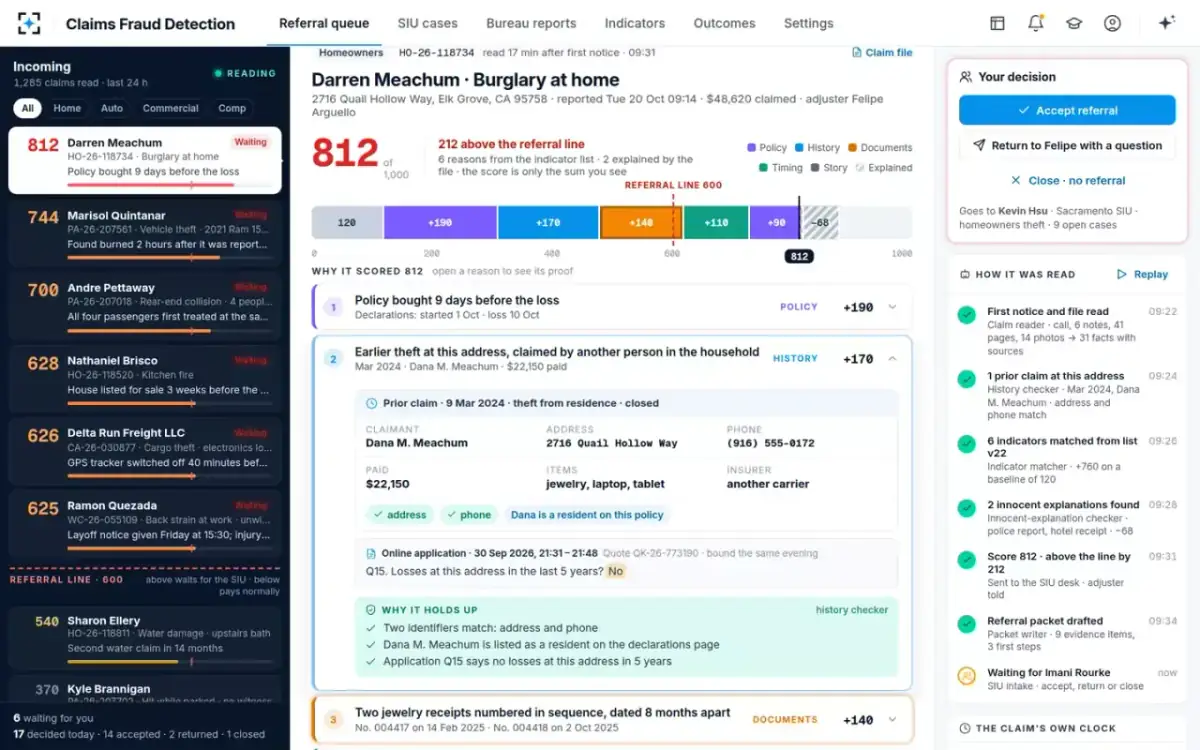
This is also where the adjuster's feeling becomes evidence. The sample burglary claim was flagged for a policy bought nine days before the loss, a prior theft at the same address under a household member's name, and two jewelry receipts numbered in sequence 230 days apart. An adjuster who sensed something wrong can now see three reasons he can test, each with the line in the file that supports it.
A reason the adjuster can check in Claims Fraud Detection: the prior claim, matched on two identifiers
Rung three: refer with reasons, and let intake decide
On the third rung the tool drafts the referral and the SIU intake analyst decides. The adjuster is told when a claim crosses the line and can add to the reasons; intake accepts, returns the referral to the adjuster with a question, or closes it. The measure that matters here is the share of referrals returned or closed as weak. On the sample carrier it was 38% before the solution went live; the solution's design target is 11%. A carrier should measure its own starting point before switching anything on.
The returned referral is the ladder's safety rail. A question sent back to a named adjuster, to be answered within a business day in the sample settings, keeps the adjuster in the loop and turns a weak referral into either a cleared one or a better one. It also gives the fraud manager something to count: which reasons keep coming back with questions.
Rung four: system referrals, with the adjuster told and an audit sample kept
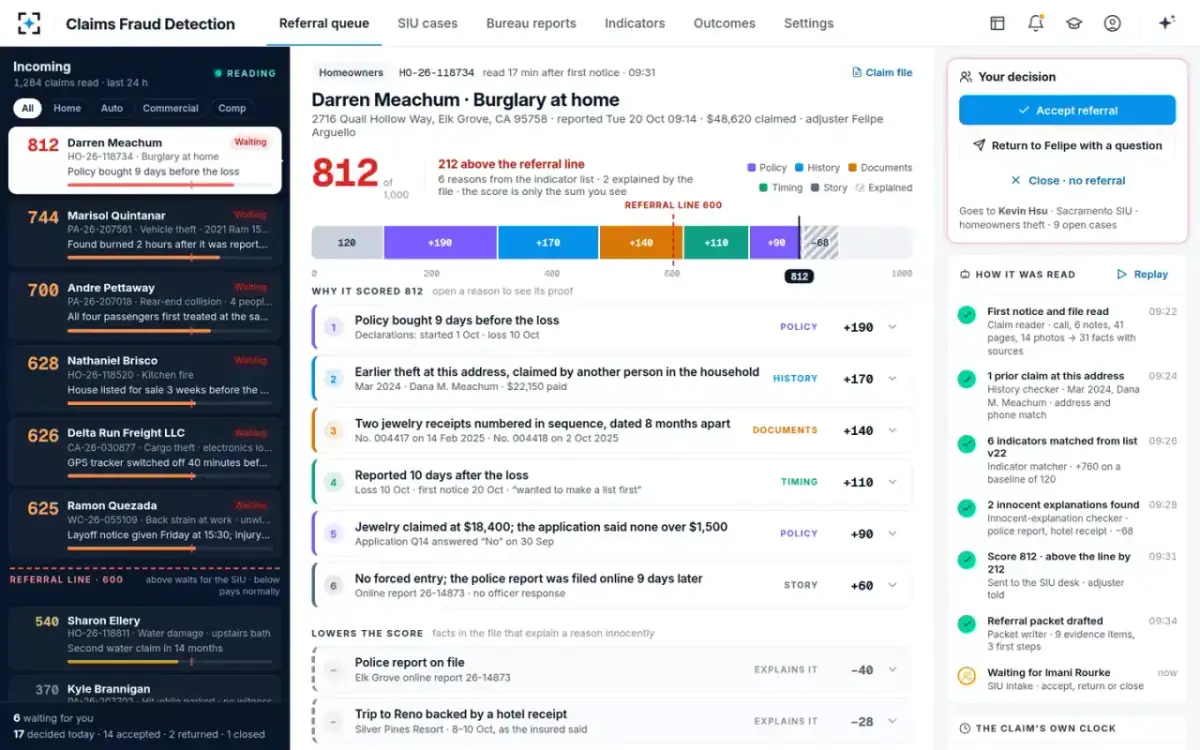
On the top rung, claims above the line go to intake as system referrals. California already treats them as referrals in their own right: the SIU's duty to investigate every credible referral expressly covers automated and system-generated ones (§ 2698.36(c); see the SIU referral form guide). Two things keep this rung safe. The adjuster's duty to refer by hand stays, because the tool only knows what its list describes. And a random sample of claims below the line, 1% in the sample settings, goes to the SIU too, so the carrier keeps learning what the line misses.
The top rung in Claims Fraud Detection: a ranked queue, the line drawn in, a person deciding
What is a good SIU referral rate?
There is no correct rate, but there is a suspicious one, and California has published the spread. In its report on 2016 workers' compensation data, the Department listed 50 insurers with more than 500 claims: their self-reported SIU referral rates ran from 18.32% to 0.00%, with a median of 2.41% and three insurers at zero, our count from the Department's table. Across all of them, 20,342 of 446,552 claims went to an SIU, 4.56% (CDI).
Workers' compensation SIU referral rates, California insurers with over 500 claims, 2016
The Department reads both ends with care. "An insurer that has low percentage of referrals to its SIU when compared with claims does not necessarily indicate the insurer is doing a poor job of fighting fraud," it writes, citing industries insured and risk appetite; "However, a low percentage of claims that resulted in SIU referrals could indicate that the insurer may not be referring suspected fraudulent claims to the insurer's SIU." Of the next step, referrals from the SIU to the state, it notes that a high rate "could indicate the insurer is doing a good job of fighting fraud or it could indicate that an insurer may be referring to CDI prematurely." A tool that moves a carrier's rate sharply in either direction has changed something the regulator watches.
How do you train adjusters to spot fraud when a tool is doing the spotting?
California's training rules still apply, and the tool changes their content. Every new employee must have an anti-fraud orientation within 90 days of starting, claims staff a yearly in-service on recognising red flags, and SIU staff at least five hours of continuing anti-fraud training a year (§ 2698.39). Florida requires its insurers' anti-fraud unit staff to receive at least two hours of initial training and a one-hour course every year after (Fla. Stat. § 626.9891).
With a tool on rung three or four, the annual session should teach three things it did not before: how to read a reason and its source line, how to look for the innocent explanation the tool may have missed, and how to answer a returned question in a way that clears or strengthens a referral. The red-flag list remains the curriculum; the method for testing a red flag before it becomes a referral is the part people have to practise.
How do you measure if a fraud tool is working?
Measure what the SIU does with its referrals, not what the tool says about claims. California's annual SIU report already asks each insurer for "A description of how the insurer measures the effectiveness of its SIU," and for the number of claims processed, claims referred to the SIU and referrals that led to an investigation (§ 2698.40(b)). A tool should move those numbers in the right direction and leave a trail that explains why.
Six measures cover it: the share of referrals intake accepts; the share returned or closed as weak; the confirmed rate by score band; days from first notice to referral; the confirmed rate in the random sample below the line, which should stay low; and the number of referrals adjusters still make by hand, which should not collapse to zero. The last one is the warning light for over-trust. Whether a score's bands are well set is a validation question, covered in what to validate in a fraud scoring model.
How long does it take to roll out fraud detection? A plan in weeks
A carrier can reach rung three in about two months and rung four after a quarter, if each rung's measure is met on time. The plan below is our suggestion for one line of business, not a requirement; a second line starts again at rung one because its red flags and its book are different.
A rollout plan for one line of business, in weeks
- Shadow on closed claimsweeks 1–3
- Compare with adjustersweeks 4–8
- Refer with reasonsweeks 9–16
- Waits for the first lineweeks 1–8
- Shadowweeks 9–11
- Compareweeks 12–16
The fastest part is usually the software; the slowest is the indicator list. A carrier whose red flags are written per line, with points and with last quarter's SIU outcomes attached, starts at rung one in its first week. One whose list lives in a training deck spends the first month writing it down.
Questions people ask
How do adjusters use fraud detection tools?
On a well-run rollout, adjusters see the reasons a claim crossed the referral line, each linked to the line in the file, and keep handling the claim on its deadlines while the SIU decides. They still refer by hand when they see something the tool's list does not describe, and they answer questions intake sends back.
What should adjusters see in a fraud alert?
The reason in plain words, the evidence behind it, why it holds up, what explains it innocently if anything does, and its limit: in the sample, the top reason warns that it is not proof on its own and gives the share of last quarter's referrals with that indicator that were confirmed, 41%. A number alone gives the adjuster nothing to test.
Do fraud tools replace the adjuster's duty to refer?
No. California makes identifying and referring suspected fraud part of claims staff's "regular duties" (10 CCR § 2698.35(a)), whatever systems the insurer runs. A tool adds referrals; it does not remove the adjuster's.
Is a fraud detection tool the same as a claims triage tool?
They overlap but answer different questions. Triage routes a claim by complexity and severity to the right desk; a fraud tool decides whether the SIU should see it. Some carriers run one score for both; the triage side is covered in the Property and Auto Claims guide on claims triage solutions.
Are insurers required to use fraud detection tools?
Not a particular tool. The NAIC's examination standards ask whether the insurer "has antifraud initiatives in place that are reasonably calculated to detect, prosecute and prevent fraudulent insurance acts," and many states require an antifraud plan that describes the detection methods. California requires written red flags per line and trained staff.
How many referrals should a fraud tool make?
As many as the SIU can investigate well, at a confirmed rate the fraud manager can defend. California's 2016 data put the median workers' compensation SIU referral rate at 2.41% of claims among larger insurers; a tool that pushes a carrier far above or below its peers should be able to show why with SIU outcomes.