Insurance fraud is prosecuted in a small fraction of the cases insurers report. In fiscal year 2023-24, California's insurers sent the Department of Insurance's Fraud Division 12,559 suspected fraudulent automobile claims; the Division assigned 602 new cases, made 272 arrests and referred 354 cases to prosecutors. Texas received 23,857 fraud reports in fiscal 2025 and opened 172 investigations. The gap is not mainly about weak evidence: the state agencies can investigate a few percent of what they receive, and California closed 875 cases for lack of resources in one recent year. For a carrier that means its referral to the state usually has to stand on its own written summary, because most will never be worked by a detective. Botminds' Claims Fraud Detection reads every new claim, refers the suspect ones to the special investigations unit (SIU) with their evidence, and drafts each state report from the SIU's case file for the fraud manager to approve and file.
California's auto fraud funnel, fiscal year 2023-24: from reports to arrests
How often is insurance fraud prosecuted? The answer depends on where you count
Counted from the insurer's report, rarely; counted from the cases investigators open, often. Of the auto reports California received in fiscal 2023-24, the cases assigned amounted to about one in twenty, and the cases sent to prosecutors to about one in thirty-five. But set against the 602 cases the Fraud Division opened that year, the 354 it sent to prosecutors suggest that once a case is worked, a prosecutor usually sees it. The funnel narrows hardest at the first step, the decision to open a case at all.
The district attorneys' side of the same program shows the prosecutions themselves. "District attorneys prosecuted 1,036 cases involving 1,111 defendants," which "resulted in 343 convictions" (CDI auto program). Those figures include local law-enforcement investigations and cases from earlier years, so they cannot be read as the end of the 12,559, but they show that charged auto fraud cases end in conviction often enough to make a good referral worth writing.
California's auto funnel, step by step
Each auto report starts as an FD-1 from an insurer and moves through intake, assignment, investigation and referral before a prosecutor sees it. The Fraud Division "is the primary law enforcement agency responsible for investigating automobile insurance fraud crimes," and its detectives "focus on categories such as medical mills, staged collision rings, false and fraudulent claims, and organized fraud activity and automobile theft groups." Completed investigations "are filed with the local district attorney or the United States Attorney's Office."
Organised auto fraud has its own program, with its own funnel: in fiscal 2023-24 the Division "assigned 65 new cases and made 99 arrests and 120 referrals to prosecuting authorities," and seven counties' district attorneys prosecuted 129 cases involving 326 defendants, with 69 convictions. More arrests than cases is what rings look like: one case, many defendants. A carrier that sees one staged collision is often looking at one claim of several, which is why fraud ring detection reads across claims.
Three programs, three funnels: auto, property and workers' compensation
California runs separate fraud programs by line, and their funnels differ sharply. Property, life and casualty fraud produced 4,580 referrals and only 16 arrests in fiscal 2023-24, from a program that "accounts for approximately five percent of the Fraud Division's allocated budgetary resources." Workers' compensation, funded by an assessment on employers, ran the most prosecutions.
California's three main fraud programs, fiscal year 2023-24
| Program | Suspected fraud reported | New cases | Referred to prosecutors | Arrests | Potential loss reported |
|---|---|---|---|---|---|
| Automobile | 12,559 | 602 | 354 | 272 | $207.6M |
| Property, life and casualty | 4,580 | 52 | 21 | 16 | $362.2M |
| Workers' compensation | 2,932 | 291 | 156 | 128 | $157.2M |
The property row is the one a homeowners carrier should study. It handles, in the Department's words, "staged commercial/residential burglaries, life insurance fraud (which includes murder for profit cases), fraudulent natural disaster claims (wildfire, flood, earthquake, wind), slip and fall claims," among others, and "can involve millions of dollars in loss." With 52 new cases from 4,580 referrals, about one in 88, a homeowners theft referral is far more likely to end in the carrier's own decision than in a criminal case.
Workers' compensation shows what funding buys. District attorneys "reported 1,313 investigations and 336 arrests," "prosecuted 1,041 cases with 1,168 defendants, resulting in 260 convictions," with $31,543,396 of restitution ordered and $11,682,851 collected (CDI workers' compensation program). Thirty-four counties shared $52.2 million of the program's funding that year.
Why are so few insurance fraud cases prosecuted?
Mainly because the investigators run out before the referrals do. At the Fraud Assessment Commission's meeting of 19 November 2024, a commissioner asked how many cases had been closed for lack of resources:
DC Charlick replied that in 22-23 it was 875 and in 21-22 it was 1,102, so it has improved.
California Fraud Assessment Commission, minutes of 19 November 2024
The same minutes show the other pressures. The Department was recruiting, with "40 detectives" placed in background checks and "30 are still in background." A commissioner said "he feels the percentage of convictions per FD-1s is too low." The Department said it had "added a checkbox to report if the FD-1 is lacking information," that poor-quality FD-1s are flagged at intake for follow-up, and that its SIU team does "targeted outreach to large insurers when there's been a large amount of FD-1s closed due to lack of evidence from them" (FAC minutes).
Triage by value adds a third filter. The Department's report on 2016 workers' compensation data says plainly that "due to limited resources, low monetary value referrals that are good quality may not be opened as cases due to higher impact case being assigned investigative resources" (CDI). A small, honest-looking homeowners theft with a strong referral can still sit unopened. The carrier's own decision on the claim cannot wait for the state.
How often is insurance fraud caught?
Nobody knows, because fraud that is never suspected is never counted. California calls even $1.2 billion of chargeable workers' compensation fraud only a small part of the real total, because so much is never identified or investigated. Research inside one insurer gives a sense of scale: Dionne, Giuliano and Picard found that even a cost-minimising audit strategy left a third of fraudulent claims unaudited, and that among about 1,000 claims the insurer had not suspected, 55 showed some indication of fraud. The fuller tracing of those figures is in what percentage of insurance claims are fraud.
Being caught and being prosecuted are also different events. Most fraud a carrier catches ends in a denied, reduced or withdrawn claim, decided under the policy, not in court. The criminal funnel above is the visible tip of a much larger civil one.
Texas and New York show the same shape
Other states that publish their numbers show the same narrow neck between reports and investigations. Texas's Fraud Unit received 23,857 fraud reports in fiscal 2025 and opened 172 investigations; New York's Insurance Frauds Bureau received 39,676 suspected health care fraud reports in 2025, most of them no-fault auto, and opened 73 health care fraud investigations.
Reports in, investigations out: Texas and New York
23,857
fraud reports received by the Texas Department of Insurance Fraud Unit, fiscal 2025
172
Texas investigations opened the same year (216 the year before)
39,676
suspected health care fraud reports to New York's Insurance Frauds Bureau, 2025; 36,835 of them no-fault auto
73and 40
New York health care fraud investigations opened, and arrests that resulted, 2025
Texas also reports how long resolution takes: the share of suspect investigations resolved within two years was 68% in fiscal 2025, against 86% the year before, and its investigations contributed to $50.9 million of court-ordered restitution. Across the country, the NAIC counts "42 states and the District of Columbia" running insurance fraud bureaus (NAIC), and the FBI focuses on "the most prevalent schemes and the top-echelon criminals and criminal organizations" (FBI).
What happens after insurance fraud is reported?
The report goes to the state's fraud bureau, which decides whether to open a case; if it does, detectives investigate and send completed cases to a prosecutor, who decides whether to charge. In California the insurer's part is the FD-1, due within 60 days of determining that a claim appears fraudulent, with workers' compensation reports also going to the district attorney (FD-1; the form is walked through in the FD-1 form guide).
After the report: who decides at each step in California
A person decides
Insurer's SIU and fraud managerFiles the FD-1 within 60 days of determining a claim appears fraudulent, saying whether the investigation is complete.
A person decides
Fraud Division intakeReviews the report; poor-quality FD-1s are flagged for follow-up with the carrier.
A person decides
Case decisionOpens a case, or rejects or closes it; a rejected case can be discussed with the Department and opened later if it merits it.
A person decides
Fraud Division detectivesInvestigate and file completed cases with the district attorney or the U.S. Attorney.
A person decides
Prosecutor and courtCharge, convict and order restitution; the insurer is updated through the party that filed the FD-1.
Two details from the Commission minutes matter to carriers. A rejected FD-1 is not final: the Department said that "if the case is rejected based on what is in the FD-1, they could always reach out to CDI to discuss the case and it can be opened after it's rejected, if the case merits it." And the reporter hears back: "we communicate with the party who submitted the FD-1." A carrier that tracks those updates learns which of its reports were opened, which is the only feedback it gets on their quality.
How long does an insurance fraud investigation take?
Months, often more, once it reaches the state. At the November 2024 meeting a commissioner objected that "a Claimant Fraud case shouldn't take 9 months," and the Department's deputy commissioner answered that "it can be months before the detectives starts working on the case." In Texas, 68% of suspect investigations were resolved within two years in fiscal 2025. Inside the carrier, the SIU's own investigation runs on the insurer's clock and the claim's.
The claim cannot wait for the state. In California an insurer suspecting fraud on "specific information available for review" by the Department may take 80 days rather than 40 to accept or deny the claim, and the period can be suspended only on the Commissioner's order, after the insurer has reported. The fraud referral and the claim decision run in parallel, and the claim usually finishes first.
What this means for a carrier's referral: it must stand on its own
Because most reports will not be worked by a detective, a carrier's referral has to be complete on paper. California's regulation asks the SIU to "complete as much of its investigation as is reasonable prior to the time the referral is made," and to say whether the investigation is finished or still needs work (§ 2698.37(d)). The summary must answer what facts caused the belief, what was misrepresented and by whom, why it matters, who the witnesses are and what documentation exists (§ 2698.38(d)(9)).
That is work the SIU's case file already holds, which is why Claims Fraud Detection drafts each report from it rather than from a blank form. On the fictional sample carrier, a staged-collision ring of five claims determined on Wednesday 2 September was due by Sunday 1 November, with the draft ready eleven days ahead; the fraud manager edits or approves and files it, and the log is kept for the next examination.
Every report due in Claims Fraud Detection, drafted from the case file, with the days left
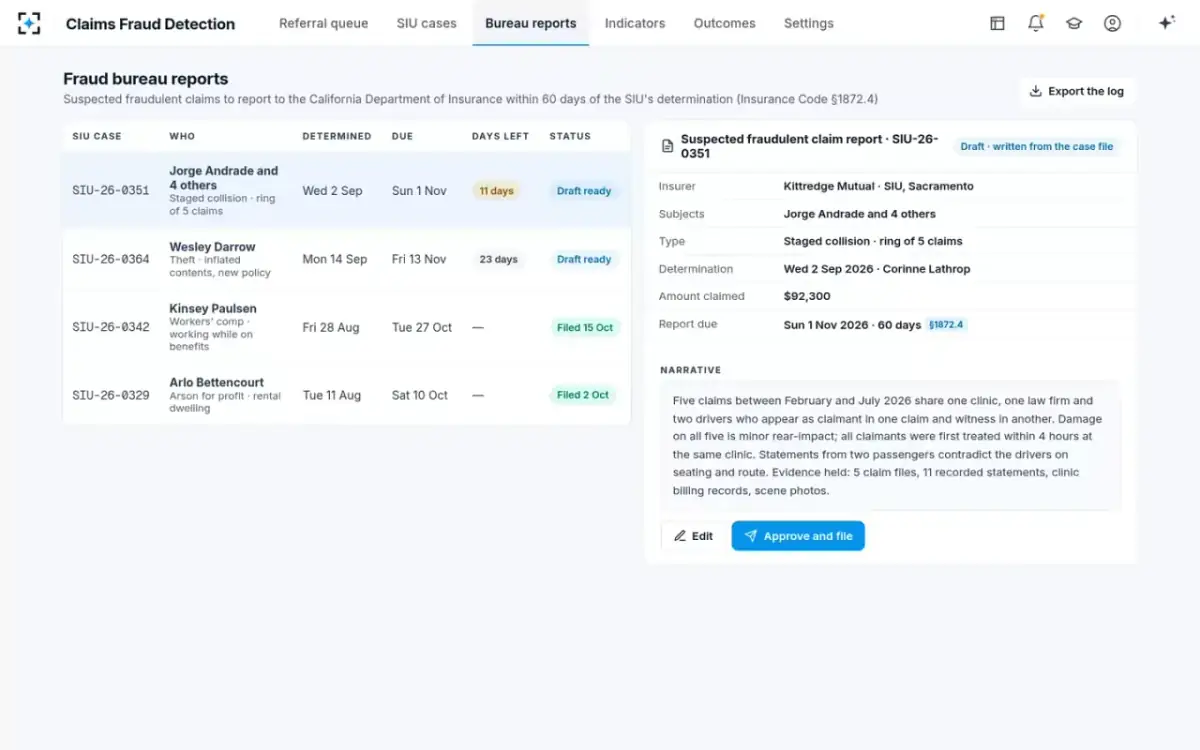
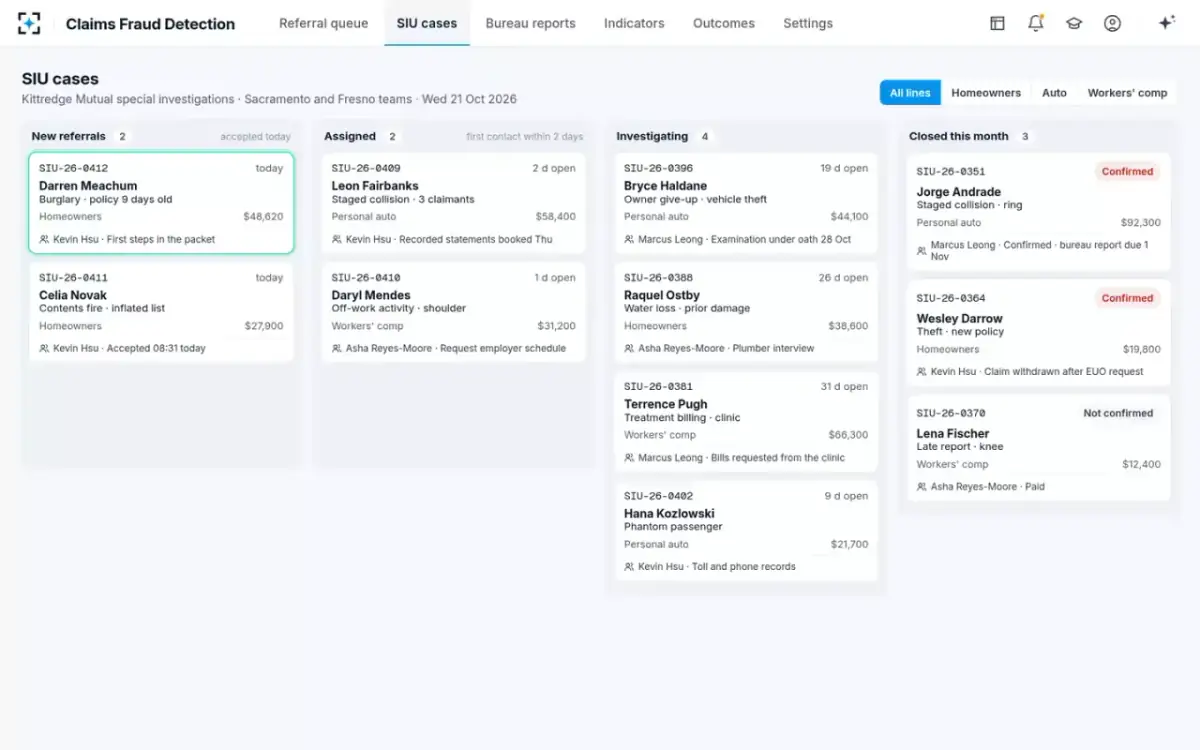
The referral that reaches the SIU in the first place is the start of that file. A referral form built around sourced red flags gives the SIU most of what the state summary later asks for, and the investigation decides the rest.
The SIU's board in Claims Fraud Detection: new referrals, assignments, investigations, closures
Questions people ask
How many insurance fraud cases are prosecuted each year?
There is no national count. California's district attorneys prosecuted 1,036 auto fraud cases and 1,041 workers' compensation fraud cases in fiscal 2023-24, plus 129 organised auto fraud cases, with 343, 260 and 69 convictions. Those counts include cases from earlier years and from local agencies.
Who investigates insurance fraud?
First the insurer's special investigations unit, then a state fraud bureau: the NAIC counts 42 states and the District of Columbia with one. In California it is the Department of Insurance's Fraud Division, working with district attorneys and, for some cases, the U.S. Attorney. The FBI takes the largest and most organised schemes.
What is a suspected fraudulent claim?
In California it is the Department's term for a claim an insurer reports on Form FD-1, the "Suspected Fraudulent Claim (SFC) Referral Form." The insurer reports when the facts create a reasonable belief that fraud may have occurred, whether or not the claim has been paid.
Does the insurer find out what happened to its report?
Yes, in California: the Department told the Fraud Assessment Commission that it communicates with whoever filed the FD-1, and that a third-party administrator filing for a self-insured employer gets the updates. Tracking them is how a carrier learns which of its reports were strong enough to be opened.
Can a rejected fraud referral be reopened?
It can. The Department said a carrier can discuss a rejected FD-1 with it and the case can be opened later if it merits it, and that a case closed for lack of resources can be reopened if staffing increases. A supplemental narrative helps only if it is read, which is an argument for a complete first report.
Is insurance fraud a felony?
Often, depending on the state and the amount. The NAIC notes that insurance fraud is a crime in 48 states, and California's legislature made workers' compensation fraud a felony when it created that program in 1991. Charging decisions belong to prosecutors.